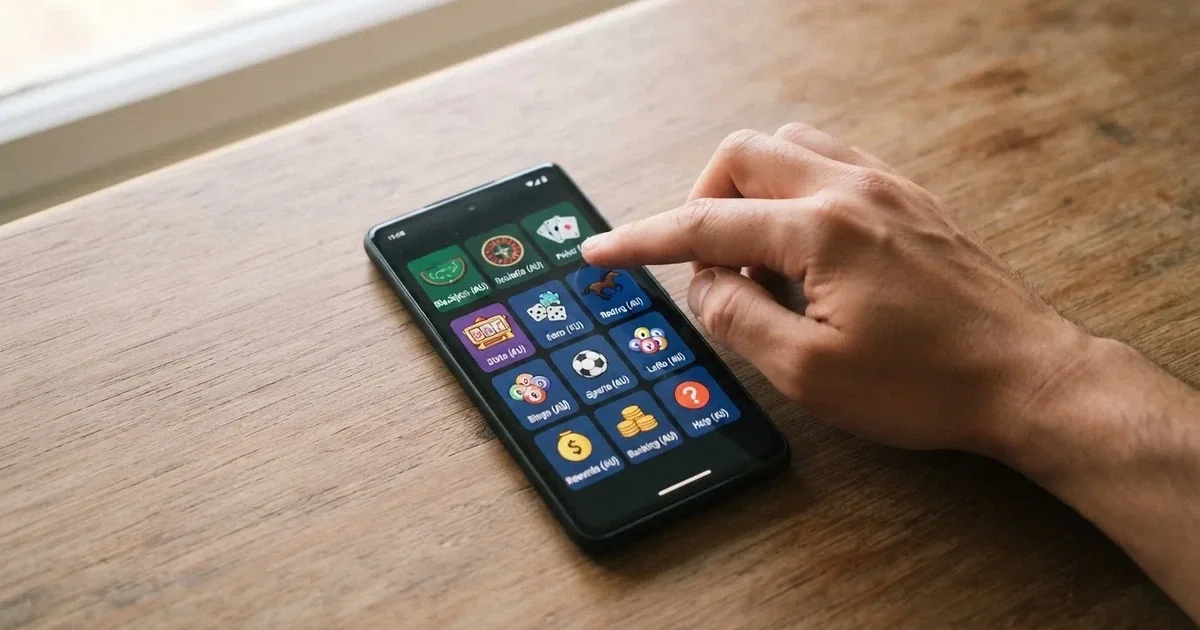
Mobile casino play in Australia: what sits behind the search
 Available in US
The phrase “mobile casino” in Australia leads to a strange kind of marketplace. Every product a person finds under it — the apps, the browser sites, the bonus offers pushed through ads — sits outside Australian law. The Interactive Gambling Act 2001 prohibits the supply of online casino games and online pokies to anyone in Australia; no state or territory issues a licence for them. What this page is for is to set out plainly how mobile casino play works as a format, why none of it is locally licensed, what the regulator has been doing about it, and what an Australian reader is actually choosing between when an offshore brand shows up in a search result.

Data current as of 24 September 2026, checked against the Australian Communications and Media Authority register of formal warnings and the Reserve Bank of Australia’s payments publications.
Table of Contents
- How mobile casino play works as a format
- Why no Australian site is licensed
- What the ACMA has actually done
- The blocking rate, in one band
- Mobile casino bonuses and free spins: what they actually cost
- Crypto and anonymity on a phone
- Mobile payments and payout speed in Australia
- Responsible play: what the local safety net actually covers
- The brands the ACMA has acted against
- Tax: the short version
- What to take from this page
- Frequently asked questions about mobile casino play in Australia
How mobile casino play works as a format
A “mobile casino” is just a casino product reached through a phone or a tablet rather than a laptop. The mechanics underneath are the same — a real-money account, a wallet, a games library of slots, table games and live dealer rooms, an operator behind it. What changes is the surface. Touch targets replace mouse clicks, the games are usually built in HTML5 so they resize to whatever screen is on hand, and a session is more often started and stopped in five-minute windows than sat through for an hour at a desk.

Two flavours of mobile product sit under that one label. The first is a browser-based site — the punter loads a URL in Chrome or Safari and the games run in the tab. The second is a downloadable app, distributed either through the operator’s own page or, more commonly, through an APK sideload because Google Play and Apple’s App Store both prohibit real-money casino apps in the Australian storefront. The game catalogue is typically the same on both routes; the difference is the wrapper.
What does not change between them is the licensing. Online casino games cannot be licensed anywhere in Australia. The brand may display a Curaçao or Anjouan number at the foot of its page, but no Australian regulator has issued it, and that is the only fact that matters under the IGA. The rest of this page is written with that front of mind.
Why no Australian site is licensed
The Interactive Gambling Act 2001, as tightened by the Interactive Gambling Amendment Act 2017, makes it an offence for an operator to supply online casino games, online pokies or in-play betting to a person physically in Australia. The law targets the provider, not the player — there is no prosecution risk in opening an app — but it also means no Australian complaint body, no local ADR scheme and no Australian court will help if a withdrawal is refused. An offshore brand is governed by its own house rules, in its own jurisdiction, under whatever licence it chose to buy.

What is licensed in Australia is wagering on races and sport placed before the event, lotteries and keno. Those services are regulated state by state; in practice most online bookmakers — Sportsbet, Bet365, Ladbrokes — are licensed in the Northern Territory, through the Northern Territory Racing and Wagering Commission, which has no full-time staff and meets once a month in Darwin. That is the regulated perimeter, and casino games sit outside it. The minimum age for any form of licensed gambling in Australia is 18.
The 2026 reform path is worth noting even on a page about the current market. The Interactive Gambling Amendment (Gambling Reform) Bill 2026 passed Parliament on 19 August 2026; its advertising and inducement measures commence on 1 January 2027. It is law with a future start date, not law in force on a 2026 page. What the Amendment does is tighten what licensed wagering operators can advertise and how; it does not open any door to licensing online casino games.
What the ACMA has actually done
The Australian Communications and Media Authority does not ban individual Australians from playing; it acts against the supply side. Three tools are in regular use.
The first is the formal warning, a published notice that names the operator behind a brand and the date of issue. Warnings carry weight because they precede civil court action under the IGA and because they are the public record anyone can check. The second is the blocking request, by which the ACMA asks Australian internet service providers to render specific domains unreachable. The third is removal: services that choose to leave the Australian market rather than face a civil penalty.
By the end of June 2026 the ACMA had reported that 1,751 illegal gambling and affiliate marketing websites had been blocked since the first blocking request in November 2019, and more than 230 unlicensed services had left the Australian market since enforcement was strengthened in 2017. In the round reported that same month, twelve more sites were added to the block list: 7Signs, ChromaBet, Donbet, Duospin, Freshbet, Slots Gem, Jacks Club, Lucky Start, Pointsbetz, Spinrise, Vinyl Casino and Wildsino.
H2 Gambling Capital’s 2025 report puts the cost side of the same picture. Australians lose about A$3.9 billion a year to illegal gambling sites, and the share of gambling going through legal channels fell from 74 per cent in 2021 to 64 per cent in 2024. The reason the figure matters on a page about mobile casinos specifically is that almost all of the A$3.9 billion is reached through a phone or a tablet — the browser on the device, an APK sideload, a web app pinned to the home screen.
The blocking rate, in one band
The arithmetic on this page is one figure, drawn from two facts in the ACMA’s own reporting: the running total of blocked sites and the date of the first blocking request. By June 2026 the ACMA had reported 1,751 blocked sites, with the first blocking request dated November 2019. That works out to roughly 240 sites a year over the eight-and-a-bit years since the regime started — a running average that hides the very uneven monthly cadence the ACMA actually publishes.
The honest way to state it is a band rather than a single number, because the regulator’s monthly batches have ranged from a handful to a dozen or more. Over the first full year of the regime the rate was modest; over the most recent twelve months the cadence has accelerated. A reader who wants a rule of thumb gets: in any given month of 2026 the ACMA is adding somewhere between five and fifteen new blocked domains to the list, on top of the formal warnings that may or may not precede a blocking request. The bloc of formal warnings above is the visible leading edge of that pipeline.
The wider point is what a band like this means for the person choosing to play offshore. A site that is reachable from an Australian IP address in any given week is one blocking round away from disappearing, and a balance held on it at that moment is one the operator is under no obligation to return through any Australian channel.
Mobile casino bonuses and free spins: what they actually cost
The marketing side of an offshore mobile casino leans hard on the welcome bonus and the free spins bundle, because that is how the operator competes for the punter’s first deposit. The grammatical shape of the offer is always the same: deposit X, receive Y in bonus funds, sometimes with Z free spins on a named slot attached. What changes between brands is the small print.
Three numbers decide what a bonus actually costs the punter. The first is the wagering requirement, expressed as a multiple of the bonus (or the bonus plus deposit) that must be turned over before any winnings can be withdrawn. The second is the game weighting, the percentage of each spin or hand that counts toward clearing the requirement — slots usually count 100 per cent, table games often count 10 per cent or zero. The third is the maximum cashout cap, which limits how much of the bonus-derived winnings can ever be withdrawn regardless of how far the balance climbs during play.
The arithmetic of a typical 100 per cent match up to A$200 with a 40-times wagering multiple on the bonus alone is straightforward. The punter must turn over A$8,000 before any withdrawal is possible. At A$1 per spin on a 96 per cent return slot, that is 8,000 spins; at five seconds a spin on a phone, it is around 11 hours of continuous play. The expected loss over those 8,000 spins, at the same 96 per cent return, is A$320 — more than the bonus itself. The “free” money is only free if the punter wins enough to clear the requirement and then walks away before the bonus-derived balance is given back to the house edge. For most players, most of the time, it is not.
Free spins are the smaller cousin. A bundle of 50 free spins at A$0.20 each on a named slot represents A$10 of nominal value and an expected loss of around A$0.40 at standard return-to-player rates. The catch is the same: winnings from free spins almost always carry their own wagering multiple, and there is usually a maximum-cashout cap on the winnings. The headline number is small; the conditions eat most of it.
None of the above is a recommendation. The point is that the bonus number on the ad is the gross, and the wagering multiple, the game weighting and the cashout cap are the net. Comparing two offers means reading three lines of small print, not the headline.
Crypto and anonymity on a phone
Crypto gets treated in the Australian context as a payment-method question rather than an anonymity question. The reason is that no Australian-licensed wagering service can accept digital currency as a deposit, and offshore services that ask an Australian for a Bitcoin or USDT transfer are operating outside the local rules regardless of any licence the brand displays.
On a phone the experience of paying with crypto is much the same as on desktop: copy a wallet address or scan a QR code, send from an exchange or a self-custody wallet, wait for confirmations. The marketing pitch around crypto deposits usually leans on three things — faster withdrawals, higher bonus caps, and a vague “privacy” frame. The first two are sometimes true at the operator’s discretion; the third is not, in the Australian setting. The transaction is pseudonymous on the blockchain, but the exchange on the punter’s side is KYC-bound, the wallet address can be linked, and the operator behind an offshore site still sees the device fingerprint, the IP and the gameplay pattern.
The second misleading word is “anonymous”. Offshore operators the ACMA has warned over all run a KYC process at withdrawal — passport, proof of address, sometimes a source-of-funds request before the first payout clears. Crypto does not get the punter past that step. It gets the punter past the credit-card ban that applies to licensed Australian wagering, which is a different and more specific thing, and it only does that because the offshore site is not bound by the local rule.
Mobile payments and payout speed in Australia
The payment side of a mobile casino in Australia is, structurally, the most interesting part. Not because it is exotic — the routes are the same bank rails an Australian punter uses for everything else — but because the legal and the technical layers do not line up the way they do for, say, retail shopping.
For licensed Australian wagering, the deposit menu is narrow on purpose. Credit cards and credit-related products have been banned as a payment method for online wagering since 11 June 2024, with penalties for operators up to A$247,500. Digital currency is banned the same way. What is permitted is debit card, bank transfer, PayID, Osko and BPAY. The Apple Pay, Google Pay and Samsung Pay buttons an Australian punter sees on a phone are wallet front-ends over those underlying rails — at the end of the chain the transaction either hits a debit card or a bank account, and it is the underlying rail that decides whether the bank will allow it.
The major Australian banks have built their own second line of defence on top of the law. Westpac’s gambling block works at card level: it refuses authorisation on transactions registered under the merchant category code “Betting/Casino Gambling” on eligible personal credit and debit cards. ANZ’s block, activated in the ANZ app, blocks gambling transactions made through a digital wallet such as Apple Pay on an eligible card, not just the physical card. Commonwealth Bank’s gambling lock is applied to eligible cards via the CommBank app and blocks most gambling transactions, though the bank is candid that it cannot guarantee every gambling-related purchase will be stopped.
Two conditions travel with every bank block. The first is that removing the block requires a waiting period — 48 hours at ANZ, with a similar cooldown at the other majors — so a punter cannot toggle the block off and back on around a single session. The second is the merchant category code limit: a block catches transactions coded as gambling, but some offshore operators route through ambiguous MCCs, and some non-gambling transactions may be blocked in error. The block is a wall with doors, not a sealed room.
The Reserve Bank’s July 2025 review of merchant card payment costs proposed removing surcharges only on eftpos, Mastercard and Visa transactions, explicitly leaving American Express outside the scope. By the end of 2025 Apple Pay, Google Pay and Samsung Pay together accounted for around 45 per cent of all card payments in Australia by number, which is why the wallet question matters even on a casino page — the wallet is the front, the bank rail is the back, and the bank’s block decides what gets through.
For punter-to-punter transfers and any refunds an operator sends back, PayID and Osko are the relevant rails. With Osko a bank transfer between participating Australian banks arrives in under a minute, 24/7 including weekends, addressed to a BSB and account number or to a PayID. Paying to a PayID shows the name of the account holder before the transfer is sent, which is worth knowing: AP+ warns that being asked to transfer money to a PayID on an illegal gambling site is almost certainly a scam signal. PayID identifiers on the New Payments Platform passed 25 million in April 2025; PayID-based instant transfers are available at over 100 Australian financial institutions; the platform’s monthly outage budget is capped at two minutes.
BPAY sits in the same stable and is run by Australian Payments Plus, the same operator as PayID and Osko. It is a bill-payment service in online banking — payer enters a Biller Code and a Customer Reference Number — and is available through more than 140 banks and financial institutions. It is not a casino deposit route, but it is the rail on which most Australian household bills run, and it is the comparison point for what a “domestic” payment looks like in a market where casino deposits usually go elsewhere.
What this means on a phone is that the most common offshore deposit path — Visa or Mastercard debit through a wallet — is the path most likely to be rejected by the bank’s own block. Bank transfer and PayID, where the operator accepts them, generally clear. Crypto, where the operator accepts it, clears every time but lands the punter outside Australian consumer protection. None of those routes is faster than the other in a meaningful sense: at the Australian end, Osko and PayID are sub-minute, and that is the floor the offshore operator’s own processing time is added on top of.
Responsible play: what the local safety net actually covers
If mobile gambling ever stops being fun, the support side of the Australian system is real, free and confidential. The National Gambling Helpline is 1800 858 858, free, 24/7, with chat available through Gambling Help Online. BetStop — the National Self-Exclusion Register, live since August 2023 — lets a person exclude themselves from every Australian-licensed online and phone wagering service in one registration. It binds licensed operators only; an offshore casino is not connected to it, which is the same gap that runs through the rest of this page.
The other constraint on the protection is the bank block. Activating a Westpac, ANZ or Commonwealth Bank gambling lock changes the deposit side of the equation immediately. ANZ warns, candidly, that not all gambling transactions will be blocked and some non-gambling transactions might be blocked in error. The block is a tool, not a guarantee.
A practical sequence for a reader who feels the habit tipping: call the helpline or open the Gambling Help Online chat first — both are free and do not require a name; register with BetStop if the issue is with licensed wagering; activate the bank gambling block as a separate step; and tell someone trusted what is happening, because each of these tools works better when someone else knows it is being used.
The brands the ACMA has acted against
The list below is the published ACMA record of formal warnings over offshore brands offering casino games to Australians. It is not a recommendation to play at any of them, and it is not a ranking. Each brand is here because the regulator itself named it.
| Brand | ACMA action and date | Operator named by the ACMA | Subject support |
|---|---|---|---|
| RocketPlay | Formal warning under the IGA, March 2026; earlier Dama N.V. action in May 2022 | Pulsup Ltd (Rocketplay), March 2026 | Listings reported in industry coverage |
| Level Up Casino | Formal warning under the IGA, May 2022 | Dama N.V., May 2022 | Listings reported in industry coverage |
| Woo Casino | Formal warning under the IGA, March 2025 | Dama N.V., March 2025 | — |
| Spirit Casino | Formal warning under the IGA, May 2025 | Dama N.V., May 2025 | — |
| National Casino | Formal warning under the IGA, July 2025 | Consolutetish S.R.L., July 2025 | Listings reported in regulatory and support registers |
| Bizzo Casino | Formal warning under the IGA, July 2025; earlier 2022 action | Consolutetish S.R.L., July 2025; earlier TechSolutions, 2022 | Listings reported in industry coverage |
| Ignition Casino | Formal warning under the IGA, July 2025 | Bamboo Media, July 2025 | — |
| Instant Casino | Formal warning under the IGA, February 2025 | EOD Code SRL, February 2025 | Listings reported by payment and ID-rail sources |
| Jackbit | Formal warning under the IGA, April 2026 | Ryker B.V., April 2026 | — |
| Casino Intense | Formal warning under the IGA, April 2025 | Sterplay Holding Ltd, April 2025 | Listings reported in regulatory and support registers |
| Sky Crown | Formal warning under the IGA, September 2022 | Hollycorn N.V. | — |
The “Subject support” column records, only where industry or payment-rail listings name the brand, what those listings say about it. It is not a description of the brand’s own features and not a recommendation. Where a brand appears here but the public listings do not name it, the cell carries the no-data marker rather than a guess.
What the table makes visible
Three patterns show up across the eleven brands. First, the operator behind a brand is rarely the brand itself — Dama N.V. alone is the named party in three of the warnings, Consolutetish S.R.L. in two, and the rest are spread across small Curaçao- and Cyprus-registered holding companies. Second, repeat warnings on the same operator are common: Bizzo Casino was warned over TechSolutions in 2022 and then again over Consolutetish S.R.L. in July 2025, and the Dama N.V. cluster runs across more than four years. Third, the brands do not differ in legal status — none of them is licensed in Australia, and the IGA’s prohibition applies equally to all eleven.
A reader using the table to compare options is using it for the wrong purpose. The right use of the table is to recognise which brands the regulator has already acted on, and to weigh that against the practical reality that an offshore brand may also be the one that disappears in the next blocking round without returning a balance.
Tax: the short version
Gambling winnings of a recreational player in Australia are not assessable income, and losses are not deductible. The rule sits at section 6-5 of the ITAA 1997 and applies at the federal level. The exception is the person who carries on a business of gambling, which is a much narrower category than the question usually implies and is decided case by case. The model answer for any specific situation is the same: check with the ATO or a registered tax agent.
What to take from this page
A reader who reached this page through “best Australian mobile casinos 2026” was, in practical terms, looking for one of three things: a way to play casino games on a phone, a way to compare the offshore options, or a way to find out whether any of it is legal. The honest answer is the same in all three cases.
There is no Australian-licensed mobile casino product. Every brand on the comparison list sits outside the IGA, and every one has been the subject of regulator action. The Australian bank system blocks most gambling transactions at card level, which is why crypto deposits exist as a workaround and why the offshore operators market them. The bonus numbers on the ad are not the cost of the offer; the wagering multiple, the game weighting and the cashout cap are. The legal protection an Australian punter gets from a licensed wagering service — BetStop, the helpline, an Australian complaints route — does not extend to any brand on the list above.
What this page is for, in the end, is to make those four points visible side by side so the choice a reader makes — to play, to play at a particular brand, to walk away, or to call the helpline — is made with the picture intact.
Frequently asked questions about mobile casino play in Australia
Is there a mobile casino app that is legal to install and use in Australia?
No. Under the Interactive Gambling Act 2001 it is an offence to supply online casino games or online pokies to a person in Australia, and no state or territory issues a licence for them. Real-money casino apps are not available in the Australian Google Play or Apple App Store storefronts, and an APK sideload does not change the legal position of the product being installed. What is licensed in Australia is wagering on sport and races before the event, lotteries and keno.
How does mobile casino play technically differ from playing through a desktop browser?
The underlying games are typically the same HTML5 builds, with touch controls layered on top of the same math. What changes is the wrapper: a smaller viewport, vertical orientation for most slots, gesture-based bet adjustment, and sessions that start and stop more often through the day. Account, wallet and licensing are unchanged from desktop, which is why a site blocked on a home network is blocked on the phone using the same network too.
Can a mobile browser be blocked from reaching an offshore casino the same as a desktop one?
Yes. ACMA blocking requests are issued at the domain level and apply to Australian ISPs regardless of the device on the other end. A punter who reaches an offshore casino through mobile data on a Telstra or Optus SIM is on the same block list as a desktop user on the same provider’s home broadband. The punter is not the target of the enforcement, but the site they reach can disappear between sessions.
Do offshore mobile casino sites use the same games as their desktop versions?
In most cases, yes. The major studios — the ones whose names an Australian punter would recognise from a desktop session — typically publish the same title to both surfaces, and the mobile build is usually HTML5 rather than a separate native app. What changes between surfaces is the catalogue size: a few legacy titles may be desktop-only because their old Flash or download clients never got a mobile port.
Is a mobile casino covered by the same ACMA warnings as a desktop site?
Yes. The ACMA’s formal warnings and blocking requests name the operator behind a brand, not the device the punter used to reach it. A brand warned over in March 2025 for offering prohibited services to Australians is the same brand whether the punter reaches it on a laptop, a phone or a tablet. The action is taken against the operator, and the operator’s product is the unit being warned, regardless of form factor.
What’s the legal difference between a mobile casino app and a licensed pokies venue’s app?
A licensed Australian pokies venue’s app, where it exists, is an extension of a venue or state lottery that is regulated under state law; it offers the same games that are licensed in the venue, and any winnings sit inside the Australian consumer-protection framework. A mobile casino app, regardless of where it is downloaded from or what licence it displays, offers casino games that cannot be licensed in Australia; the punter has no local complaints body, no Australian court recourse, and the app can be blocked in Australia at any time.
Prepared by the Casino No Wager Hub editorial staff.