7-Reel Slots Australia: The Format, the Law, and What a Punter Should Know
 Available in US
A “7-reel slot” sounds like a curiosity — one extra reel beyond the five most modern video slots use, and three more than the old mechanical three-reel machines. Most people reading this page are not after novelty for its own sake. They want to know whether the format plays differently, where it can be played in Australia at all, and whether any comparison of online casinos is worth their time when the activity itself sits outside Australian law. That last question is the one the rest of the page answers.
Current as of 24 September 2026 · Operator licence claims verified against the ACMA’s public register of formal warnings and blocking actions.
Table of Contents
- What a 7-Reel Slot Actually Is
- Paytables, Symbols and the Maths Behind the Spin
- Why “Best” Is the Wrong Frame for This Question
- What the ACMA Has Actually Done — and What That Tells a Punter
- Responsible Gambling: Where Help Actually Is
- Bonuses, Free Spins and the “Bonus” Marketing Word
- Games, Providers and What the Format Looks Like in Practice
- Offshore Sites the ACMA Has Formally Warned
- Reading a Casino Comparison When the Casino Is Prohibited
- What a Punter Actually Has in 2026
- Frequently Asked Questions
What a 7-Reel Slot Actually Is
A reel, in the original sense, is a metal hoop painted with symbols that spins behind a window. A 7-reel machine is the same idea with seven hoops side by side, each carrying roughly ten to twenty symbols. With about a thousand possible three-of-a-kind combinations on a classic three-reel machine, multiplying the reels pushes the total combinations into the millions — and as the symbol count rises, the odds of any specific top line stretch far enough that the longest shot stops looking meaningful on a single spin.

Mechanically, a 7-reel slot is closer to a 1970s video slot than to a modern branded release. Fortune Coin Co. introduced the first video slot in 1976, replacing physical hoops with a small television screen that simulated spinning. A 7-reel online slot today is the same simulation, running in a browser, with seven columns of symbols and a paytable the player reads before pressing spin. The “seven” is a layout choice, not a physics one — the random number generator behind it does not care how the columns are arranged.
Two things follow from the format itself. First, a 7-reel layout multiplies the number of possible symbol combinations on a single spin, which pushes the longest odds out farther than a five-reel game would. That is what makes a 7-reel machine feel “harder to hit” — the top combination is rarer per spin, even though each spin still costs the same. Second, the format is older than the modern branded slot, which is why most 7-reel titles carry fruit symbols, BARs, bells and sevens rather than a movie licence or a jackpot mini-game.
Why the format still exists
Three-reel mechanical machines started life with Charles Fey in late-19th-century San Francisco, where five symbols — horseshoes, diamonds, spades, hearts and the Liberty Bell — paid ten nickels for three bells in a row. Bally’s 1963 “Money Honey” added a bottomless hopper that paid up to 500 coins without an attendant. The reel count crept up over the 1990s and 2000s as screens replaced drums. A 7-reel slot is part of that drift: a layout some studios still produce because a meaningful slice of the market prefers the older visual grammar over the cascading reels, free-spin rounds and licensed characters of modern five-reel video slots.

Australia has been a heavy slot market for decades. New South Wales legalised slot machines in 1956; by 2010 the country operated an estimated 97,103 gaming machines outside casinos, a per-capita density about five times that of the United States. Those machines, locally called pokies, sit in pubs and clubs and use the older three- and five-reel layouts. None of them are 7-reel online slots — the physical machines and the online ones are different products, sold under different rules.
Paytables, Symbols and the Maths Behind the Spin
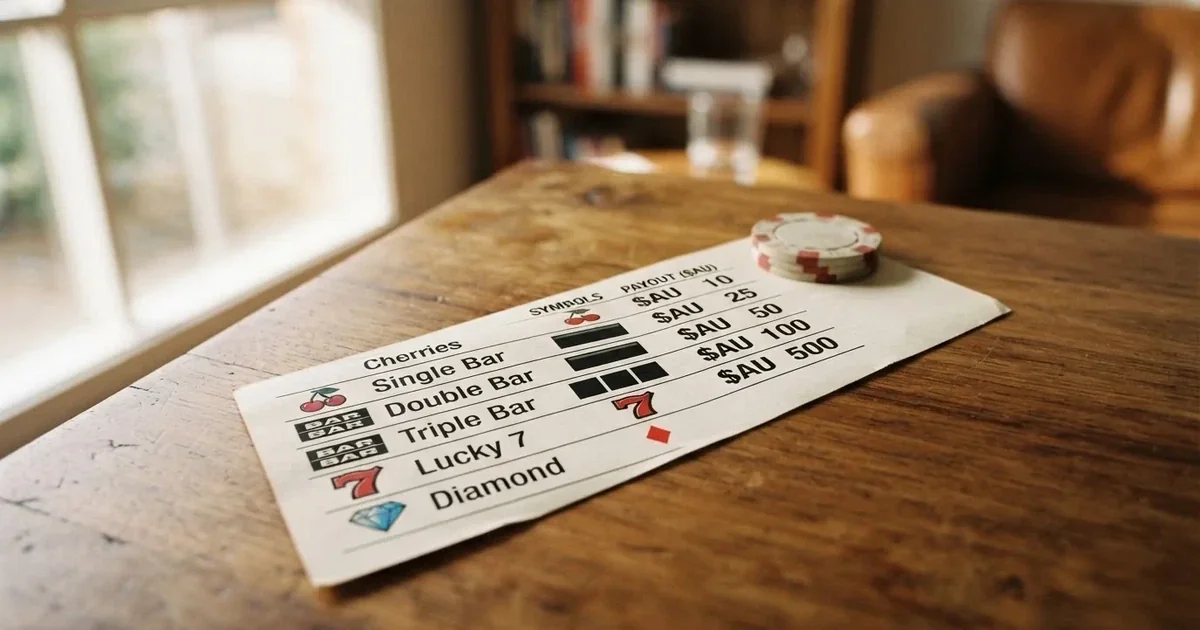
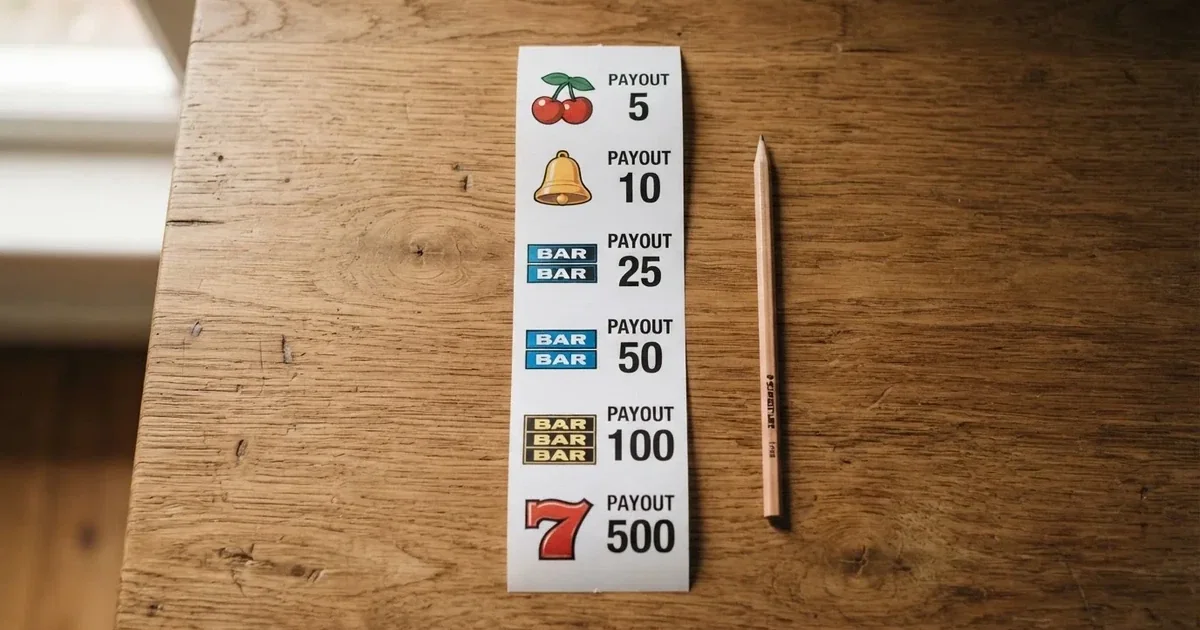
A 7-reel slot’s paytable is the small printed chart that lists every winning combination and what it pays in coins or credits. On a seven-column layout, the paytable covers horizontal rows, sometimes diagonals, and on some titles scattered combinations where any matching symbols across the seven columns trigger a payout. The fewer symbols required, the lower the payout per line — three matching across seven columns pays less than seven matching, because the longer combination is rarer.
Where the format genuinely differs from a five-reel slot is in the dispersion of wins. A 5-reel slot with 50 symbols per reel, on the longest shots, can produce odds of about 300 million to one against the top combination. A 7-reel machine with 10 to 20 symbols per reel keeps the odds of any single top line far shorter than that ceiling, but the spin-by-spin variance still runs higher than a classic three-reel machine. The reels look more crowded; the screen scrolls longer; the eye keeps tracking for matches that almost line up but do not quite.
For comparison, US state regulation sets minimum payout percentages that vary by jurisdiction: Nevada at 75%, Mississippi at 80%, New Jersey at 83%. Australia does not impose a comparable national floor on machine returns — what matters for a player is what each venue publishes on its machine, and what the regulator approves for that title. In NSW, section 66 of the Casino Control Act 1992 requires that the rules of any approved game be available to patrons on request. The same disclosure principle applies elsewhere, but the numbers themselves are venue-specific and not centrally published.
House edges on the games 7-reel players compare against
Slot house edges are not published centrally in Australia and are not standardised across the offline market. Where a player is comparing formats, the published numbers for table games give a reference point. Baccarat’s house edge runs at 1.06% on the Banker bet, 1.24% on the Player bet and 14.36% on the Tie. Blackjack, played under liberal Las Vegas Strip rules, runs about 0.28% with optimal strategy. Craps runs 1.41% on Pass/Come and 1.36% on Don’t Pass/Don’t Come. Those numbers do not transfer to a 7-reel slot — every slot title carries its own return-to-player figure set by its developer — but they set a sense of where a “reasonable” edge sits. A 7-reel title returning 94% has a 6% house edge; a 7-reel title returning 88% carries a 12% edge, twice the worst baccarat bet on a casino floor.
The deeper comparison is structural. Table games at Crown Melbourne, for example, are approved by the Victorian Gambling and Casino Control Commission, which replaced the VCGLR on 1 July 2022 and which keeps a public log of approved rule changes — including renaming Crown’s “Perfect Pairs” blackjack side bet to “Crown Pairs” in December 2024 and adding a “Free Bet” option with a new “Pot of Gold” side bet in March 2024. That is the level of public oversight Australian venues carry on table games. None of it applies to a 7-reel online slot hosted offshore.
Why “Best” Is the Wrong Frame for This Question
Most lists of “best 7-reel slots” are written for readers who can actually play. In Australia they cannot. The Interactive Gambling Act 2001, tightened by the 2017 amendment, makes it an offence to provide online casino games — including online pokies — to a person in Australia. No state or territory issues a licence for the activity. What is licensable is wagering on races and sport placed before the event, lotteries and keno, and even those are licensed in practice through the Northern Territory.
That is the single most important fact on this page. A 7-reel slot exists in Australia only as:
- a physical pokie in a pub, club or casino, on a three- or five-reel cabinet rather than a 7-reel layout, or
- a browser-based game on an offshore site that operates outside Australian law.
The Commonwealth regulator, the Australian Communications and Media Authority, treats the second category as an illegal service. The IGA targets the provider, not the individual player — there is no record of an Australian punter being prosecuted for opening a browser tab. But the practical consequences fall on the punter, not the operator: no Australian consumer protection, no complaints body, no recourse if a withdrawal is refused, and a real possibility that the site is blocked by an internet service provider while a balance still sits on it.
The 2026 reform package makes this picture clearer without changing it yet. The Interactive Gambling Amendment (Gambling Reform) Bill 2026 passed Parliament on 19 August 2026; its advertising and inducement measures commence 1 January 2027. On a 2026 page, that is law with a future start date — passed, gazetted, not yet in force.
What the ACMA Has Actually Done — and What That Tells a Punter
The ACMA’s enforcement is the most concrete piece of evidence a reader can check. Since the first blocking request in November 2019, the regulator has directed Australian ISPs to block 1,751 illegal gambling and affiliate marketing websites, and more than 230 unlicensed services have left the Australian market since 2017. In the round reported on 26 June 2026 the ACMA asked ISPs to block 12 more sites in a single batch: 7Signs, ChromaBet, Donbet, Duospin, Freshbet, Slots Gem, Jacks Club, Lucky Start, Pointsbetz.com, Spinrise, Vinyl Casino and Wildsino. That is a snapshot, not a final tally — the count keeps moving.
The formal-warning layer runs separately from blocking. A formal warning is the regulator’s public, written record that it has found a specific operator in breach of the IGA. The operator is named, the warning is dated, and the warning is published on the ACMA’s site. It does not require a court order. It does require the operator to take the prohibited service offline for Australian customers or face further action.
The blocking-rate calculation
The arithmetic here is simple. The ACMA’s first blocking request went out in November 2019. As of the snapshot reported in June 2026, the running total of blocked sites reached 1,751. That is roughly six years and seven months from the first block to the latest count, or about 79 months. Dividing 1,751 blocked sites by 79 months gives a long-run rate of about 22 blocked sites per month, with the actual rate running materially higher in recent rounds and lower in the early ones. State the result as a band, not a single figure: roughly 15 to 25 sites blocked per month across the whole period, and a clearly faster pace in the 2024-2026 rounds than in 2019-2021. The point of the calculation is not the precise monthly number — it is that the regulator’s enforcement cadence is sustained and accelerating, which means any comparison of offshore “best 7-reel slot” sites is a snapshot of services that may not be reachable by the time the reader visits them.
Responsible Gambling: Where Help Actually Is
Help lines and exclusion registers are the practical answer to a question readers do not always ask out loud. Gambling Help Online runs a free, confidential, 24-hour chat and phone service — the National Gambling Helpline on 1800 858 858 is free from any Australian phone. BetStop, the National Self-Exclusion Register, has been live since August 2023 and binds every Australian-licensed online and phone wagering service, which means a self-excluded person cannot open a new account with Sportsbet, Bet365, Ladbrokes or any other NT-licensed bookmaker while the exclusion is in force.
That protection has a sharp edge. BetStop covers wagering services licensed in Australia. An offshore casino is not connected to it. A punter who has self-excluded from every Australian bookmaker can still open an account at an offshore site that takes Australian traffic — and the offshore site is under no obligation to honour the Australian exclusion. The same limitation applies to deposit limits and reality checks: they exist on the licensed side of the market and stop at the border.
The 2026 payment rules underline the gap. Since 11 June 2024, credit cards, credit-related products and digital currency have been banned as payment for licensed online wagering, with penalties up to $247,500 for operators that breach the rule. Legal deposit routes for licensed wagering are debit card, bank transfer, PayID/Osko and BPAY. A site asking for a credit card or a crypto deposit from an Australian customer is, by definition, operating outside the Australian licensed framework. That is a check a punter can make in two clicks before depositing anything.
What the regulator will not do is refund a balance lost offshore. The ACMA’s job is to investigate, warn and block. A punter who deposits at an offshore site and is then refused a withdrawal has no Australian complaints body to approach — which is the practical answer to “why does this matter”.
Bonuses, Free Spins and the “Bonus” Marketing Word
Search queries around “7 reel bonus slots” and “free 7 reel slots with bonus” tend to lead to affiliate marketing pages that describe the offer in the marketing word and not the mathematics. A bonus, in the offshore casino context where these offers exist, is almost always a deposit match: deposit A$X, the site adds a percentage on top, and that bonus amount is then locked behind a wagering requirement — a multiplier the player must turn over before any of it can be withdrawn.
Three numbers matter on any such offer. The match percentage decides how much is added to the deposit. The wagering multiplier decides how much total play the bonus must generate before withdrawal. The maximum cashout, where it exists, decides how much of the winnings generated on bonus play can actually leave the site. None of those numbers is standardised across the offshore market. What is standardised is the shape: a headline figure that looks generous and three smaller numbers that decide whether it is.
A punter comparing two bonuses should read the smaller numbers first. A 100% match up to A$200 with a 40x wagering multiplier means the player must turn over 40 × A$200 = A$8,000 in bets before the bonus is released — assuming only the bonus amount is wagered. If the bonus is “sticky” and the wagering applies to bonus plus deposit, the requirement roughly doubles. If the maximum cashout is set at 5x the bonus, then A$1,000 is the ceiling on what can come back out, regardless of how the play went.
For a 2026 reader looking at a 7-reel slot specifically, the format itself does not change the wagering arithmetic. A spin on a 7-reel title at A$1 per spin counts as A$1 of turnover whatever the layout. The point is the offer terms — and on the offshore market, those terms are written by the operator and not approved by any Australian regulator.
This is also where the marketing word earns its puncture. “Bonus” reads as free money. It is not. It is a loan with a turnover attached, and the turnover is what the operator collects.
Games, Providers and What the Format Looks Like in Practice
The 7-reel slot is a niche in the developer catalogue rather than a flagship category. Major studios producing modern branded video slots tend to build on the 5-reel, three-row grid because it accommodates cascading reels, expanding wilds and the free-spin rounds the market has standardised on. The 7-reel layout sits in the older end of the catalogue — closer to the fruit-symbol, BAR-and-seven visual grammar that harked back to Charles Fey’s Liberty Bell machine.
Where 7-reel titles appear in the listings of offshore casinos, the providers are mostly the studios that have built a long-tail library around classic formats. Some of those studios also appear in licensed wagering-adjacent products. The connection between a provider’s appearance in a BGaming catalogue listing and a 7-reel game in the same studio’s library is incidental — it tells a reader the studio makes both products, not that the offshore casino is endorsed.
Two games from the broader Australian-relevant catalogue are worth naming for context, because they illustrate how thin the 7-reel-specific information is in the public domain. Baccarat, in its punto banco form developed in 1940s Havana, is dealt from a shoe of six or eight decks with the casino banking both hands at all times. Blackjack, derived from the English game vingt-un and described in Cervantes’ “Rinconete y Cortadillo” around 1601-1602, counts cards at face value, face cards at 10 and aces as 1 or 11, with the dealer drawing to 17. Neither is a 7-reel slot — but both sit in the same regulatory frame as the online casino games that the IGA prohibits, and both are the games Australian venues actually license on the floor. The contrast tells the story: in-person, the menu is curated by the regulator; online, the menu is whatever the offshore operator loads.
Offshore Sites the ACMA Has Formally Warned
What follows is not a ranking, not a recommendation, and not a list to play on. It is the ACMA’s own record of formal warnings it has issued over offshore operators offering prohibited online casino services to Australians. The brands appear in the order the research sets them in. Every one of them sits on the wrong side of the IGA. Where the research carried no specific 7-reel game support for a brand, that absence is kept as an absence — a casino named by the regulator is not the same as a casino that publishes a 7-reel catalogue, and an offshore site’s “yes we have 7-reel slots” claim is the kind of marketing line a reader cannot verify from Australia.
The table below sets each brand against the date the ACMA’s formal warning was issued, the operating company the regulator named in the warning, and what the public record carries on the brand’s catalogue. Where research returned no information on a brand’s 7-reel games, the cell is empty — that is the honest answer, not a guessed one.
| Brand | ACMA action and date | Operating company named by the ACMA | 7-reel slot support |
|---|---|---|---|
| RocketPlay | Formal warning, March 2026 (Pulsup Ltd); earlier May 2022 (Dama N.V.) | Pulsup Ltd / Dama N.V. | — |
| Level Up Casino | Formal warning, May 2022 | Dama N.V. | BGaming catalogue listings (no 7-reel-specific data) |
| Woo Casino | Formal warning, March 2025 | Dama N.V. | — |
| Spirit Casino | Formal warning, May 2025 | Dama N.V. | — |
| National Casino | Formal warning, July 2025 | Consolutetish S.R.L. | Wikipedia listing (no 7-reel-specific data) |
| Bizzo Casino | Formal warning, July 2025 (Consolutetish); earlier 2022 (TechSolutions) | Consolutetish S.R.L. / TechSolutions | — |
| Ignition Casino | Formal warning, July 2025 | Bamboo Media | — |
| Instant Casino | Formal warning, February 2025 | EOD Code SRL | — |
| Jackbit | Formal warning, April 2026 | Ryker B.V. | — |
| Casino Intense | Formal warning, April 2025 | Sterplay Holding Ltd | ABC / ACMA / Crown Melbourne listings (no 7-reel-specific data) |
| Sky Crown | Formal warning, September 2022 | Hollycorn N.V. | — |
A reader looking for the “best” 7-reel slot on these sites will not find one through this page, because the comparison the research supports is not a comparison of games but a comparison of regulatory exposure. Every brand above is on the wrong side of Australian law; that is what the ACMA has said in writing. The wager the ACMA is making is that naming the operator publicly will push it to withdraw from the Australian market, and in some cases that is what has happened — the 230 services that left the market after 2017 are the long-run evidence that the regulator’s approach works.
What the table actually shows
The dates cluster. Of the eleven warnings above, three were issued in 2022, four in 2025 and four in 2026. The gap between 2022 and 2025 is partly an artefact of which operators the regulator chose to pursue and partly a reflection that the ACMA shifted more of its enforcement weight into blocking during that window — formal warnings are one tool, blocking requests are another, and the regulator can use either or both.
The operating-company column tells its own story. Two operators — Dama N.V. and TechSolutions — appear under different brand names, which is the standard offshore pattern. The same holding company runs half a dozen skins; the regulator warns them one at a time as they appear on the ACMA’s radar. A punter who has self-excluded from one Dama N.V. brand has not self-excluded from the other five. The same offshore address often serves all of them.
The 7-reel support column is the honest answer to a marketing question. Three brands have any third-party listing data at all, and none of it confirms a 7-reel-specific catalogue. That is what the public record carries. Anything more specific is the offshore site’s own marketing claim, and an offshore site’s marketing claim is exactly what the ACMA is acting against.
Reading a Casino Comparison When the Casino Is Prohibited
A reader who has followed the comparison section this far will have noticed that the table does not rank these brands and does not recommend one over another. That is the right shape for a prohibited market. Three comparison frameworks still earn their place, because they tell a punter something useful:
- Recency of ACMA action. A formal warning issued this year is a stronger signal that the operator is actively courting Australian customers than a warning issued four years ago. Both are breaches; only one is current.
- Repeated warnings under different names. A brand that has been warned twice — once in 2022 under a previous operator and again in 2025 or 2026 under a new operator — is a brand that has rebranded to keep operating. The pattern is the signal, not the name.
- Operating company overlap. Two brands sharing a single operating company means a punter who has had a problem with one of them has had a problem with the offshore group’s policies, not with a single skin’s accident.
What does not earn its place in a comparison for a prohibited market is payout time, bonus percentage, or game catalogue breadth. Those are the comparison axes an affiliate marketing page will deploy — and they are also the axes the ACMA’s enforcement record makes irrelevant. A fast payout at an illegal site is still a payout at an illegal site.
What a Punter Actually Has in 2026
For a player in Australia who wants to play a slot-style game in 2026, the legal options are not offshore online casinos. They are:
- Pub, club and casino pokies. About 87,298 in NSW as of June 2023, 26,380 in Victoria across 2021-22, 21,122 in Queensland as of October 2023, 11,672 in South Australia as of September 2023 and 3,587 in the ACT as of November 2023. These are physical machines on three- and five-reel layouts, not 7-reel, and they sit inside venues that publish their own return-to-player figures.
- Licensed wagering. Sports and race betting, lotteries and keno, licensed in practice through the Northern Territory. Sportsbet, Bet365 and Ladbrokes are among the 52 NT-licensed bookmakers the NTRWC regulates — a commission that has no full-time staff and meets once a month in Darwin. The NT regulator is the de facto national sportsbook regulator, which is itself a story about how thinly the Australian framework is staffed.
- Free-play and demo modes. A punter who wants to see what a 7-reel slot looks like can find demo versions of older 7-reel titles on developer sites without depositing. No Australian licence is required to play a free demo, no money changes hands and no offshore operator collects a deposit. That is what a “best 7-reel slot” comparison can usefully point to in Australia.
For a player who specifically wants the 7-reel format, the answer is that the legal Australian market does not carry it. The format exists; the legal supply does not.
Frequently Asked Questions
How is a 7-reel slot different from a five-reel video slot?
A 7-reel slot has seven columns of symbols instead of five, which multiplies the total possible symbol combinations on a single spin and stretches the odds against the top line. Most modern branded video slots use a 5-reel, three-row grid because it accommodates cascading reels and free-spin rounds; a 7-reel layout usually carries the older fruit-symbol visual grammar rather than a licensed theme.
Are 7-reel slot machines available in licensed Australian venues?
No Australian venue has been documented offering a 7-reel slot cabinet. Pub, club and casino pokies run on three- and five-reel layouts. Across NSW, Victoria, Queensland, South Australia and the ACT the published pokie counts run into the tens of thousands, but the 7-reel format is not among them.
Do 7-reel slots pay out differently than 5-reel formats?
Every slot title carries its own return-to-player figure set by its developer, so a specific 7-reel game’s payout rate is a property of that game and not of the format. The structural difference is variance: a 7-reel layout with the same symbol count per reel produces a wider spread of outcomes per spin, which means longer dry runs between wins on average and rarer top combinations.
Is a 7-reel slot online the same game as a 7-reel machine on a casino floor?
A 7-reel online slot is a browser-based simulation running on a random number generator; a physical 7-reel machine, where one existed in a venue, would run on a mechanical or electronic reel mechanism subject to the venue’s regulator. The two products share a layout name and nothing else, including the rules under which they are offered in Australia.
Can 7-reel slots be played legally for real money from an Australian-based site?
No. The Interactive Gambling Act 2001 prohibits the supply of online casino games — including online pokies — to a person in Australia. No state or territory licences the activity. Real-money 7-reel play exists only on offshore sites operating outside Australian law, and the ACMA has formally warned a number of them and directed ISPs to block more than 1,750 illegal sites since November 2019.
Is reel count still a useful way to compare volatility between older and newer slots?
It is a rough proxy, not a precise one. A higher reel count generally pushes variance up, but the symbol count per reel, the paytable structure and the bonus mechanics drive most of the volatility in practice. Reel count is one input among several, and a player who wants a real volatility reading needs the title’s published return-to-player and hit-frequency figures, not the reel count alone.
Prepared by the Casino No Wager Hub editorial staff.