Best 5-Reel Slots in Australia: What the Format Is, Why Online Play Has No Legal Home Here, and Where the ACMA Has Stepped In
 Available in US
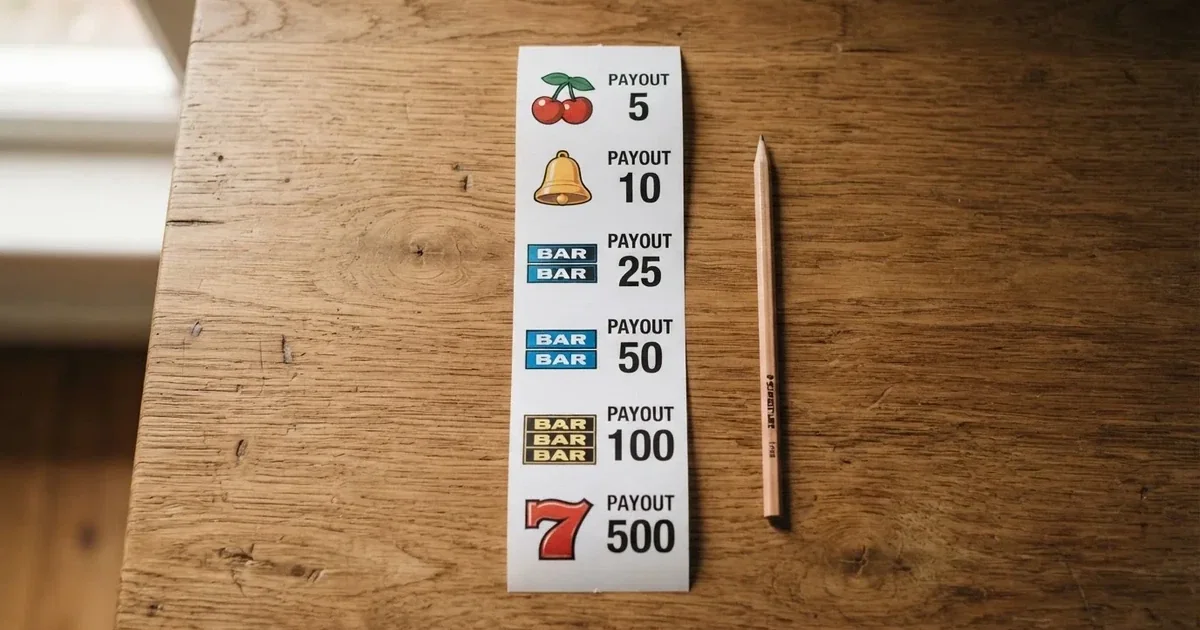
A 5-reel slot is the most familiar shape a slot machine ever took — five spinning columns of symbols, anywhere from a handful of pay lines to dozens, and a paytable that turns a line-up of matching icons into whatever the chart says it’s worth. That shape lives in tens of thousands of poker machines in Australian clubs, pubs and casinos. What it does not have, in this country, is a legal home online. The Interactive Gambling Act 2001, tightened in 2017, makes providing online casino games or online pokies to anyone in Australia an offence, and no state or territory issues a licence for it. Every 5-reel slot a person in Australia can play for real money on a website is being offered by an operator the regulator has already acted against, is acting against, or could act against tomorrow.
This page sets out what the 5-reel format actually is, why every online version of it exists outside Australian law, what the Australian Communications and Media Authority (ACMA) has done about that since 2019, and which offshore brands have been on the receiving end of formal warnings. It is not a ranking of where to play. It is reading material for someone who is interested in 5-reel slots and deserves to know what they run into.
Data current as of 24 September 2026. Verified against the ACMA’s published formal-warning register and enforcement reports.
Table of Contents
- The Legal Picture for Online Pokies in Australia
- Responsible Gambling and Where Help Is Available
- What Bonus Offers on 5-Reel Slots Actually Look Like
- The Format Itself: What a 5-Reel Slot Actually Is
- The Operators the ACMA Has Warned: What the Register Shows
- The Wider Picture: What This Page Is For
- Frequently Asked Questions
The Legal Picture for Online Pokies in Australia
The law that governs this market is short on nuance. The Interactive Gambling Act 2001 prohibits the supply of interactive gambling services to customers physically in Australia, and the 2017 amendments closed the loophole that had let offshore operators keep running. An “interactive gambling service” includes casino games and online pokies — the entire category 5-reel slots online falls into. The penalty targets the provider, not the player, but that distinction does not buy the player anything: an offshore operator exists outside Australian consumer law, so a refused withdrawal has no local complaints body to escalate to and no regulator to phone.

What is licensable, in practice, is wagering on sport and racing placed before the event, lotteries, and keno. The Northern Territory Racing and Wagering Commission (NTRWC) regulates 52 of Australia’s online bookmakers — Sportsbet, Bet365 and Ladbrokes among them — and is the de facto licensing body for that licensed slice. The commission runs on a meeting-a-month cadence with no full-time staff, which tells you something about the volume of activity it oversees and the gap between that activity and casino-style play. None of those 52 licences covers slots. None could.
Minimum age across every Australian gambling product is 18. Credit cards, credit-related products and digital currency have been banned as a payment method for licensed online wagering since 11 June 2024, with operator penalties up to A$247,500. Legal deposit routes for the licensed slice are debit card, bank transfer, PayID/Osko and BPAY. A site that asks an Australian customer for a credit card or a crypto deposit is, by definition, not operating under Australian rules — because no site licensed in Australia is allowed to take those.
The 2026 reform wave is law with a future start date. The Interactive Gambling Amendment (Gambling Reform) Bill 2026 passed Parliament on 19 August 2026; its advertising and inducement measures commence 1 January 2027. The provisions are not in force at the time of writing, so this page treats them as future context rather than current rule.
The Blocking Cadence and What It Actually Adds Up To
The ACMA’s enforcement tool is the section 313 request to Australian internet service providers — a formal ask that an offending site be made unreachable from Australian IP addresses. Between the first blocking request in November 2019 and June 2026, the ACMA reported that 1,751 illegal gambling and affiliate marketing websites had been blocked, and that more than 230 unlicensed gambling services had left the Australian market since enforcement was strengthened in 2017. The June 2026 round alone added 12 more names: 7Signs, ChromaBet, Donbet, Duospin, Freshbet, Slots Gem, Jacks Club, Lucky Start, Pointsbetz (a betting site), Spinrise, Vinyl Casino and Wildsino.

A blocking rate falls out of those numbers that frames the rest of this page. Over roughly 79 months between November 2019 and June 2026, the cumulative count reached 1,751 sites — a long-run pace of about 22 blocked sites per month, or roughly 266 per year. That pace has been anything but even; the early years were quieter as the ACMA built its case-law base, and recent rounds have been heavier. What it means for a reader is that any offshore brand an Australian can reach today is one the regulator has either not got to yet or has not yet finished processing. The pipeline is the point: the number does not stop climbing, it just adds the next name to the list.
The scale of the underlying market is large enough that the blocking effort is fighting a tide. H2 Gambling Capital’s 2025 report estimated that Australians lose about A$3.9 billion a year to illegal gambling sites, and that the share of gambling going through legal channels fell from 74% in 2021 to 64% over the same period. Every blocked site is replaced, in time, by a new domain or a mirror. The legal channels are the licensed bookmakers, lotteries and keno operators — not casino games, not online pokies.
Tax Reality for the Player
Gambling winnings for a recreational player are not assessable income under section 6-5 of the Income Tax Assessment Act 1997, and losses are not deductible. That holds whether the play happens in a licensed venue or on an offshore site. The tax treatment does not depend on whether the operator is legitimate. A player using an offshore 5-reel site that later disappears with the balance has no more tax exposure, but also no more recourse, than one who wins and is paid. The only category for whom gambling is taxable is someone running a business of gambling — a professional punter, in the tax-office sense — and that is a model, not a routine. Anyone with a serious question about their own position should check with the ATO.
Responsible Gambling and Where Help Is Available
A page about a format that can only be played offshore in Australia should not skip this. The legal status of the site does not change what the activity can do to the person doing it.
BetStop, the National Self-Exclusion Register, has been live since August 2023. It binds Australian-licensed online and phone wagering services — every operator that holds one of those 52 NTRWC licences is required to honour a BetStop registration. The boundary matters here: an offshore casino is not connected to BetStop, so a self-exclusion through the register does not stop an offshore site from accepting bets. The register is a tool, not a wall, and what it covers is the licensed slice only.
Confidential support is available around the clock through Gambling Help Online and the National Gambling Helpline on 1800 858 858. The line is free, the chat is free, and neither asks for a name or a billing detail. A person reading this page who has noticed the activity starting to feel compulsive — chasing losses, hiding the spend, playing through money earmarked for something else — has somewhere to call tonight.
The same logic applies the other way. A person whose gambling is recreational and controlled does not need to change anything because of the offshore status. The offshore piece is a consumer-protection issue, not a personal-risk one. The personal-risk piece is the part that BetStop and the helpline are built for.
What Bonus Offers on 5-Reel Slots Actually Look Like
For the licensed Australian market, this section is short. Licensed wagering services are not in the slots business, so a “5-reel bonus” has no local, lawful expression. The vocabulary comes from offshore sites: deposit matches that credit bonus funds on top of a real-money deposit, free-spin bundles tied to a specific slot title, and the wagering requirements that decide how much of the bonus amount has to be cycled before a withdrawal becomes possible.
A deposit-match bonus sounds like free money until the wagering multiple is read. If the bonus carries a 40× wagering requirement on the bonus amount, a A$100 bonus means A$4,000 of qualifying bets before any of the bonus-linked balance can be withdrawn. Free spins look closer to a free sample, but they come with their own terms: winnings from free spins are usually credited as bonus funds, which means the same wagering multiple applies to them. Max-cashout caps are common — a ceiling on what can be withdrawn from bonus-derived winnings regardless of how much the bonus account shows.
None of this is a reason to claim a bonus and a reason not to, in general. The arithmetic is what matters for any specific offer, and the arithmetic differs by brand and by promotion. The conditions to watch are the wagering multiple, the game-weighting (slots typically count 100% toward wagering, table games often count less), the time limit on meeting the requirement, and the max-cashout cap. Where any of those is missing from the offer page, that absence is itself information.
The Calculation That Makes the Offer Concrete
Working through one typical offer shows what the headline number actually costs. Take a A$200 bonus with a 40× wagering requirement on the bonus amount, used on 5-reel slots at an average stake of A$1 per spin:
- Required turnover: A$200 × 40 = A$8,000 of qualifying bets
- Spins at A$1 per spin: A$8,000 ÷ A$1 = 8,000 spins
- Play time at 5 seconds per spin: 8,000 × 5 ÷ 3,600 ≈ 11.1 hours
That is the play time required to clear the wagering requirement, on the assumption that only the bonus amount is being wagered. The expected loss over those 8,000 spins depends on the return-to-player (RTP) of the specific game; at a 96% RTP, the statistical cost of the playthrough is roughly A$320 (A$8,000 × 4%). That figure is an average over many spins, not a guaranteed outcome for any single session — and it sits on top of the A$200 deposit, which the player keeps regardless.
The point of running the arithmetic is not to produce a single number to remember. It is to show that “A$200 bonus” and “A$200 cost” are different statements, and the difference is the wagering requirement and the game’s RTP. A bonus is a coupon for time on the reels; it is not a credit toward the bill.
The Format Itself: What a 5-Reel Slot Actually Is
The 5-reel format traces back to a series of mechanical innovations that started in San Francisco in the late 19th century. Charles Fey’s automatic slot machine used three reels with five symbols — horseshoes, diamonds, spades, hearts and the Liberty Bell — and three bells in a row paid ten nickels. Bally’s “Money Honey” arrived in 1963 as the first machine with a bottomless hopper and automatic payout of up to 500 coins, removing the need for an attendant. The first video slot followed in 1976, from Fortune Coin Co. in Kearny Mesa, California. The reel count climbed from three to five as the machines moved from mechanical to electronic, and the move let designers pack in more symbols and more pay lines without changing the basic gesture.
A modern 5-reel video slot can carry 50 or more symbols per reel, producing odds as high as 300 million to one against a top combination. A classic mechanical three-reel machine with around 10 symbols per reel offers roughly 1,000 possible combinations. The 5-reel format is the standard video slot — five reels, three rows, a variable number of pay lines (often 20, 25 or 40), and a paytable that prices every symbol combination by line count and bet size. Wilds, scatters, free-spin triggers and bonus rounds live on top of that frame; they do not replace it.
Where 5-Reel Slots Are Actually Played in Australia
Australia operates one of the densest slot-machine populations outside the United States — by 2010 an estimated 97,103 gaming machines sat outside casinos, a per-capita rate about five times the US figure. The state-by-state snapshot, as of the latest published counts: 87,298 in New South Wales (June 2023), 26,380 in Victoria (2021–22), 21,122 in Queensland (October 2023), 11,672 in South Australia (September 2023) and 3,587 in the ACT (November 2023). New South Wales legalised the machines in 1956; the rest of the country followed over the following decades.
In pubs, clubs and casinos, those machines are called pokies, and the 5-reel video format is the dominant one. The game on the floor is the legal version of what an offshore site offers online: same reel count, same general paytable logic, same bonus-round architecture. The difference is the licence on the wall and the regulator behind it. The pub pokies are approved and tested; the offshore online pokies are not. The consumer protections on the floor — return-to-player disclosures, problem-gambling signage, venue-level self-exclusion — have no online equivalent at an offshore site.
The Paytable and the Volatility Question
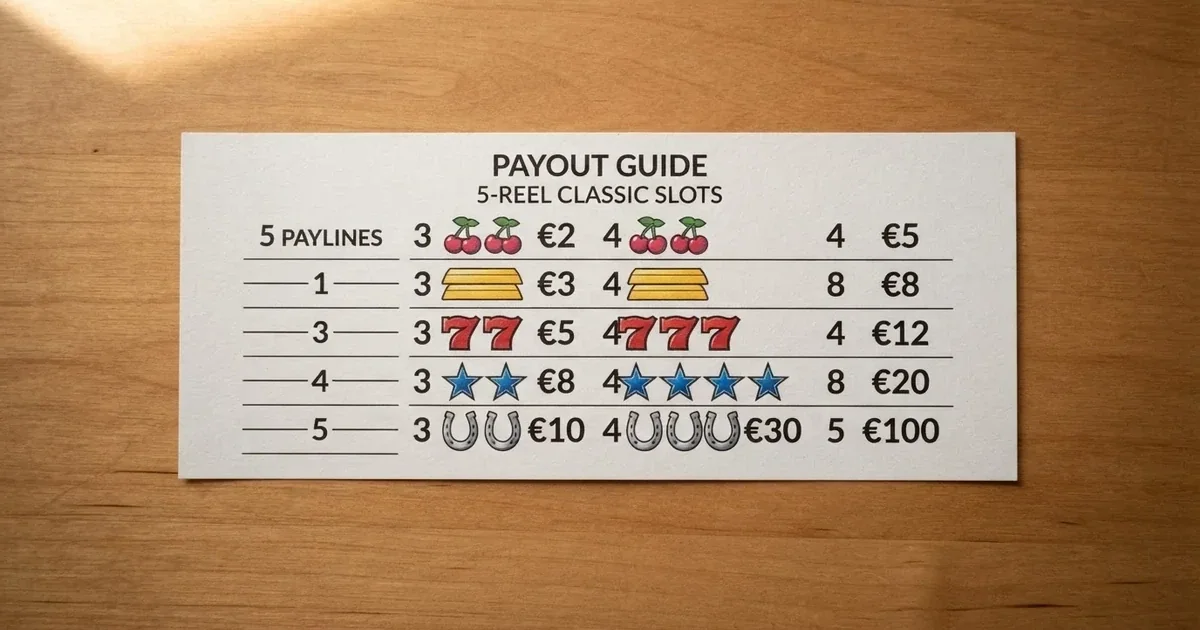
A paytable is the chart that turns symbol combinations into money. Each symbol has a value; each combination of matching symbols on a paying line has a multiplier; the line structure determines what counts as a “match.” A 5-reel, 25-line game with low-value card symbols (10, J, Q, K, A) paying small amounts and high-value themed symbols paying large amounts is the standard construction. Wilds substitute for other symbols to complete a line; scatters pay anywhere on the reels and often trigger a feature; free-spin symbols unlock a round of spins at no additional cost.
Volatility, sometimes called variance, describes how the payouts are distributed. A low-volatility slot pays small amounts frequently — the bankroll moves slowly and steadily. A high-volatility slot pays rarely but in larger bursts — the bankroll can swing widely between long losing stretches and a single big hit. The reel count does not determine volatility; a 5-reel game can be high or low, just as a three-reel classic game can be either. The reel count shapes the maximum number of combinations, which influences the upper end of the prize range, but the volatility is set by the paytable’s spread between common small wins and rare large ones.
The payout-percentage floor is set by the regulator, not the operator. In the United States, Nevada requires at least 75%, Mississippi at least 80%, and New Jersey at least 83% — and that is for the regulated market. An offshore 5-reel slot offers no equivalent guarantee, and the published RTP on an offshore site is the operator’s own figure with no local verification. The cluster of facts below the table — payout timeframes, identity-check policies, withdrawal limits — is the part a player cannot check from the lobby screen, and it is the part that matters when the balance hits a payout threshold.
The Operators the ACMA Has Warned: What the Register Shows
The brands below are not ranked as places to play. Most are not places an Australian can play at right now — the ACMA’s blocking regime takes them off reach from Australian IP addresses once a formal warning runs its course. They appear here because the ACMA itself issued formal warnings over each of them for offering prohibited interactive gambling services to Australians, and that record is the only honest starting point for a comparison. The columns carry the warning, the operator named in it, the date the ACMA published it, and any subject-support data research was able to confirm independently. Where research could confirm nothing, the cell carries the no-data marker.
| Brand | Operator named by the ACMA | ACMA action and date |
|---|---|---|
| RocketPlay | Pulsup Ltd (Rocketplay.com.au) | Formal warning, March 2026; earlier Dama N.V., May 2022 |
| Level Up Casino | Dama N.V. | Formal warning, May 2022 |
| Woo Casino | Dama N.V. | Formal warning, March 2025 |
| Spirit Casino | Dama N.V. | Formal warning, May 2025 |
| National Casino | Consolutetish S.R.L. | Formal warning, July 2025 |
| Bizzo Casino | Consolutetish S.R.L. | Formal warning, July 2025; earlier TechSolutions, 2022 |
| Ignition Casino | Bamboo Media | Formal warning, July 2025 |
| Instant Casino | EOD Code SRL | Formal warning, February 2025 |
| Jackbit | Ryker B.V. | Formal warning, April 2026 |
| Casino Intense | Sterplay Holding Ltd | Formal warning, April 2025 |
| Sky Crown | Hollycorn N.V. | Formal warning, September 2022 |
The pattern in the table is not subtle. The same operator names appear more than once: Dama N.V. surfaces four times (Level Up, Woo, Spirit, plus the earlier RocketPlay link), Consolutetish S.R.L. surfaces twice (National, Bizzo), and TechSolutions surfaces as the earlier warning over Bizzo from 2022. Re-warning the same corporate group with a different brand name is a feature of how the offshore market re-presents itself: when a brand is blocked, the operator spins up another domain under the same licence and the cycle starts over. The ACMA’s published register is the public side of that cycle; the back end is a corporate structure that treats the warning as a cost of doing business.
Reading the Register in Context
A formal warning is not a fine and not a prosecution. It is the ACMA’s documented step before asking ISPs to block the site at the network level. The site usually stays reachable during the warning period; the block follows once the ACMA moves to the next stage under section 313 of the Telecommunications Act 1997. For a player, that means the window between the warning and the block is the only time the site is technically reachable from Australia, and the experience during that window is no different from any other week — same games, same cashier, same terms. What changes is what happens at withdrawal time when the operator’s domain is no longer reachable to the player who needs to log in.
The eleven brands above are the ones the ACMA has named in formal warnings. They are not a complete list of the offshore market — the blocking register is much longer (the 1,751 figure includes affiliate marketing sites, mirrors, and brands the ACMA has blocked without a published warning) — and they are not a recommendation of any kind. They are what the regulator’s own published record shows.
What “Subject Support” Means and Why Most Cells Are Empty
The research column marked subject support tracks whether any independent listing or directory confirms that the brand carries 5-reel slot content from named providers. Most cells are empty: the ACMA’s formal-warning publication does not include a content catalogue, and the offshore sites themselves are not a reliable source for what they host (a domain that changes branding every quarter will not keep a stable game list). Where the cell has data — Level Up Casino on BGaming’s directory, Casino Intense on a press clipping — it is the listing talking, not the operator. The absence of a cell is not a denial that the brand offers 5-reel slots; it is a refusal to put the operator’s own word for it on this page.
For RocketPlay, Woo Casino, Spirit Casino, Bizzo Casino, Ignition Casino, Instant Casino, Jackbit and Sky Crown, no independent listing could be confirmed in research. They appear in the table on the ACMA’s record alone. The reader is welcome to treat that as the limit of what can be said about them without making the page into a marketing channel.
The Wider Picture: What This Page Is For
The 5-reel format is not exotic. It is the most common shape a slot machine takes in Australia — on the floor of every pub and club that holds a gaming-machine licence, and on the screen of every video pokies terminal in every casino. What is exotic is the idea that an Australian can reach a legal online version of that format. They cannot. The Interactive Gambling Act says so, the ACMA enforces it through a blocking programme that has added 1,751 sites to its list since 2019, and the 230-plus services that have left the Australian market since 2017 are the voluntary side of the same pressure.
The phrase “best 5 reel slots australia” is a common search query. It runs into a regulatory wall instead. The honest answer is that the legal 5-reel slot in Australia is the one in the pub down the road, on the casino floor at Crown Melbourne, or at the local RSL — and that the online version of that game is offered exclusively by operators the ACMA has acted against, is acting against, or could act against next. That is not a recommendation to play any of them, and it is not a recommendation to avoid them entirely. It is the picture the regulator’s own record paints, and it is what that search query runs into.
What a Reader Comparing Options Should Actually Compare
A reader who has decided to play anyway — and the page does not endorse that choice — is comparing on the wrong axes if the comparison is brand name or welcome bonus size. The comparison that matters is consumer-protection: does the operator hold a licence from a regulator that handles player complaints, what is the published RTP and is it independently audited, what is the withdrawal timeframe and what documentation does the cashier demand, what recourse exists if a payout is refused. Every offshore site fails at least one of those tests by virtue of being offshore. The question is how badly each one fails, and the published record does not answer it.
The comparison that matters for a reader who has decided not to play offshore is what the legal market offers instead. The licensed bookmakers carry sports and racing, not slots. Lotteries and keno are their own products. The pub and club pokies are the legal 5-reel slot in Australia, on a machine that returns a published percentage to a regulated venue, with the venue’s own self-exclusion scheme and the Gambling Help Online number printed on the signage. That is not a substitute for what the offshore sites offer, but the difference is the licence and the recourse — not the reel count.
Frequently Asked Questions
What makes a 5-reel slot different from a standard five-reel video slot?
Nothing, in modern usage — the two terms describe the same machine. The 5-reel designation refers to the original mechanical era when slot machines had three reels, and five reels was the upgrade. Every video slot built since the late 1970s has used five or more reels, so “5-reel slot” and “five-reel video slot” have converged into the same product. The number of pay lines, the bonus features, and the volatility are what vary between titles; the reel count has stopped being a distinguishing feature.
Can 5-reel slot machines be found in licensed Australian pubs and clubs?
Yes, and they are the legal version of the format. By 2010 Australia operated an estimated 97,103 gaming machines outside casinos — most of them 5-reel video pokies — making the country one of the densest slot markets in the world. New South Wales alone held 87,298 pokies outside casinos as of June 2023. These machines are state-regulated, carry a published return-to-player percentage, and sit inside venues that operate self-exclusion schemes and display problem-gambling signage.
Do 5-reel slots typically pay out differently than newer five-reel formats?
The payout percentage is set by the paytable, not by the reel count. A 5-reel, 25-line game and a 5-reel cluster-pay game can share an RTP of 96%, or they can diverge by several percentage points depending on how the paytable is structured. What does change with newer formats is the volatility — games with more reels and more symbols tend toward higher volatility, paying less often but in larger bursts when they do. The reel count shapes the upper prize range; the paytable decides everything else.
Is a 5-reel slot online the same game as a 5-reel machine on a casino floor?
The game design is the same — same software studios supply both markets, often with the same titles. The difference is the licence and the regulator. A pub pokie in Melbourne is approved by the Victorian Gambling and Casino Control Commission, sits inside a tested cabinet, and pays out under a published return-to-player percentage. An online version on an offshore site uses the same software but operates outside any Australian regulatory oversight, has no consumer-protection regime behind it, and can be blocked by the ACMA at any time. The reel symbols may match; the player protections do not.
Are 5-reel slots for real money available legally from an Australian-based site?
No. The Interactive Gambling Act 2001 prohibits the supply of online casino games and online pokies to anyone in Australia, and no state or territory issues a licence for them. Every offshore site offering 5-reel slots to Australian players is operating outside Australian law. The player is not the target of the Act, but the offshore operator provides no Australian consumer protection, no complaints body, and no recourse if a withdrawal is refused — and the site can be blocked while a balance is still on it.
Written by the editors at Casino No Wager Hub.