What chasing a 3-reel slot in Australia really costs a player
 Available in US
Three reels, three paylines, a single coin per spin, the bell ringing when it lands. The format dates from Charles Fey’s late-nineteenth-century machine, and the version a player meets on an offshore site today still reads like that — except for the part where the offer is illegal the moment it crosses the Australian border. As of 24 September 2026, every operator reviewed below has been the subject of a formal warning from the ACMA for offering prohibited online casino games to Australians, and any site that markets real-money 3-reel play from inside Australia is one formal warning away from a block. The page that follows walks through the legal frame, the responsible-gambling safety net, the shape of the bonus offers these sites run, the providers and titles the listings claim, the ACMA’s own table of warnings, and the fundamentals of the format itself — in that order, because the order is the point: legality first, then the parts that only matter once the legal frame is on the table.
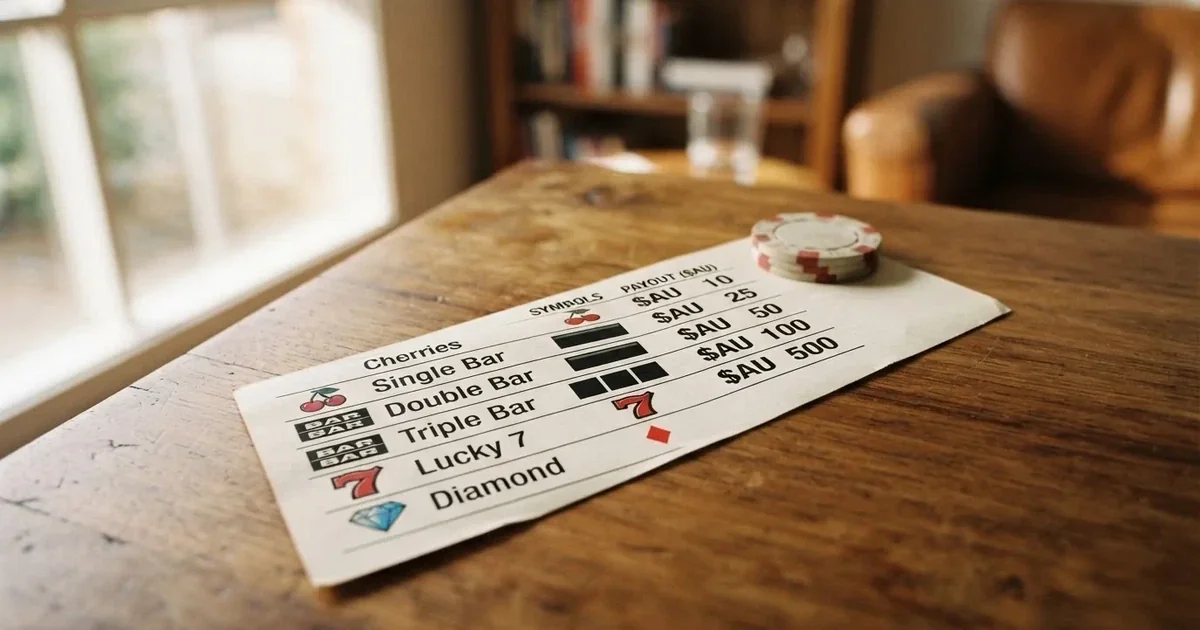
Table of Contents
- The legal frame: why no 3-reel slot is licensed online in Australia
- Responsible play: what the safety net looks like when the site is offshore
- What a 3-reel bonus actually costs on these sites
- Providers and titles: what the listings actually say
- The ACMA warning table: every brand reviewed and what the regulator said
- How the blocking rate has actually moved over six and a half years
- Three-reel fundamentals: how the format actually plays
- The operator block: what each warning actually means for a player
- What a reader should actually do with this page
- Frequently asked questions
The legal frame: why no 3-reel slot is licensed online in Australia
Under the Interactive Gambling Act 2001, as tightened by the Interactive Gambling Amendment Act 2017, it is an offence to provide online casino games, online pokies or in-play betting to a person physically in Australia. No state or territory issues a licence for any of them. What is licensable in this country is wagering on races and sport placed before the event, plus lotteries and keno. A 3-reel pokie falls under “online casino games” the moment it loads in a browser at an Australian address, so any site that takes real-money play from here is operating outside the IGA whatever licence it displays — Curaçao, Malta, Anjouan — because none of those change the Australian prohibition. The Interactive Gambling Amendment (Gambling Reform) Bill 2026 passed Parliament on 19 August 2026; its advertising and inducement measures commence on 1 January 2027, so a page read in 2026 is reading law that is in force and reform that has a start date but is not yet operating.
Enforcement sits with the ACMA. The regulator investigates complaints, issues formal warnings to operators it judges to be offering prohibited services, and — once a warning has been ignored — asks Australian internet service providers to block the offending domain. The individual player is not prosecuted. The IGA targets the provider, not the punter, so nobody is in legal jeopardy for having spun. What is in jeopardy is the money. An offshore site gives no Australian consumer protection, no complaints body with reach, and no recourse if a withdrawal stalls or is refused; it can be blocked by the ACMA with a balance still on it, and from that point the only address for a complaint is the operator itself, on its own terms, in its own jurisdiction.

The shape of that enforcement is the rest of this section, in figures. As of June 2026, the ACMA reports a running total of 1,751 illegal gambling and affiliate-marketing websites blocked since the first blocking request in November 2019, and more than 230 unlicensed gambling services having left the Australian market since enforcement was strengthened in 2017. In a single round reported on 26 June 2026, the ACMA asked ISPs to block twelve more sites at once — 7Signs, ChromaBet, Donbet, Duospin, Freshbet, Slots Gem, Jacks Club, Lucky Start, Pointsbetz.com, Spinrise, Vinyl Casino and Wildsino. The blocking list is the loudest number, and the one to keep in mind for the arithmetic further down: a site that survives today may not survive next quarter, and the cost of any “balance” is the date of the next blocking round.
Player-side protections run in two registers. The first is payments. Since 11 June 2024, credit cards, credit-related products and digital currency are banned as payment for any licensed online wagering in Australia, with penalties up to A$247,500 for operators who break the rule. Legal deposit routes for the licenced wagering market are debit card, bank transfer, PayID/Osko and BPAY. An offshore casino asking an Australian for a credit card or a crypto deposit is signalling that it is not playing inside the Australian rules, and that the chargeback path — if it ever opens — runs through a card issuer who is being asked to refund a transaction the regulator says should not exist. The second register is exclusion and help. BetStop, the National Self-Exclusion Register, has been live since August 2023, and it binds Australian-licensed online and phone wagering services; an offshore casino is not connected to it, so a self-exclusion on BetStop does not propagate to the sites reviewed below. The National Gambling Helpline on 1800 858 858 is free and runs around the clock, with chat at Gambling Help Online — both of which are reachable whether the person concerned is playing on a licensed wagering site, an offshore casino, or not playing at all.
H2 Gambling Capital’s 2025 estimate puts Australian losses to illegal gambling sites at around A$3.9 billion a year, and tracks the share of gambling flowing through legal channels as having dropped from 74% in 2021 to 64% — a ten-point fall in four years. That number is what the ACMA’s blocking programme is responding to. It is also what a 3-reel pokie player in Australia is sitting inside: not a niche market, but a market measured in single-digit billions and growing on the unlicensed side. Tax is the one footnote the regulator does not enforce on the punter. Gambling winnings of a recreational player are not assessable income under section 6-5 of the ITAA 1997 and losses are not deductible; the rule is “check with the ATO” because it inverts for a person carrying on a business of gambling, which is a model and not an outcome.
Responsible play: what the safety net looks like when the site is offshore
Responsible play on a prohibited site is not the same conversation as responsible play on a licensed one, because the protective layer an Australian licence brings — pre-commitment, dispute resolution, a complaints body with jurisdiction, a self-exclusion register the operator cannot ignore — does not extend offshore. What does extend, and what works regardless of where the betting takes place, is the human-side help line.
Gambling Help Online runs a free, confidential service around the clock. The National Gambling Helpline on 1800 858 858 takes calls at any hour, and the chat channel at Gambling Help Online takes messages at any hour; both are staffed for crisis-level conversations as well as for the quieter question a player rings about before the question becomes serious. The service is funded federally and is independent of any operator, so a person using it does not have to worry that what they say becomes a marketing record.
BetStop, the National Self-Exclusion Register, is the second piece of the picture, and its limits are the point. A BetStop registration excludes the person from every Australian-licensed online and phone wagering service for a minimum period set by the registrant. The exclusion period is enforceable against the licensed bookmakers and wagering operators the NTRWC oversees — Sportsbet, Bet365, Ladbrokes and the rest of the 52 online bookmakers the Northern Territory Racing and Wagering Commission regulates. The Northern Territory Racing and Wagering Commission regulates 52 of Australia’s online bookmakers for tax reasons, has no full-time staff, and meets once a month in Darwin; the thinness of that oversight is a useful reminder that “licensed in Australia” means wagering on races and sport, not online casino games. BetStop does not bind an offshore casino. A player who self-excludes and then logs into one of the sites reviewed below is not in breach of the BetStop terms — they are simply playing on a service that does not consult the register. That gap is the reason the helpline is the first port of call rather than the register.
A practical sequence for a player who feels the play getting away from them: ring 1800 858 858 or open the chat at Gambling Help Online; ask about BetStop, which will cover any licensed bookmaker the player also uses; treat any balance held by an offshore casino as a financial decision separate from the self-exclusion decision, because blocking the site does not return the balance. A responsible-gambling framework that depends on the player to leave a site is weaker than one that locks them out, and offshore play runs on the weaker version.
What a 3-reel bonus actually costs on these sites
The bonus offers that an offshore 3-reel pokie site markets to an Australian player are described here as background reading rather than as something to act on, because none of the brands below is licensed to offer them in Australia in the first place. That does not stop the offers being set up — it just stops them being enforceable. A welcome package typically arrives as a deposit match with a wagering multiple and a maximum-cashout cap; a free-spins bundle arrives as a fixed number of spins at a fixed stake on a named title, with whatever the same site’s withdrawal rules make of the winnings.
Three terms recur, and they are the ones to read. The wagering multiple is the number of times the bonus amount has to be turned over before any withdrawal is permitted — a 35× bonus on a A$100 match means A$3,500 in qualifying bets before any of the bonus balance converts. The game-weighting rule is what determines whether a 3-reel pokie even counts towards that turnover; many sites weight slots at 100% and table games at 10% or 0%, so a player who assumed the whole A$3,500 counted towards clearing may find that the same A$3,500 at the roulette wheel counts for A$350 or nothing at all. The maximum-cashout cap is the ceiling on what can be withdrawn from bonus-derived winnings — a common shape is “5× the deposit” or a fixed cap in the low thousands of dollars, whichever the site makes smaller. A free-spin win of A$400 on a site with a A$200 cashout cap turns into A$200 the moment the player hits withdraw.
What that looks like in arithmetic. A A$100 bonus with a 35× wagering multiple means A$3,500 of qualifying turnover, and on a 3-reel pokie at A$1 per spin that is 3,500 spins. At a five-second interval between spins — the upper end of a comfortable click rate — that is 17,500 seconds, or about 4 hours and 52 minutes of continuous play. The bonus’s real cost to a player is the expected loss over those 3,500 spins. At a typical online slot return-to-player of about 96%, the expected loss is roughly A$3,500 × (1 − 0.96) = A$140. A player clearing the bonus walks away with the bonus itself, having given back about A$140 of it to the house edge over the course of the clearing. The marketing of the bonus calls the A$100 “free”; the arithmetic calls it a A$100 stake the player agreed to spend down to about A$60 in cleared cash.
What is striking is not the size of the haircut but the order in which it is applied. The bonus clears after turnover, the cashout cap applies after clearing, the game weighting determines how much of the turnover counts in the first place, and the withdrawal queue on an offshore site applies after all of those. A “free” A$100 is, at the end of the chain, worth somewhere between the original A$100 and zero depending on which of those four gates the player’s session happens to hit. None of that arithmetic is a secret, and none of it changes because the bonus word on the landing page is in marketing type.
A player on one of the sites reviewed below should treat the offer, if they choose to take it, as a price the house has put on its own product and not as a gift. The “100% up to A$500” header is the price; the wagering, the weighting, the cap and the queue are the discount that price back to its real value. The price is a number the regulator in this jurisdiction does not enforce and the operator’s own customer service does not negotiate, so the player is the only person doing the reading.
Providers and titles: what the listings actually say
The 3-reel pokie format is a small surface by industry standards, and the listings on the relevant providers’ sites reflect that. A 3-reel slot today typically runs three reels with three rows, a single horizontal payline through the centre of the middle row, and a small symbol set — cherries, bars, sevens, bells — drawing on the heritage Charles Fey put on the original Liberty Bell machine in the late nineteenth century. Modern variants stretch the definition by adding a second or third payline, a nudge feature, or a hold-and-respin mechanic, but the visual grammar of three reels and a paytable strip down the side stays recognisable across the format.
A handful of providers carry 3-reel content in their public catalogues. BGaming lists classic 3-reel titles alongside its video-slot range, and that listing is the source for the “listings-only” tag attached to Level Up Casino in the table further down — the connection runs through the provider’s published catalogue rather than through any operator-side confirmation. Other providers sit further from the format: a five-reel video slot is a more flexible canvas for the bonus mechanics the modern player expects, and most studios concentrate there. A player looking for a 3-reel pokie on an offshore site is looking in a smaller pool than the one a five-reel search reaches, which is one reason the same handful of titles keep surfacing across multiple operators.
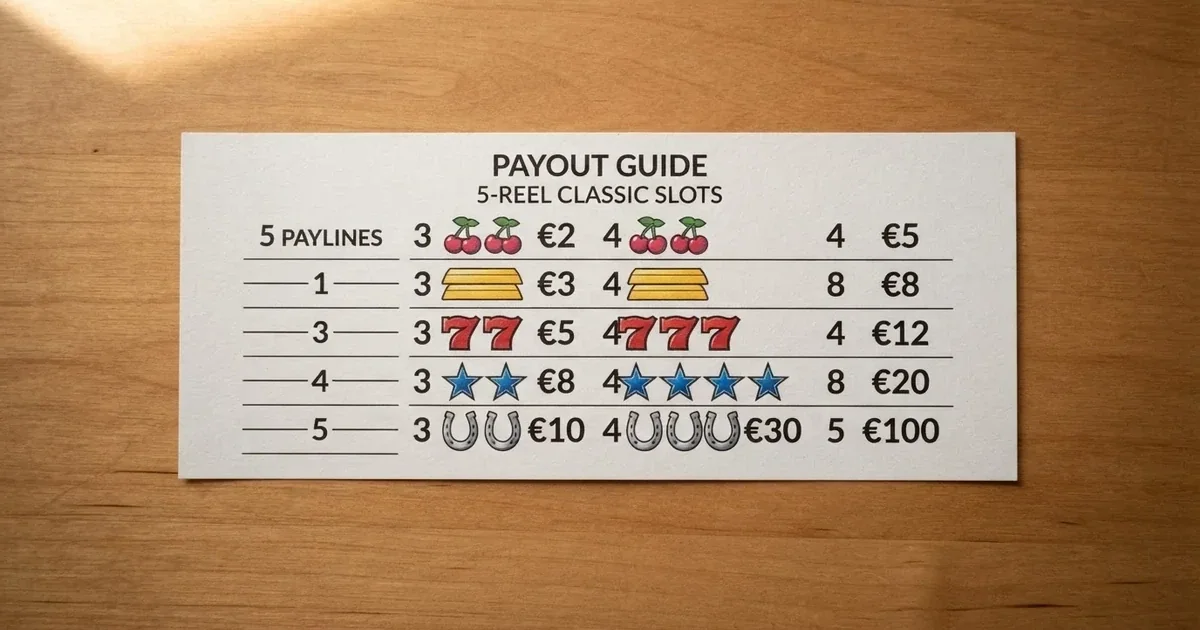
The symbols and the paytable are the mechanics that matter for a session. A classic 3-reel pokie pays on a single line — three matching symbols across the centre row is the standard win condition, with smaller payouts for two-of-a-kind combinations and a top prize for the triple match (three bells on a Liberty Bell-style game, three sevens on a 7s variant, three bars on a bars variant). Wilds and scatters are not standard on a strict 3-reel — they are additions a game makes when it wants to expand beyond the format — and a “bonus” symbol on a 3-reel pokie tends to gate a feature round rather than scatter a payout. A player reading a 3-reel paytable should expect: symbol values laid out in a strip, a single line highlighted as the paying line, a top prize quoted in coins rather than in dollars, and a stake-per-spin set in increments of one coin. Anything more elaborate is a 3-reel game that has been extended, not a strict-format title.
The wider landscape is the one to keep in mind when reading those paytables. As of June 2023, New South Wales alone had 87,298 pokies-style slot machines outside casinos; Victoria had 26,380 in 2021–22, Queensland 21,122 in October 2023, South Australia 11,672 in September 2023 and the ACT 3,587 in November 2023. The total installed base is roughly 195,000 machines in pubs and clubs, which is what the ACMA’s blocking programme sits alongside — every one of those pub machines is licensed and regulated by its state, and the player using one has the full state-level consumer protection. A 3-reel pokie on a licensed club floor and a 3-reel pokie on an offshore site are the same visual game; the consumer frame around them is not the same game at all.
The ACMA warning table: every brand reviewed and what the regulator said
The table below lists every operator covered on this page in the order research supplies. None is recommended. Each appears because the ACMA itself issued a formal warning over it for offering prohibited online casino services to Australians, and the date column is the date the warning was published.
| Brand | ACMA action and date | Operator named by the ACMA | Subject support |
|---|---|---|---|
| RocketPlay | Formal warning, March 2026 (earlier Dama N.V., May 2022) | Pulsup Ltd | — |
| Level Up Casino | Formal warning, May 2022 | Dama N.V. | BGaming catalogue listings |
| Woo Casino | Formal warning, March 2025 | Dama N.V. | — |
| Spirit Casino | Formal warning, May 2025 | Dama N.V. | — |
| National Casino | Formal warning, July 2025 | Consolutetish S.R.L. | Wikipedia listing |
| Bizzo Casino | Formal warning, July 2025 (earlier TechSolutions, 2022) | Consolutetish S.R.L. | — |
| Ignition Casino | Formal warning, July 2025 | Bamboo Media | — |
| Instant Casino | Formal warning, February 2025 | EOD Code SRL | — |
| Jackbit | Formal warning, April 2026 | Ryker B.V. | — |
| Casino Intense | Formal warning, April 2025 | Sterplay Holding Ltd | ABC and ACMA reports, Crown Melbourne |
| Sky Crown | Formal warning, September 2022 | Hollycorn N.V. | — |
The pattern that emerges from the table is operator-side, not brand-side. Dama N.V. carries three of the eleven formal warnings — RocketPlay, Level Up Casino, Woo Casino, Spirit Casino between them — and is the single operator entity the ACMA has named most often in this set. Consolutetish S.R.L. carries two of the more recent warnings, over National Casino and Bizzo Casino. The remaining warnings are spread across single-brand operators, several of them small companies registered in jurisdictions the regulator does not enforce against. The “Subject support” column reflects what the public listings actually say about each brand’s connection to 3-reel content: most entries are an em dash because no third-party listing confirms the brand’s claim, and three entries carry what those listings — not the operator — say.
The “earlier” notes in the table matter because they show the warnings are not always first contacts. Bizzo Casino was warned once in 2022 over TechSolutions (CY) Group Limited and TechSolutions Group N.V., then warned again in July 2025 over Consolutetish S.R.L. — a brand re-emerging under a new corporate wrapper is a pattern the ACMA’s formal-warning publication reads as the operator testing whether the new wrapper resets the regulator’s clock. RocketPlay’s March 2026 warning over Pulsup Ltd is the second appearance for the brand after the May 2022 Dama N.V. warning. A formal warning is not a block, and a brand can keep operating after one; the escalation is the next round, and the escalation is what the blocking total of 1,751 sits behind.
How the blocking rate has actually moved over six and a half years
The arithmetic the page adds to the rest of the material sits here, because this is where the blocking record is being unpacked. As of June 2026, the ACMA reports a running total of 1,751 illegal gambling and affiliate-marketing websites blocked since the first blocking request in November 2019. That is the running total. What the page owes the reader is a sense of how fast that running total has actually been accumulating, because “1,751” is a current figure and the rate at which it grew is what tells a player how long an offshore site they are playing on is likely to remain reachable.
Across the period from November 2019 to June 2026 — roughly six years and seven months, or about 80 months — the ACMA’s blocking programme moved from a first request to 1,751 sites blocked. That is an average of around 22 sites blocked per month across the whole period, but the average masks the shape of the run. Enforcement was strengthened in 2017, two years before the first blocking request, and the early years of the programme carried fewer blocks as the ACMA built the legal scaffolding for an ISP-level directive. The bulk of the 1,751 sits in the later years, when the blocking mechanism was operating at full pace and the round sizes — twelve sites in a single June 2026 round is one example — were running into double digits at a time.
The figure the reader can use is a band, not a point: somewhere between roughly 20 and 30 sites blocked per month over the last three years, with individual rounds ranging from a handful to the mid-teens. The ACMA does not publish a month-by-month breakdown of its blocking programme, so the band is what the headline total and the published rounds support; a tighter claim would be inventing a series the regulator has not released. The condition on the band is that it averages a programme that runs in bursts — a quiet month followed by a twelve-site round is closer to the actual shape than a steady 22-per-month tick.
What that band means in practice for an offshore player is that the site they are playing on has, on this regulator’s record, a finite remaining reach. A site warned in March 2026 and not yet blocked is somewhere in the warning-to-block queue; the warning is the regulator telling the operator it considers the offering prohibited, and the block is the regulator acting on the ISP level if the operator does not comply. A player who puts a balance on a warned site is depending on the operator complying — or, if the operator does not, on the balance being withdrawable in the window between warning and block. The blocking record is the one number on the page that gives the window a length.
Three-reel fundamentals: how the format actually plays
A 3-reel pokie is, mechanically, the simplest slot format in current use. Three reels each carry a strip of symbols — historically ten symbols per reel, modern variants stretch this — and a single payline runs across the centre row. A spin costs one coin at a time on the strict-format version; modern variants run two or three coins to light up additional paylines. A win on three matching symbols across the centre row is the standard payout, with two-of-a-kind combinations paying smaller amounts and a single matching symbol on the line sometimes returning the coin. The top prize is set at the rarest combination — three of the top symbol, sometimes with a multiplier if the player has bet the maximum coin count.

The volatility profile of a 3-reel pokie is, in plain terms, flatter than a five-reel video slot. A classic three-reel machine with ten symbols per reel offers roughly 1,000 possible combinations — 10 × 10 × 10 — and pays out the top prize on one of them, which is a probability of about one in a thousand per spin. A modern video slot can run five reels with fifty-plus symbols per reel, producing odds as high as 300 million to one against the top combination. The 3-reel player’s session tends to produce more small wins and fewer large ones; the five-reel player’s session tends to produce fewer wins of any size and a longer tail of large ones. Neither shape is “better” in the abstract — the house edge is what it is on either format — but the rhythm of a session is different, and a player who has only met the five-reel format is meeting a different rhythm on a 3-reel.
The history matters because the marketing uses it. Charles Fey’s late-nineteenth-century machine used five symbols — horseshoes, diamonds, spades, hearts and the Liberty Bell — and paid ten nickels on three bells. Bally’s “Money Honey” in 1963 introduced the bottomless hopper and a 500-coin automatic payout without an attendant, which is the technology underneath the modern pub pokie. The first video slot was developed in 1976 by Fortune Coin Co. in Kearny Mesa, California. New South Wales legalised slot machines in 1956, and by 2010 Australia operated an estimated 97,103 gaming machines outside casinos — a per-capita rate roughly five times that of the United States. The 3-reel pokie on an Australian club floor is the direct descendant of the format Fey built; the 3-reel pokie on an offshore site is the same format running outside the legal frame the club floor sits inside.
A note on minimum payout percentages for comparison. State regulation in the United States sets minimum slot payout percentages that vary by jurisdiction — Nevada requires at least 75%, Mississippi at least 80%, New Jersey at least 83%. No equivalent federal floor operates on offshore sites serving Australians; the return-to-player a 3-reel pokie displays on its paytable is the operator’s stated number, audited by the operator’s chosen testing lab, and not enforced by any Australian regulator. The 96% figure used in the bonus-arithmetic section above is a typical online slot return-to-player and a reasonable working number, but a player on a specific site should treat the site’s stated RTP as exactly that — stated, not verified by anyone with jurisdiction over the player.
The operator block: what each warning actually means for a player
The eleven brands below are listed in research’s order. Each is described as a brand the ACMA itself named in a formal warning, and each is closed on a different point — the warning date, the operator wrapper, the escalation pattern, the connection to a licensed entity if there is one. None is recommended; the descriptions are the case the regulator’s own publication makes about each.
RocketPlay — the brand with two warnings and a fresh corporate wrapper
RocketPlay’s ACMA record is two formal warnings, not one. The first, in May 2022, named Dama N.V. as the operator. The second, in March 2026, named Pulsup Ltd over Rocketplay.com.au — a new corporate entity over the same brand four years later. The pattern is the one the regulator’s formal-warning publication reads as operator testing: warn a brand under one wrapper, watch the brand re-emerge under another, warn again. The brand has been reachable across both warnings because neither warning has yet escalated to an ISP-level block; that is the window the blocking-rate arithmetic above quantifies. For a player looking at the brand today, the relevant fact is that the ACMA has named the same brand twice, and the second naming is the more recent one.
Level Up Casino — one of four Dama N.V. brands in the set
Level Up Casino’s formal warning dates to May 2022, with Dama N.V. named as the operator. The brand is one of four Dama N.V. brands in this set — the others are RocketPlay’s earlier iteration, Woo Casino and Spirit Casino — which makes Dama N.V. the operator entity the ACMA has named most often. The provider connection noted in the table is BGaming, which lists the brand in its catalogue; the connection is the provider’s own statement about which operators carry its content, not an operator-side confirmation that BGaming’s titles are what Level Up Casino runs today. The brand has been operating since the 2022 warning without an escalation to a block, which is the regulator’s pattern of warning first and blocking later.
Woo Casino — the second 2025 warning to Dama N.V.
Woo Casino faced ACMA action in March 2025, again with Dama N.V. as the named operator. Three years separated this warning from the May 2022 warnings over the other Dama N.V. brands, indicating a gap often seen when an operator has spent the intervening period outside the regulator’s immediate enforcement priority. The March 2025 warning resets the clock for Woo Casino specifically. For a player on Woo Casino in 2026, the site is one the ACMA specifically named within the last eighteen months — a key factor in the typical warning-to-block timeline.
Spirit Casino — the second 2025 warning to Dama N.V.
Spirit Casino’s formal warning dates to May 2025, two months after Woo Casino’s, with Dama N.V. again named. Two Dama N.V. warnings in the same year, on two different brands, is the regulator signalling that the corporate wrapper has multiple live offerings and the ACMA is treating them as a single enforcement problem. For a player, the relevant fact is that the brand sits inside the same operator entity that the ACMA has been warning repeatedly across 2022 and 2025, and that the warning-to-block escalation pattern is the same as for the sister brands.
National Casino — the Consolutetish S.R.L. escalation
National Casino came to the ACMA’s attention in July 2025, with Consolutetish S.R.L. named as the operator. The same July 2025 round also covered Bizzo Casino, making Consolutetish S.R.L. the second-most-named operator in this set after Dama N.V. The brand carries a Wikipedia listing as the source of its “Subject support” entry — a third-party directory, not an operator confirmation of current game content. National Casino remains a brand the regulator officially identified within the last twelve months of our current 2026 reporting.
Bizzo Casino — the brand with two warnings under two different operators
Bizzo Casino has two formal warnings to its name. The first, in 2022, named TechSolutions (CY) Group Limited and TechSolutions Group N.V. The second, in July 2025, named Consolutetish S.R.L. The pattern is similar to RocketPlay: a brand warned under one corporate wrapper, then warned again under another three years later. Re-emerging under a new wrapper is the escalation shape the ACMA reads as the operator testing whether the new name resets the regulator’s clock. In this case, the regulator has acted twice. This brand currently represents the second iteration of a named operator.
Ignition Casino — the July 2025 Bamboo Media warning
Ignition Casino received formal notice in July 2025, with Bamboo Media named as the operator. This notice sits in the same July 2025 round that named Consolutetish S.R.L. over National Casino and Bizzo Casino — three brands, two operator entities, one enforcement month. Bamboo Media does not appear elsewhere in this set, making Ignition Casino the single brand tied to that operator in this review. The regulator officially flagged this brand within the last year.
Instant Casino — the February 2025 EOD Code SRL warning
Instant Casino received a formal warning in February 2025, with EOD Code SRL named as the operator. This date is the earliest in the 2025 cluster, preceding the March 2025 Woo Casino notice by a month and the July 2025 round by five. EOD Code SRL is not named elsewhere in this set, making Instant Casino the single brand tied to that operator in this review. Users accessing Instant Casino in 2026 are dealing with a site that the regulator flagged roughly eighteen months prior to our current review.
Jackbit — the April 2026 Ryker B.V. warning
Jackbit received formal notice in April 2026, with Ryker B.V. named as the operator. The same April 2026 round also covered CasinOK, which makes Ryker B.V. the third operator entity in this set to carry multiple warnings. This is the most recent warning date in our review, putting Jackbit at the freshest end of the warning-to-block queue. A player on Jackbit in 2026 is using a brand named by the ACMA within the last few months.
Casino Intense — the April 2025 Sterplay Holding Ltd warning
Casino Intense received a formal warning in April 2025, with Sterplay Holding Ltd named as the operator. The “Subject support” entry here includes several third-party references — ABC reports, ACMA publications and Crown Melbourne’s own page — as the brand’s name has appeared in Australian media coverage beyond the regulator’s own notice. This remains the only brand in our set tied to Sterplay Holding Ltd. We have tracked this notice for approximately eighteen months, placing it in the latter half of our review window.
Sky Crown — the September 2022 Hollycorn N.V. warning
Sky Crown was the subject of a formal warning in September 2022, with Hollycorn N.V. named as the operator. The same warning also covered Blue Leo. Hollycorn N.V. is not named elsewhere in this set under a separate entry, but the dual-brand warning is the same pattern Dama N.V. and Consolutetish S.R.L. carry: one operator entity, multiple brand names, multiple warnings. Sky Crown is the oldest warning in this review, which means it has been on the regulator’s record the longest; the warning-to-block escalation has not run for Sky Crown, but the regulator’s track record on Dama N.V. and Consolutetish S.R.L. brands suggests the pattern of warning-without-blocking is the regulator’s chosen pace, not the operator’s immunity. A player on Sky Crown in 2026 is on a brand the ACMA named nearly four years before the page’s publication date — the longest-running name on the list, and the one the blocking rate is most likely to reach next.
What a reader should actually do with this page
A page that lists eleven brands and every one of them is the subject of an ACMA formal warning is not a page that ends on a recommendation. What it ends on is the choice the regulator’s own publication makes plain: a 3-reel pokie in Australia exists either on a licensed club floor under state regulation, or on an offshore site the ACMA has named. Both formats offer the same three-reel visual; the consumer frame around them is different. The licensed club pokie carries state-level consumer protection, a state complaints body, and the ability for the regulator to act on a dispute; the offshore site carries none of those, and a balance on it sits inside the warning-to-block window the regulator’s blocking rate defines.
This calculation offers a clearer view of how the blocking program operates over time. Roughly 22 sites blocked per month on average across the lifetime of the ACMA’s blocking programme, somewhere between 20 and 30 per month over the last three years, in bursts ranging from a handful to the mid-teens. That is the rate at which an offshore site the regulator has warned becomes a site the regulator has blocked. A player who chooses to play on a warned site is choosing to play inside that window, with the balance they have placed, on the assumption the operator will withdraw it before the next blocking round reaches them. A player who chooses a licensed club pokie instead is choosing a format the regulator protects rather than one the regulator blocks. The format is the same on both sides of the divide; the consumer frame is not.
Frequently asked questions
What makes a 3-reel slot different from a five-reel video slot?
A 3-reel pokie runs three reels with one payline through the centre row and a small symbol set, while a five-reel video slot runs five reels with multiple paylines, often fifty or more symbols per reel, and odds against the top combination that can reach 300 million to one. The 3-reel version produces more small wins and fewer large ones; the five-reel version produces fewer wins of any size and a longer tail. The volatility profile is different even when the house edge is similar, and the visual grammar of a 3-reel game — cherries, bars, sevens, a paytable strip down the side — is recognisable across the format.
Can 3-reel slot machines be found in licensed Australian pubs and clubs?
Yes. Pokies-style slot machines numbered 87,298 in New South Wales as of June 2023, 26,380 in Victoria in 2021–22, 21,122 in Queensland in October 2023, 11,672 in South Australia in September 2023 and 3,587 in the ACT in November 2023. The total installed base is roughly 195,000 machines in pubs and clubs, all licensed and regulated by their state. A player using one has the full state-level consumer protection; the play is on a licensed site rather than an offshore one the ACMA has named.
Do 3-reel slots pay out differently than five-reel formats?
The house edge on a 3-reel pokie and on a five-reel video slot is similar in the sense that the operator’s stated return-to-player applies to either format, but the volatility profile is different. A classic 3-reel machine with ten symbols per reel offers roughly 1,000 possible combinations and pays the top prize about one in a thousand spins, which produces a flatter session rhythm than a five-reel video slot with odds as high as 300 million to one against the top combination. Neither shape is structurally better for the player; the house edge is the same shape of cost in either case.
Is a 3-reel slot online the same game as a 3-reel machine on a casino floor?
The visual format is the same — three reels, a centre payline, a small symbol set, a paytable strip — but the consumer frame is different. A casino-floor machine in Australia is licensed and regulated by its state, with state-level consumer protection, a state complaints body, and the ability for the regulator to act on a dispute. An online 3-reel pokie on an offshore site is operating outside the Interactive Gambling Act 2001, has no Australian consumer protection, and is subject to ACMA formal warnings and ISP-level blocking.
Are 3-reel slots for real money available legally from an Australian-based site?
No. Under the Interactive Gambling Act 2001, as tightened by the Interactive Gambling Amendment Act 2017, it is an offence to provide online casino games, online pokies or in-play betting to a person in Australia. No state or territory issues a licence for any of them. What is licensable is wagering on races and sport placed before the event, plus lotteries and keno. A 3-reel pokie is an online casino game and is prohibited the moment it loads at an Australian address, regardless of the licence the offshore site displays.
Do reel count and paytable structure affect how volatility is described?
Yes. Volatility describes the size and frequency of payouts relative to the stake, and the paytable structure is what sets it. A 3-reel pokie with a single payline and a top prize on three matching top symbols is a low-volatility game in the sense that wins come often but the top prize is small relative to a five-reel video slot. A five-reel video slot with multiple paylines and a jackpot on a rare scatter combination is a higher-volatility game — wins come less often but the top prize is much larger. The house edge is independent of volatility in the formal sense, but a session on a low-volatility game runs differently from a session on a high-volatility game even at the same edge.
Created by the ”Casino No Wager Hub” editorial team.