
Casino promo codes in Australia in 2026: what the marketing actually leads to
Data current as of 30 October 2026 and cross-checked against the ACMA’s published formal warnings and blocking notices.
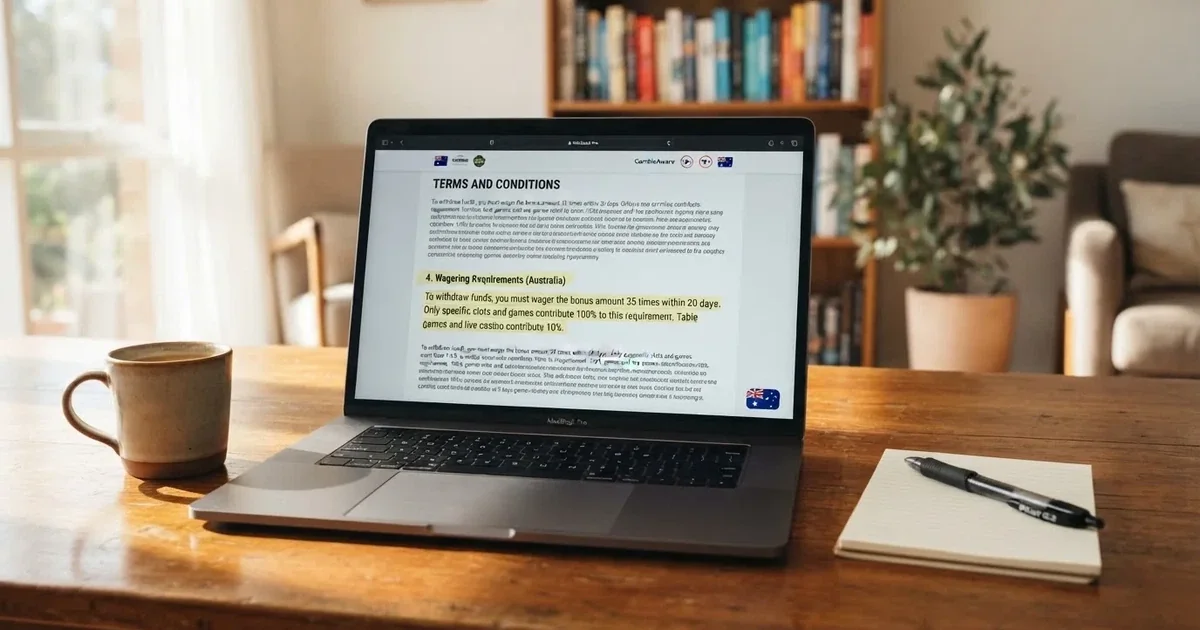
A “casino promo code” is, on its face, a string of letters and numbers a player pastes into a sign-up box or a cashier field, in exchange for a bonus, a handful of free spins or a deposit match. In Australia the product it unlocks sits outside the law. The Interactive Gambling Act 2001 makes it an offence to provide online casino games to a person physically in Australia; no state or territory issues a licence for the product, so no code typed into an Australian-facing form is redeemed against an Australian-licensed casino. Every code a reader might be offered is delivered by an offshore operator, and every one of those operators has spent the last several years on the receiving end of an Australian regulator.
This page is not a list of codes to copy. It is an account of what those codes actually lead to: the legal prohibition, the rate at which Australian authorities are removing the sites that hand them out, the payments plumbing behind the deposit that comes next, and the operators the ACMA has called out by name. The point is consequence, not promotion.
Table of Contents
- Legality: why every casino promo code in Australia is an offshore offer
- The ACMA’s pace: 1,751 sites blocked since November 2019
- How the ACMA names operators: a rolling register of formal warnings
- Responsible gambling supports: what works and what an offshore site does not connect to
- Payments: how deposits reach an offshore site, and how the banks have started fighting back
- Bonuses and promo codes: the inducement mechanic and what it actually costs
- The operator set: brands the ACMA has formally warned
- RocketPlay: the brand, the parent, and the rebrand pattern
- Level Up Casino: a 2022 warning that has not gone away
- Woo Casino and Spirit Casino: two warnings in two months, one parent
- National Casino and Bizzo Casino: the doubled warning on Bizzo
- Ignition Casino: a one-parent warning with no listings trail
- Instant Casino: the brand that asks for the payment rails the regulators warn about
- Jackbit: the most recent warning and the operator the ACMA called out by parent
- Casino Intense: an April 2025 warning with the deepest listings footprint
- Sky Crown: the Hollycorn N.V. brand the ACMA paired with Blue Leo
- How a promo-code offer is structured on the offshore side
- Tax, winnings and the ATO
- What an Australian player should do before entering details on an offshore promo page
- The arithmetic behind the block rate
- Conclusion: the position this page reaches
- Frequently asked questions
Legality: why every casino promo code in Australia is an offshore offer
The Interactive Gambling Act 2001 (the IGA) prohibits the supply of online casino games and online pokies to customers in Australia. The 2017 amendments turned what had been a civil regime into one the regulator can enforce through formal warnings, civil penalty orders and, ultimately, internet service provider blocking. Lotteries, keno and pre-event wagering on sport and racing are licensable; in-play betting and casino products are not. Minimum age is 18.

What that means in practice is narrow and absolute. The only Australian licence a casino-style site can display is a wagering licence from the Northern Territory Racing and Wagering Commission (NTRWC), and the NTRWC does not licence online casino games — its 52 active bookmakers, including Sportsbet, Bet365 and Ladbrokes, run under that Territory licence for tax reasons. The commission itself has no full-time staff and meets once a month in Darwin. There is no second licence an Australian-facing casino could hold; “licensed and regulated” on an offshore casino page refers to Curaçao, the Philippines, Anjouan or Kahnawake, not Australia.
Enforcement runs through the Australian Communications and Media Authority (ACMA). The regulator investigates complaints, issues formal warnings to operators it judges to be supplying prohibited services, and asks Australian ISPs to block offending domains. The individual player is not prosecuted — the IGA targets the provider — but the offshore site that took the deposit gives no Australian consumer protection. There is no local complaints body, no Australian Financial Complaints Authority route, and no recourse if a withdrawal stalls or a max-cashout clause silently voids winnings. The site can also be blocked while a balance is still sitting on it.
A reform the Parliament passed in 2026 tightens that further. The Interactive Gambling Amendment (Gambling Reform) Bill 2026 cleared both houses on 19 August 2026, and its advertising and inducement measures commence on 1 January 2027. The clause that directly targets promo codes, deposit-match bonuses and similar inducements is law with a start date, not yet in force on a page written for this year. From 1 January 2027 an offshore operator cannot lawfully target an Australian customer with a “use code X for 200% bonus” offer; the rule binds offshore operators only against Australian customers, and the civil penalty sits with the operator, not with the player who clicks the link.
The share of Australians still sending money to illegal sites tells the rest of the story. H2 Gambling Capital’s 2025 report estimates roughly A$3.9 billion a year flows to offshore operators, and the share of gambling going through legal channels fell from 74% in 2021 to 64%. The legal market is not shrinking because Australians have stopped gambling; it is shrinking because the offshore market has grown faster than enforcement has blocked it.
See also Casino VIP programs in Australia.
The ACMA’s pace: 1,751 sites blocked since November 2019
By the end of the round reported on 26 June 2026 the ACMA had asked Australian internet service providers to block 1,751 illegal gambling and affiliate marketing websites since it lodged its first blocking request in November 2019, and more than 230 unlicensed services had left the Australian market entirely since the 2017 amendments strengthened enforcement. That is the cumulative tally; the rate is the news.
From November 2019 to the end of June 2026 the regulator has averaged roughly 27 new blocking requests per month across seven years, or about one blocking notice every 11 days. The most recent batch alone — 12 sites including 7Signs, ChromaBet, Donbet, Duospin, Freshbet, Slots Gem, Jacks Club, Lucky Start, Pointsbetz, Spinrise, Vinyl Casino and Wildsino — was issued in a single round on 26 June 2026, more than one site per working day. Some sites reappear at new domains after a block; each reappearance triggers another notice, and the count goes up.
The pace has its own arithmetic. Two thousand sites blocked in roughly seven years means about 27 per month, but the rate has clearly accelerated as the legal tools have matured and the operator roster has rotated. A promo code posted on an affiliate page in January may resolve to a blocked domain by July; the marketing cycle is shorter than the enforcement cycle, which is why the affiliate pages that carry the codes keep cycling through mirror domains.
For a player, that speed has a direct consequence. The site a code unlocks can be unreachable from an Australian IP within months of the code appearing. Any balance still on the account at that point is, in practical terms, gone. There is no Australian ombudsman to recover it from and no chargeback path against a Curaçao-licensed operator that has simply vanished.
How the ACMA names operators: a rolling register of formal warnings
Before a site reaches the blocking stage it usually reaches the formal-warning stage, and the ACMA publishes those warnings. A formal warning is not a prosecution; it is a public notice that the regulator has formed the view an operator is supplying prohibited interactive gambling services to Australians. Operators that ignore a warning progress to enforcement.
The register reads like a history of the offshore casino market over the last four years, and it shows which brands have been called out, by which parent company, and when:
- Dama N.V., May 2022: Bambet, Dazard, Level Up, Rocketplay, Wild Tornado and Cobra Casinos.
- Dama N.V., March 2025: Woo Casino.
- Dama N.V., May 2025: Spirit Casino.
- Bamboo Media, July 2025: Ignition Casino.
- Consolutetish S.R.L., July 2025: National Casino and Bizzo Casino. Bizzo had already been the subject of a 2022 warning to TechSolutions (CY) Group Limited and TechSolutions Group N.V.
- EOD Code SRL, February 2025: Instant Casino.
- Hollycorn N.V.: Sky Crown and Blue Leo.
- Pulsup Ltd, March 2026: Rocketplay.
- Sterplay Holding Ltd, April 2025: Casino Intense.
- Ryker B.V., April 2026: Jackbit and CasinOK.
The Dama N.V. thread is the one to watch. The same parent company drew a formal warning covering six brands in 2022, then two more brands two and three years later. The pattern is the operator moving brand names rather than exiting the market, and the regulator naming the parent behind them. A “new” offshore casino launched the same week an older sibling is blocked is, in most cases, the same corporate group behind a different front.
Responsible gambling supports: what works and what an offshore site does not connect to
The Australian safety net is built around BetStop, the National Self-Exclusion Register run by the Australian Communications and Media Authority since August 2023. A player who registers with BetStop is barred from opening new accounts with every Australian-licensed online and phone wagering service for a chosen period, and existing accounts are closed.
The critical caveat for this page: BetStop binds only Australian-licensed operators. An offshore casino offering a promo code is not connected to BetStop, has no obligation to honour an exclusion registered against an Australian licensee, and is under no compulsion to close an existing account even if the player asks. The 24/7 National Gambling Helpline (1800 858 858) and the chat service at Gambling Help Online are free and confidential and will help with an exclusion regardless of where the gambling took place, but the exclusion itself only holds on the licensed side of the market.
State-level self-exclusion registers add a venue-based layer — a barring order from a pub or club pokies room in New South Wales, Victoria or Western Australia — and these too apply only to the licensed venues they cover. They are useful where they are useful, and silent where the gambling happens offshore.
A practical sequence: register with BetStop, close any Australian-licensed accounts, then speak to a Gambling Help Online counsellor about the offshore side. The counsellors will not be able to block the offshore site, but they can work through the financial side — chargeback attempts, contacting the bank about a gambling block, redirecting direct debits.
Payments: how deposits reach an offshore site, and how the banks have started fighting back
The deposit is the part of the funnel that most Australian players do not look at carefully, and it is the part where the Australian rules have moved furthest in the last two years.
Under amendments to the Interactive Gambling Act that took effect on 11 June 2024, Australian-licensed online wagering services cannot accept payment by credit card or any credit-related product. Civil penalties for an operator that accepts one reach A$247,500. The rule is written around the licensed side of the market, but the major banks have extended the same logic onto the cards they issue. Westpac’s gambling block refuses authorisation of any transaction that carries the merchant category code ‘Betting/Casino Gambling’ on an eligible personal credit or debit card. Commonwealth Bank lets a customer apply a gambling lock to eligible cards in the CommBank app, with the same caveat the bank states openly: it cannot guarantee every gambling transaction will be stopped. ANZ’s gambling block works in the ANZ app and also blocks gambling transactions made through a digital wallet such as Apple Pay on an eligible card, not just the physical card; once turned on, removing it requires a 48-hour cooling-off period.
The big-three wallet question is the one most readers actually need answered. Apple Pay does not add a surcharge to a card payment; the merchant’s own processing fee is what is charged, and Apple’s terms make that explicit. Limits and PIN requirements on Apple Pay purchases are set by the card issuer, not by Apple. By the end of 2025 Apple Pay, Google Pay and Samsung Pay together accounted for around 45% of all card payments in Australia by number. The 11 June 2024 ban on credit for licensed wagering extends to credit-funded digital-wallet transactions in practice, because the underlying card transaction still resolves to a credit product.
The direct-debit alternative the licensed operators use is PayID over the New Payments Platform. With Osko, a bank transfer between participating Australian banks arrives in under a minute, 24/7, addressed either to a BSB and account number or to a PayID. The platform became publicly accessible on 13 February 2018; it is run by New Payments Platform Australia Ltd, a non-profit whose 13 shareholders include the Reserve Bank of Australia and the major banks, and it merged with BPAY and eftpos under Australian Payments Plus (AP+) in 2021. By April 2025 more than 25 million PayIDs had been registered. PayID transfers show the name of the account holder before the money is sent, and AP+ warns directly that being asked to send money to a PayID on an illegal gambling site is “almost certainly” a scam signal. The threshold-transaction-report rule that requires AUSTRAC reporting of cash transfers of A$10,000 or more does not apply to ordinary electronic bank transfers, so the direct-debit side of the deposit does not flag on its own.
BPAY is the older bill-payment rail, available through the online banking of more than 140 institutions and used by over 95,000 businesses; the payer enters the Biller Code and Customer Reference Number printed on the bill. It launched on 18 November 1997 and has been owned, via parent Cardlink Services Limited, jointly by the four major banks since then. It runs on the same AP+ infrastructure as PayID and Osko and is a permitted deposit rail on the licensed wagering side. It is not the rail an offshore casino uses; the offshore side tends to ask for crypto, a credit card funded through a digital wallet, or a card that has not been gambling-blocked by the issuing bank.
Two consequences follow. First, an Australian whose bank has the gambling block on will find that the first deposit attempt to an offshore casino simply declines, which is the bank’s policy working as intended. Second, an Australian whose bank does not have the block on, or who holds a card issued by a smaller institution outside the major four, can still fund an offshore site through PayID or a credit-funded wallet, and the offshore casino will still process the deposit. The credit-card ban under the 2024 amendments is enforced at the licensed-operator level; the bank’s own gambling block is the more reliable defence on the consumer side.
Bonuses and promo codes: the inducement mechanic and what it actually costs
A “promo code” is a marketing string that maps to an offer the casino has already decided to run; pasting the code into the right field is just the on-switch for an inducement the operator wants to plant. The two offer shapes an Australian reader will encounter most often are a deposit match (the casino adds a percentage of the deposit as bonus funds, usually 100% of the first deposit up to a stated cap) and a free-spins bundle (a fixed number of spins on a named slot, with the winnings paid as bonus funds). A third, less common shape is the “no deposit” code, where the bonus is paid for nothing more than sign-up, usually a small amount of bonus cash or a handful of free spins.
Every one of these offers carries the same four qualifiers, and the qualifiers are where the cost lives.
The first is the wagering requirement. A bonus paid as bonus funds cannot be withdrawn until it has been wagered a stated multiple of times — typically 35x to 50x the bonus amount, sometimes higher. A A$500 bonus with a 40x wagering requirement needs A$20,000 of qualifying bets before any of the bonus-derived winnings can be withdrawn. Free-spin winnings carry the same requirement, calculated on the cash equivalent of the spin winnings. The figure looks modest on the marketing page; the turnover it generates is what the player actually has to play through.
The second is the maximum-bet cap. While a bonus is active the casino will not accept a single spin or hand that exceeds a small stake, typically A$5 to A$8. A player who bets above the cap, even once, voids the bonus and any winnings derived from it. The cap exists to stop a player with a large bankroll from clearing the wagering requirement in a single evening of high-stakes play; the effect on a player with a smaller bankroll is that the cap mostly goes unnoticed, and the bonus takes longer to clear than the player expected.
The third is the max-cashout cap. Some bonuses, particularly the no-deposit kind, cap the amount that can be withdrawn from bonus-derived winnings regardless of how much is won — a A$100 no-deposit bonus might cap withdrawals at A$200 even if the bonus spins produce a A$2,000 balance. Anything above the cap is removed on withdrawal.
The fourth is game weighting. Slots usually contribute 100% of the stake to the wagering requirement; table games and live casino typically contribute 10% or 0%. A player who tries to clear the bonus at blackjack burns through the turnover requirement ten times more slowly than the same stake on slots, and the casino’s terms make that explicit.
A worked example using the standard formula. A A$200 deposit bonus at 100% match with a 40x wagering factor on the bonus produces A$8,000 of required turnover. At a A$1 stake per spin that is 8,000 spins. At a five-second interval between spins that is 40,000 seconds, or roughly 11 hours of continuous play. The expected loss on that turnover at a typical slot RTP of 96% is 4% of A$8,000, which is A$320. The bonus pays A$200 of bonus funds; the expected cost of clearing it is A$320. The arithmetic is unfavourable on average even before the max-bet cap and the max-cashout clause are factored in.
The expiry window is the part that catches players out last. Promo-code offers typically expire inside seven to fourteen days. Free-spin bundles can expire in 24 to 72 hours. A player who claims a bonus on a Friday and returns on the following Wednesday often finds the bonus has been removed from the account and any winnings derived from it have been forfeited. The short window is deliberate: a long window allows a player to walk away, come back, and decide not to play through; a short window pushes the player back to the casino before they have cooled off.
One structural caveat sits on top of all of this. The only sources for bonus terms on an offshore casino are the operator’s own terms page and the affiliate marketing pages that reproduce them. Neither source is regulated by an Australian authority. The bonus the marketing page describes is the bonus the operator decides to pay; the terms the player is bound by are the terms the operator has posted on the day the player tries to withdraw. The Australian Consumer Law does not apply to a Curaçao-licensed operator selling to an Australian, and there is no path to compel the operator to honour the version of the terms the affiliate page carried last week.
The operator set: brands the ACMA has formally warned
The eleven operators covered below are not a recommended shortlist. Each appears because the ACMA has issued a formal warning over it, and the table that follows names the action and the date. The page is for readers who want to know what is on the regulator’s record, not for readers looking for somewhere to play.
| Brand | ACMA action and date | Operator named by the ACMA | Subject support |
|---|---|---|---|
| RocketPlay | Formal warning March 2026 (Pulsup Ltd); earlier Dama N.V., May 2022 | Pulsup Ltd; Dama N.V. | Listings report that the brand is offered with promo-code bonuses (Gambling Insider) |
| Level Up Casino | Formal warning May 2022 | Dama N.V. | Listings report Westpac gambling-block encounters (Westpac) |
| Woo Casino | Formal warning March 2025 | Dama N.V. | — |
| Spirit Casino | Formal warning May 2025 | Dama N.V. | — |
| National Casino | Formal warning July 2025 | Consolutetish S.R.L. | ACMA, AUSTRAC and BetStop listings report the brand (acma.gov.au, austrac.gov.au, betstop.gov.au) |
| Bizzo Casino | Formal warning July 2025 (Consolutetish); earlier 2022 (TechSolutions) | Consolutetish S.R.L.; TechSolutions (CY) Group Limited; TechSolutions Group N.V. | Listings report the brand is offered with promo-code bonuses (Gamblinginsider.com) |
| Ignition Casino | Formal warning July 2025 | Bamboo Media | — |
| Instant Casino | Formal warning February 2025 | EOD Code SRL | EcoPayz and PayID listings report the brand (EcoPayz, PayID) |
| Jackbit | Formal warning April 2026 | Ryker B.V. | — |
| Casino Intense | Formal warning April 2025 | Sterplay Holding Ltd | AUSTRAC, BetStop and gambling-insider listings report the brand (austrac.gov.au, betstop.gov.au, Gamblinginsider.com) |
| Sky Crown | Formal warning, ACMA publication, 2022 | Hollycorn N.V. | — |
Three threads stand out from the table. First, Dama N.V. has been the named operator behind four of the eleven brands, across two separate formal warnings three years apart, which is consistent with a parent company rotating brand fronts while the regulator names the holder behind them. Second, several brands draw no coverage at all from Australian-facing listings in the source set; that absence is not the same as the brand having no Australian-facing presence, and the formal warning is the ACMA’s own statement that it does. Third, the dates cluster heavily in 2025 and the first half of 2026, which reflects both the regulator’s accelerating enforcement and the offshore operators’ continued attempts to cycle back into the market.
A note on the bonus terms these sites market. The table carries no welcome-offer amount, no wagering multiple, no max-bet cap and no max-cashout figure, because the only sources for those figures are the operators’ own pages and the affiliate marketing pages that reproduce them. A reader looking for the A$1,000 / 200% / 200 free spins headline will find it on the affiliate page; the reader looking for a figure a regulator has verified will not, because no Australian regulator has verified one.
Casino promo codes in Australia in 2026 — More on this topic at casino no wager.
RocketPlay: the brand, the parent, and the rebrand pattern
RocketPlay is the clearest case study in the operator set for how a single corporate parent recycles a brand through regulatory trouble. The ACMA issued a formal warning covering Rocketplay to Dama N.V. in May 2022 as part of a six-brand action, then issued a second formal warning specifically over Rocketplay.com.au to Pulsup Ltd in March 2026. Two operators, one brand, four years apart — which strongly suggests the brand has moved between parent companies during the window, or that the original parent has re-emerged under a new corporate name.
The brand’s listings coverage, where it exists, comes from affiliate marketing pages that describe welcome packages and free-spin offers. Those pages are the same marketing channels the ACMA’s enforcement action targets, and they are not a reliable source for current terms.
The verdict on RocketPlay is straightforward. A brand the ACMA has warned twice in four years under two different parent companies is a brand whose relationship with the Australian regulator is not improving with time. A reader who is not an Australian resident is reading a page that is not for them; a reader who is, has a one-click path to a balance that the regulator has just named as one it is happy to block.
Level Up Casino: a 2022 warning that has not gone away
Level Up Casino was named in the same May 2022 Dama N.V. action as Rocketplay, Bambet, Dazard, Wild Tornado and Cobra Casinos. Four years on, the brand continues to appear on listings the major Australian banks have flagged — Westpac’s gambling block explicitly catches Level Up transactions, which means the bank’s own data places Australian cardholders attempting to fund the site.
The reason the warning is still relevant is that Dama N.V. has not stopped operating. Three of its other 2022-warning brands (Woo Casino, Spirit Casino) received fresh warnings in 2025; a fourth (Rocketplay) received a fresh warning in 2026 under a new parent. The parent company is the through-line, and the ACMA has kept naming it.
The verdict on Level Up is the one a reader who has seen the table can reach themselves. A 2022 formal warning is not a stale artefact; it is the start of a regulator relationship that has produced three further formal warnings against the same parent. The site has had four years to come into compliance and has not done so.
Woo Casino and Spirit Casino: two warnings in two months, one parent
Woo Casino drew a formal warning to Dama N.V. in March 2025, and Spirit Casino drew one to the same parent two months later in May 2025. Two brands from one parent in two months is the regulator’s signal that a parent company is running a portfolio rotation, not a single offending site.
The marketing pages for both brands continue to describe deposit-match welcome packages and free-spin bundles in the same shape as every other Dama N.V. property. There is no Australian-facing listings presence in the source set for either brand; that is consistent with these being properties aimed at non-Australian markets, with the ACMA’s warnings reflecting cross-border reach into Australia rather than a dedicated Australian marketing effort.
The verdict is the same in both cases. The pattern — one parent, two warnings, sixty days apart — is the case for treating the warning as a signal about the parent rather than about the brand. A reader who sees a Dama N.V. brand marketing a promo code to them is, in the ACMA’s own record, looking at a parent the regulator has now warned four times in four years.
National Casino and Bizzo Casino: the doubled warning on Bizzo
National Casino and Bizzo Casino were both named in the same July 2025 formal warning to Consolutetish S.R.L., which means one parent company has been the regulator’s named operator for two brands at once. Bizzo is the more interesting case because it had already been the subject of a 2022 formal warning, but to a different operator — TechSolutions (CY) Group Limited and TechSolutions Group N.V. A brand that has changed parent twice and been warned both times has, in the ACMA’s own record, been on the receiving end of the regulator’s view for four years under three different corporate names.
Both brands appear on listings the Australian-facing source set carries: National Casino on ACMA, AUSTRAC and BetStop pages; Bizzo on affiliate marketing listings. The listings are exactly the channels the regulator’s enforcement is targeted at.
The verdict is the case for the parent-as-signal rule. Consolutetish S.R.L. is a parent the ACMA has now named; the brands it owns are not separate cases.
Ignition Casino: a one-parent warning with no listings trail
Ignition Casino received a July 2025 formal warning to Bamboo Media. The brand draws no coverage in the Australian-facing listings the source set covers, which is what one would expect of a brand aimed primarily at the United States market. The ACMA’s warning is for cross-border reach into Australian customers, not for an Australian-facing marketing push.
The verdict reflects that. A brand without an Australian listings footprint is a brand the regulator has reached because the site itself reached into Australia, not because someone in Australia was looking for it. A reader who finds a promo code for Ignition Casino has been marketed to across a border the operator has already been told to stop crossing.
Instant Casino: the brand that asks for the payment rails the regulators warn about
Instant Casino’s February 2025 formal warning to EOD Code SRL sits alongside listings that name the brand in connection with payment services the Australian regulators specifically caution against — EcoPayz, an e-wallet long associated with offshore gambling deposits, and PayID, the Australian instant-transfer rail that AP+ warns is being used by scam operators on illegal gambling sites. The pairing is the picture: a brand that asks for the payment methods that the Australian payments regulator has flagged as the ones the regulator is warning Australians about.
The verdict is direct. A casino that requests a PayID deposit from an Australian customer is asking for the exact transfer rail AP+ has warned Australians against using for gambling payments. The warning was published before the ACMA’s formal warning, not after.
Jackbit: the most recent warning and the operator the ACMA called out by parent
Jackbit was named in an April 2026 formal warning to Ryker B.V., the same parent as CasinOK. The brand draws no Australian-facing listings coverage in the source set, which is consistent with Jackbit’s primary market being crypto-funded offshore casino play rather than an Australian audience. The ACMA’s warning reflects cross-border reach.
The verdict reflects what the regulator’s record shows. A brand the ACMA has named in 2026, with the same parent as CasinOK, is on the freshest page of the regulator’s file. The brand has had the least time to adjust, and the regulator’s view is the most recent.
Casino Intense: an April 2025 warning with the deepest listings footprint
Casino Intense was named in an April 2025 formal warning to Sterplay Holding Ltd. The brand draws the deepest Australian-facing listings footprint of any operator in the set: AUSTRAC’s threshold-transaction-report guidance, BetStop’s exclusion register pages and affiliate marketing listings all name it. The depth of the footprint is the picture — the brand is being seen by every Australian-facing compliance channel the regulator maintains.
The verdict follows from that. A brand that appears in three different regulator-side listings in addition to the ACMA’s own formal warning is a brand that has been comprehensively mapped by the Australian enforcement infrastructure. A reader with a balance on this site has the regulator’s view, the bank’s view, the AUSTRAC view and the self-exclusion view to consider, and none of them are favourable.
Sky Crown: the Hollycorn N.V. brand the ACMA paired with Blue Leo
Sky Crown was named in an ACMA formal warning to Hollycorn N.V., published in 2022 alongside Blue Leo. The brand draws no Australian-facing listings coverage in the source set, and Hollycorn N.V. is the parent behind several other offshore casino brands operating in the same market segment. The pairing with Blue Leo is the signal — the regulator named one parent, two brands, in one warning.
The verdict is the same as for the other Hollycorn N.V. property. A parent that runs two casino brands named in the same warning is running a portfolio the regulator has treated as one case.
How a promo-code offer is structured on the offshore side
A reader who has not seen an offshore casino’s cashier page can still be told what one looks like, because the structure is consistent across the operator set. The first step is account creation: name, email, date of birth, address. The second is the promo-code field, which sits above or beside the deposit field and which the marketing page has told the player to fill with a specific string. The third is the deposit itself, which the cashier page routes through whichever combination of methods the operator has set up — credit card, debit card, e-wallet, voucher, crypto, sometimes PayID through a third-party processor. The fourth is the bonus crediting, which happens either at deposit or after the deposit clears. The fifth is the wagering requirement, which the player discovers when they try to withdraw.
The five steps are the funnel. The marketing concentrates on the first three — sign up, paste the code, deposit. The terms concentrate on the last two — the wagering requirement and the max-cashout clause. The asymmetry is the point. The marketing copy takes the player to the deposit; the terms take effect at the withdrawal.
For an Australian reader specifically, the first two steps are already a regulatory exposure. The IGA prohibits the supply of online casino games to a person in Australia; the operator that supplies them is the offender, not the player, but the act of supplying requires the player to provide personal information to an offshore site with no obligation under Australian privacy law. The data the player provides leaves the country at the moment they click submit.
Tax, winnings and the ATO
Recreational gambling winnings in Australia are not assessable income, and gambling losses are not deductible, except where the ATO treats the activity as the carrying on of a business. Section 6-5 of the Income Tax Assessment Act 1997 sets the position for the recreational case. A player who has claimed a promo code, deposited with an offshore casino, hit a bonus-derived win and managed to withdraw it before the site blocked is in the position of someone whose winnings are not taxable; the offshore casino does not withhold tax on the winnings and the ATO does not ask for them.
The corollary is that the losses are not recoverable either. A player who has lost A$20,000 clearing a bonus at an offshore casino cannot claim those losses against any Australian income, because gambling losses are not deductible to a recreational player. The economic outcome of the promo-code transaction sits outside the tax system on both sides.
What an Australian player should do before entering details on an offshore promo page
A short sequence, in the order it actually works:
- Check the brand against the ACMA’s formal-warning register. A brand with a published warning is one the regulator has already formed a view about.
- Turn on the card-level gambling block in the issuing bank’s app. Westpac, ANZ and Commonwealth Bank all offer one; the block stops most card and wallet transactions at the merchant-code level.
- Register with BetStop to close off the Australian-licensed side of the market. The exclusion does not bind offshore sites, but it removes the licensed path and is the action an Australian-based counsellor will recommend first.
- Call the National Gambling Helpline on 1800 858 858 or start a chat at Gambling Help Online if the decision to engage with an offshore promo page has already been made. The counsellors cannot block the offshore site but they can help with the financial aftermath.
- Do not send money to a PayID on a gambling site that has no Australian presence; AP+ warns that this is “almost certainly” a scam signal.
The list is short and the steps are concrete. The first two remove the path. The third removes the licensed alternative. The fourth is the safety net. The fifth is the heuristic for the case where the offshore operator has set up the deposit rail the regulator has already named as the scam rail.
The arithmetic behind the block rate
The ACMA’s record is the arithmetic the page is built around. From November 2019 to 26 June 2026 the regulator lodged 1,751 blocking requests covering illegal gambling and affiliate marketing websites — a cumulative total that works out to roughly 250 blocking requests a year, or about 21 a month on average across the seven-year window. The pace is not uniform: the round reported on 26 June 2026 alone contained 12 sites, which is more than half a typical month’s worth of blocks in a single notice.
The rate is the news. A promo code marketed today can resolve to a blocked domain by the time the bonus clears. A player who has accepted a bonus and is part-way through clearing the wagering requirement when the site is blocked loses both the bonus balance and any winnings derived from it, and there is no Australian authority to recover either. The block rate is the cost an Australian takes on the moment a promo code is redeemed, and it is the cost the marketing page never quotes.
Conclusion: the position this page reaches
The promo-code market in Australia is an offshore-only market operating against a regulator that has formally warned at least eleven of its brands in the last four years, blocked 1,751 sites since 2019 and is now legislating for an advertising ban that takes effect on 1 January 2027. The credit-card ban that took effect on 11 June 2024 has closed off the most common card-funded route on the licensed side, and the major banks’ gambling blocks are extending the same logic onto the cards they issue, including through digital wallets. The bonus economics — high wagering requirements, short expiry windows, max-bet caps and max-cashout clauses — make the average promo-code offer a cost on the arithmetic, not a free chance.
What is left is the licensed wagering side: sports and racing bookmakers licensed in the Northern Territory, with pre-event betting only, no in-play, no credit cards, no crypto, no casino products, all of them connected to BetStop and to the National Gambling Helpline. The promo-code funnel is closed by the regulator at one end and by the banks at the other; the legal alternative is a smaller market, but it is one with consumer protections the offshore side does not have.
A reader who has reached the end of this page and is still holding a promo code has a clear next step: deposit only through a licensed Australian wagering service, register with BetStop if pre-event betting is a problem, and call 1800 858 858 if the offshore side is the part that needs to stop. The promo-code itself is not the asset. The decision about whether to redeem it is.
Frequently asked questions
How does a casino promo code differ from a permanent welcome offer?
A promo code is a marketing string that unlocks a specific named offer — a deposit match at a stated percentage, a free-spin bundle, or a no-deposit bonus — usually for a short window. A permanent welcome offer is the standing offer the operator runs on its sign-up page without a code. Both carry the same wagering requirements, max-bet caps and expiry rules; the difference is whether the player needs to paste a code to claim it.
Are promo-code offers from offshore casino sites subject to any Australian consumer protection?
No. The Interactive Gambling Act 2001 prohibits the supply of online casino games to a person in Australia, so no offshore casino offering a promo code is operating under an Australian licence. The Australian Consumer Law does not apply to a Curaçao-licensed operator selling to an Australian customer, the Australian Financial Complaints Authority has no jurisdiction, and there is no Australian ombudsman to escalate a withdrawal dispute to.
What’s a common maximum-bet restriction attached to promo-code winnings?
While a bonus is active most offshore casinos enforce a maximum stake per spin or per hand, typically between A$5 and A$8, and a single bet above the cap voids the bonus and any winnings derived from it. The cap is set to prevent a player clearing the wagering requirement in a single session of high-stakes play, and it applies from the moment the bonus is credited until the wagering requirement is cleared.
Can a promo code be combined with another offer at the same offshore site?
Generally no. The standard rule on offshore casinos is one active bonus per account at a time, and claiming a second offer before the first has cleared either voids the first or blocks the second from being claimed. Some operators run specific code combinations during short promotional windows, but the standing rule is single-active-bonus, and the terms page makes that explicit.
Why do promo codes often carry a short expiry window?
Promo codes typically expire inside seven to fourteen days for a deposit match and 24 to 72 hours for a free-spin bundle. The short window is deliberate: a long window gives the player time to walk away and reconsider, while a short window pushes them back to the casino before they have cooled off. It also forces the player to clear the wagering requirement faster, which improves the casino’s expected return on the bonus.
What should an Australian do before entering any personal details on an offshore promo page?
Check the brand against the ACMA’s published formal-warning register, turn on the issuing bank’s card-level gambling block, register with BetStop to close off the licensed side, and call the National Gambling Helpline on 1800 858 858 if the offshore engagement is the part that needs to stop. PayID transfers to a gambling site with no Australian presence are flagged by Australian Payments Plus as “almost certainly” a scam signal and should be treated as such.