
No-deposit free spins at offshore casinos: the offer, the law, and the cards that block the deposit
A no-deposit free spins offer is the casino’s signup gift with the smallest visible price tag. The page says “free”, the page says “no deposit”, and the offer sounds like the rare deal that costs nothing up front. For an Australian reader, the offer is one side of the page. The other side is that no Australian licence covers online casino games anywhere in the country, so the brand making the promise is operating outside the Australian rules. This page walks through what the offer typically takes to clear, the brands the ACMA has formally warned over, the payment routes that block the deposit the offer claims isn’t needed, and where a reader can turn if the marketing lands harder than expected.

Current as of 29 October 2026 · verified against the ACMA’s formal warning register.
Table of Contents
- How a no-deposit free spins offer is built
- The titles these offers tend to spotlight
- The landscape of brands the ACMA has warned
- Where the offshore claim sits in the broader Australian market
- The fundamental prohibition and the enforcement behind it
- Keeping the offer in perspective
- Why crypto doesn’t make an offshore casino legal here
- PayID, Osko, BPAY and the card-block layer
- The eleven brands the ACMA has named
- Frequently asked questions
How a no-deposit free spins offer is built
The marketing word at the centre of a no-deposit free spins offer is “free”, and the cost sits in the terms page. A no-deposit offer is the cheapest acquisition tool the casino has, and the casino recoups the cost through the wagering, the max cashout cap, the time limit, the game weighting, and the deposit that the offer quietly steers the player toward. The reader who skips the terms page has accepted all of these in one click.
The standard offer has six moving parts. A small number of spins — typically 10 to 50 — is credited to a new account on a named pokie or a short list. Anything won on those spins sits behind a wagering requirement, often 35x to 65x, calculated on the winnings rather than on a bonus balance. A maximum cashout cap — frequently A$100 to A$200 — limits what any single spin can pay out. A short expiry — often 24 to 72 hours — runs against both the unused spins and any un-cleared winnings. Game restrictions exclude the higher-RTP titles from the wagering contribution. And a first-deposit upsell converts the no-deposit offer into the front door of a deposit-gated package, with the deposit matched at 100% or 200% once the player has had a chance to try the site.
Wagering multiples on free spins winnings are almost always higher than the multiples on a deposit bonus. The industry reason is straightforward: a no-deposit offer is the most expensive customer-acquisition cost the casino has, since the player pays nothing to find out whether they like the site. The cost is passed through the terms, with a 50x wagering requirement on free spins winnings being more common than the same multiple on a deposit bonus.
Game weighting is the second cost most players miss. A pokie might count 100% toward wagering, but live dealer games, table games and the higher-RTP titles are routinely weighted at 10% or excluded entirely. A player who enjoys blackjack might find their wagering contribution is one tenth of what they expect. Some sites also exclude jackpot slots from any no-deposit offer, which means the headline title on the offer tile is often the one that does not count toward clearing.
The max cashout cap is the third cost, and it is the easiest to miss. A 50-spin offer with a A$100 max cashout caps a thousand-dollar hit at A$100, with the rest removed at withdrawal. The win is real, but only the cap leaves. The cap is also a percentage of what was won rather than a multiplier of the deposit, since there is no deposit.
The expiry is the fourth cost, and it bites players who log in once a day or once a week. A 24-hour expiry on a 50x wagering requirement on the winnings is not generous, and a player who logs in once a day might find the offer expired while they slept. The expiry is set so that most players clear only a fraction of the wagering, with the remainder and any winnings attached removed at the deadline.
The deposit that follows is the fifth cost, even though the offer’s headline says “no deposit”. The no-deposit offer is the loss-leader; the deposit is the upsell. A player who enjoyed the free spins has been pre-qualified for the deposit-gated package, and the casino’s email sequence will start arriving within hours. The “no deposit” line on the offer tile is technically true; it is also the start of the funnel.
The marketing word “free” gets its cost across the wagering, the cashout cap, the clock, the game restrictions and the deposit. None of these are visible on the tile. The terms page is the offer; the tile is the wrapper.
| Terms Factor | Typical Requirement | Notes |
|---|---|---|
| Wagering | 35x – 65x | Calculated on winnings |
| Max Cashout | A$100 – A$200 | Percentage of winnings |
| Expiry | 24 – 72 Hours | Strict deadline |
| Game Weighting | 0% – 100% | High-RTP titles often excluded |
The titles these offers tend to spotlight
The titles no-deposit free spins offers name on their tiles are the titles the providers have approved for promotional use, that the marketing team has art for, and that the casino can advertise without paying a per-spin placement fee. The reader sees a familiar pokie; the studio sees a marketing placement.
Three names recur more than any others. Starburst, the NetEnt slot, sits on more no-deposit tiles than almost any other title. Book of Dead, Play’n GO’s Egyptian-themed game, gets the same treatment. Wolf Gold, Pragmatic Play’s animal-themed slot, is the third name most likely to appear. None of these are the highest-RTP titles in their studios’ catalogues; they are the titles that read well on a marketing screenshot, that players recognise, and that the studios have licensed for promotional use at a fee the casino is willing to pay.
The choice is not random. The studios approve titles for promotional use separately from the licences for real-money play, which means a casino can put a title on an offer tile without giving the studio a per-spin fee on the player’s free play. Newer releases, branded titles and jackpot slots tend to be excluded from no-deposit offers, both because the studio has not approved them for promotion and because the casino does not want to give away spins on a game the player could then play with their own money at a higher house edge.
The RTP picture is what matters for the player. A 96% pokie returns A$96 for every A$100 wagered, on average across millions of spins. The figure does not change whether the spin was free or purchased, but the contribution of that spin toward the wagering requirement depends on the casino’s weighting table. A pokie weighted at 100% on the offer terms means the player is clearing the wagering at the pokie’s actual RTP. A pokie weighted at 10% means the player is clearing at one tenth of the actual rate, which extends the clearing time by a factor of ten.
The reader looking at the offer tile sees a familiar pokie name. The studio sees a placement, and the casino sees a marketing asset. The pokie itself pays the same RTP whether the spin was free or paid, but the player’s experience of clearing the wagering depends entirely on whether the title on the tile is the title on the weighting table.
See also Crypto.
The landscape of brands the ACMA has warned
There is no clean list of “best no-deposit free spins casinos for Australia”, because the brands offering these promotions are not licensed to offer them in Australia. The clean list that exists is the ACMA’s list of brands it has formally warned, and the names on that list are not recommendations. They are the operators the regulator has identified as offering prohibited services to Australians.
The eleven brands in the table below were the subject of formal warnings under the Interactive Gambling Act 2001 between September 2022 and April 2026. The list is a record of the regulator’s actions, not a ranking by offer quality. Several of the brands share an operating company, which means a warning over one brand often follows a warning over a related brand, sometimes years apart and sometimes within the same enforcement round.
| Brand | ACMA warning | Operator named by the ACMA | Subject support | Earlier warning |
|---|---|---|---|---|
| RocketPlay | Formal warning, March 2026 | Pulsup Ltd | listings-only (Gambling Insider) | Dama N.V., May 2022 |
| Level Up Casino | Formal warning, May 2022 | Dama N.V. | listings-only (Westpac) | — |
| Woo Casino | Formal warning, March 2025 | Dama N.V. | no-data | — |
| Spirit Casino | Formal warning, May 2025 | Dama N.V. | no-data | — |
| National Casino | Formal warning, July 2025 | Consolutetish S.R.L. | listings-only (ACMA, AUSTRAC, BetStop) | — |
| Bizzo Casino | Formal warning, July 2025 | Consolutetish S.R.L. | listings-only (Gambling Insider) | TechSolutions, 2022 |
| Ignition Casino | Formal warning, July 2025 | Bamboo Media | no-data | — |
| Instant Casino | Formal warning, February 2025 | EOD Code SRL | listings-only (ecoPayz, PayID) | — |
| Jackbit | Formal warning, April 2026 | Ryker B.V. | no-data | — |
| Casino Intense | Formal warning, April 2025 | Sterplay Holding Ltd | listings-only (AUSTRAC, BetStop, Gambling Insider) | — |
| Sky Crown | Formal warning, September 2022 | Hollycorn N.V. | no-data | — |
The pattern in the table is what stands out. Three of the eleven brands — RocketPlay, Woo Casino and Spirit Casino — are or were owned by Dama N.V., which was warned in May 2022 and then again in 2025 over two of those brands. Two of the eleven — National Casino and Bizzo Casino — are owned by Consolutetish S.R.L., warned together in July 2025. Bizzo was also warned in 2022 under TechSolutions, which means the brand has been the subject of two warnings under two different operators in three years. The ACMA’s enforcement is not following brands; it is following corporate entities, and the corporate entities keep launching new skins.
The “Subject support” column reflects what the consulted research found about each brand’s free-spins offering. “listings-only” means the only mention in the consulted sources was on affiliate or operator pages — pages where the offer is being marketed, not verified. The listings named in the cell are the consulted sources where the brand appeared. “no-data” means the consulted sources had no mention at all, and so the offer terms are not what the research could write about.
Either way, the absence of a verifiable offer from a non-marketing source is the more telling finding. The marketing pages name a brand and an offer; the consulted sources have less to say.
The table is the landscape. The next section reads as the broader Australian market that this landscape sits inside.
Where the offshore claim sits in the broader Australian market
The Australian gambling market in 2026 is a market where the legal channel is racing the illegal one, and starting to lose. The H2 Gambling Capital 2025 report put annual losses to illegal sites at around A$3.9 billion, with the legal channel’s share of total gambling spend falling from 74% in 2021 to 64% over the same period.
The legal Australian market is built around licensed wagering — sports betting and racing — run by providers licensed by the Northern Territory Racing and Wagering Commission or by state regulators. The NTRWC alone covers 52 of Australia’s online bookmakers, including the names most Australians would recognise: Sportsbet, Bet365, Ladbrokes. The commission meets once a month in Darwin and operates with no full-time staff, a fact that prompted the 2026 reform bill that would, if passed, give the territory regulator the full-time staff the body currently lacks.
Online casino games are not part of the legal Australian market. They are not licensed in any state or territory, and the Interactive Gambling Act 2001 makes offering them to an Australian customer an offence. The 2017 amendment strengthened the regulator’s enforcement powers; the 2023 amendment extended the credit card ban to digital wallets; the 2026 amendment adds advertising and inducement measures that commence on 1 January 2027.
What this means in practice: a player in Australia who opens an account at an offshore casino is not playing at a grey-market operator that might be licensed somewhere else and is just lacking an Australian endorsement. They are playing at an operator that is prohibited from offering the product to Australians at all, regardless of any Curaçao, Malta or other licence the site footer displays.
The shape of the illegal market is the marketing funnel of every offshore casino. No-deposit free spins offers are the top of that funnel — the cheapest way for a casino to put a real-money spin in front of a new account, with the player paying nothing up front. The marketing spend on these offers is what the A$3.9 billion figure partly reflects: the cost of acquiring a customer is paid in free spins, and the casino recoups it through the wagering requirements, the cashout caps, the deposit upsells, and the players who go on to deposit.
The brands the affiliate pages push are the brands the ACMA has been warning. The marketing reach that produces A$3.9 billion in illegal losses is the same marketing reach that produces the warnings the regulator has issued. The funnel starts at the offer tile and ends at the ACMA’s formal warning register, with most players never reaching the register because they cleared the offer, lost the bonus and left.
The fundamental prohibition and the enforcement behind it
The legal frame and the enforcement behind it sit in this section. Three sub-headings carry the image anchors, and the blocking-rate calculation lives here too.

The fundamental framework: IGA 2001 and its 2017 amendment
The Interactive Gambling Act 2001 is the centre of the Australian online gambling frame. Its purpose is straightforward: it prohibits the supply of interactive gambling services to customers physically in Australia, with “interactive gambling service” defined to cover casino games, online pokies and in-play betting. The 2017 amendment strengthened the regulator’s hand by giving the ACMA the power to issue formal warnings, accept enforceable undertakings, and direct Australian internet service providers to block illegal sites.
The 2023 amendment extended the credit card ban to digital wallets and credit-related products, closing the route where a player might fund an online wagering account through Apple Pay or Google Pay linked to a credit card. The 2026 amendment, the Interactive Gambling Amendment (Gambling Reform) Bill, passed Parliament on 19 August 2026 and added advertising and inducement measures that commence on 1 January 2027.
What is licensable, and what is not, follows from the Act. Online wagering on racing and sport — placed before the event — is licensable. Lotteries and keno are licensable. Online casino games, online pokies and in-play betting are not licensable in any state or territory. The minimum age for any licensable product is 18.
The offshore brand offering a no-deposit free spins sign-up offer to an Australian player is therefore operating outside the Australian legal frame, whatever licence the site’s footer shows. The site’s Curaçao licence, if it has one, covers its operations in Curaçao and any other jurisdiction that accepts that licence. It does not authorise the site to offer online casino games to an Australian customer.
The inducements the regulator has targeted in 2025
The formal warnings over the past three years cluster around the marketing inducements the ACMA has chosen to enforce against. The July 2025 warnings to Bamboo Media, Consolutetish S.R.L. and the earlier Dama N.V. warnings are warnings about brands that were actively marketing inducements — sign-up bonuses, free spin offers, deposit matches — to Australian customers. The marketing word on the tile is what the regulator is reading.
This is a different enforcement pattern from the earlier rounds, which targeted brands that simply offered prohibited services. The 2025 and 2026 rounds are going after brands that are marketing inducements to Australians, which means the regulator is paying attention to the affiliate pages as well as the brands themselves.
The implication for a reader is that the marketing word “free” sits at the centre of the regulator’s enforcement priorities. A site that promises “no deposit” and “free spins” to an Australian reader is the kind of marketing the ACMA has been acting against. The same letter that warns a brand for offering online casino games also names the inducement the brand used to find the Australian player in the first place.
Prohibition at the operator level: 2025–2026 warnings
The pace of formal warnings has stepped up. In 2022 the ACMA warned a handful of brands under Hollycorn N.V. and Dama N.V. In 2025 the regulator warned at least seven more, including the brands in this guide’s table. In 2026 the warnings continued, with RocketPlay warned in March and Jackbit and CasinOK warned in April.
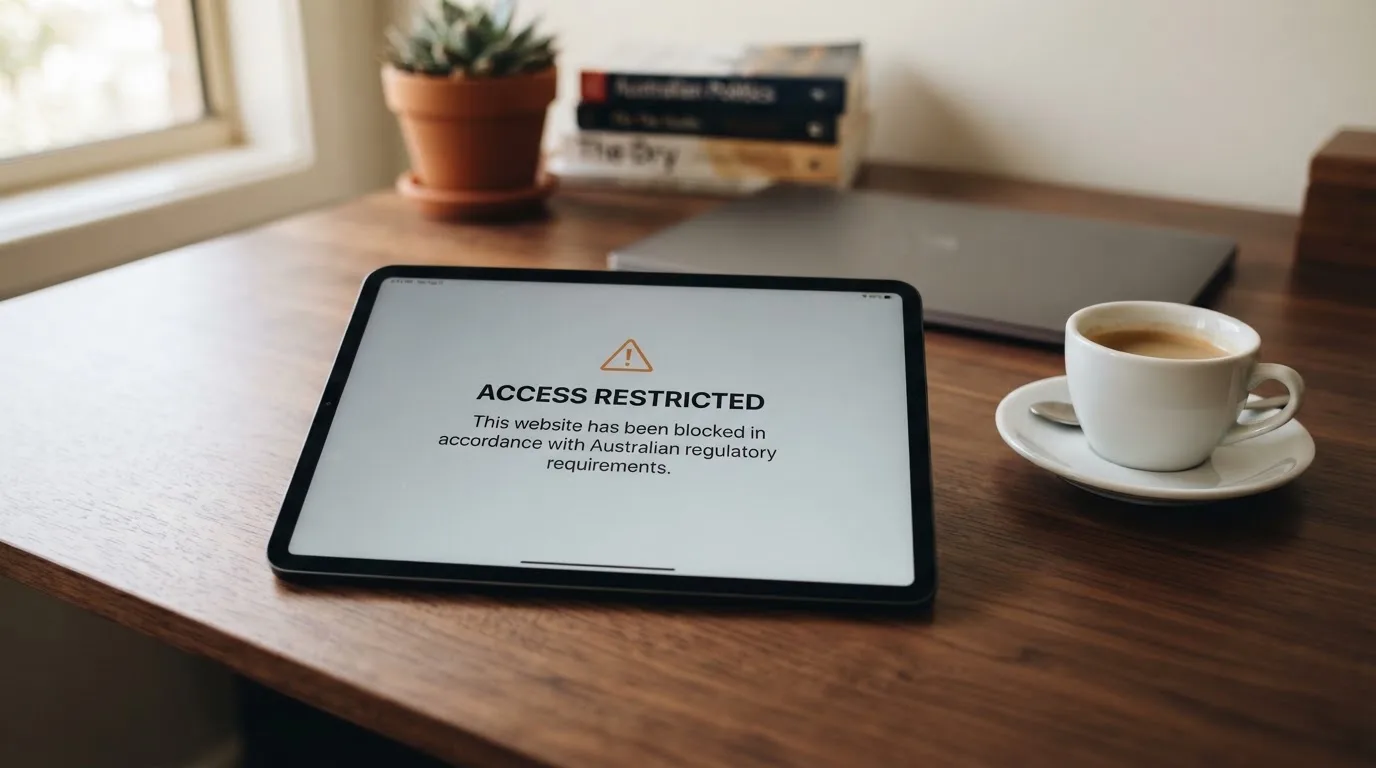
The calculation behind that pace gives a sense of the regulator’s enforcement volume. As of June 2026, the ACMA had asked Australian ISPs to block 1,751 illegal gambling and affiliate marketing websites since the first blocking request in November 2019, with more than 230 unlicensed gambling services having left the Australian market since enforcement was strengthened in 2017.
That total breaks down to a band rather than a single figure. Across the 79 months from November 2019 to June 2026, the average is roughly 22 sites per month, or about 266 sites per year. The first year of enforcement was lighter than the post-2022 pace, and the post-2024 pace has been heavier still, reflecting the ACMA’s expanded resources and the operator industry’s habit of relaunching under new domains. The right framing for a reader is a band: somewhere between roughly 10 and 30 sites blocked per month over the period since November 2019, with the most recent quarters running closer to the higher end of that band. Treating the rate as a steady 22 per month overstates the early rounds and understates the current pace.
The most recent blocking round, reported on 26 June 2026, added 12 more sites to the block list: 7Signs, ChromaBet, Donbet, Duospin, Freshbet, Slots Gem, Jacks Club, Lucky Start, Pointsbetz, Spinrise, Vinyl Casino and Wildsino.
The practical meaning is that the offshore brand a reader encounters today has a meaningful chance of being on a block list within months of appearing. The block is on the ISP side, which means the site may still resolve on the DNS but fail to load in the browser. The player’s account balance at the time of the block is not protected by any Australian consumer protection, and the block itself gives no recourse.
No-deposit free spins at offshore casinos — More on this topic at casino no wager.
Keeping the offer in perspective
A reader who has reached the bottom of an offshore casino’s offer page and is still considering signing up is at the point where a step back is worth taking.
BetStop, the National Self-Exclusion Register, went live in August 2023. It binds Australian-licensed online and phone wagering services, which means a person who has registered with BetStop is blocked from opening new accounts or making deposits at the licensed bookmakers. An offshore casino is not connected to BetStop, and registering with the offshore casino is not blocked by a BetStop registration. The exclusion stops where the licence stops.
The National Gambling Helpline, 1800 858 858, is free, 24 hours, with chat available at Gambling Help Online. The helpline is the route for a player who feels the offer has landed harder than expected, or who wants to talk through what their spending looks like. The helpline is not connected to any offshore casino, and it does not share information with offshore operators.
The offshore casino itself offers no Australian consumer protection. There is no local regulator to complain to, no local ombudsman, no Australian Small Claims Court that has jurisdiction over a Curaçao-licensed operator. The site’s own complaints process is the only process, and the site’s own terms page is the only contract. A player who has a withdrawal refused has no Australian recourse.
The offer is the cheapest part of the casino’s funnel, and the player pays for it in the terms, in the missing recourse, and in the connection to support services that the licensed market offers. The licensed market connects to BetStop, the helpline and a state regulator; the offshore market connects to none of them. The reader who has registered with BetStop and is still looking at an offshore casino’s offer page is looking at an offer the licensed market would have blocked.
Why crypto doesn’t make an offshore casino legal here
A crypto slots site is the same offshore casino, paid for in a different unit. Bitcoin and other cryptocurrencies are marketed on no-deposit offer pages as the “anonymous” deposit method — no bank, no card, no identity check. The marketing sounds like it solves the offshore problem, but it does not.
The legal frame is unchanged by the payment method. The Interactive Gambling Act 2001 prohibits the supply of interactive gambling services to Australians, and the prohibition does not care whether the player paid in Australian dollars, US dollars or bitcoin. A Curaçao-licensed crypto casino offering no-deposit free spins to an Australian player is breaking the same law a fiat casino would, and the crypto route gives the casino no additional cover.
The “no KYC” claim is the marketing word at the centre of crypto casino marketing. It is partly true — many crypto casinos do not require identity verification for small withdrawals — but it is not the protection the marketing suggests. A casino that does not verify identity at withdrawal may still freeze funds when the withdrawal is large enough to be worth investigating, and the player has no regulator to complain to. The anonymity is one-directional: the casino can see the blockchain, and Australian exchanges report transactions to AUSTRAC above the relevant thresholds.
The “no KYC” claim is also misleading in the opposite direction. The licensed Australian market runs KYC on every withdrawal by law, and the offshore market offers “no KYC” as a feature. The licensed market’s KYC is a consumer protection; the offshore market’s lack of it is the absence of one.
The payment method does not change the legal frame, and it does not change the consumer protection. A bitcoin deposit at an offshore casino is not a private deposit, and it does not exempt the player from the prohibition. The marketing word “anonymous” is the most expensive word on the offer page.
AUSTRAC’s threshold-transaction-report rule applies to physical cash transfers of A$10,000 or more, not to ordinary electronic bank transfers. The reporting framework is not a barrier to a small offshore crypto deposit, but the cumulative report trail across multiple deposits is what AUSTRAC and the exchanges use for pattern detection. A player who assumes bitcoin means invisible has misread both the exchange and the regulator. The gambling block at the major Australian banks is configured to refuse the merchant category code ‘Betting/Casino Gambling’ regardless of whether the funding source is a credit card or a crypto on-ramp.
PayID, Osko, BPAY and the card-block layer
The Australian payment system an offshore casino would interact with is the New Payments Platform, Osko, PayID and BPAY — the instant and bill-payment layers that sit on top of the banks’ deposit accounts. The platform went live on 13 February 2018, is owned by Australian Payments Plus (a non-profit whose shareholders include the Reserve Bank of Australia and the major banks), and connects more than 100 financial institutions.
A PayID is a registered identifier — a phone number, an email, an ABN or a PayID-specific handle — linked to a bank account. Paying to a PayID shows the name of the account holder before the transfer is sent, and AP+ warns that being asked to transfer money to a PayID on an illegal gambling site is almost certainly a scam site. By April 2025, more than 25 million PayIDs had been registered across the system.
Osko is the instant-transfer layer: a bank-to-bank transfer between participating banks arrives in under a minute, 24/7, whether addressed to a BSB and account number or to a PayID. Participants in the platform must keep monthly outages to no more than two minutes, and in 2021 the ACCC authorised the merger of NPP Australia with BPAY and eftpos into Australian Payments Plus.
BPAY is the bill-payment layer: the payer enters a Biller Code and a Customer Reference Number from the bill, and the payment routes through the payer’s online banking. BPAY has been in operation since 18 November 1997, is available in over 140 banks and financial institutions, and is offered by over 95,000 businesses. It is owned equally, via Cardlink Services Limited, by Australia’s four major banks: ANZ, Commonwealth Bank, National Australia Bank and Westpac.
Apple Pay, Google Pay and Samsung Pay collectively accounted for around 45% of all card payments in Australia by number at the end of 2025. Apple does not charge consumer fees for Apple Pay, and any surcharge is the merchant’s own card-processing fee. Transaction limits and PIN requirements for Apple Pay are set by the card issuer, not by Apple.
The card-block layer sits on top of all of this. ANZ’s gambling transaction block, activated in the ANZ app, blocks gambling transactions on eligible cards, including those routed through Apple Pay or Google Pay. The block requires a 48-hour waiting period to remove, and the bank warns that not all gambling transactions will be blocked and some non-gambling transactions might be blocked in error. Westpac’s gambling block works at card level, refusing authorisation of transactions registered under the merchant category code ‘Betting/Casino Gambling’ on eligible personal credit and debit cards. Commonwealth Bank offers a gambling lock to eligible cards via the CommBank app, which automatically blocks most gambling transactions, though the bank states it cannot guarantee all gambling-related purchases will be stopped.
The Reserve Bank of Australia’s July 2025 review proposes removing surcharges only on eftpos, Mastercard and Visa card transactions, explicitly leaving American Express outside the scope of the proposed surcharge ban. The credit card ban under the Interactive Gambling Act 2001, strengthened by the 2023 amendment, applies to credit cards, credit-related products and digital currency, a restriction that also constrains gambling use of linked digital wallets.
The result is that the no-deposit offer that claims to need no deposit is unlikely to be funded by an Australian credit card or a credit-linked wallet. Debit card, bank transfer, PayID/Osko and BPAY remain the legal deposit routes for licensed wagering, and the same routes are what an offshore casino would accept. The card-block layer is the bank’s own filter, set up by the customer in their banking app, that refuses authorisation of the merchant category the offshore casino sits under. The no-deposit offer meets its first barrier at the card, not at the casino.
The eleven brands the ACMA has named
These are the eleven operators the ACMA has formally warned under the Interactive Gambling Act 2001. None is licensed for online casino games anywhere in Australia, whatever licence the site footer shows. Each write-up below names the operator, the warning date, what the consulted research actually found, and the verdict the record supports.
RocketPlay — the brand warned twice under two different operators
The ACMA’s March 2026 formal warning over Rocketplay was addressed to Pulsup Ltd. A separate warning in May 2022 was addressed to Dama N.V. over the same brand. The brand has been the subject of two formal warnings under two different operators, which is the record’s actual shape.
The consulted research found RocketPlay’s free-spins offering mentioned only on affiliate marketing pages, with no independent verification of the offer’s terms. The marketing pages are not the operator’s own disclosure.
A brand with two ACMA warnings under different parents in four years, with the more recent one issued in 2026. The dual record is what a reader should weigh, and the pattern of relaunching under new operators is the conclusion the warnings actually support.
Level Up Casino — the 2022 Dama N.V. brand with a Westpac block reference
Level Up Casino was the subject of the May 2022 Dama N.V. warning, which covered six Dama brands in a single notice. The consulted research found Level Up mentioned on a Westpac page about gambling blocks, in the context of merchant category codes the bank’s block is configured to refuse.
That finding is the offer detail the research actually carries: a bank block reference, not an offer tile. The offer terms on affiliate pages are not what the consulted sources verified.
A 2022 Dama brand whose reference still lives on Westpac’s block list. The block is the longer-running finding, and the bank page is where the record has outlasted the offer tile.
Woo Casino — the 2025 Dama N.V. brand with nothing in the consulted sources
Woo Casino was the subject of the March 2025 Dama N.V. warning, the first of two Dama brands warned in 2025. This section reflects only the ACMA action as the research found no independent offer data.
A 2025 Dama brand whose offer details the consulted sources did not carry. The absence is the more useful piece of information a reader can take away from this entry.
Spirit Casino — the second Dama N.V. brand warned in 2025
Spirit Casino was the subject of the May 2025 Dama N.V. warning, two months after Woo Casino received the same letter under the same parent. The research found no independent offer data for this brand.
A 2025 Dama brand with a sibling warning two months earlier under the same corporate parent. The corporate parent is the unit the regulator has been tracking, and the pattern of corporate skin-swapping is what the warnings trace.
National Casino — the most regulator-listed brand in the set
National Casino was the subject of the July 2025 warning to Consolutetish S.R.L., alongside Bizzo Casino under the same parent. The consulted research found National Casino mentioned on the ACMA’s own pages, on AUSTRAC’s threshold-transaction-report guidance, and on BetStop’s National Self-Exclusion Register pages.
That spread of regulator-side references is what the research actually carries. A brand mentioned in the regulator’s own pages and in AUSTRAC’s reporting guidance is a brand the regulator has had to address on multiple fronts.
The most regulator-listed brand in this set, with mentions across ACMA, AUSTRAC and BetStop. The spread of regulator-side references is the finding, and the absence of an independent offer verification sits alongside it.
Bizzo Casino — the brand warned twice under two different operators
Bizzo Casino was the subject of the July 2025 Consolutetish S.R.L. warning and an earlier 2022 warning addressed to TechSolutions (CY) Group Limited and TechSolutions Group N.V. The brand has been warned under two operators in three years, which is the record’s pattern.
The consulted research found Bizzo Casino mentioned on affiliate marketing pages, with no independent verification of the offer’s terms.
A brand warned twice under two different operators in three years, with no third-party verification of the offer. The operator churn is the pattern a reader should weigh against the marketing on the affiliate page.
Ignition Casino — the July 2025 warning under Bamboo Media
Ignition Casino was the subject of the July 2025 Bamboo Media warning, alongside Consolutetish S.R.L.’s warnings over National Casino and Bizzo Casino. No independent offer data exists for this brand, so this summary reflects only the ACMA action.
A 2025 brand under Bamboo Media whose offer details the consulted sources did not carry. The warning is what the regulator’s record actually has, and the offer tile is what the consulted sources do not.
Instant Casino — the PayID-named brand in the ecoPayz listings
Instant Casino was the subject of the February 2025 EOD Code SRL warning. The consulted research found Instant Casino mentioned on ecoPayz’s merchant pages and on PayID’s own scam-warning guidance, in the context of payment routes the operator has been linked to.
The PayID reference is the more telling finding: a brand named on the same platform that warns about illegal gambling sites. The ecoPayz merchant listing is the second reference.
A brand the regulator’s payment partners have had to mention on merchant pages and scam-warning guidance. The merchant-page reference is the more durable finding, and the PayID listing sits where a reader would expect to find the regulator’s red flag.
Jackbit — the most recent formal warning at the time of writing
Jackbit was the subject of the April 2026 Ryker B.V. warning, alongside CasinOK under the same parent. No independent offer data exists for this brand, so this summary reflects only the ACMA action.
The most recent formal warning in the set, issued in April 2026 under Ryker B.V. The currency of the action is the relevant fact, and the parent company links it to CasinOK in the same letter.
Casino Intense — the 2025 brand with regulator-source listings
Casino Intense was the subject of the April 2025 Sterplay Holding Ltd warning. The consulted research found Casino Intense mentioned on AUSTRAC’s threshold-transaction-report guidance, on BetStop’s National Self-Exclusion Register pages, and on affiliate marketing pages.
The regulator-side references are the more durable findings: a casino the regulator has had to mention on multiple pages.
A 2025 brand with regulator-side mentions across more than one agency. The references are where the regulator’s attention sits, and the regulator-side mentions are what the consulted sources actually verified.
Sky Crown — the older Hollycorn N.V. warning still on the register
Sky Crown was the subject of the September 2022 Hollycorn N.V. warning, alongside Blue Leo under the same parent. No independent offer data exists for this brand, so this summary reflects only the ACMA action.
An older Hollycorn warning still on the register three years on, with a sibling brand warned in the same letter. Its continued listing is what the record shows, and the duration on the register is the relevant fact.
Frequently asked questions
What’s the difference between a no-deposit bonus and a no-deposit free spins offer?
A no-deposit bonus is cash credited to a new account, with wagering on the bonus itself. A no-deposit free spins offer is a small number of spins on a named pokie, with wagering on the winnings. The free spins route is cheaper for the casino, since the player never sees cash until wagering is cleared.
Do crypto slots sites run different terms to fiat ones?
The terms are usually structured the same way: a small number of spins, a wagering multiple on the winnings, a max cashout cap, a short expiry. The crypto angle changes the marketing language — “anonymous”, “no KYC” — but not the mechanics. A bitcoin deposit is not a private deposit.
Is claiming free spins from an offshore casino lawful for an Australian?
The Interactive Gambling Act 2001 targets the provider, not the individual player. Australians are not prosecuted for claiming the offer. The legal consequence falls on the offshore operator, which is why the ACMA issues warnings and blocks the sites. The player still has no Australian consumer protection if a withdrawal is refused.
Why do sites pair free spins with a PayID deposit claim?
The PayID route is what an Australian player would use to fund an account. The “free” part is the spins; the deposit that follows is what the casino expects to convert. The PayID mention signals an Australian-facing brand, but the spins are the loss-leader and the deposit is the upsell.
How many free spins do these offers typically advertise, and does the number matter?
The offer tile usually names 10 to 50 spins, with 20 being the most common. The number matters less than the terms: a 50-spin offer with 65x wagering and a A$100 cap is worth less than a 20-spin offer with 20x wagering and a higher cap. The terms carry the value.