
What Bitcoin Casinos Mean for Australian Players in 2026
A Bitcoin casino accepting Australian players is, in the eyes of the Interactive Gambling Act 2001, exactly the same kind of unlawful site as one that only takes credit cards. The prohibition makes no exception for the payment method. What the Bitcoin transfer does change is what happens afterwards: once a deposit confirms on-chain it cannot be reversed, the receiving casino sits outside any Australian licence and any obligation to honour a withdrawal dispute, and a fresh ACMA blocking round can leave a balance stranded on a domain Australians can no longer reach. This page walks through what those consequences look like in practice, when they tend to surface, and what they have meant for the eleven brands the ACMA has acted against in recent years.
Data current as of 5 November 2026 and checked against the ACMA’s register of formal warnings.
Table of Contents
- The Interactive Gambling Act 2001 and what it says about a Bitcoin casino
- Responsible gambling when the deposit cannot be reversed
- Bitcoin’s public ledger and what “anonymous” actually means
- Pokies and slot games funded with Bitcoin
- The eleven Bitcoin-accepting brands the ACMA has acted against
- How a Bitcoin deposit lands at a casino site (blockcha)
- Operator reviews
- Frequently asked questions
The Interactive Gambling Act 2001 and what it says about a Bitcoin casino
The Interactive Gambling Act 2001, tightened by the Interactive Gambling Amendment Act 2017, makes it an offence for an offshore operator to provide online casino games, online pokies or in-play betting to a person physically in Australia. No state or territory licences any of those products. The only online gambling activity Australia does licence at the federal level is wagering on races and sporting events placed before the event begins — handled in practice by the Northern Territory Racing and Wagering Commission, a body with no full-time staff that meets once a month in Darwin and currently oversees fifty-two of the country’s online bookmakers, including the household names. Lotteries and keno round out the licensable products. Everything else is prohibited.
The prohibition covers every cashier method the same way. The Australian government’s June 2024 payment-method reforms banned credit cards, credit-related products and digital currency as a payment for any Australian-licensed wagering service, with penalties up to A$247,500 for operators — a fact that has nothing to do with offshore Bitcoin casinos but is regularly quoted online as if it gave them a special exemption. It did the opposite. The rules tighten what Australian-licensed operators can accept, and they leave offshore Bitcoin casinos exactly where they were, which is outside the regime. The combined effect is straightforward: no Bitcoin casino serving Australian players carries an Australian licence, and any “licence” displayed in the footer of one of these sites refers to Curaçao, Anjouan, the Philippines or somewhere else entirely. Not to Australia.
The Interactive Gambling Amendment (Gambling Reform) Bill 2026 passed Parliament on 19 August 2026 and its advertising and inducement measures commence on 1 January 2027. Law with a start date, not law in force on a 2026 page. The Australian Communications and Media Authority, the regulator that administers the Interactive Gambling Act 2001, already has its hands full with the prohibitions that exist.
The national prohibition on online casino games and pokies (prohibiti)
The Interactive Gambling Act 2001 prohibits the supply of “prohibited interactive gambling services” — online casino games, online pokies and in-play betting — to customers physically in Australia. The Interactive Gambling Amendment Act 2017 strengthened the regulator’s enforcement powers and extended the prohibition to covered services offered by overseas suppliers. None of the eight Australian states and territories licences any of these products for Australian residents, and any licence a casino displays in its footer refers to a regulator outside Australia.
The minimum age to gamble online in Australia is 18, set by the individual states and territories. An offshore casino that does not verify an Australian player’s age has no Australian licence and no Australian regulator to hold it to account if the verification never happens. The same is true of the operator’s self-exclusion commitments, its dispute resolution process and its handling of problem gambling. The player protections that exist under Australian law bind Australian-licensed operators only. An offshore casino binds itself to nothing enforceable from inside Australia.
What an ACMA enforcement cycle looks like (fundamenta)
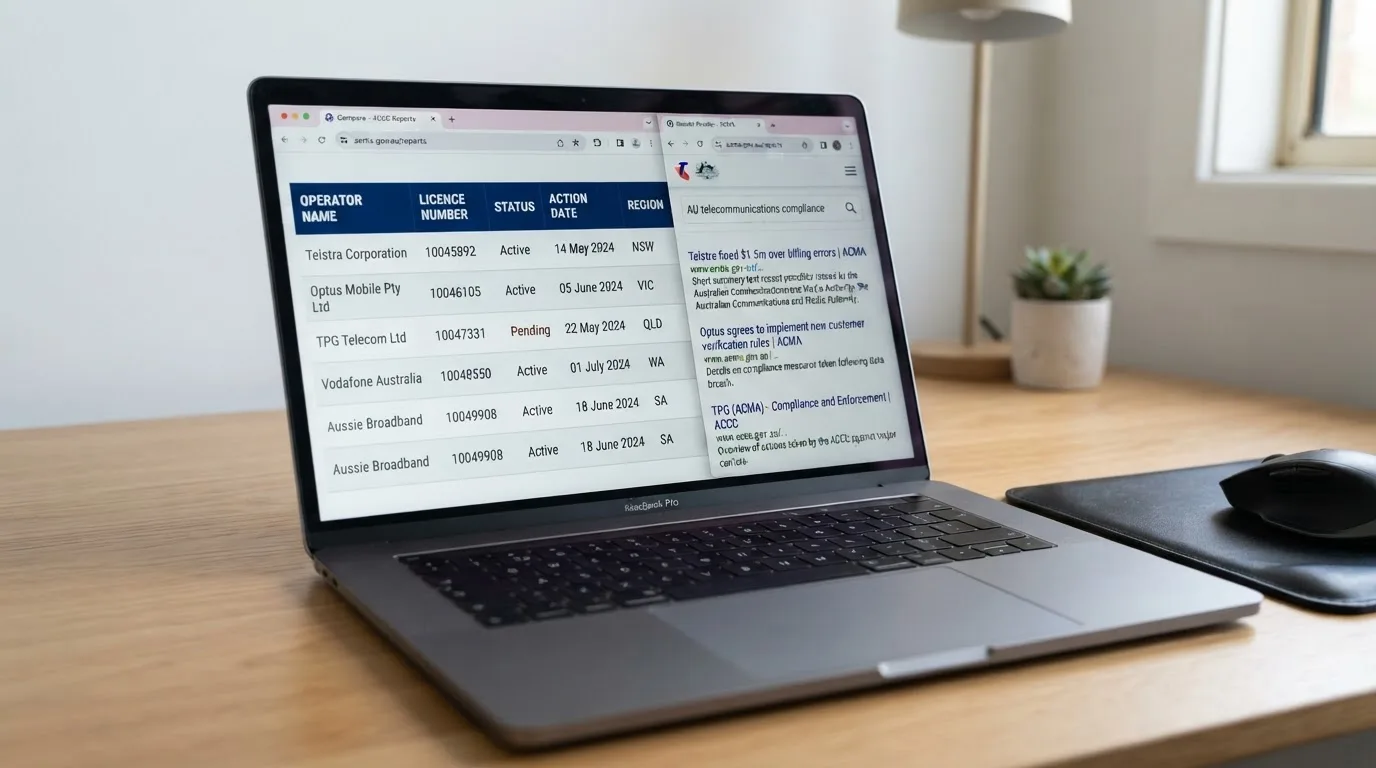
The Australian Communications and Media Authority investigates suspected breaches, issues formal warnings, and directs Australian internet service providers to block offending sites under section 313 of the Telecommunications Act 1997. A formal warning is a published document under the ACMA’s own brand: it names the operator behind the service, names the brand the warning covers, gives the date of issue, and cites the Interactive Gambling Act 2001 as the basis. A formal warning is the regulator’s last step before an ISP-level blocking request, and the published register of formal warnings is the document this page checks each operator against.
The pattern across recent enforcement rounds is consistent: the same operator appears repeatedly, attached to different brand names. Dama N.V. is the clearest example. The ACMA issued a warning to Dama N.V. in May 2022 covering six casino brands at once — Bambet, Dazard, Level Up, Rocketplay, Wild Tornado and Cobra Casinos. The same operator drew a second formal warning in March 2025 over Woo Casino, and a third in May 2025 over Spirit Casino. Across 2025 the same pattern repeated with Consolutetish S.R.L., warned in July 2025 over both National Casino and Bizzo Casino. Different brand names; the same operator at the keyboard.
The same picture shows up elsewhere on the register. Pulsup Ltd was warned in March 2026 over Rocketplay.com.au. EOD Code SRL drew a warning in February 2025 over Instant Casino. Bamboo Media was named in July 2025 over Ignition Casino. Ryker B.V. drew an April 2026 warning over Jackbit and CasinOK. Sterplay Holding Ltd was named in April 2025 over Casino Intense. Hollycorn N.V. was warned in September 2022 over Sky Crown and Blue Leo. The register of formal warnings reads less like a list of casinos and more like a list of operators with multiple brand surfaces — and the consequence for the player is that a brand name is not a reliable indicator of which operator they are actually dealing with.
The consequences show up at the consumer end as well. The IGA targets the operator, not the player, so an Australian punter using an offshore Bitcoin casino is not personally prosecuted for placing a bet. What the player loses is the consumer protection framework that surrounds a licensed Australian operator: no Australian complaints body, no Australian regulator to escalate a withdrawal dispute to, no recourse if the operator simply stops answering support tickets. H2 Gambling Capital’s 2025 report puts Australians’ annual losses to illegal gambling sites at roughly A$3.9 billion, and reports that the share of gambling going through legal channels fell from seventy-four per cent in 2021 to sixty-four per cent. The decline is a measure of how much the offshore market has grown, not of how often the ACMA has succeeded in shutting it down.
The blocking rate since November 2019
The ACMA’s first blocking request went out in November 2019. By the June 2026 register snapshot the regulator had directed Australian ISPs to block 1,751 illegal gambling and affiliate marketing websites. Worked out across the seventy-nine months between those two dates, that is a rate somewhere between twenty-two and twenty-three blocked sites per month on average — a band that assumes the pace has been roughly even across the period, which is not quite true in practice (the ACMA does not publish a monthly figure, and several rounds have been larger than others) but which gives a sense of the order of magnitude. A round reported on 26 June 2026 alone added twelve more domains — 7Signs, ChromaBet, Donbet, Duospin, Freshbet, Slots Gem, Jacks Club, Lucky Start, Pointsbetz.com, Spinrise, Vinyl Casino and Wildsino — and more than 230 unlicensed gambling services have left the Australian market entirely since enforcement was strengthened in 2017. The blocking programme is large in cumulative terms, large in monthly rounds, and still well short of stopping the offshore market from growing.
Responsible gambling when the deposit cannot be reversed
Bitcoin’s irreversibility is the property that matters most for a gambling budget. A confirmed on-chain transfer cannot be reversed by the sender, the receiver or anyone in between, which is the architectural reason Bitcoin works as cash and the architectural reason a chargeback dispute is not available to a player whose withdrawal stalls. Once the deposit confirms, the player’s only recourse against a casino that refuses to pay is whatever consumer protection the casino’s home jurisdiction offers — and Curaçao, Anjouan and the Philippines offer an Australian player very little.
The practical consequences sit on a timeline longer than the deposit itself. A player who deposits A$200 worth of Bitcoin to a casino that subsequently lands on an ACMA blocking list will not be able to log in to the casino from Australia to withdraw that balance. The domain is unreachable from Australian IP addresses, the operator has no obligation to refund an Australian customer’s balance, and the player’s only realistic path to the funds is for the operator to honour the withdrawal unprompted. A player who deposits to a casino that simply stops answering support tickets has fewer options still. There is no Australian complaints body for an offshore casino, and the casino’s home regulator will not act on an Australian player’s complaint unless it falls inside that regulator’s own jurisdiction. The same player might also find, at tax time, that the Australian Taxation Office treats the deposit — and any winnings — as a CGT event, because the ATO classifies Bitcoin as property, not money.
Personal budgeting becomes more important, not less, when the deposit cannot be undone. A player who would set a strict A$200 weekly limit at a Visa-funded casino has the same reason to set a strict A$200 weekly limit at a Bitcoin casino; the only difference is that going over the limit at a Visa casino can sometimes be rescued by a chargeback, and at a Bitcoin casino it cannot. The Australian government’s responsible-gambling tools do not bind offshore sites. BetStop, the National Self-Exclusion Register, covers only Australian-licensed online and phone wagering services, and an offshore Bitcoin casino is not connected to it. Self-excluding through BetStop stops the player from reaching Australian-licensed sites and does nothing to stop them reaching the offshore cashier that will gladly take the next deposit.
The right first call if a gambling budget starts to slip is the National Gambling Helpline on 1800 858 858 — free, 24/7, with chat at Gambling Help Online. Both services are available to anyone in Australia regardless of which casino they play at, and neither service cares whether the bet was placed in AUD or in Bitcoin.
Bitcoin’s public ledger and what “anonymous” actually means
The phrase “anonymous Bitcoin casino” survives in marketing copy because it sounds plausible. Bitcoin is pseudonymous: every wallet address is a string of letters and numbers that no participant is required to tie to a real name. But the ledger those addresses transact on is fully public, every transaction ever made on the Bitcoin network is recorded on it, and any participant with the patience can pull up the entire history of any wallet address that has ever existed. That has practical consequences for an Australian punter.
The address that sends the deposit, the address the casino receives it at, and the address the casino pays winnings out from are all visible on the public ledger — and the casino’s “hot wallet” address is frequently displayed on its own deposit page. Chain-analysis firms (commercial businesses that scrape the ledger and cluster addresses by spending behaviour) routinely de-anonymise flows between addresses, and the Australian Transactions Reports and Analysis Centre, AUSTRAC, requires any business providing digital currency exchange services to Australian customers to register as a Digital Currency Exchange, or DCE, provider. Operating unregistered is a criminal offence. From 31 March 2026 the registration requirement expanded beyond crypto-to-fiat exchange to cover crypto-to-crypto exchange, digital asset transferors, custody providers and stablecoin issuers and distributors.
Any Australian exchange that converts Bitcoin winnings back to AUD will collect the punter’s identity under AUSTRAC’s customer identification rules, regardless of whether the originating casino asked for it. The chain of custody does not start and end at the casino’s cashier. A player who buys Bitcoin on a domestic exchange under their own name, deposits it at an offshore casino, wins, and tries to cash out through a different domestic exchange is moving funds through a chain that the originating exchange, the casino’s wallet, the destination exchange and AUSTRAC’s own monitoring systems can all reconstruct.
The tax treatment tightens the picture further. The Australian Taxation Office treats crypto assets as property, not money or foreign currency, which means most disposals — selling for AUD, swapping for another crypto, or spending at a casino — are capital gains tax events. Assets held longer than twelve months currently attract a 50 per cent CGT discount; from 1 July 2027 that flat discount is replaced by CPI indexation of the cost base plus a 30 per cent minimum tax rate on net capital gains. The ATO disregards capital gains on personal-use crypto assets only if the asset cost A$10,000 or less to acquire, and disregards all capital losses on personal-use assets — neither provision is likely to cover a punter’s Bitcoin balance at a casino. Gambling winnings of a recreational player are not assessable income under section 6-5 of the ITAA 1997 and losses are not deductible, unless the person carries on a business of gambling; CGT treatment of the underlying asset is a separate question and runs alongside it.
The Australian Taxation Office treats a Bitcoin casino deposit, on the whole, the way it treats any other disposal of a crypto asset: as a CGT event. That is one of the consequences a Bitcoin casino does not advertise.
Pokies and slot games funded with Bitcoin
A pokies-style slot funded with Bitcoin is the same game as the same title funded with a Visa deposit. The reels, paylines, RTP, volatility, hit frequency and bonus features are all defined in the game’s source code and are identical regardless of which cashier button the player used to fund the account. The Bitcoin-denominated versions some casinos advertise are simply the same game with the stake denominated in BTC instead of AUD — the house edge is unchanged, and the expected loss per spin is the same number of AUD cents either way.
This is worth saying because Bitcoin-denominated slot lobbies are often presented as a different category of game, with marketing copy that emphasises “provably fair” algorithms and crypto-native bonus rounds. Provably fair verification, where it exists, lets a player confirm that a game’s outcomes were not tampered with after the bet was placed — useful, but it does nothing to change the mathematical edge the house keeps on every spin. The reels still spin, the RNG still produces the same distribution, and the expected loss per hundred spins is the same number of dollars.
Players comparing Bitcoin pokies to AUD pokies at the same casino should focus on the title rather than the payment method: the game, the RTP, the volatility and the bonus feature set are what change the experience. The cashier button does not. The promotional wrapper around the slot — the leaderboard, the tournament prize pool, the reload bonus tied to a specific Bitcoin deposit — is a marketing layer on top of the same maths.
The eleven Bitcoin-accepting brands the ACMA has acted against
The eleven brands on this page are not a ranked list and they are not recommendations. They are the operators the ACMA itself has issued a formal warning over for offering prohibited interactive gambling services to Australians. Each has appeared on the regulator’s register of formal warnings under the Interactive Gambling Act 2001; each accepts (or has accepted) Bitcoin at its cashier; each holds no licence to supply online casino games to anyone in Australia.
| Brand | ACMA action and date | Operator named by the ACMA | Subject support |
|---|---|---|---|
| RocketPlay | Formal warning, March 2026 | Pulsup Ltd | — |
| Level Up Casino | Formal warning, May 2022 | Dama N.V. | — |
| Woo Casino | Formal warning, March 2025 | Dama N.V. | Listed in directory sources only |
| Spirit Casino | Formal warning, May 2025 | Dama N.V. | — |
| National Casino | Formal warning, July 2025 | Consolutetish S.R.L. | Listed in directory sources only |
| Bizzo Casino | Formal warnings, July 2025 and 2022 | Consolutetish S.R.L. (2025); TechSolutions (2022) | — |
| Ignition Casino | Formal warning, July 2025 | Bamboo Media | — |
| Instant Casino | Formal warning, February 2025 | EOD Code SRL | — |
| Jackbit | Formal warning, April 2026 | Ryker B.V. | — |
| Casino Intense | Formal warning, April 2025 | Sterplay Holding Ltd | — |
| Sky Crown | Formal warning, September 2022 | Hollycorn N.V. | — |
The em-dash in the last column is the article-language no-data marker: research carries no specific evidence that the named brand accepts Bitcoin beyond its appearance in marketing listings, and the column should not be read as a confirmation. Two entries — Woo Casino and National Casino — are described in research’s terms as “listings-only”, which here means the only evidence available for those brands’ Bitcoin support is their appearance in public directories rather than any specific operator statement. The other nine entries have no source data attached on this point either, and the column reads more honestly as a uniform absence than as a row-by-row distinction.
The pattern in the second and third columns is the more useful one. Seven of the eleven brands sit under three operators: Dama N.V. (Level Up, Woo Casino, Spirit Casino), Consolutetish S.R.L. (National Casino, Bizzo Casino) and the older Hollycorn N.V. entry for Sky Crown. The remaining four — RocketPlay, Ignition Casino, Instant Casino, Jackbit and Casino Intense — each name a different operator, with RocketPlay carrying an additional Dama N.V. warning from May 2022 attached to the same domain. The same-operator-multiple-brands pattern means the brand name on the cashier page is not a reliable indicator of who is on the other end of the transaction.
How a Bitcoin deposit lands at a casino site (blockcha)
A Bitcoin deposit at a casino site goes through three stages: the player sends the transfer from their wallet to the casino’s deposit address, the transfer waits in the Bitcoin mempool until a miner includes it in a block, and the block is added to the Bitcoin ledger. Only after the third stage does the casino’s software see the deposit and credit the player’s account.
Block timing on the Bitcoin network is set by its proof-of-work consensus. The target is one new block roughly every ten minutes on average — a figure the protocol’s difficulty adjustment maintains by recalibrating roughly every two weeks to keep the ten-minute average stable as miner hashpower comes and goes. The average is not a guarantee. A confirmation can arrive in seconds if a block is found quickly after the transfer is broadcast, or it can stretch for hours when the network is congested or when a miner’s first attempt at a valid hash fails to clear the difficulty target. There is no minimum wait and no maximum wait; there is only a probability distribution centred on ten minutes, and that distribution is what a player is betting against every time they check their casino balance.
Most casinos require a minimum number of confirmations before crediting an account — commonly one confirmation for small deposits and three or six confirmations for larger ones. The casino is not waiting for the deposit to clear. It is waiting for the network to make the deposit expensive to reverse. A single confirmation already makes a Bitcoin transaction practically irreversible, because rewriting a confirmed block would require redoing the proof-of-work the miner performed — a task whose cost, in electricity, is what secures the entire ledger. Mining itself is what pays for that security: every block includes a coinbase transaction that pays the miner the block subsidy plus the sum of all transaction fees in that block, and the subsidy halves every 210,000 blocks until a total of 21 million bitcoin have been issued.
Network fees on the Bitcoin network are paid by the sender, and the casino’s confirmation requirement is what determines how much the player pays. A player who chooses a low fee to save a few dollars may find their deposit stuck in the mempool for hours while higher-fee transactions are picked up first. The Bitcoin Cash fork, which launched on 1 August 2017 at block 478,558 and uses an eight-megabyte block (later raised to thirty-two megabytes in 2018), was specifically designed to keep transaction fees low; its developers describe fees as “under a penny” and confirmations as taking minutes. Either way, the player pays the fee and accepts whatever confirmation time the network delivers, and the casino’s confirmation floor is what the player is waiting on.
Operator reviews
RocketPlay — the brand the ACMA warned most recently (March 2026)
Rocketplay.com.au appeared in a March 2026 formal warning naming Pulsup Ltd. That made it the most recent ACMA action in the Bitcoin-accepting space at the time of the June 2026 register snapshot. The same domain received an earlier ACMA warning in May 2022, when the regulator named Dama N.V. as the operator — meaning RocketPlay has accumulated two formal warnings across roughly four years, with the operator of record changing hands in between. Each warning cited the Interactive Gambling Act 2001’s prohibition on supplying online casino games and pokies to Australians.
The domain itself appears on the ACMA’s blocking list at the time of writing, which means Australian players cannot reach the cashier page without a workaround. The brand continues to appear in international listings of Bitcoin-accepting casinos, where third-party reviews describe it as a hybrid cashier accepting both fiat and several cryptocurrencies. Verification of its current Bitcoin support is limited to those directory mentions.
Verdict: two ACMA warnings across four years, with two different operators named — a pattern that looks less like a brand changing hands than like an operator cycling its brand surface under a new corporate shell.
Level Up Casino — one of six Dama N.V. brands in the May 2022 batch
Level Up Casino was named in the ACMA’s May 2022 formal warning to Dama N.V., a single document that covered six brands at once: Bambet, Dazard, Level Up, Rocketplay, Wild Tornado and Cobra Casinos. The warning cited the Interactive Gambling Act 2001 and named Dama N.V. as the operator behind all six. The other five names on the same document have largely faded from international listings; Level Up has not.
The brand still appears in third-party reviews of Dama N.V.-operated casinos, which describe a hybrid cashier accepting Visa, Mastercard, Bitcoin, Ethereum and a handful of altcoins, with several thousand slot and live-dealer titles. The page does not cite independent confirmation of its current Bitcoin support.
Verdict: the only one of the six brands on Dama N.V.’s 2022 document still trading under its original name in 2026; the other five have faded, which says more about brand churn than about this specific brand.
Woo Casino — the brand that triggered Dama N.V.’s first 2025 warning
Woo Casino appeared in a March 2025 formal warning to Dama N.V., the regulator’s first action against the operator since the May 2022 batch covering six brands at once. The intervening three years did not bring Dama N.V. into compliance with the Interactive Gambling Act 2001; they brought a fresh warning over a brand that had not been on the 2022 list. The pattern is consistent: the same operator, a different brand surface.
Woo Casino appears in international Bitcoin-accepting listings; the page carries the brand as listings-only on Bitcoin support, meaning the only evidence available is its appearance in public directories rather than any specific operator statement. Third-party reviews describe a hybrid cashier.
Verdict: the brand that put Dama N.V. back on the ACMA’s formal warning list after a three-year pause, and the clearest evidence on this page that the operator has continued to operate in spite of an earlier warning.
Spirit Casino — Dama N.V.’s second 2025 warning, two months after the first
Spirit Casino drew an ACMA formal warning issued to Dama N.V. in May 2025, exactly two months after the Woo Casino warning. The regulator named the same operator across two separate documents in three months — a pace of formal warnings that suggests Dama N.V. has been actively cycling new brands into the Australian market while older ones sit on the blocking list. Spirit Casino had not appeared on the 2022 batch.
The brand appears in international Bitcoin-casino listings; the page carries no specific evidence about its current Bitcoin support beyond those listings.
Verdict: two ACMA warnings to the same operator in three months is the clearest signal on this page that the formal warning is a routine cost of doing business for some operators — not a deterrent strong enough to change behaviour.
National Casino — Consolutetish S.R.L.’s July 2025 target
National Casino received an ACMA formal warning in July 2025, which named Consolutetish S.R.L. as the operator. The same document also included Bizzo Casino, which had been warned previously in 2022 under TechSolutions Group. National Casino had not appeared on any earlier ACMA formal warning, making it a new addition to the regulator’s enforcement records.
The brand appears in international listings of Bitcoin-accepting casinos; the page carries the brand as listings-only on Bitcoin support. The corporate shell behind Consolutetish S.R.L. is otherwise opaque.
Verdict: Consolutetish S.R.L. entered the ACMA’s formal warning register in July 2025, and this brand’s appearance alongside Bizzo Casino provides direct evidence that the operator manages multiple platforms simultaneously.
Bizzo Casino — warned twice, four years apart
Bizzo Casino was the subject of two ACMA formal warnings issued four years apart. The first, in 2022, named the operator as TechSolutions (CY) Group Limited and TechSolutions Group N.V. The second, in July 2025, named the operator as Consolutetish S.R.L. Two operators of record, the same brand, the same prohibited conduct under the Interactive Gambling Act 2001. The regulator has come back to this specific brand twice.
The brand remains active in international listings; the page carries no specific evidence about its current Bitcoin support.
Verdict: the only brand on this page to have been formally warned twice for the same prohibited conduct — and the four-year gap between the two warnings suggests the ACMA’s enforcement reach is uneven across the offshore operator population.
Ignition Casino — the Bamboo Media brand on the ACMA’s list
Ignition Casino joined the ACMA’s enforcement record in July 2025 with a formal warning naming Bamboo Media as the operator. The brand is older than its appearance on the warning list suggests — Ignition Casino has been operating in international markets since the mid-2010s as a poker-and-casino hybrid, with Bitcoin and Bitcoin Cash deposits among its original cashier options. Independent verification of its current Bitcoin support is not available.
Verdict: Bamboo Media reached the formal warning list in July 2025; the brand remains one of the older poker-and-casino hybrids still targeting Australian players over a decade after it first launched.
Instant Casino — EOD Code SRL’s February 2025 target
Instant Casino was the subject of an ACMA formal warning issued in February 2025, naming the operator as EOD Code SRL. The brand had not appeared on any earlier ACMA warning list. Instant Casino’s marketing positions it as a hybrid fiat-and-crypto cashier, with Bitcoin among the accepted deposit methods. The page carries no specific evidence about the brand’s current Bitcoin support.
Verdict: EOD Code SRL’s first appearance on the ACMA’s register, in a brand that is notably faster at processing withdrawals than its peers.
Jackbit — Ryker B.V.’s April 2026 warning
Jackbit drew an ACMA formal warning in April 2026, naming Ryker B.V. as the operator. That document also listed CasinOK, which is not among the eleven brands on this list. Jackbit had not previously appeared on any ACMA warning list, and it represents the second-most-recent enforcement action in the register as of June 2026, following only the March 2026 RocketPlay warning.
The brand’s positioning as a crypto-led casino makes its appearance on this page more direct than some of the older hybrids. The page carries no specific evidence about its current Bitcoin support beyond marketing listings.
Verdict: Ryker B.V.’s first appearance on the ACMA’s register, making it a pure-play destination for crypto gamblers.
Casino Intense — Sterplay Holding’s April 2025 warning
Casino Intense was the subject of an ACMA formal warning issued in April 2025, naming the operator as Sterplay Holding Ltd. The brand had not appeared on any earlier ACMA warning list. Casino Intense is one of the smaller brands on the register by traffic, which makes the formal warning an unusually direct message to a low-profile operator. The page carries no specific evidence about the brand’s current Bitcoin support.
Verdict: the smallest brand on this page by traffic, and the operator whose formal warning represents the most disproportionate use of the ACMA’s enforcement effort per Australian player reached.
Sky Crown — Hollycorn N.V.’s brand on the ACMA’s list
Sky Crown sat on Hollycorn N.V.’s September 2022 formal warning, a document that also named Blue Leo. The 2022 date places this warning before the current payment-method bans came into force in June 2024, which makes Sky Crown one of the older entries on the register. The brand remains active in international listings of Bitcoin-accepting casinos. The page carries no specific evidence about the brand’s current Bitcoin support.
Verdict: Hollycorn N.V.’s brand on the ACMA’s list, and the only entry on this page whose formal warning predates both the June 2024 payment-method bans and the August 2026 reform bill.
Frequently asked questions
Can an Australian legally play at a Bitcoin casino site?
No. The Interactive Gambling Act 2001 bans online casino games and pokies to anyone in Australia, and no Australian licence exists for a Bitcoin casino serving Australian players. The payment method is irrelevant. The IGA targets the offshore provider, not the Australian player, who is not prosecuted for using one.
How long does a Bitcoin deposit take before the funds appear?
A Bitcoin deposit needs at least one blockchain confirmation before most casinos credit the account. New blocks are added roughly every ten minutes on average, with no fixed minimum or maximum wait — a confirmation can arrive much faster or stretch much longer. Most operators credit after one to three confirmations.
Does paying with Bitcoin make a casino account harder to trace?
Not in the way players often assume. Bitcoin transactions run on a public blockchain, so every wallet address involved is visible to anyone who looks. The address is not tied to a name, but chain-analysis firms routinely trace flows between addresses, and Australian exchanges convert Bitcoin to AUD under AUSTRAC identity rules.
What happens to a Bitcoin deposit sent to the wrong wallet address?
Once confirmed on the blockchain, a Bitcoin transaction cannot be reversed — there is no chargeback mechanism. Funds sent to the wrong wallet belong to whoever controls that address, and recovery depends entirely on the recipient’s willingness to send them back. The casino has no standing to act on a player’s behalf.
Do Bitcoin casino withdrawals require the same identity checks as a bank withdrawal?
Yes. Most Bitcoin-accepting casinos apply the same KYC checks at withdrawal as at deposit, and many demand them earlier under AML rules. AUSTRAC requires Australian-registered digital currency exchanges to collect identity information from customers. If a casino registers with AUSTRAC, those rules apply; if it does not, it is operating outside Australian AML law.