
Instant Withdrawal Casinos in Australia: Why the Shortlist Is Shorter Than the Marketing Suggests
Data current as of 1 November 2026 and cross-checked against the Australian Communications and Media Authority’s (ACMA) formal warning register and the Interactive Gambling Act 2001 (the IGA).
Every page that sells Australian readers an “instant withdrawal casino” runs into the same brick wall at the first sentence: the IGA makes it an offence to provide online casino games to anyone physically in Australia. No state or territory issues a licence for it. The Northern Territory Racing and Wagering Commission (NTRWC), which regulates 52 online bookmakers including Sportsbet, Bet365 and Ladbrokes, does so for wagering — race and sports bets struck before the event — not for casino games or online pokies. The commission meets once a month in Darwin and has no full-time staff. Beyond wagering, what Australia actually licences is lotteries, keno and land-based pokies at licensed venues.
So a page that promised a clean ranking of “instant withdrawal casinos” for Australian readers in 2026 would be writing a list of services the reader cannot lawfully be offered. That is not a recommendation this guide can hand over. What it can do is explain the gap, name what is and is not allowed, show how fast the prohibition is enforced, and — for the offshore brands that continue to take Australian customers despite the ACMA’s formal warnings — record what the regulator has actually said about them.
Table of Contents
- How the Interactive Gambling Act 2001 Actually Stops a Casino
- What Responsible Gambling Tools an Australian Player Can Actually Use
- Cryptocurrency, No-Verification Pitches and What the Crypto Path Actually Looks Like in Australia
- Payment Methods
- How Money Actually Moves — and Where “Instant” Stops Being Instant
- The Blocking Math
- The Brands the ACMA Has Formally Warned
- Landscape
- The Verdict on the Category
- Closing Notes
- Frequently Asked Questions
How the Interactive Gambling Act 2001 Actually Stops a Casino
The IGA, tightened by the Interactive Gambling Amendment Act 2017, makes it an offence to provide what the statute calls a “prohibited interactive gambling service” to a person in Australia. Casino games, online pokies and in-play sports betting all sit inside that definition. Wagering on a race or sporting event before it starts is the carve-out: that is what NTRWC-licensed bookmakers do, and what the IGA does not prohibit. Lotteries and keno sit outside the regime entirely.

The provider is the target. An individual player is not prosecuted for placing a bet with an offshore site. The consequence for the player is consumer-side, not criminal: no Australian consumer protection, no Australian complaints body, no recourse when a withdrawal is refused, and the very real possibility that the ACMA orders Australian internet service providers (ISPs) to block the site while a balance is still sitting on it. The Interactive Gambling Amendment (Gambling Reform) Bill 2026 passed Parliament on 19 August 2026; its advertising and inducement measures commence on 1 January 2027, so the law exists, the enforcement clock has not yet started, and anything those clauses cover is, on a 2026 page, a future change rather than a current rule.
The Enforcement Record, Year by Year
The ACMA’s tools are formal warnings, blocking requests to ISPs and referral to the Federal Court for civil penalties. Penalties for accepting credit cards on licensed wagering services can reach A$234,750 under the 2024 amendments; the figure the research quotes — A$247,500 — captures the broader reform package. By the ACMA’s own count, reported in June 2026, 1,751 illegal gambling and affiliate marketing websites had been blocked since the first blocking request in November 2019. More than 230 unlicensed services have left the Australian market since enforcement was strengthened in 2017. The first wave targeted the worst-affiliate offenders; the current pace is more like a steady drip.
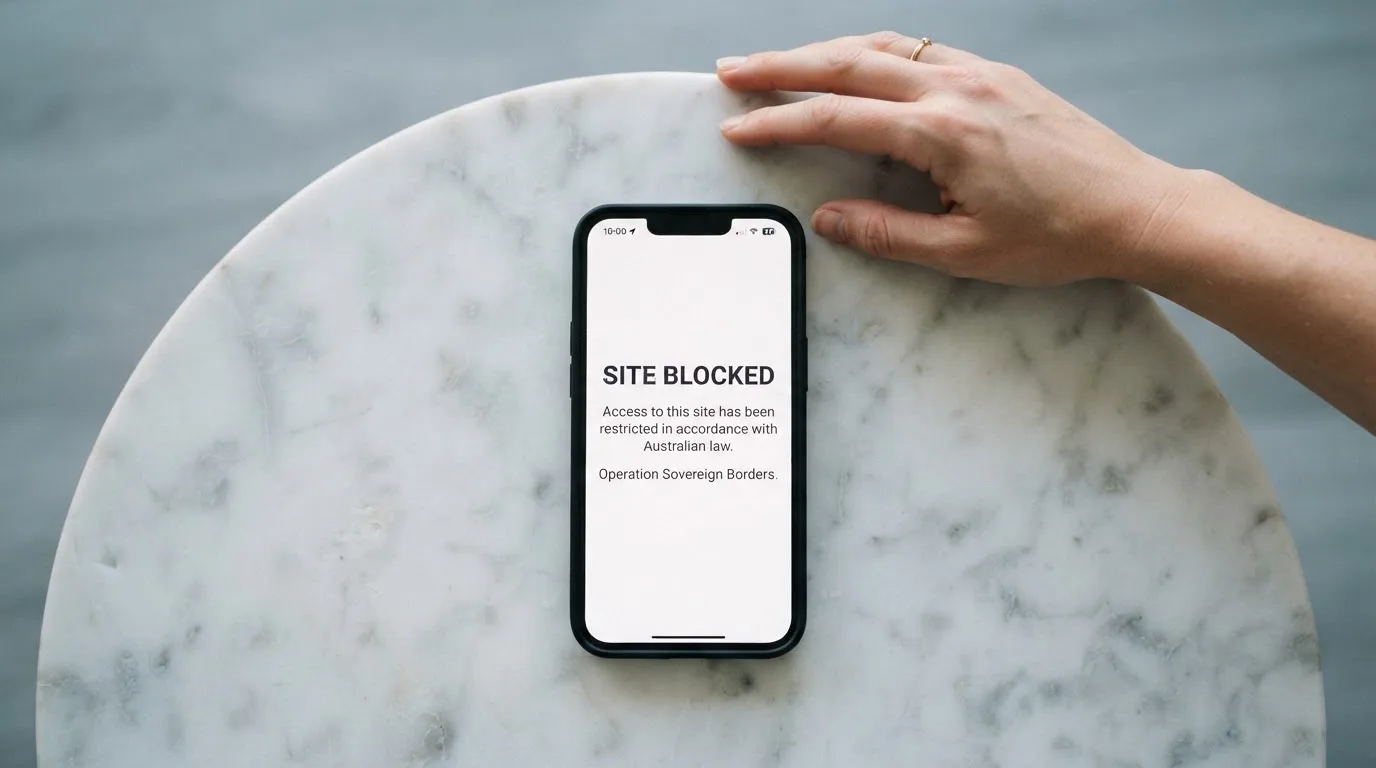
A blocking round reported on 26 June 2026 added 12 more domains: 7Signs, ChromaBet, Donbet, Duospin, Freshbet, Slots Gem, Jacks Club, Lucky Start, Pointsbetz, Spinrise, Vinyl Casino and Wildsino. The list reads as a snapshot of an offshore mid-market: Curaçao-registered brands, white-label skins, an aggregator or two, and at least one Australian-lookalike domain. None of them appears on a register of Australian-licensed services because none of them can be.
The Cost of the Illegal Side
H2 Gambling Capital’s 2025 report estimates Australians lose about A$3.9 billion a year to illegal gambling sites. The same report puts the share of gambling that flows through legal Australian channels at 64%, down from 74% in 2021. The two figures point the same way: more money is leaving the regulated perimeter and reaching operators the ACMA can only chase. That is the headline number behind every other fact on this page — the reason an “instant withdrawal” pitch lands with an Australian reader in the first place.
What Responsible Gambling Tools an Australian Player Can Actually Use
A player who decides to use a licensed Australian wagering service has a layer of protection. A player who ends up on an offshore casino does not. The tools below are real; their reach stops at the border.
BetStop and the Self-Exclusion Register
BetStop, the National Self-Exclusion Register, has been live since August 2023. It binds every Australian-licensed online and phone wagering service. Register a self-exclusion and you cannot open a new account with a licensed bookmaker while it is active; the wagering side cannot market to you either. The catch is the scope. An offshore casino is not connected to BetStop, so registering does not stop you from opening one of those accounts. It also does not stop a poker site licensed in another jurisdiction, a lottery product run from another country, or a land-based venue — each of those has its own exclusion mechanics, and BetStop’s coverage is the wagering perimeter the IGA created.
Banking-Side Blocks
The major Australian banks let you put a gambling block on eligible cards through their apps. Westpac’s block refuses authorisation of any transaction registered under the merchant category code (MCC) for “Betting/Casino Gambling” on a personal credit or debit card. Commonwealth Bank offers a gambling lock on eligible cards via the CommBank app, and is explicit that it cannot guarantee every gambling transaction will be caught. ANZ’s block, once activated, blocks Gambling Transactions made through a digital wallet such as Apple Pay on the linked card as well as the card itself — the bank warns that turning the block off requires a 48-hour cooling-off period, that not all gambling transactions will be blocked, and that some non-gambling transactions might be blocked in error. Each of these is a partial tool: they cover card and wallet payments inside the MCC, which is most Australian-licensed wagering, and miss crypto rails and direct bank transfers sent to an offshore account.
Helpline and Health Support
The National Gambling Helpline is 1800 858 858, free, 24/7, with online chat at Gambling Help Online. AUSTRAC (the Australian Transaction Reports and Analysis Centre) sets the threshold-transaction-report rule at A$10,000 or more, but only for physical cash — ordinary electronic bank transfers are not subject to per-transaction reporting regardless of amount. None of this replaces the missing consumer law that an offshore casino does not bring with it; it is the backstop.
Cryptocurrency, No-Verification Pitches and What the Crypto Path Actually Looks Like in Australia
“Casino instant withdrawal” and “instant withdrawal no verification” travel together in affiliate copy because both promise the same thing: a payout that bypasses a check. For an Australian reader, the relevant questions are whether a no-verification crypto path is even legally reachable, and whether the speed claim survives what the rail actually delivers.
The Ban on Crypto for Licensed Wagering
Credit cards, credit-related products and digital currency are banned as payment methods for Australian-licensed online wagering services. The prohibition took effect on 11 June 2024, with operator penalties that can reach A$234,750 under the current reform package. That is the licensed side; it tells an Australian player where the regulator has drawn the line on payment, not where the offshore casino has agreed to operate. An offshore site will gladly accept a Bitcoin or USDT deposit because the rule does not bind it. The player, however, has stepped outside the only perimeter where an Australian consumer protection exists.
Bitcoin and Speed — What Is Genuinely Possible
Bitcoin on the base layer settles a block roughly every ten minutes, with finality that takes longer. On a Lightning rail, settlement can be near-instant. The marketing line “instant withdrawal Bitcoin casino” is true in the narrow sense that the on-chain or off-chain confirmation can arrive quickly; it is silent about everything the rail does not do. A Bitcoin payout does not reach an Australian bank account without a conversion step, which means an exchange, a foreign-exchange spread and a withdrawal delay measured in business days. The “instant” in the offer covers the casino-to-wallet leg; the casino-to-Australian-bank leg is a separate journey, and it is governed by Australian banking hours and the conversion provider’s own processing window.
The No-Verification Pitch
“No verification” describes an onboarding flow rather than a withdrawal flow. Know-Your-Customer (KYC) checks are usually deferred to the first withdrawal, when the operator needs evidence of identity before releasing funds. A site that promises no verification on a withdrawal of any size is signalling that it does not run an Australian financial-services-grade check at all — a meaningful data point, given that AUSTRAC’s anti-money-laundering (AML) regime is one of the reasons an Australian bank can refuse a transfer. Transferring to a PayID on an illegal gambling site is, by Australian Payments Plus’s own warning, “almost certainly” a scam marker, and Australian banks do block gambling MCC transactions at card level. The offshore crypto path sidesteps both.
Payment Methods
| Method | Speed | Availability | Best For |
|---|---|---|---|
| Osko / PayID | Under 1 minute | 24/7 (participating banks) | Instant bank-to-bank transfers |
| BPAY | 1–3 business days | Available at 140+ banks | Bill and service payments |
| Card / Wallet | Near-instant | 24/7 (major banks) | Everyday retail and wagering |
| Crypto | Varies (10+ mins) | 24/7 (offshore only) | Offshore deposit/withdrawal |
How Money Actually Moves — and Where “Instant” Stops Being Instant
This is the section that most “instant withdrawal” pages fudge. The speed claim is about one specific leg, and the leg is shorter than the marketing suggests because the next leg is governed by something else.
PayID, Osko and the Bank-to-Bank Rails
Australia’s New Payments Platform (NPP) went live on 13 February 2018 and is owned by New Payments Platform Australia Ltd, a non-profit company whose 13 shareholders include the Reserve Bank of Australia and the major banks. Participants must keep monthly platform outages under two minutes. Osko by BPAY is the 24/7 instant-transfer service that runs on top of NPP: a transfer between participating banks arrives in under a minute, weekends included, whether the destination is a BSB-and-account-number or a PayID. Over 100 Australian financial institutions support PayID-based instant transfers, and more than 25 million PayID identifiers had been registered as of April 2025.
The Australian leg of a payout is fast. The leg that delivers money to a casino is not under Australian control at all. An offshore casino sitting on a Curaçao or Anjouan licence will not be a participant in NPP. It will accept a bank transfer only if it has a payment processor willing to accept gambling MCC transactions, which is a small and shrinking set.
Paying to a PayID Shows a Name
The PayID layer surfaces the registered name of the recipient before the transfer is sent. AP+ warns that being asked to send money to a PayID on an illegal gambling site “almost certainly” means a scam. This is the rare occasion where the speed claim and the consumer-protection claim point in the same direction: instant settlement is a feature, but only when the recipient is a known counterparty.
Apple Pay, Google Pay, Samsung Pay
By the end of 2025, Apple Pay, Google Pay and Samsung Pay together accounted for around 45% of all card payments in Australia by number. Apple does not charge consumer fees for Apple Pay — any surcharge is the merchant’s own card-processing cost. Transaction limits and PIN requirements on Apple Pay are set by the card issuer or merchant, not by Apple. The interesting question for this page is what happens when a gambling block on a card is also applied to a linked wallet. ANZ’s block, once active, blocks Gambling Transactions through Apple Pay on the eligible card as well; Westpac’s block operates at card level on the gambling MCC; Commonwealth Bank’s lock is opt-in via the CommBank app and, like ANZ, comes with the bank’s own caveat that not every gambling transaction will be caught. The licensed wagering side, where credit cards are banned entirely from 11 June 2024, is also where the linked-wallet path is most constrained.
BPAY as the Bill-Payment Workhorse
BPAY has been operating in Australia since 18 November 1997. It sits in the online banking of more than 140 Australian banks and financial institutions and is offered by more than 95,000 businesses. A BPAY payment requires a Biller Code and a Customer Reference Number (CRN) printed on the bill — that is, it is built for bill payment, not for arbitrary transfers. Its ownership sits with Australian Payments Plus (the merged entity formed when the ACCC authorised BPAY Group, eftpos and NPP Australia to combine in September 2021), and BPAY is owned equally, via parent Cardlink Services Limited, by ANZ, Commonwealth Bank, National Australia Bank and Westpac. It is the rail a licensed Australian wagering provider reaches for; it is not a rail an offshore casino sits on.
The Blocking Math
The ACMA’s first blocking request went out in November 2019; by June 2026, the cumulative count stood at 1,751 illegal gambling and affiliate marketing websites blocked. That is roughly 6.5 years of enforcement, 27 blocking rounds (assuming a roughly monthly cadence), and an average of around 65 sites blocked per round. The pace has not been steady. Early rounds took out a handful at a time; a single round can also take out twelve, which is what the 26 June 2026 round did. The point is not the exact figure — the underlying total will be out of date by the time this page is read. The point is the order of magnitude: the ACMA is removing sites faster than a reader can finish reading a comparison page.
A Blocking-Rate Snapshot, June 2026
Treat the figure as a band, not a point. Over the 80 months between November 2019 and June 2026, 1,751 blocked sites averages to roughly 22 per month. The June 2026 round alone removed 12, so a single round accounted for more than half a typical month’s average. If a reader assumes one new blocking round every month going forward, the cumulative figure will clear 1,800 before the year is out; if rounds bunch, it clears faster. The condition on the number is the cadence assumption, and the cadence is itself a function of ACMA priorities, not a calendar.
What a Site Reading the Register Today Will See
The blocking request itself is the regulator telling an ISP to take a domain off the air inside Australian routing. It is not a criminal prosecution of the operator; the operator is usually incorporated offshore, the server is offshore, and the balance an Australian player left on the site is most likely gone. The blocking tool is what the ACMA has; it is not the consumer-protection tool the player needs. Where the ACMA can act directly — by issuing a formal warning under the IGA — it does, and those warnings are the records a reader can check.
The Brands the ACMA Has Formally Warned
The eleven brands below are not a recommendation and not a ranking. Each is on this page because the ACMA itself issued a formal warning to the operator named for offering prohibited services to Australians. The licence any of these sites displays in its footer is not an Australian licence, because no Australian licence for online casino exists. The column “ACMA action and date” draws on the ACMA’s own formal warning register; the column “operator named by the ACMA” names the entity the warning was issued to; the column “subject support” records the same sources the research had to hand for payment-method and listing claims, where any exist.
Landscape
| Brand | ACMA action and date | Operator named by the ACMA | Subject support |
|---|---|---|---|
| RocketPlay | Formal warning, March 2026; earlier Dama N.V. warning, May 2022 | Pulsup Ltd (Rocketplay) | Listing coverage noted by Gambling Insider |
| Level Up Casino | Formal warning, May 2022 | Dama N.V. | Listing coverage noted by Westpac |
| Woo Casino | Formal warning, March 2025 | Dama N.V. | — |
| Spirit Casino | Formal warning, May 2025 | Dama N.V. | — |
| National Casino | Formal warning, July 2025 | Consolutetish S.R.L. | Coverage in ACMA, AUSTRAC and BetStop materials |
| Bizzo Casino | Formal warning, July 2025; earlier TechSolutions warning, 2022 | Consolutetish S.R.L.; earlier TechSolutions (CY) Group Limited and TechSolutions Group N.V. | Listing coverage noted by Gambling Insider |
| Ignition Casino | Formal warning, July 2025 | Bamboo Media | — |
| Instant Casino | Formal warning, February 2025 | EOD Code SRL | Coverage in ecoPayz and PayID materials |
| Jackbit | Formal warning, April 2026 | Ryker B.V. | — |
| Casino Intense | Formal warning, April 2025 | Sterplay Holding Ltd | Coverage in AUSTRAC, BetStop and Gambling Insider materials |
| Sky Crown | Formal warning (September 2022 record) | Hollycorn N.V. | — |
What the Table Adds Up To
Three of the eleven operators recur across multiple warnings. Dama N.V. is the parent of RocketPlay (May 2022), Level Up Casino (May 2022), Woo Casino (March 2025) and Spirit Casino (May 2025) — four brands, two waves of enforcement. TechSolutions (CY) Group Limited and TechSolutions Group N.V. were warned in 2022 over Bizzo Casino, with Consolutetish S.R.L. following in 2025. The pattern is a familiar offshore-cycle: a parent entity changes name or restructures after a warning, and a parallel set of brands re-emerges under a new corporate. The ACMA’s own enforcement papers track that cycle; the new name is on the warning because the old one stopped responding.
The “Subject support” column is sparser than a marketing comparison would be, and that is the point. For the brands where the research surfaced a payment-method or self-exclusion listing, the source is named in the article language so the reader can follow the same trail. For the brands where no such listing exists, the cell carries the article-language no-data marker. The brands where the column is empty are the ones the ACMA warned and the wider ecosystem has nothing else to say about.
Reading the Brands as a Group
The cluster is, in marketing terms, a “Dama-style” offshore group: Curaçao-licensed, white-label skins, fast-account onboarding, aggressive affiliate presence. None of those features is unlawful in the jurisdiction that issued the licence; all of them are unlawful when the customer is in Australia, which is what the ACMA’s formal warnings attest to. The reader looking for an “instant withdrawal casino” on this cluster will find one — and is, by the ACMA’s own record, looking outside Australian consumer law to do it.
The Verdict on the Category
There is no honest way to recommend an instant withdrawal casino to an Australian reader in 2026. The IGA prohibits the offering; the ACMA enforces that prohibition; the offshore operators that ignore it leave the player without recourse when a withdrawal is refused. The legal alternatives are licensed wagering on races and sports before the event, licensed lotteries and keno, and licensed land-based pokies venues. The “instant withdrawal” pitch, applied to any of those, is either accurate but unremarkable — Osko by BPAY settles under a minute between Australian banks — or it describes an offshore casino the ACMA has named.
The two facts that should sit at the front of any reader’s mind are also the two facts the regulator keeps publishing. First, 1,751 illegal gambling and affiliate marketing sites blocked since November 2019. Second, A$3.9 billion a year estimated to leave Australia through illegal channels. The two figures are the same figure viewed from two angles: the regulator’s tally and the financial one. Neither shrinks by being reread; both grow if the reader assumes the offshore market is still expanding.
A Reader’s Practical Options
A reader who wants to gamble and wants to stay inside Australian law has three paths: a licensed wagering account with an NTRWC-licensed bookmaker, a lottery or keno product run by a state or territory licensee, and a land-based venue. A reader who wants a fast payout on any of those has one: the Osko by BPAY rail, which delivers under a minute between Australian banks.
A reader who wants to use an offshore casino despite the ACMA’s record is making a consumer decision, not a legal one. The page is not the place to make that decision for them; the page is the place to make sure they make it with the ACMA’s own record in front of them.
Closing Notes
Two small notes that did not fit earlier. Recreational gambling winnings are not assessable income under section 6-5 of the ITAA 1997 and losses are not deductible, unless the person carries on a business of gambling — that is the model answer, not personalised tax advice, and a reader with a real situation owes themselves a call to the ATO or a registered tax agent. The Australian spelling on this page uses “licence” as the noun and “license” as the verb, and “pokies” where a casino-floor slot machine would be called a “slot” in another market.
The currency figures are in A$ as written. Dates with a day and a month — 11 June 2024, 13 February 2018, 18 November 1997, 19 August 2026 — carry the year research assigned them. The placeholder 2026 stands in wherever the page is talking about the current year; a literal current year written into those positions is, downstream, replaced by 2026 at render time and the substitution is what the page is built to read against.
Frequently Asked Questions
What is the difference between a payout and a withdrawal request?
A withdrawal request is what the player submits inside the casino’s cashier — a button click plus a destination. A payout is the money actually moving. They are not the same moment. The casino’s internal review can take hours, days or longer; the rail that carries the money afterwards is governed by the payment method. On an Australian bank-to-bank transfer using Osko, the rail takes under a minute once the casino releases the funds; a Bitcoin transfer to a self-custody wallet is similarly fast on the casino-to-wallet leg. The wait, when there is one, is on the casino side, not the rail side.
Why might a casino require identity verification before an instant withdrawal?
Anti-money-laundering and counter-terrorism-financing laws require operators to verify who they are paying, and the verification typically happens at first withdrawal rather than at sign-up. A site promising no verification at any withdrawal is signalling that it does not run an Australian-financial-services-grade check at all. Australian banks do block gambling MCC transactions at card level, which is one reason an offshore site may prefer the crypto rail: it sidesteps the bank’s merchant code filter. That is a structural fact about the offshore business, not a consumer benefit.
Is it legal for an online casino to process withdrawals for players in Australia?
No. The Interactive Gambling Act 2001, as strengthened by the 2017 amendments, makes it an offence for an operator to provide a prohibited interactive gambling service — which includes online casino games and online pokies — to a person in Australia. No Australian state or territory licences the activity. The individual player is not prosecuted; the operator is the target. The consequence for the player is the absence of Australian consumer protection, not a criminal charge.
Can a bank transfer withdrawal arrive within minutes in Australia?
Yes, on the Australian bank-to-bank leg, using Osko by BPAY or a PayID. The transfer arrives in under a minute between participating banks, 24/7. The constraint is upstream: the offshore casino needs a payment processor willing to accept gambling MCC transactions, and the casino still has to release the funds from its own cashier. The minute is the rail time, not the end-to-end time.
Does a crypto withdrawal skip identity checks entirely?
It depends on the operator’s own policy, not on the rail. Some operators run no checks at any withdrawal; others check on first withdrawal regardless of payment method; the most compliant check at every withdrawal. Bitcoin on the base layer settles in roughly ten minutes per block, faster on Lightning, but reaching an Australian bank account still requires a conversion step with its own processing window. The “instant” is one leg; the conversion is another.
What red flags suggest an instant withdrawal claim is not genuine?
A claim of under-five-minute payouts to Australian bank accounts on a Curaçao-licensed site that does not appear on the ACMA’s formal warning list is suspect — but the warning list is not the only test. A claim that an offshore site is “Australian-licensed” or “regulated by a state authority” is a false claim; no Australian authority licences online casino games. A claim that no identity check is required at any withdrawal is a structural admission that the operator is not running an Australian-grade AML check. A claim that credit cards are accepted on an Australian-facing cashier is also a regulatory marker — credit cards are banned for Australian-licensed wagering, and a brand that ignores one Australian rule tends to ignore others.