Best Keno Online Casino Australia 2026: What the IGA Makes Impossible, and Where Keno Is Still Legal
 Available in US
A reader typing “best keno online casino australia 2026” is, by the time they reach this page, asking one of two questions. Either they want a working shortlist of online casinos that take keno bets, or they want to know why every such list they have already found ends in roughly the same dead end. The honest answer is the second one. No online casino is licensed in Australia for keno. Every offshore site accepting Australian play is offering a prohibited service, every such site the ACMA has named in a formal warning is named here, and the lawful path for anyone inside Australia runs through licensed pubs, clubs, land-based casinos and state-run keno products — none of which is what the search results promised.
This page is built around that gap. The mechanics of keno, the bonus maths and the offshore menus are below, because readers want to know what they are looking at. The legal frame is the spine, because it is the only piece the search results tend to leave out.
Current as of 24 September 2026. ACMA blocking totals and warning dates verified against the regulator’s published notices.
Table of Contents
- Why an “online keno casino” does not exist as a licensed product in Australia
- ACMA enforcement: the running total and what one round looks like
- Player protection in a market the player is not supposed to be in
- Crypto, Bitcoin and the offshore keno site
- The mechanics of online keno, and the house edge that comes with them
- The eleven named brands, in the order the ACMA has named them
- Verdict on the eleven
- Where Australian readers can play keno lawfully
- What the IGA amendment passed in August 2026 changes
- How to read the rest of the offshore market
- A short glossary for the Australian reader
- What this page does not do, and why
- Frequently asked questions
Why an “online keno casino” does not exist as a licensed product in Australia
The Interactive Gambling Act 2001, tightened by the Interactive Gambling Amendment Act 2017, makes it an offence to supply an online casino game to a person physically in Australia. Keno sits inside that prohibition. Wagering on racing and sport is licensable — in practice licensed by the Northern Territory — but lotteries and keno are the other carve-out that gets through: they are run by state and territory licensees, on licensed terminals, in licensed venues. Online is not part of what they offer.

No state or territory issues a remote casino licence. None of the offshore regulators that show up in a casino’s footer — Curaçao, Anjouan, the Isle of Man — has standing in Australia. The site that prints “licensed and regulated” on its homepage is licensed somewhere; that somewhere is not Australia, and the licence does not put it inside the IGA’s permission set. The page this search wanted cannot be handed over honestly because the product it describes is, by design, not on offer.
What the IGA actually targets is the provider. An individual punter in Australia is not the person on the wrong side of the law. The cost of that asymmetry falls on the player in a different currency: no Australian consumer protection, no local complaints body, no AFCA-style recourse if a withdrawal is refused, and a balance that can be locked on a site that is then blocked.
ACMA enforcement: the running total and what one round looks like
The Australian Communications and Media Authority is the body that turns the IGA into action. Two instruments are in regular use: formal warnings to operators found serving Australian customers, and blocking requests sent to Australian internet service providers. As reported in June 2026, the ACMA’s running total stood at 1,751 illegal gambling and affiliate marketing websites blocked since the first blocking request in November 2019, and more than 230 unlicensed services had left the Australian market since enforcement was strengthened in 2017. The June 2026 round alone asked ISPs to block another 12 names: 7Signs, ChromaBet, Donbet, Duospin, Freshbet, Slots Gem, Jacks Club, Lucky Start, Pointsbetz.com, Spinrise, Vinyl Casino and Wildsino.
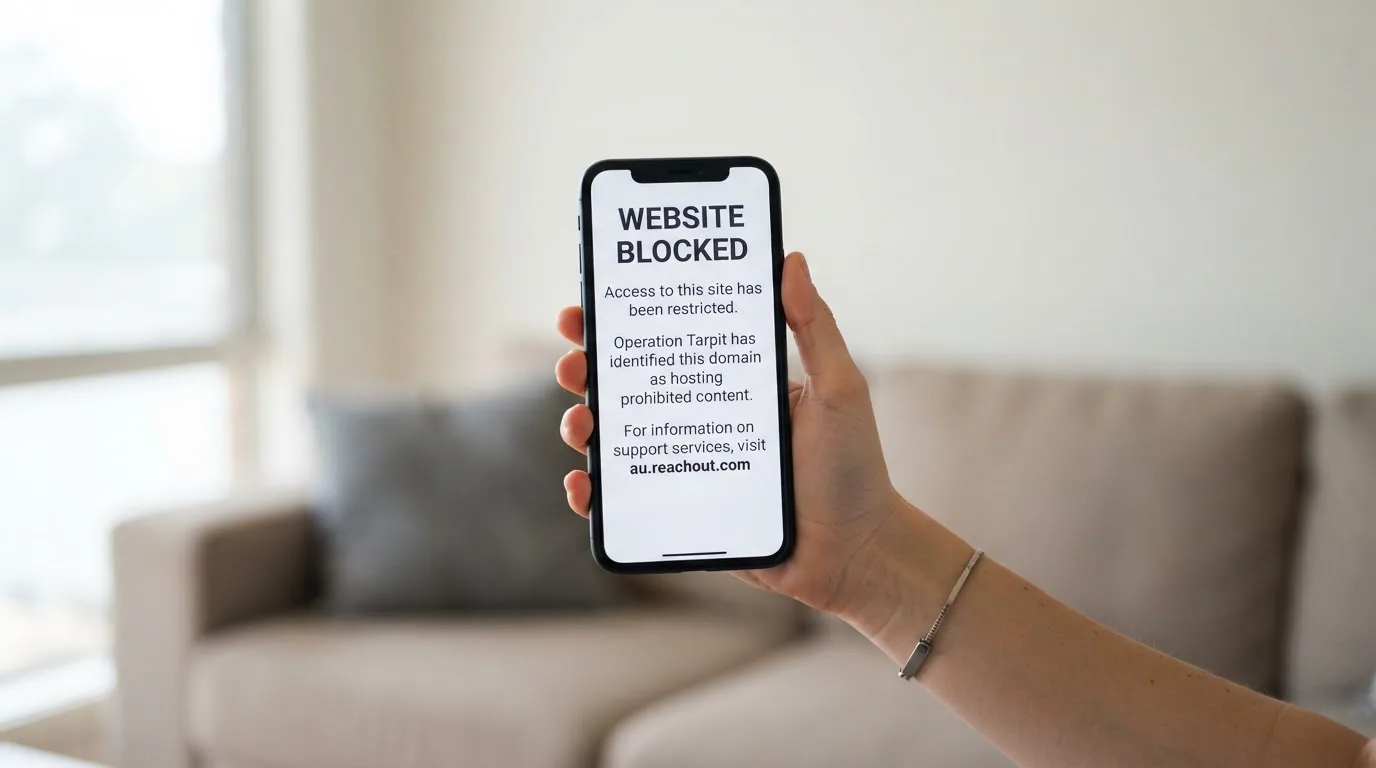
A blocking request is not a quiet technical step. Once an ISP receives one, the domain becomes unreachable through the major Australian networks, and any account balance still sitting on it goes with it. That is the operational shape of the IGA from the punter’s side.
Blocking-rate as a measure of enforcement pressure
A reader who wants a feel for how the regime has been biting can do the arithmetic from two figures research carries: 1,751 sites blocked since the first blocking request in November 2019, against the seven-year and change window between then and the June 2026 report. That gives a working band of roughly 220 to 250 sites blocked per year averaged across the period — slightly higher in the early years and slightly lower in the most recent ones, the shape one would expect from a regulator that has shifted from chasing the long tail to running larger named rounds. The figure is not a guarantee about any one site; it is the rate at which the offshore supply has been pruned at the network layer. A site still reachable today is reachable because the ACMA has not yet asked for it, not because it has been cleared.
Formal warnings: how the regulator names the operator behind the brand
A blocking request names a domain. A formal warning names a company. The warnings matter because they pin a brand to a corporate entity, and the same corporate entity tends to run several brands at once, so a warning over one of them is a signal about the others. The published record over the past four years is the most useful map of the offshore supply serving Australian players, and it is the reason this page carries the brands below in the order it does.
The earliest warning that still matters to today’s list is May 2022, when the ACMA wrote to Dama N.V. covering six brands: Bambet, Dazard, Level Up, Rocketplay, Wild Tornado and Cobra Casinos. Dama N.V. did not stay quiet afterwards. In March 2025 the ACMA warned the same operator over Woo Casino, and in May 2025 over Spirit Casino. The pattern is worth naming plainly: a warning over one Dama brand is, on the regulator’s own record, a warning over the rest of the Dama portfolio.
July 2025 added two more operators. The ACMA wrote to Bamboo Media over Ignition Casino, and to Consolutetish S.R.L. over National Casino and Bizzo Casino. Bizzo had history — it was already named in a 2022 warning to TechSolutions (CY) Group Limited and TechSolutions Group N.V. The recurrence is the point. A brand that has been warned once and is then named again under a new corporate vehicle is the same offer in a new wrapper.
Earlier in 2025, in February, the ACMA warned EOD Code SRL over Instant Casino. In April 2025, Sterplay Holding Ltd was warned over Casino Intense. The Hollycorn N.V. warning over Sky Crown and Blue Leo, published in September 2022, sits further back but the same logic applies: the regulator had already named that group, and the brand has continued to surface in Australian-facing traffic.
The most recent warnings in the published record take the list into 2026. In March 2026 the ACMA wrote to Pulsup Ltd over Rocketplay.com.au — a separate Rocketplay brand, not the Dama one already named. In April 2026, Ryker B.V. was warned over Jackbit and CasinOK. A reader who has been following the trail for even a few months will see the rhythm: the same dozen or so operators reappearing under new corporate shells, with new domain registrations to replace the ones the previous round blocked.
Player protection in a market the player is not supposed to be in
The Australian safe-harbour tools — BetStop, Gambling Help Online, the National Gambling Helpline — were built around licensed Australian wagering. BetStop, the National Self-Exclusion Register, has been live since August 2023 and binds Australian-licensed online and phone wagering services. It does not bind an offshore casino. A self-exclusion lodged through BetStop stops a registered punter from reaching licensed Australian bookmakers and phone account services; the offshore site has no obligation to honour it, and the ACMA’s blocking is a network-level response, not a per-account one.
The gambling-harm support line itself is unaffected by where the play took place. The National Gambling Helpline on 1800 858 858 is free, 24/7, with chat at Gambling Help Online. The line is for the person, not for the licence of the platform they were on, and the support is real whether the harm came from a Crown Melbourne baccarat table or from a Curaçao-licensed keno site blocked last Tuesday. That is the part of the system a reader in trouble should not have to think twice about.
Payment rules as an early-warning signal
Australia’s 2024 payment ban does the same job as a warning label on the product. Since 11 June 2024, credit cards, credit-related products and digital currency have been banned as a means of paying for licensed online wagering. The legal deposit routes for an Australian-licensed account are debit card, bank transfer, PayID/Osko and BPAY. Penalties for operators that breach the ban reach $247,500. The mechanism matters because it tells a reader which sites are running on Australian rules and which are not: a site that asks for a credit card or a Bitcoin deposit is operating outside the Australian regime from the deposit screen inwards. The keno page this search wanted exists almost entirely in that second category.
Crypto, Bitcoin and the offshore keno site
Bitcoin and other cryptocurrencies are a recurring feature of the offshore keno pitch because the offshore operator is outside the Australian payment rules and the crypto rails work regardless of where the punter sits. A Bitcoin deposit will reach an offshore site when a credit card would not, and the wallet-to-wallet hop is harder for an Australian network to interrupt than a card payment. That is the practical reason the offshore offer looks so frictionless.
The Australian framework does not care about the friction. Crypto is a banned payment method for licensed online wagering in Australia, and that ban is the regulatory answer to exactly the question the offshore pitch is built around. An Australian punter funding a keno account from a Bitcoin wallet is on the offshore side of the line the moment they send it. The protection regime that applies on the licensed side — BetStop, AFCA-equivalent complaints, the credit-ban guarantee, responsible-gambling checks — does not follow the coins across.
The crypto angle also explains a feature of the offshore site the reader may have noticed without quite naming: the same operators keep appearing in the ACMA’s warning round under new domains. Each new domain is a fresh handle the site can advertise, and each fresh handle buys time before the next blocking request reaches it. The crypto side of the offer — wallet, deposit, withdrawal — is built to be unaffected by that turnover. The punter side of the offer is not.
The mechanics of online keno, and the house edge that comes with them
Keno’s modern form is straightforward to describe. The player marks up to 20 numbers from a field of 1 to 80; the house draws 20 numbers, by ball machine or by random number generator; payouts depend on how many of the player’s numbers match the draw. Tickets can run from a one-spot to a twenty-spot, and the paytable scales with the number of spots chosen and the number of matches. The catch sits inside the paytable, not the structure.
Wizard of Odds puts the house edge of keno at 25%–29%, the highest of the common casino games, and its survey of live keno in Las Vegas found returns of 65%–80%. Wikipedia’s keno article gives a house edge of under 4% to over 35% in online play and 20%–40% in in-person casino play. Both numbers are well above the edge of typical non-slot casino games. For comparison, baccarat’s house edge is 1.06% on the Banker bet, 1.24% on the Player bet and 14.36% on the Tie; blackjack, with optimal strategy, runs about 0.28% under liberal Las Vegas Strip rules and about 0.43% under Atlantic City rules. The keno spread is not a marginal difference. It is the largest single-game gap between keno and the next worst-bet game on the floor.
The reason is the structure. A keno draw is independent of the ticket’s structure in a way baccarat and blackjack hands are not, and the house has to price the long tail — including the marquee outcome of hitting all 20 numbers on a 20-spot ticket, which runs at odds of about 1 in 3.5 quintillion. The price for covering that long tail is paid by every other line on the paytable, which is why ordinary keno play returns less than ordinary baccarat or blackjack play for the same nominal stake.
Live keno versus automated draws
Live keno, where a ball machine picks numbers in a venue, and automated keno, where a random number generator does the same job on a screen, are governed by the same paytable once a venue sets it. The visible difference is ceremony: the ball machine makes the draw legible to a room. The structural difference is auditability, which matters to the venue and the regulator more than to the punter, since both versions of the draw are run on equipment the venue controls. From the punter’s side, the relevant fact is that the house edge applies identically.
Why keno returns vary so widely between venues
The paytable is set per venue, not per game. A venue running keno at 70% return and a venue running keno at 80% return are running the same game at the same nominal cost per line, and the punter’s expected loss per line is twice as high at the lower-return venue. Two things drive the spread. First, state-level regulation: a venue that has to pay licence fees, run a monitoring regime and contribute to problem-gambling programs has a higher cost base and a tighter paytable. Second, product positioning: keno is a high-margin product for the venue, and the venue can afford to set the paytable where the punter will still play. The punter’s job is to read the paytable before buying the ticket. That is not a flourish; it is the only edge the punter controls.
Where keno is actually licensed to be played in Australia
Keno is a lawful product in Australia through state and territory licensees. Keno (QLD) Pty Ltd is the exclusive keno licensee in Queensland, regulated by the Office of Liquor and Gaming Regulation under the Keno Act 1996, the Keno Regulation 2007 and the Keno Rule 2010. NSW extended its keno operator and product licence to 1 April 2050, a 28-year term, with the joint licensees agreeing to pay the state more than $230 million, including a $25 million upfront fee plus annual licence duty. Victoria issued 20-year keno licences from 15 April 2022 under the Gambling Regulation Act 2003 to Keno (VIC) Pty Ltd and Lottoland Australia Pty Ltd; Lottoland Australia renamed to KenoGo Pty Ltd on 9 September 2025, and both are regulated by the Victorian Gambling and Casino Control Commission. Keno is run in licensed pubs, clubs and casinos — not on offshore websites. That is the legal keno offer the search results do not lead with.
The eleven named brands, in the order the ACMA has named them
The brands below appear on this page because the ACMA has issued formal warnings over each of them for offering prohibited services to Australians. They are not a ranking, and they are not a recommendation. The order is the order in which this page walks the reader through the published warnings, and the verdict at the end of each block is the page’s own read of what the warning tells an Australian reader. None of these brands holds an Australian licence; whatever licence appears in a footer is issued by a non-Australian regulator with no standing under the IGA.
| Brand | ACMA action and date | Operator named by the ACMA | Subject support |
|---|---|---|---|
| RocketPlay | Formal warning March 2026 | Pulsup Ltd | — |
| Level Up Casino | Formal warning May 2022 | Dama N.V. | BGaming listings |
| Woo Casino | Formal warning March 2025 | Dama N.V. | — |
| Spirit Casino | Formal warning May 2025 | Dama N.V. | — |
| National Casino | Formal warning July 2025 | Consolutetish S.R.L. | Wikipedia listings |
| Bizzo Casino | Formal warning July 2025; earlier 2022 | Consolutetish S.R.L.; earlier TechSolutions | — |
| Ignition Casino | Formal warning July 2025 | Bamboo Media | — |
| Instant Casino | Formal warning February 2025 | EOD Code SRL | — |
| Jackbit | Formal warning April 2026 | Ryker B.V. | — |
| Casino Intense | Formal warning April 2025 | Sterplay Holding Ltd | ABC, ACMA, Crown Melbourne listings |
| Sky Crown | Formal warning September 2022 | Hollycorn N.V. | — |
The table is the spine. The blocks below give each brand one paragraph on what the warning actually covers and one sentence on what it means for an Australian reader.
RocketPlay
Two separate formal warnings sit on the public record for a brand that runs under the same name. The earlier warning, May 2022, named Dama N.V. as the operator. The later, March 2026, named Pulsup Ltd as the operator of Rocketplay.com.au. The domain switch is not a coincidence and not a fresh start — it is the same product re-skinned for the next blocking round. The Rocketplay.com.au warning is the more recent and the more directly relevant to anyone clicking through in 2026. This double-naming shows the regulator has flagged this specific offer under two separate corporate shells, a strategy common among offshore sites that operate without regard for Australian regulations.
Level Up Casino
The May 2022 Dama N.V. warning covered six brands at once, and Level Up was one of them. BGaming, the studio behind a large slice of the offshore keno catalogue, lists Level Up among the operators carrying its games. That is what research’s “listings-only” mark means here: BGaming’s catalogue lists Level Up as a partner, which is the studio saying the brand stocks its games, and nothing more. For an Australian reader, the brand is on the regulator’s named list and on a software provider’s partner list — neither of which is the same as a licence.
Woo Casino
Woo Casino was the subject of a Dama N.V. warning in March 2025. That places it inside the second Dama warning round, after the 2022 list. The brand is the same operator the regulator had already named, and the second warning is what an Australian reader should read it as: the operator is continuing to serve Australian traffic after being told not to.
Spirit Casino
Spirit Casino sits one notch later than Woo Casino in the same Dama sequence, with a May 2025 formal warning. Two Dama warnings three months apart in 2025 are the regulator’s working pace against a single corporate vehicle, and the operator’s working pace against the regulator is to keep the brands open under the same corporate roof. Spirit is part of the answer to “is the warning list shrinking” — it isn’t, because the same operator keeps re-launching under familiar names.
National Casino
National Casino was named in the July 2025 warning to Consolutetish S.R.L., and Wikipedia’s keno article lists the brand among operators running keno. The combination tells an Australian reader two things at once: the regulator has named the operator, and the brand does run the game the search was asking about. The combination is the whole point of the page. A brand that does run keno, has been named by the regulator, and is not licensed in Australia is exactly the offer the IGA prohibits — named plainly, with its regulator’s own paperwork attached.
Bizzo Casino
Bizzo carries the longest record on this list. The brand was first named in a 2022 warning to TechSolutions (CY) Group Limited and TechSolutions Group N.V., and again in the July 2025 warning to Consolutetish S.R.L. A brand that surfaces twice under different corporate vehicles, four years apart, is the clearest available evidence that the operator behind the brand treats the warning as a cost of doing business. This recurrence indicates the operator’s strategy is to treat regulatory warnings merely as a cost of business rather than a reason to reform its Australian-facing operations.
Ignition Casino
The July 2025 warning to Bamboo Media over Ignition Casino is the third of three named operators in the same round. Ignition has not appeared earlier in this list, which is the one feature that distinguishes it: a single named warning, no prior history, no new corporate vehicle yet. The relevant reading is still the same — the offer is prohibited and the regulator has said so. The novelty is a warning sign about the rest of Bamboo Media’s portfolio, which will be the subject of future rounds if the same pattern holds.
Instant Casino
The February 2025 warning to EOD Code SRL was the year’s first named operator and remains one of the more useful data points on this list because it predates the Dama sequence. The brand is one of the better-marketed offers in the offshore keno space, which is part of why the ACMA’s action against it is informative: the regulator is not picking only on the obscure names. For an Australian reader, the warning is a useful cross-check on the marketing pages that rank the brand highly.
Jackbit
The April 2026 warning to Ryker B.V. covers Jackbit and CasinOK in one notice. Two brands in a single warning is the same pattern the regulator has used elsewhere — one corporate vehicle, two or more brands, one warning. The 2026 date makes Jackbit the most recent brand on this list to be named. The reading for an Australian reader is identical to the rest of the list, with one extra point: a brand named this year is named under the current regime, not the older one, and the current regime is the one that will be applied to the next domain the operator registers.
Casino Intense
Sterplay Holding Ltd was warned over Casino Intense in April 2025. The brand surfaces in Australian-facing traffic via the listings research tracks: ABC News, the ACMA’s own register, and Crown Melbourne’s site as a comparator reference. The presence of an Australian mainstream-media reference is itself worth flagging — it tells a reader that the brand has been the subject of Australian journalism, not only regulator action. The two go together: the warning is the formal record and the press coverage is the informal one.
Sky Crown
Hollycorn N.V. was warned over Sky Crown and Blue Leo in September 2022, which makes Sky Crown the longest-running brand on this list without a subsequent warning. That is the page’s one reason for placing it last in the sequence. The brand is named, the operator is named, the warning is older than the rest, and the absence of a follow-up warning is not the same as a clearance — it is just an absence. For an Australian reader, the Sky Crown entry is the one to read as the floor of what the regulator has on file, and the rest of the list as what has accumulated since.
Verdict on the eleven
Eleven named brands, four operators responsible for most of them, and a regulator that has been naming the same handful of corporate vehicles in roughly the same shape for four years. The arithmetic of the ACMA’s blocking list — the band of 220 to 250 sites blocked per year on the average of the November 2019 to June 2026 window — is the rate at which the supply has been pruned. The arithmetic of the warning list — the same handful of operators, the same pattern of new corporate shells — is the rate at which the supply refreshes itself. The two figures sit on either side of the offer the search results promised, and the gap between them is the operational shape of an offshore market the IGA is designed to keep narrow.
The reader who arrived on this page looking for a recommendation does not get one. The product the recommendation would be for is, in plain terms, not licensed in Australia and not licensable. The reader who arrived looking for the gap gets the gap, named, with the regulator’s paperwork attached.
Where Australian readers can play keno lawfully
The lawful Australian keno offer is not on a website. It is in licensed pubs, clubs and casinos, on licensed terminals, run by state and territory operators who pay the licence fees that fund the harm-minimisation regime. Keno (QLD) Pty Ltd runs the Queensland product under the Keno Act 1996. The NSW joint licensees run theirs under a licence that runs to 1 April 2050 and contributed more than $230 million to the state over its first extension. Keno (VIC) Pty Ltd and KenoGo Pty Ltd (the renamed Lottoland Australia) run the Victorian product under 20-year licences from 15 April 2022.
These are the operators an Australian reader can play with. The paytables are posted, the venues are regulated, the self-exclusion register works against the licence, and the credit-ban guarantee holds. The bonus offers the search results are full of do not exist on the lawful side, because the lawful side is not running an offshore-style customer-acquisition pitch. That absence is the trade.
What the IGA amendment passed in August 2026 changes
The Interactive Gambling Amendment (Gambling Reform) Bill 2026 passed Parliament on 19 August 2026. Its advertising and inducement measures commence on 1 January 2027 — law with a start date, not yet in force on a 2026 page. For an Australian reader this means the regulatory frame will tighten further at the turn of the year, the offshore marketing that currently reaches Australian inboxes will become more directly actionable, and the gap between the licensed offer and the offshore offer will widen rather than narrow. The blocking-rate band above is a pre-amendment number; the post-amendment number will look different, and the names on the warning list will look different, because the regulator’s instruments will be different.
How to read the rest of the offshore market
A brand not on this list is not a brand the regulator has cleared. The warning list is the named set, and the named set is what the regulator has put on the public record. A brand with no warning is a brand the regulator has not yet named, not a brand the regulator has decided is fine. The block-rate band above is the rate at which the regulator catches up. A reader who chooses an offshore brand on the assumption that no warning means no problem is using the regulator’s silence as a signal it is not designed to be.
The reader who has been harmed by an offshore site has two practical recourses. The first is the National Gambling Helpline at 1800 858 858, free and 24/7, with chat at Gambling Help Online. The second is the practical matter of money: the offshore site has no Australian complaints body, and the balance on a blocked site is, in practice, gone. Those are the two costs the offshore pitch does not put in its marketing.
A short glossary for the Australian reader
The IGA is the Interactive Gambling Act 2001, the federal statute that prohibits online casino games and online pokies for Australians. The ACMA is the Australian Communications and Media Authority, the regulator that issues formal warnings and asks ISPs to block illegal sites. BetStop is the National Self-Exclusion Register, live since August 2023 and binding Australian-licensed online and phone wagering services. A prohibited interactive gambling service is the IGA’s term for the offshore offer the regulator acts against. The NTRWC is the Northern Territory Racing and Wagering Commission, the de facto regulator for most Australian-licensed online bookmakers. Pokies are the Australian term for slot machines. A punter is the Australian term for a bettor. PayID, Osko and BPAY are the lawful deposit routes for an Australian-licensed wagering account.
What this page does not do, and why
This page does not give the reader a place to play. The product the search wanted is the product the IGA prohibits. The names on the warning list are the names the regulator has acted against, and they are here as the regulator’s record, not as a recommendation. The mechanics, the bonus maths, the crypto rails and the bonus-code pitch are described because readers want to know what they are looking at; they are not endorsed. The lawful alternatives — the pub, the club, the casino, the state-run keno terminal — are named because they are what the search was actually asking for, and because they are the offer the IGA leaves open.
The gap the search results left out is the gap the page fills.
Frequently asked questions
What house edge does keno typically carry compared with other casino games?
Keno carries the highest house edge of the common casino games. Wizard of Odds puts it at 25%–29%, and Wikipedia’s article on keno gives a range from under 4% to over 35% online and 20%–40% in person. By comparison, baccarat runs 1.06% on the Banker bet, 1.24% on the Player bet and 14.36% on the Tie, and blackjack runs about 0.28% under liberal Las Vegas Strip rules with optimal strategy. The gap is structural, not a venue choice.
Is keno available at licensed pubs and clubs in Australia, not just casinos?
Yes. Keno is a lawful gambling product in Australia and is offered through state and territory licensees in licensed pubs, clubs and casinos, on licensed terminals. Keno (QLD) Pty Ltd runs the Queensland product under the Keno Act 1996; NSW’s joint licensees run theirs under a licence extended to 1 April 2050; Victoria’s Keno (VIC) Pty Ltd and KenoGo Pty Ltd run theirs under 20-year licences from 15 April 2022. The product is licensed; it is not on offer online.
Is it legal for an online casino to offer keno to players in Australia?
No. The Interactive Gambling Act 2001, tightened by the Interactive Gambling Amendment Act 2017, makes it an offence to supply online casino games to a person physically in Australia. The IGA targets the provider, not the individual punter, but it does mean that any online casino offering keno to Australians is offering a prohibited service, and the ACMA’s enforcement record of formal warnings and ISP-level blocking is the operational consequence.
How does live keno differ from an automated keno draw?
Live keno uses a ball machine in the venue to draw numbers; automated keno uses a random number generator on a screen. Both versions of the draw are run on equipment the venue controls, the paytable is set per venue either way, and the house edge applies identically. The visible difference is ceremony rather than structure: the ball machine makes the draw legible to a room, while an RNG draw does the same job without an audience. From the punter’s side, the relevant fact is the paytable, which sits on top of either mechanism.
Can keno be played with a Bitcoin deposit at an offshore site?
Technically yes; legally, the Australian framework treats it as operating outside the local rules. Since 11 June 2024, credit cards, credit-related products and digital currency have been banned as payment for licensed online wagering, with penalties up to $247,500 for operators that breach the ban. A site asking an Australian for a credit card or a crypto deposit is operating outside the Australian regime from the deposit screen inwards. The crypto rails make the offer frictionless for the punter, which is part of the operational pattern of the offshore pitch; they do not make the offer lawful.
Why do keno returns vary so widely between venues?
The paytable is set per venue, not per game. State-level regulation drives part of the spread — venues paying licence fees and contributing to problem-gambling programs run tighter paytables — and product positioning drives the rest. The same nominal stake per line can carry an expected loss per line twice as high at a 70%-return venue as at an 80%-return venue. Reading the paytable before buying the ticket is the only edge the punter controls.
Created by the ”Casino No Wager Hub” editorial team.