
Pokies With the Highest Return to Player in Australian Venues
Australian pokies return, on average, somewhere between 85% and 90% of every dollar wagered — depending on the state, the venue type and the machine on the floor. The figure is honest; the marketing that surrounds it is not. And the offshore brand promising the highest number to an Australian player is, by construction, a brand the Australian regulator has been telling to stop.
Verified as of 1 November 2026 against the ACMA’s formal warnings register and the state-based gaming machine regulators.
Table of Contents
- Reading the Paytable: What RTP, Hit Rate and Volatility Actually Mean
- Eleven Offshore Brands the ACMA Has Named for Offering Online Pokies to Australians
- The Fundamentals of the Australian Pokies Market
- The Prohibition: Why the ACMA’s List Is the Only “Australian Online Pokies” List
- Responsible-Gambling Supports and Where the Offshore Brands Fall Outside Them
- RocketPlay — Two Formal Warnings, Same Brand, Four Years Apart
- Level Up Casino — One of Six Dama Brands Caught in the May 2022 Batch
- Woo Casino — Dama N.V.’s First Warning After the Credit-Card Reform Took Effect
- Spirit Casino — The Second Dama N.V. Brand Named Within Two Months
- National Casino — A July 2025 Warning Bundled with Bizzo Casino
- Bizzo Casino — A Warning History That Begins in 2022 and Runs Through Two Operators
- Ignition Casino — Bamboo Media’s Brand, Paired with the Consolutetish Warnings of July 2025
- Instant Casino — The First 2025 Warning, on EOD Code SRL
- Jackbit — Paired with CasinOK Under Ryker B.V. in April 2026
- Casino Intense — Sterplay Holding Ltd, April 2025
- Sky Crown — The Oldest Warning Still on the ACMA’s List
- Frequently Asked Questions on High-RTP Pokies in Australia
Reading the Paytable: What RTP, Hit Rate and Volatility Actually Mean
A “high” return-to-player figure on an Australian pokies machine is, by the formal standards regulators set, anything in the upper band of what the law allows. Every jurisdiction publishes its own minimum: 85% in New South Wales, the Northern Territory and Queensland, and generally across Victoria outside the casino floor; 87% in the Australian Capital Territory and Tasmania, and at Crown Melbourne; 87.5% in South Australia; and 90% in Western Australia, where the only legal venue is the casino floor at Crown Perth. The state minimums sit, on average, somewhere between 85% and 90%, and a machine genuinely “high” by local standards sits a notch or two above its state’s floor.
A high figure is not the same as a generous machine. RTP is the long-run average payout, expressed as a percentage of every dollar a player wagers across millions of spins. It says nothing about what any individual spin will produce. Hit rate and volatility describe the shape of the journey between the average and the individual spin: how often a spin pays something, and how concentrated the wins are when they come. A low-volatility machine pays smaller amounts more often; a high-volatility machine holds for longer and pays out in fewer, larger bursts. Both can sit at the same RTP. The average is identical; the texture is different.
This distinction is the part the marketing tends to flatten. “Highest RTP” as a headline invites a player to treat one figure as a forecast; the math behind it does not work that way. Every licensed machine in Australia carries a fixed theoretical return, set at the time of approval and locked in. State regulators set the floor, the manufacturer submits the math, and the licensed venue cannot move the dial from a back office to chase the weekend’s takings. The figure on the help screen is the figure the game will pay across its working life — minus the variance that makes any individual session feel like anything at all.
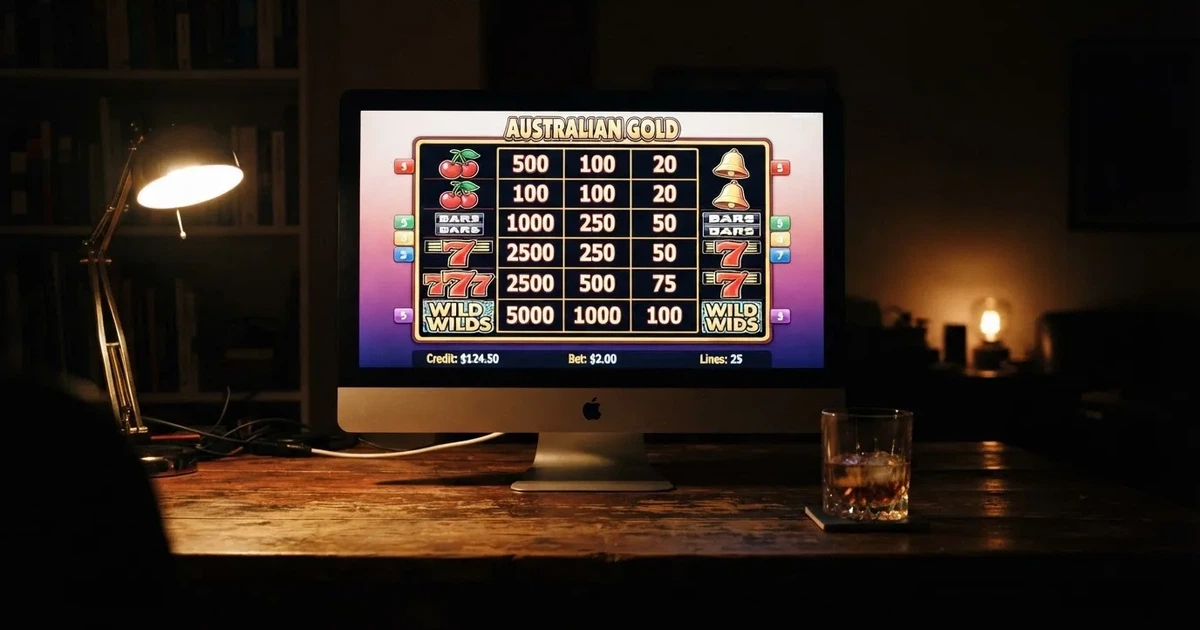
The paytable itself is a precise document that does one job. It states the symbols, the line combinations that pay, the value of each combination and, on most modern Australian machines, the theoretical return-to-player figure the manufacturer submitted for approval. A punter who opens the help or information screen on a NSW pub machine sees the same kind of disclosure a Crown Melbourne player sees — the disclosure format varies by jurisdiction, but the disclosure itself is mandatory. What changes between the two venues is the mix of titles on the floor, the bet size the venue allows, and the rules of the game the player has chosen. Two machines at the same RTP can pay very differently in the same hour. The screen says so, plainly, to anyone who reads it.
A pub or club player in NSW sees the same floor a casino player sees in Melbourne — the difference is the venue’s mix of titles, not the rule. Western Australia, by contrast, has had a different conversation since 1985, when Crown Perth opened and the state banned pokies from pubs and clubs entirely. Crown Perth’s own count has grown from about 200 machines in 1985 to roughly 2,500 today, all of them at the 90% Western Australian floor and approved one by one by the state’s Gaming and Wagering Commission. Tasmania has taken the opposite tack: a 2021 act ended the decades-long Federal Group monopoly, and the regulator is now the Tasmanian Liquor and Gaming Commission, with mandatory pre-commitment cards — the player sets a cap before they sit down — whose introduction slipped from 2024 into late 2025.
Queensland sits inside the 85% floor, but the state-level comparison can mislead: 21,122 machines were operating across 351 Queensland venues in October 2023. New South Wales, the country’s largest machine population outside Crown’s floors, had 87,298 gaming machines outside casinos across 2,195 venues as of June 2023, with player losses of A$8.18 billion in 2022-23 alone. The volume is the consequence of the lax minimum, not a separate fact about the machines. A higher state floor does not, on its own, mean the average player keeps more of their money; it shifts where the house edge sits, and what remains in a player’s pocket over a year of play. The machine on the floor returns less, on average, than the rule suggests the floor would allow, and the gap between the floor and the average is where the venue’s take lives.
Eleven Offshore Brands the ACMA Has Named for Offering Online Pokies to Australians
A shortlist of “best” high-RTP pokies that can actually be played by a person in Australia is, by law, an empty list. No Australian regulator licences online casino games, online pokies or in-play betting — the Interactive Gambling Act 2001, tightened by the 2017 amendment, makes the offer itself the offence, and the Australian Communications and Media Authority acts on the providers. What can be assembled, instead, is a list of the brands the regulator has formally warned for offering exactly this product to Australians. The list below is that list, in the order the ACMA has put them on its register, and it is not a recommendation. Every brand on it is one the ACMA considers to be providing a prohibited interactive gambling service.
The comparison a reader can actually draw here runs across ACMA action dates, the operator entities the regulator has named, and whether each brand is independently listed in public game-provider directories (which matters only as a measure of how visible the brand is outside the ACMA’s own register). The “best” frame — highest payout, smoothest site, fastest withdrawal — is the marketing frame the regulator has decided does not apply in Australia, because the product itself is not legally on offer.
| Brand | Operator named by the ACMA | ACMA action and date | Listed in public game-provider directories |
|---|---|---|---|
| RocketPlay | Pulsup Ltd (RocketPlay); earlier Dama N.V. | Formal warning, March 2026; earlier May 2022 | — |
| Level Up Casino | Dama N.V. | Formal warning, May 2022 | Yes (public listings reference BGaming content) |
| Woo Casino | Dama N.V. | Formal warning, March 2025 | — |
| Spirit Casino | Dama N.V. | Formal warning, May 2025 | — |
| National Casino | Consolutetish S.R.L. | Formal warning, July 2025 | Yes (public encyclopaedia entries reference the brand) |
| Bizzo Casino | Consolutetish S.R.L.; earlier TechSolutions | Formal warning, July 2025; earlier 2022 | — |
| Ignition Casino | Bamboo Media | Formal warning, July 2025 | — |
| Instant Casino | EOD Code SRL | Formal warning, February 2025 | — |
| Jackbit | Ryker B.V. | Formal warning, April 2026 | Yes (paired with CasinOK in the same notice) |
| Casino Intense | Sterplay Holding Ltd | Formal warning, April 2025 | — |
| Sky Crown | Hollycorn N.V. | Formal warning (published September 2022) | — |
Two patterns sit behind the table, with a third one easier to miss. Operator reuse runs through the file: Dama N.V. alone accounts for four of the eleven, and the regulator has had to reissue formal warnings on the same parent entity over different brands as recently as May 2025. The gap between formal warning and action runs through it too: a formal warning is the ACMA’s first public step, not a block, and the brands in this table have remained reachable from Australian internet connections for months after the date the ACMA published its notice. For a reader who has ever searched a name on this list and found the site still resolving, the warning is the regulator’s record of its own act — not a guarantee the brand is offline.
The third pattern, easier to miss, is the warning date’s relationship to the rule book. Two of the eleven (Bizzo and Sky Crown) pre-date the 2024 prohibition on credit cards and crypto for licensed online wagering, and four (Woo, Spirit, Instant, Casino Intense) post-date it. The post-2024 group is the one still operating against a tightened deposit regime; the pre-2024 group is the one the regulator had to chase across a narrower set of payment tells. The two batches read, in the register, as the regulator’s record of a market that did not narrow with the rules.
The Fundamentals of the Australian Pokies Market
Australian pokies are not one market. They are eight, with each state and territory running its own regime of machine design, return-to-player floor, venue cap and venue category. Registered clubs operated Australia’s first legal poker machines from 1956 in New South Wales, and the country’s machine estate grew from that NSW beginning into the patchwork it is today: about 3% of the world’s pub and club poker machines, by one count, on a population of 0.3% of the global total. In 2020-21 alone, Australians bet almost A$150 billion through gaming machines and lost A$12.18 billion on them.

The shape of that estate is lopsided, and the shape is itself a consequence of the rules. NSW holds 87,298 gaming machines outside casinos across 2,195 venues, on the lowest of the state minimums (85%). Victoria, on the same 85% floor in general venues and 87% at Crown Melbourne, sits at 26,380 machines outside Crown across 488 venues under a 30,000-machine statewide limit. Queensland runs 21,122 machines in 351 venues. The ACT and Tasmania sit on an 87% floor; South Australia on 87.5%; Western Australia on 90%, but only at the casino floor — pubs and clubs do not have pokies at all. The 90% Western Australian floor is a single-venue ceiling on a market the state closed to everything else in 1985.
What this gives a reader who is comparing numbers is a map, not a market. “High RTP” against this map means high relative to the state floor the player is sitting in. A 90% machine at Crown Perth is not the same offer as a 90% machine in NSW, because there is no 90% machine in NSW — the floor is 85%, and the average licensed machine in the state sits somewhere on or above that floor but not at the Western Australian level. A comparison across state lines has to be a comparison of the rules and not of the machines, because the machines are different products to begin with.
The reason the distinction matters in 2026 is that the offshore sites claiming high-RTP pokies to Australian players are claiming a product the onshore market does not sell. The onshore market sells the machine on the floor at the venue in the state the player is in; the offshore site sells a website address. The state regulator cannot touch the website, because the website is not licensed in the state. The ACMA can — and the warnings on the next section are the ACMA’s record of doing so — but the consequence the ACMA’s action produces is the brand’s exit from the Australian market, not the brand’s transformation into a licensed venue.
A punter comparing “best RTP” in Australia is, in practice, comparing three different things at once: the licensed machine in the licensed venue in the state where they are; the licensed machine in the licensed venue in a state they would have to travel to; and the website the offshore operator says offers the highest figure. The first two are products the state regulator approves one by one; the third is the subject of the rest of this page. The state minimums are the rule the onshore market obeys, and the ACMA’s warnings are the rule the offshore market has been told to obey and has, in most cases, declined.
The Prohibition: Why the ACMA’s List Is the Only “Australian Online Pokies” List
The Interactive Gambling Act 2001, as amended in 2017, makes it an offence to provide an online casino game, an online pokies product or in-play betting to a person physically in Australia. No state or territory issues a licence for the product, and no offshore licence — Curaçao, Malta, the Isle of Man — has any force against the Australian prohibition. What can be licensed is wagering on a race or sporting event placed before the event starts, lotteries, and keno. In practice, almost all licensed Australian online bookmakers are licensed by the Northern Territory Racing and Wagering Commission — 52 of them, including Sportsbet, Bet365 and Ladbrokes — for tax reasons; the commission has no full-time staff and meets once a month in Darwin.

The Two Stages of ACMA Enforcement
The ACMA’s enforcement work has two stages. The first is a formal warning under the Interactive Gambling Act, naming the operator and the brand. The second, where the brand does not comply, is a request to Australian internet service providers to block the site. As of June 2026, the ACMA had asked ISPs to block 1,751 illegal gambling and affiliate marketing websites since the first blocking request in November 2019, and more than 230 unlicensed gambling services had left the Australian market since the 2017 strengthening of enforcement. The most recent blocking round, reported on 26 June 2026, took in 12 more sites: 7Signs, ChromaBet, Donbet, Duospin, Freshbet, Slots Gem, Jacks Club, Lucky Start, Pointsbetz, Spinrise, Vinyl Casino and Wildsino.
The “no prosecution of the player” line the offshore brands put forward is technically correct but practically thin. The Interactive Gambling Act targets the provider, not the punter; no Australian has been prosecuted for placing a wager with an offshore brand. The relevant consequence sits further down: an offshore site gives no Australian consumer protection, no complaints body and no recourse if a withdrawal is refused, and a balance can be lost when the ACMA asks the ISP to block the site. The site, in other words, can vanish with the money in it.
The Blocking Rate Since November 2019
The pace of the regulator’s work, measured from the first blocking request in November 2019 to the June 2026 round, runs at roughly 22 websites blocked per month on the long-run average — between about 260 and 270 a year, with the recent rounds pulling the rate higher than the early years of enforcement. Spread over the approximately 79 months between the first request and the June 2026 figure, that works out to one block for every working day, sustained across six and a half years, against a market that loses roughly A$3.9 billion a year to illegal operators (H2 Gambling Capital’s 2025 estimate), and where the share of gambling going through legal channels fell from 74% in 2021 to 64%.
The regulator’s record, in monthly cuts, is the data a reader has to compare against when an offshore brand claims a high-RTP pokie to an Australian audience. The number is not a forecast of the next blocking round; it is the average rate the ACMA has kept up since the 2017 strengthening of the regime. A reader who treats that average as a steady drip is understating the recent pace; a reader who treats any one round as the new normal is overstating it. The band is the honest read.
Payment Rules Since 11 June 2024
Two payment rules sharpen the prohibition in practice. Since 11 June 2024, credit cards, credit-related products and digital currency are banned as a means of paying for any licensed online wagering service in Australia, with penalties up to A$247,500 for operators who breach the rule. The legal deposit routes for licensed wagering are debit card, bank transfer, PayID and Osko, and BPAY. A site that asks an Australian for a credit card or a crypto deposit is, by construction, operating outside the rules the Australian regulator enforces. The same rule is also a tell for a reader comparing offers: the deposit page a brand asks for is the strongest evidence of which regulator the brand actually answers to.
The 2026 Reform and the Tax Position
A 2026 reform extends the prohibition further. The Interactive Gambling Amendment (Gambling Reform) Bill 2026 passed Parliament on 19 August 2026, and its advertising and inducement measures commence on 1 January 2027. As of 2026, the law is on the books but the inducement ban is not yet in force, which is the period the offshore brands listed in this page are running their Australian-facing campaigns. When the inducement measures start, the marketing that runs alongside those campaigns becomes a separate contravention, separate from the prohibition on the offer itself.
Tax treatment is the last piece that lands at the player’s wallet. Gambling winnings of a recreational player are not assessable income under section 6-5 of the ITAA 1997, and losses are not deductible — unless the person carries on a business of gambling. The ATO’s working position is, check with the ATO. The reason this matters for an offshore brand is that the same tax treatment applies whether the brand is licensed or not; what does not apply is any of the consumer protection or complaints infrastructure that the licensed bookmakers answer to.
Responsible-Gambling Supports and Where the Offshore Brands Fall Outside Them
The Australian responsible-gambling regime for online play assumes the product is a wagering product, not a casino product. BetStop, the National Self-Exclusion Register, has been operating since August 2023 and binds Australian-licensed online and phone wagering services; an offshore casino is not connected to it. A punter who self-excludes through BetStop is closing an account at a licensed bookmaker, not a balance at an offshore brand.
The offshore brands in the ACMA register are out of reach of every piece of the Australian player-protection framework. They do not answer to BetStop, do not fall under the Australian credit-card ban on licensed wagering (because they are not licensed wagering), and do not report to the state regulators whose machines and venues are subject to harm-minimisation measures — pre-commitment cards in Tasmania, mandatory exclusion at certain venue types in Victoria, the cashless card trials the ACT and others have run. The National Gambling Helpline (1800 858 858), free and 24/7, and the Gambling Help Online chat service, are the two services that remain available regardless of where the bet was placed. They are not part of the wagering regulator’s framework; they are part of the broader health response.
The consequence a player feels, when an offshore site is blocked, is that the balance they had on it becomes inaccessible from an Australian internet connection. The recourse that does not exist, in that moment, is the Australian complaints body. The recourse that does, and always did, is the helpline — for harm, for budget, for self-exclusion from the licensed bookmakers the helpline can connect a caller to. BetStop is not the helpline; it is the registry that the helpline can route a caller into.
RocketPlay — Two Formal Warnings, Same Brand, Four Years Apart
The ACMA has named RocketPlay twice. The first warning, in May 2022, named Dama N.V. as the operator of a brand set that included Rocketplay among six others the regulator pulled into a single notice (Bambet, Dazard, Level Up, Wild Tornado and Cobra Casinos went into the same warning). The second, in March 2026, named Pulsup Ltd as the operator of RocketPlay — a different parent entity, on the same brand, on the same product, with the same prohibition applying. Two operators, four years apart, one domain name the regulator had to publish twice.
The brand’s status in Australian public directories of game providers is not separately documented in the regulator’s register or in independent press. What the ACMA’s two-record file gives a reader is a measure of how the prohibition runs in practice: when an offshore operator is warned, the brand does not disappear, and the operator does not always stay the same parent either. A punter who opens Rocketplay today is looking at a domain the regulator has had on its register, in two forms, for the better part of a decade.
Same product, two operators, four years apart, one domain the regulator had to publish twice. The brand’s offer of a high-RTP pokie is the offer of an unlicensed operator, twice-told — and the regulator’s record is the only durable fact on either side of the page.
Level Up Casino — One of Six Dama Brands Caught in the May 2022 Batch
Level Up Casino was one of six brands the ACMA named in a single formal warning to Dama N.V. in May 2022 — the same notice that caught Bambet, Dazard, Rocketplay, Wild Tornado and Cobra Casinos. The pattern that warning established is the one that has run through Dama N.V.’s file ever since: a parent entity operating several brand front-ends to the same prohibited product, picked up by the regulator as a group rather than as individual sites. Level Up is the most-cited of those six in independent press references to BGaming content, which is the only public-directory visibility the brand carries on the data this page is built on.
The May 2022 warning predates the 2024 payment restrictions and predates the ACMA’s later formal warnings to Dama N.V. over Woo Casino (March 2025) and Spirit Casino (May 2025). For a reader looking at the file as a single record, Level Up is the original entry; Woo and Spirit are the follow-on warnings on the same operator, four years apart. The regulator has not blocked Level Up at the time of writing — the brand sits in the warning register, not the block register — but the ACMA has had cause to publish Dama N.V.’s name four times across that window.
The cluster is what the regulator acted on; the brand is one face of it.
Woo Casino — Dama N.V.’s First Warning After the Credit-Card Reform Took Effect
Dama N.V. drew a further formal warning over Woo Casino in March 2025 — the operator’s first warning post-dating the 11 June 2024 ban on credit cards and crypto for licensed Australian online wagering. The May 2022 batch caught six Dama N.V. brands in one notice; the March 2025 warning caught Woo on its own, with Spirit Casino following two months later. The regulator’s three-year gap between Dama N.V. warnings is the gap between the 2024 payment reform and the regulator’s resumption of formal action against the same operator on a new brand.
Woo Casino’s listing in public game-provider directories is not documented in independent press or in the ACMA’s register. Our data provides no figure for the brand’s claimed RTP, no published wagering term, and no record of a withdrawal time the regulator has had to act against. The only public fact on the brand is the formal warning.
Woo is the brand Dama N.V. ran when the ACMA resumed action under the post-2024 payment regime. The March 2025 notice is the file’s record of that resumption.
Spirit Casino — The Second Dama N.V. Brand Named Within Two Months
The ACMA’s formal warning to Dama N.V. over Spirit Casino in May 2025 came two months after the regulator’s warning over Woo Casino — the second Dama N.V. brand to be named in a fresh notice in a single quarter, after a three-year gap from the May 2022 batch. Spirit is the third Dama N.V. brand the ACMA has named in a stand-alone formal warning since the 2024 payment reform; Woo was the first.
Independent press does not list Spirit Casino in game-provider directories, and the regulator’s register gives the brand no separate record outside the formal warning. What Spirit gives the file, alongside Woo, is the regulator’s pattern on a single operator within the new payment regime: a first warning, then a second, in adjacent months, against two different brand front-ends of the same parent entity. The two-warning pattern is the regulator’s signal that the operator did not narrow its Australian offer after the first.
Spirit is the second Dama N.V. brand the regulator had to name in the same quarter, two months after Woo. The pattern matters more than the brand.
National Casino — A July 2025 Warning Bundled with Bizzo Casino
The ACMA’s July 2025 formal warning to Consolutetish S.R.L. named both National Casino and Bizzo Casino in a single notice. Two brands, one operator, one date. The paired warning is the regulator’s standard form for a parent entity running multiple front-ends, and Consolutetish is one of three operators in this file (with Dama N.V. and Ryker B.V.) on that pattern. The other July 2025 warning, on the same date, named Bamboo Media over Ignition Casino — a different operator, paired with a different brand, on the same regulator’s calendar.
National Casino is one of the three brands in this file that show up in independent press outside the ACMA’s register: encyclopaedia entries reference the brand, and BGaming-class content is named alongside it. The brand’s footprint outside the regulator’s own register is the part of the data that is not the ACMA’s. The brand’s relationship to the ACMA is the same as every other entry on this page — a prohibited interactive gambling service.
National is one of two brands Consolutetish S.R.L. had to publish on the same day. The regulator’s record is on the operator, not the front-end.
Bizzo Casino — A Warning History That Begins in 2022 and Runs Through Two Operators
Bizzo Casino is the brand on this list with the longest formal-warning history. The ACMA first warned TechSolutions (CY) Group Limited and TechSolutions Group N.V. over Bizzo Casino in 2022; in July 2025 the regulator issued a further formal warning to Consolutetish S.R.L. over Bizzo Casino alongside National Casino. Two operators, three years apart, same brand. The July 2025 notice did not replace the 2022 one; the regulator’s register carries both.
The brand’s footprint outside the ACMA’s file is not separately documented in independent press. The data we have provides no figure for the brand’s claimed RTP, no published wagering term, and no record of a withdrawal time the regulator has had to act against. What the brand carries, uniquely on this list, is the regulator’s two-operator, two-notice history on the same brand name.
Bizzo is the brand on this list with the longest formal-warning history — two operators, two ACMA notices across three years. The warning did not stick, and the data records the gap.
Ignition Casino — Bamboo Media’s Brand, Paired with the Consolutetish Warnings of July 2025
Ignition Casino’s formal warning was issued by the ACMA to Bamboo Media in July 2025 — the same date as the regulator’s warnings over National Casino and Bizzo Casino under Consolutetish S.R.L. Two operators, three brands, one calendar date. The regulator publishes warnings by operator, and the July 2025 calendar shows the regulator moving against multiple parent entities in the same week.
Independent press does not list Ignition Casino in Australian game-provider directories, and the regulator’s register gives the brand no separate record outside the formal warning. Its payout statistics, wagering rules, and withdrawal history are undocumented by regulators. The only public fact on the brand is the July 2025 formal warning.
Ignition is the third brand on the regulator’s July 2025 calendar. Two operators, three brands, one week’s notices.
Instant Casino — The First 2025 Warning, on EOD Code SRL
The ACMA’s February 2025 formal warning to EOD Code SRL over Instant Casino was the regulator’s first stand-alone brand warning of 2025 — two months before the Woo Casino notice (March 2025) and three months before Casino Intense (April 2025). The February date sits between the 11 June 2024 payment reform and the rest of the 2025 cohort, and the operator is EOD Code SRL, an entity that does not appear elsewhere on this list.
Instant Casino’s listing in Australian public directories of game providers is not separately documented. The brand shows no figure for its claimed RTP, no published wagering term, and no record of a withdrawal time the regulator has had to act against. What the brand carries is the regulator’s February 2025 notice — the calendar anchor of the 2025 cohort.
Instant is the brand that opens the regulator’s 2025 cohort. The February date is the calendar anchor of every warning that followed.
Jackbit — Paired with CasinOK Under Ryker B.V. in April 2026
The ACMA’s April 2026 formal warning to Ryker B.V. named both Jackbit and CasinOK in a single notice. Two brands, one operator, one date — the regulator’s standard form for a parent entity running multiple front-ends. April 2026 is the most recent date in this file alongside the March 2026 RocketPlay warning, and Jackbit is one of two Ryker B.V. brands the regulator had to publish on the same day.
Independent press references the brand in connection with the regulator’s paired action. It carries no figure for its claimed RTP, no published wagering term, and no historical record of a withdrawal dispute. The only public fact on the brand is the ACMA’s paired formal warning.
Jackbit is one of two Ryker B.V. brands the regulator named in the same April 2026 notice. The most recent cohort; the operator is the unit the file is built on.
Casino Intense — Sterplay Holding Ltd, April 2025
Casino Intense’s formal warning was issued by the ACMA to Sterplay Holding Ltd in April 2025 — the same calendar month as no other warning on this list, and a month before Spirit Casino’s May 2025 notice. The operator, Sterplay Holding Ltd, does not appear elsewhere on the file, and the April 2025 date sits inside the post-2024 payment-reform cohort.
Casino Intense is one of three brands on this list that show up in Australian independent press outside the ACMA’s own register — references in the ABC’s coverage of Australian gambling and in ACMA notices themselves, alongside Crown Melbourne press coverage in adjacent pieces. The brand’s footprint outside the regulator’s file is the part of the data that is not the regulator’s.
Casino Intense is the brand Sterplay Holding Ltd ran under a single April 2025 notice. The operator does not recur; the brand is its sole entry on the register.
Sky Crown — The Oldest Warning Still on the ACMA’s List
Sky Crown is the oldest entry on this page. The ACMA’s formal warning to Hollycorn N.V. over Sky Crown and Blue Leo was published in September 2022, and the regulator has not, on the data this page is built on, issued a further formal warning to Hollycorn N.V. over Sky Crown since. The brand has been on the register, in the same form, longer than any other on this list; the September 2022 date is the calendar anchor of the file.
Independent press does not list Sky Crown in Australian game-provider directories, and the regulator’s register gives the brand no separate record outside the formal warning. The brand carries no figure for its claimed RTP, no published wagering term, and no prior record of a withdrawal dispute. What the brand carries is the longest standing record on the page.
Sky Crown is the brand that has sat on the regulator’s register the longest. Three and a half years on, same operator, same brand, same prohibition — and the brand’s offer of a high-RTP pokie is the offer of an unlicensed operator that has, on the available record, drawn no further notice.
Frequently Asked Questions on High-RTP Pokies in Australia
What RTP figure actually counts as “high” on a licensed Australian pokie?
Australian state minimums run from 85% (NSW, Queensland, the Northern Territory and general Victoria) to 87% (the ACT, Tasmania, and Crown Melbourne), 87.5% (South Australia) and 90% (Western Australia, casino only). Anything above the local floor counts as high by local standards.
Is the RTP on a paytable the same as the chance of winning the next spin?
No. RTP is the long-run average return across millions of spins, not a forecast for any one of them. A 90% machine will, on average, return 90 cents per dollar wagered over its working life — not over the half-hour a punter spends at the pub.
Where on the machine is the RTP figure displayed, and is that required by law?
The figure is on the help or information screen a player can open from the game’s menu. Australian state regulators require the licensed machine to disclose its theoretical return; the rules on how it is displayed vary by jurisdiction, but the disclosure itself is mandatory.
Can a venue or operator alter a pokie’s RTP setting once it is in service?
No. The theoretical return is set when the game is approved by the state regulator and is fixed for the machine’s working life. A licensed venue cannot move the dial from a back office, and a player who sees the figure on the help screen is seeing the figure the game will pay.
Does a higher RTP mean bigger individual payouts, or just more frequent ones?
It means neither, on its own. RTP is the long-run average; volatility is what shapes any session. Two machines at 90% can pay very differently — frequent small wins versus rare large ones — and the figure on the help screen says nothing about which one a player is sitting at.