
Real-money no-deposit online pokies in Australia: what follows when the offer is taken at face value
Data current as of 8 November 2026, verified against the ACMA’s formal-warning register and the Interactive Gambling Act 2001 as it stands in 2026. Anything offered to an Australian under the label “no deposit, real money, online pokies” sits in a market the ACMA treats as prohibited — the only debate worth having is what that means for the person being asked to sign up.
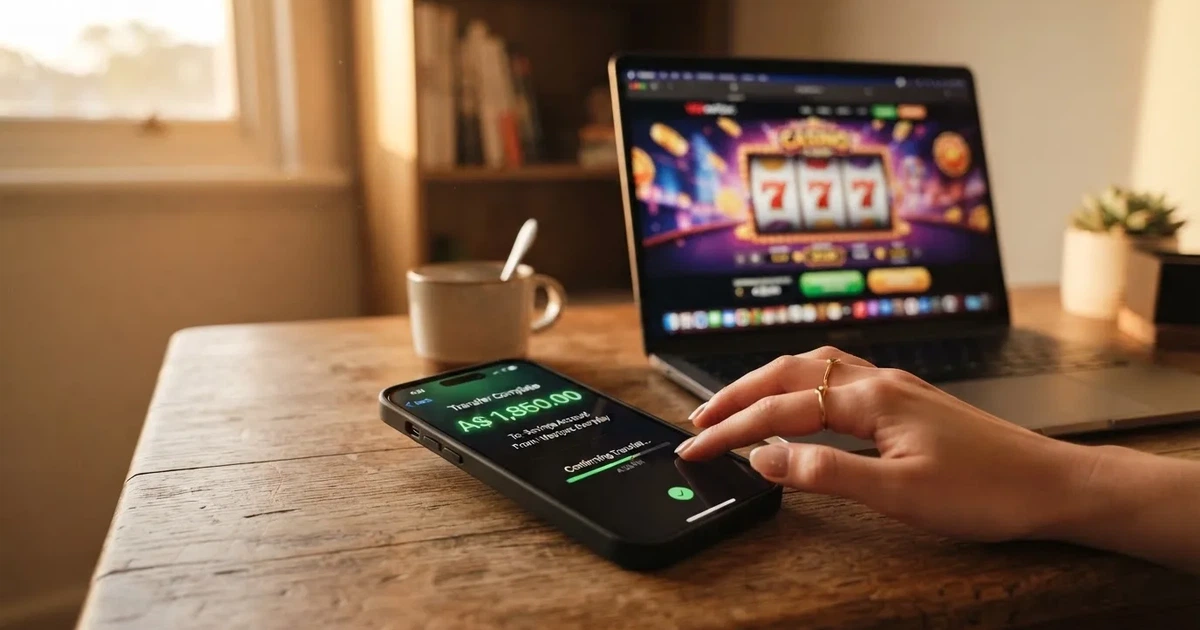
The “no deposit” label is one of the simpler marketing phrases in this market, and one of the more expensive. The offer is small, the claim is large, and the gap between the two is where most of the cost of the offer lives. Australians searching for it in 2026 are not short on land-based options — New South Wales alone runs more than 87,000 gaming machines outside casinos — but those machines are licensed state by state and do not run online. Anything that does run online, with a “no deposit” hook or without one, is offered from offshore, is not licensed in any Australian state or territory, and has been the subject of a steady stream of ACMA formal warnings. The page that follows walks through what those offers actually contain, how the settlement claim holds up against what an offshore operator can deliver, and where the law leaves the player standing once the balance is on the site.
Table of Contents
Settlement, payout speed and the instant-PayID pitch
The instant-PayID claim
PayID settles in seconds when both ends of a transfer support it — the New Payments Platform, run by Australian banks, clears individual payments in roughly the time it takes a confirmation screen to refresh. The technology works. The way it is sometimes attached to offshore pokies offers is the part worth understanding.

A PayID deposit from an Australian bank account to an Australian-licensed wagering service is ordinary. A PayID deposit from an Australian bank account to an offshore casino is something else: the funds leave a regulated system and enter one with no Australian regulator attached to the receiving end. The “instant” part of the pitch is true on the way in. The “instant” part on the way out — withdrawal — is a different mechanism entirely, governed by the offshore operator’s own terms, the payment processor the operator uses, and the verification steps that follow a first withdrawal. Nothing about the New Payments Platform forces an offshore operator to settle a payout in seconds; the technology lets a withdrawal arrive quickly if the operator releases it, and “if” is doing the work.
What follows, in practice, is this: the deposit lands, the player spends a small no-deposit credit or makes a first real deposit, accumulates a balance, requests a withdrawal. The wait, when it stretches, is rarely a PayID limit. It is verification — ID, address, source of funds — followed by the operator’s own pending window, followed by the chosen payment rail. Instant-PayID on the way in does not buy instant anything on the way out, because the queue between withdrawal request and release is not a queue at all; it is a sequence of discretionary checks run by a counterparty that is not bound by Australian law.
Settlement times as a marketing channel
“24-hour withdrawals” and “instant payouts” appear together because they are useful together — a small number plus a fast adjective. The claims vary by operator and shift with the payment method. E-wallets and cryptocurrency are typically the fastest rails offered; bank transfers and card withdrawals are slower. None of that is specific to no-deposit pokies, and none of it is enforceable against an offshore operator that chooses to delay, since the operator sits outside the Australian Consumer Law regime that ordinarily disciplines refund and payout disputes.
The consequence is that the settlement claim is best read as the operator’s stated intent rather than a service level. A brand that publishes 24-hour e-wallet withdrawals and meets that target for most players on most days can still sit on a particular withdrawal for a week pending “additional verification”, and the Australian player has nowhere to escalate that delay short of the operator’s own complaints email. The dispute body that exists for Australian-licensed wagering — the Australian Financial Complaints Authority, where it applies — does not extend to a Curaçao- or Costa Rica-licensed casino that has never registered with it.
The land-based comparison sharpens this. A pokies machine in a Sydney pub or a Melbourne club is regulated by Liquor & Gaming NSW or the Victorian Gambling and Casino Control Commission, both of which publish rules on dispute resolution, both of which can be approached by a player. A balance on an offshore site is, in regulatory terms, a private dispute with a private company in another jurisdiction. Settlement speed matters less than the absence of an Australian counterparty to enforce it.
What the deposit-and-withdrawal picture actually looks like
The deposit side is rarely the obstacle. Australians are asked for credit cards, which have been banned for licensed online wagering since 11 June 2024; they are offered debit card, bank transfer, PayID/Osko and BPAY for licensed services, and offshore sites typically accept a wider range that includes crypto. The point at which the picture changes is the withdrawal, and three things govern what happens there:
The first is the verification step. First withdrawal almost always triggers KYC, and offshore operators vary in how thorough this is — some accept a single document, some request source-of-funds evidence that takes a player to their bank. The second is the operator’s internal pending window, which is usually between 24 and 72 hours, with “instant” being a special case rather than the default. The third is the payment rail, which is the part PayID actually controls — once the operator releases funds, PayID is fast. The wait is almost always upstream of that.
What follows for a player who treated “no deposit” as the whole offer is a small bonus balance, an account that needs to clear a wagering requirement, a withdrawal request, and a multi-day process during which the operator can ask for more documents and the player has no Australian regulator to complain to. None of that is unique to no-deposit offers, and none of it is rare. What makes it worth flagging is the marketing positioning: the offer is sold on speed and simplicity, and the back end is neither.
Comparing the brands the ACMA has named
The featured brands and what the ACMA record says
The eleven operators below are not ranked and not recommended. Each appears here because the Australian Communications and Media Authority itself issued a formal warning over the brand for offering prohibited interactive gambling services to Australians — an act that, in itself, settles the question of whether the site is licensed in Australia. The table sets out what the ACMA record actually says, in the operator’s own legal name as published, so the reader can see the pattern rather than read about it.
| Brand | ACMA action and date | Operator named by the ACMA | Licensing claim visible on the page |
|---|---|---|---|
| RocketPlay | Formal warning, March 2026 (Pulsup Ltd); earlier Dama N.V., May 2022 | Pulsup Ltd | Overseas licence, not an Australian one |
| Level Up Casino | Formal warning, May 2022 | Dama N.V. | Overseas licence, not an Australian one |
| Woo Casino | Formal warning, March 2025 | Dama N.V. | Overseas licence, not an Australian one |
| Spirit Casino | Formal warning, May 2025 | Dama N.V. | Overseas licence, not an Australian one |
| National Casino | Formal warning, July 2025 | Consolutetish S.R.L. | Overseas licence, not an Australian one |
| Bizzo Casino | Formal warning, July 2025 (Consolutetish S.R.L.); earlier TechSolutions, 2022 | Consolutetish S.R.L. | Overseas licence, not an Australian one |
| Ignition Casino | Formal warning, July 2025 | Bamboo Media | Overseas licence, not an Australian one |
| Instant Casino | Formal warning, February 2025 | EOD Code SRL | Overseas licence, not an Australian one |
| Jackbit | Formal warning, April 2026 | Ryker B.V. | Overseas licence, not an Australian one |
| Casino Intense | Formal warning, April 2025 | Sterplay Holding Ltd | Overseas licence, not an Australian one |
| Sky Crown | Formal warning, September 2022 | Hollycorn N.V. | Overseas licence, not an Australian one |
The matter added to the table — the licence claim visible on the page — is uniform across the eleven, and that uniformity is the point. Every brand in this set displays a non-Australian licence somewhere on its site. None of those licences permits it to take a real-money bet from a person in Australia. The ACMA’s formal warnings are issued precisely because the brand continued to take Australian customers after the regulator’s prior interventions, and the regulator’s response is to publish the warning and, where it follows, ask Australian ISPs to block the domain.
The pattern across the eleven is not that one is more or less compliant than another. It is that the regulator’s intervention is the only fact that ties them together: the ACMA names each one because it offers prohibited services to Australians, not because the brands share an owner or a software platform. Several are linked — Dama N.V. appears under five brands, Hollycorn N.V. under one with a sibling in Blue Leo — but most sit alone, and the licensing structure behind them is rarely disclosed in a way that an Australian reader can act on. The column the table cannot show is what happens after the warning: whether the brand stops taking Australian players, restricts them, or carries on. The ACMA does not publish follow-up data in real time; readers who land on any of these brands should treat the warning as current unless the brand itself can demonstrate otherwise.
How the brands compare on what they actually offer
The marketing pages for these brands, before the regulator acts, tend to look interchangeable: a hero banner, a “no deposit” or “free spins” headline, a real-money signup flow, and a Curaçao or Anjouan licence in the footer. What differs across them is not the Australian legal position — that is identical for all eleven — but the construction of the offer, the wagering multiple, the maximum-cashout cap, and the small print that determines whether a player who wins anything on the no-deposit credit ever sees a withdrawal.
Where the ACMA record gives one figure and the brand gives another, the ACMA record wins, because the ACMA record is what determines whether the site can legally be reached from Australia. Where the ACMA has acted and the brand carries on, the player is the one absorbing the consequence of that decision. The brands do not compete on legality; they compete on bonus size, game count, payment-method range, and withdrawal promises — none of which is enforceable in Australia.
The shape of the market a no-deposit offer sits inside
The pokies Australia already has
Australians are not short of ways to play a poker machine. Gaming machines — pokies — operate in every state and territory under separate regulatory regimes, and the numbers are large: more than 87,000 in New South Wales outside casinos as of June 2023, more than 21,000 in Queensland as of October 2023, more than 26,000 in Victoria outside Crown Melbourne under a 30,000-machine statewide cap. Tasmania, the Australian Capital Territory and the Northern Territory run smaller fleets. Western Australia is the exception: poker machines were banned in pubs and clubs when Crown Perth opened in 1985, and the casino itself now holds roughly 2,500 of them.
In 2020–21 Australians bet almost A$150 billion through these machines and lost A$12.18 billion on them — close to A$400 per adult. Australia has about 3% of the world’s pub and club poker machines with around 0.3% of the global population. The market is mature, regulated, and the dominant gambling product in the country by handle. The minimum return-to-player on these machines varies by jurisdiction — 85% in NSW, the Northern Territory and Queensland, 87% in the ACT and Tasmania, 87.5% in South Australia, 90% in Western Australia. Crown Melbourne runs at 87%. Those floors are set by state regulators and apply to the licensed machines only.
The picture that follows is a long-standing, state-regulated product that Australians use at scale, with a parallel and wholly separate online market that the IGA 2001 (as strengthened by the 2017 amendment) prohibits from being offered to Australians at all. A “real-money no-deposit online pokies” offer is, by definition, addressed to a market that the offshore operator is not licensed to serve — which is why the ACMA’s warnings cluster around online casinos and not around the licensed clubs and pubs.
Where the prohibition actually lands
The Interactive Gambling Act 2001 makes it an offence to provide an “interactive gambling service” — defined to include online casino games, online pokies and in-play betting — to a person physically in Australia. The 2017 amendment strengthened the civil penalty regime and the enforcement powers of the ACMA. What the IGA does not do is prosecute the individual player. The Act targets the provider, not the customer. An Australian who signs up, deposits and plays is not personally at risk of prosecution; the operator is. The consequences for the player are not legal in the criminal sense. They are practical: no Australian regulator to complain to, no Australian dispute body, no Australian consumer law to fall back on, and a real chance the site is blocked mid-session with a balance on it.
The BetStop national self-exclusion register, live since August 2023, applies only to Australian-licensed wagering services — offshore casinos are not connected to it. A player who self-excludes via BetStop has not excluded themselves from an offshore casino, and the offshore casino has no obligation to honour the exclusion. The National Gambling Helpline (1800 858 858, free, 24/7, with chat at Gambling Help Online) is available regardless of where a person plays, and remains the right contact for anyone who finds themselves playing more than they intended.
The consequence to carry forward from this section is straightforward. The market an Australian is being addressed in does not exist as a legal Australian market. The offer is real; the licence behind it is overseas; the consequences of any dispute are borne by the player.
The 2026 enforcement picture
In a round reported on 26 June 2026, the ACMA asked Australian internet service providers to block 12 more illegal gambling websites: 7Signs, ChromaBet, Donbet, Duospin, Freshbet, Slots Gem, Jacks Club, Lucky Start, Pointsbetz.com, Spinrise, Vinyl Casino and Wildsino. That round sits inside a cumulative total reported the same day: 1,751 illegal gambling and affiliate marketing websites blocked since the first blocking request in November 2019, and more than 230 unlicensed gambling services having left the Australian market since enforcement was strengthened in 2017.
A blocking request is the heaviest tool the ACMA has — it does not stop at a formal warning, it does not stop at a referral to the operator’s home regulator, it asks every major Australian ISP to cut the route to the domain. The blocking record is the most readable proxy for how often the regulator finds the formal-warning route insufficient, and the running total since November 2019 is the figure that shows what “enforcement” looks like as a sustained policy rather than a one-off action.
That gives a rate worth doing the arithmetic on. The first blocking request was issued in November 2019; the cumulative count at the end of June 2026 stood at 1,751 sites. The arithmetic below is straightforward, and the result is what the page’s calculation block is for.
The arithmetic of blocking
The ACMA’s blocking record runs from November 2019 to June 2026 — roughly 80 months. Across that period, 1,751 illegal gambling and affiliate marketing websites were added to the blocking list. The simplest rate is straightforward: 1,751 divided by 80 gives about 22 blocked sites per month on average, or close to one every 36 hours. The figure is a band rather than a point, because the count is cumulative and the rate is not constant — early years saw fewer blocks as the formal-warning regime took shape, and the most recent rounds have run in larger batches.
The condition that produces the band is the wording of the count itself. The 1,751 figure includes affiliate marketing websites — sites that promote the casinos rather than host the games — alongside the gambling services themselves. Stripping affiliates out would lower the count; reading the ACMA’s published list strictly as casinos would lower it further. The band reported here assumes the published total is taken at face value: somewhere between 20 and 25 sites added per month, with the higher end reflecting the larger batches the regulator has run in 2026 and 2026–2026.
What follows from this rate is the comparison that matters to a reader. A “no deposit” offer is a marketing spend by an operator that does not have an Australian licence to lose. The operator’s incentive to honour the offer is the lifetime value of the player who signs up, weighed against the cost of acquiring that player through an affiliate. The regulator’s incentive is the reverse — to make the affiliate traffic expensive enough that the operator pulls out. The blocking rate is the regulator’s pace, and the formal-warning register is the regulator’s patience. Both are running at speed.
What the ACMA has acted on, and how the picture is changing
The recent formal-warning record
The ACMA’s formal-warning register names the operator behind the brand and the date the warning was issued. In the months between February 2025 and June 2026 the register has carried: Instant Casino (EOD Code SRL, February 2025); Woo Casino and Spirit Casino (Dama N.V., March and May 2025 respectively); Casino Intense (Sterplay Holding Ltd, April 2025); Ignition Casino (Bamboo Media, July 2025); National Casino and Bizzo Casino (Consolutetish S.R.L., July 2025); Jackbit and CasinOK (Ryker B.V., April 2026); and Rocketplay.com.au (Pulsup Ltd, March 2026). Each warning was issued under the Interactive Gambling Act 2001, and each names a brand that was offering prohibited services to Australians.
What the register does not show is the outcome. The ACMA publishes the warning and the regulator’s expectation that the operator stop offering the service; whether the operator complies is rarely followed up in the public register. Dama N.V. was warned in May 2022 over six brands — Bambet, Dazard, Level Up, Rocketplay, Wild Tornado and Cobra Casinos — and again in March 2025 and May 2025 over two more, which is to say the operator was warned twice, three years apart, and continued to offer to Australians in between. Hollycorn N.V. was warned in September 2022 over Sky Crown and Blue Leo, and the ACMA’s record at that date stops there. The reader who lands on one of these brands today is being offered a service the regulator has already told the operator to stop offering.
The consequence that follows from this record is a one-line test that holds for all eleven brands in the table. Is the brand listed on the ACMA’s formal-warning register? If yes, the regulator has already decided that the offer to Australians is prohibited. The brand’s own characterisation of its licence, the size of its no-deposit bonus, and the speed of its PayID withdrawals do not change that finding.
What the regulator’s pace actually means
The cumulative count of 1,751 blocked sites since November 2019, and the 12-site round reported in June 2026, are the numbers most worth holding on to. They describe a regulator that is escalating rather than winding down — a pace of roughly 22 blocked sites per month on the published count, with rounds of between 10 and 30 names at a time. An industry report from 2025 estimates that Australians lose about A$3.9 billion a year to illegal gambling sites puts the market behind those blocks at scale, and the fall in legal-channel share from 74% in 2021 to 64% in the 2025 estimate suggests the illegal market has been growing, not shrinking, while the block list has been growing with it.
The 2026 reform package is the part that changes the picture rather than continuing it. The Interactive Gambling Amendment (Gambling Reform) Bill 2026 passed Parliament on 19 August 2026. Its advertising and inducement measures commence on 1 January 2027. What this means for a 2026 page is that the new advertising rules are law with a future start date — not yet in force, not yet being enforced, but already passed. The consequence for “no deposit” offers is direct: inducement-style advertising, of which no-deposit headlines are a textbook case, falls inside the scope of the new measures. A page written in the second half of 2026 is writing about an offer type whose advertising is about to be regulated in a new way, and the offer itself remains prohibited in the meantime.
Keeping the offer in proportion
What the offers actually contain
The “no deposit” label, in this market, almost always means a small allocation of bonus funds or free spins attached to a fresh account, with a wagering requirement, a maximum-cashout cap and a game restriction attached to the winnings. The structure is uniform across offshore operators, which is the structural fact most worth understanding.
The wagering requirement is the multiplier on the bonus that determines how much has to be turned over before a withdrawal is allowed. Forty times is common; fifty times appears; thirty times is on the generous end. A “no deposit” bonus of A$10 with a 40x wagering requirement means A$400 of turnover before any winnings become withdrawable — and the A$400 is turned over on games whose house edge sits between roughly 1% (some baccarat bets, with optimal play) and well over 10% on many pokies variants. The expected loss from clearing that bonus is not zero, and the offer is not the gift the headline suggests.
The maximum-cashout cap is the second constraint. A typical cap on a no-deposit bonus is in the A$50 to A$200 range — whatever the player wins from the bonus, the maximum amount the operator will pay out is that cap, and any balance above it is removed at the point of withdrawal. The cap is rarely advertised in the headline, and it is the single largest reason the offer’s headline value does not survive contact with the small print.
The game restriction is the third. Not every game counts 100% toward the wagering requirement. Pokies usually count fully; table games often count at 10% or are excluded entirely; some pokies variants are excluded by name. The restriction exists because a player who could clear wagering on a low-edge game would do exactly that, and the offer would become a small guaranteed payment.
What follows, taken together, is a small bonus that requires a meaningful turnover, capped at a payout the operator chooses, on games the operator chooses. The arithmetic the offer invites is the comparison between the headline bonus and the expected loss from clearing it, and the expected loss almost always exceeds the headline. The offer is structured to be tried, not to be cleared profitably.
The support services that actually apply
The Australian support services for anyone who finds themselves playing more than they intended are the same regardless of where the play happens. The National Gambling Helpline is 1800 858 858, free, 24/7. Gambling Help Online provides web chat. State-based services — Gambler’s Help in Victoria, GambleAware in NSW, the relevant service in each other state — offer counselling and financial counselling. Gambling Help Online is the right starting point for anyone who is unsure which state service applies.
The minimum age for any gambling activity in Australia is 18. The IGA targets the provider; the age restriction targets everyone. BetStop is the national self-exclusion register, but — as described in the Legality section — it binds only Australian-licensed services, which means an offshore casino is not bound by a BetStop registration. A self-excluded player who opens an offshore account is not protected by the registration they hold. The support services, by contrast, are reachable regardless of where the play happened.
The decision the page invites
The decision is not a hard one to describe, even if it is a hard one to make. The offer is structured to attract a signup; the operator is not licensed in Australia; the regulator has already told the operator to stop; the consequences of any dispute sit with the player. The arithmetic on the offer does not work in the player’s favour, and the support services are there for the cases where it has been tried.
For the reader who is reading because the offer sounded too good to ignore, the page is not an attack on the impulse. It is a statement of what the offer contains, where it sits in Australian law, and what the record shows the regulator doing about it. The rest is the reader’s call.
Frequently asked questions
Can “real money” and “no deposit” genuinely go together, or is one of those claims always doing the work?
They go together in the sense that the offer exists — an offshore operator will credit a small bonus or a set of free spins to a new account and let the winnings be played for real money. The claim that does the work is “no deposit”: the deposit is not required to start, but the wagering requirement, the maximum-cashout cap and the game restrictions are what the player exchanges for the bonus. The real-money part is true on the operator’s platform; it is not protected by any Australian regulator.
How does an instant-PayID no-deposit pokies claim differ from an ordinary no-deposit one?
The PayID label describes the deposit rail. PayID settles in seconds when both ends support it, and a PayID deposit from an Australian bank account into an offshore casino is technically a fast transaction. The instant-PayID claim rarely says anything about the withdrawal rail, where the operator’s verification and pending window are the actual limit on payout speed. A deposit that lands in seconds and a withdrawal that takes days is the common shape; the marketing copy rarely covers both.
Is playing real-money pokies for no deposit from an offshore site something Australians can legally do?
The player is not prosecuted — the Interactive Gambling Act 2001 targets the provider, not the customer. But the service itself is prohibited, and the ACMA has issued formal warnings over multiple offshore brands for offering it. Playing at one of those brands is not illegal for the player, but it sits outside any Australian regulatory protection: no dispute body, no consumer-law recourse, and a real possibility the site is blocked mid-session with a balance on it.
What withdrawal limit usually applies to winnings from a no-deposit real-money pokies offer?
A maximum-cashout cap sits on the offer, almost always between A$50 and A$200. Whatever the player wins from the bonus, the operator will only pay out up to that cap, and any balance above it is removed at withdrawal. The cap is in the operator’s terms rather than the headline, and is the largest single reason the headline value of the offer does not survive the small print.
Why do best-of lists for this keep mixing free pokies with genuine real-money no-deposit offers?
Because both phrases convert well in search. “Free pokies” covers demo play, which is not a real-money offer and never has been, and “real money no deposit” covers the offshore bonus-credit structure. A list that mixes the two can rank for both queries, and the affiliate revenue per click is the same regardless of what the player finds on the other side. The mix is a commercial choice, not a categorisation one, and the reader who treats the two as the same offer is the reader the affiliate model is built around.
What separates “online pokies real money no deposit” from “free pokies real money no deposit” claims?
The first names an offer that exists only on offshore sites — bonus credit, wagering requirements, a cashout cap, and no Australian licence behind it. The second sometimes names the same offer and sometimes names a demo version of a pokie that is not a real-money offer at all. The difference matters because the demo version costs nothing and pays nothing out; the offshore version costs the player the expected loss from the wagering requirement, capped at whatever the operator’s maximum cashout is.