
Safe online casino australia 2026: what the marketing does not say, and how to read a brand’s safety claims
The phrase “safe online casino australia 2026” gets typed into search boxes by people who have already noticed that something feels off about the offshore sites they’re looking at, and want to know which of them genuinely deserve their trust. The honest answer is uncomfortable: there is no Australian-licensed online casino to be safe at, because the Interactive Gambling Act 2001 prohibits the supply of online casino games and online pokies to anyone physically in Australia, and no state or territory licence covers them. What this page is actually about, then, is how to read the safety claims an offshore brand makes, what the regulator has already done about it, and what an Australian player can put in place on their own side when nothing on the operator’s side will protect them.
This page is current as of 25 November 2026 and was checked against the ACMA’s published list of formal warnings and blocking actions, plus the RBA’s most recent payments data. Operators that have been the subject of a formal warning under the Interactive Gambling Act 2001 are reviewed in §6 of the research, in the order the regulator itself took action. None of them is recommended to a reader as a place to play.
Table of Contents
- Legality and what the ACMA has actually been doing
- Responsible gaming in a market without licensed online casinos
- The actual subject of the search: what to check on an offshore brand’s claims
- The brand-by-brand record
- Practical safeguards an Australian can put in place today
- What to take from the page
- Frequently asked questions
Legality and what the ACMA has actually been doing
The legal position, plainly
The Interactive Gambling Act 2001, as tightened by the Interactive Gambling Amendment Act 2017, makes it an offence to supply online casino games, online pokies or in-play betting to a person in Australia. The provider is the target of the law, not the player — no Australian punter has been prosecuted for placing a bet, and the regulator’s stated focus is on the offshore operator continuing to advertise and accept payment. What is licensable in Australia is wagering on races and sporting events placed before the event, lotteries and keno, and the practical licensing body for online wagering is the Northern Territory Racing and Wagering Commission, which sits over 52 of the country’s online bookmakers — Sportsbet, Bet365 and Ladbrokes included — and runs, by the ABC’s 2026 reporting, without full-time staff, meeting once a month in Darwin.

The consequence for someone reading this page is sharp and worth spelling out. Any site that takes an Australian deposit for casino games or online pokies is doing so without an Australian licence, no matter what licence badge it shows in its footer. A Curaçao or Anjouan sub-licence, a Kahnawake registration, a Costa Rica incorporation — none of these authorise supply into Australia. The brands in §6 of the research all display some such offshore credential; the ACMA’s formal warnings exist because the regulator treats that credential as irrelevant to the Australian-facing offer.
How the ACMA has moved against offshore brands
The Australian Communications and Media Authority has been the working arm of enforcement since the 2017 amendments, and its actions fall into two distinct streams: formal warnings to operators, and blocking requests directed at ISPs. Both streams are published, both are named, and both have been picking up pace.
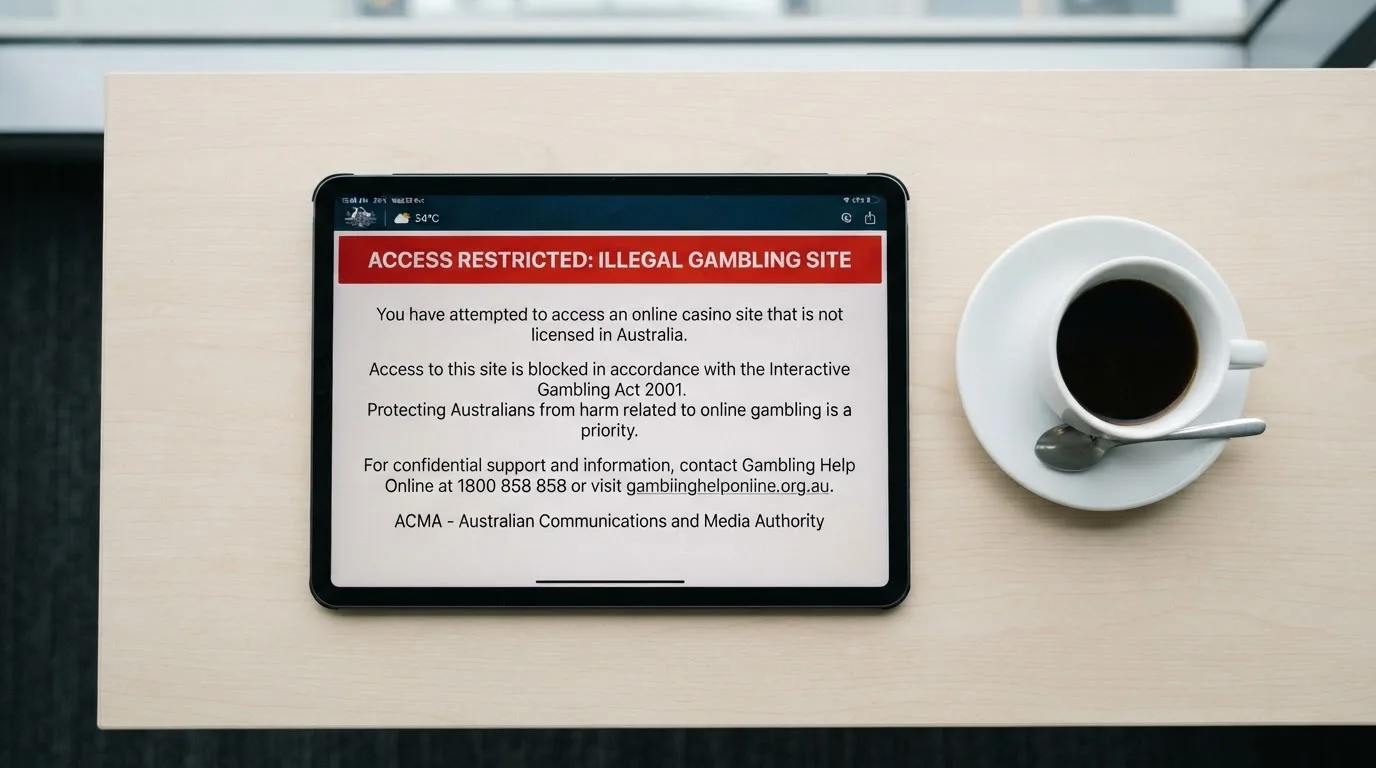
Formal warnings are public letters to a named company pointing out a specific breach of the Act, with a stated remediation window. The ACMA has published warnings to Dama N.V. covering six brands in May 2022 — Bambet, Dazard, Level Up, Rocketplay, Wild Tornado and Cobra Casinos — and followed that with two more Dama N.V. warnings over Woo Casino in March 2025 and Spirit Casino in May 2025. The July 2025 round added three more operators in a single batch: Bamboo Media over Ignition Casino, Consolutetish S.R.L. over National Casino and Bizzo Casino, the latter already warned once before in 2022. EOD Code SRL received a warning over Instant Casino in February 2025; Sterplay Holding Ltd over Casino Intense in April 2025; Hollycorn N.V. over Sky Crown and Blue Leo in September 2022; Ryker B.V. over Jackbit and CasinOK in April 2026; and Pulsup Ltd over RocketPlay in March 2026. Each is a public record the reader can look up on the ACMA’s website, with a date, a named corporate entity, and a named brand.
Blocking is the harder edge of the regime. By June 2026, the ACMA had asked Australian internet service providers to block 1,751 illegal gambling and affiliate marketing websites since the first blocking request in November 2019, and more than 230 unlicensed gambling services had left the Australian market since enforcement was strengthened in 2017. The 26 June 2026 round alone added 12 sites to the block list — 7Signs, ChromaBet, Donbet, Duospin, Freshbet, Slots Gem, Jacks Club, Lucky Start, Pointsbetz, Spinrise, Vinyl Casino and Wildsino — names that turn over month to month, but the cumulative arithmetic keeps marching.
The blocking-rate calculation the page is built around asks the simple question: how fast is that arithmetic moving? Working from the published totals — 1,751 sites blocked across the period from the first blocking request in November 2019 to the 26 June 2026 round — the ACMA has averaged in the order of 260 blocking actions per year over the seven-year window. The figure is not exact: the rate rises year on year as enforcement ramps up, and the early years of the regime carried very few blocks compared to the post-2023 cadence. Read as a band rather than a single number, blocking has run somewhere between roughly 200 and roughly 350 sites per year since 2019, with the highest single-year totals landing in the last two reporting cycles. The direction of travel is the point: this is a regulator that publishes what it has done, and what it has done is increasing.
What enforcement costs the operator
The cost is not theoretical. Once a site is on the blocking list, Australian ISPs refuse to resolve its domain, which means Australian customers cannot reach the cashier. A player with a balance still on the site at the moment of blocking has no Australian complaints body to escalate to, no Australian regulator to call, and no Australian court whose order the offshore operator is obliged to recognise. The same operator that advertised “responsible gaming” and “safe and secure” in its footer two days earlier can, with no Australian recourse mechanism, simply stop answering withdrawal emails. The marketing language of “safety” carries no contractual weight against an offshore entity that is, by definition, breaking Australian law to take the deposit in the first place.
This is what makes “safe” a peculiar word for the search. The marketing copy uses it to mean encrypted payments, RNG-tested games and a responsible-gaming link in the footer. The regulator uses it to mean licensed for Australian supply under the Interactive Gambling Act 2001. Those are not the same claim, and the ACMA’s formal warning record is the regulator telling readers that they are not the same claim.
Responsible gaming in a market without licensed online casinos
The safeguards that actually exist
The Australian responsible-gaming infrastructure was built around licensed wagering, and its pillars are real. BetStop — the National Self-Exclusion Register, live since August 2023 — lets a person exclude themselves from every Australian-licensed online and phone wagering service in a single registration. The exclusion periods are meaningful, and the licensed operators are bound to enforce them. The National Gambling Helpline, 1800 858 858, is free, runs 24/7 and connects to Gambling Help Online for chat-based support and counselling. Financial Counselling Australia and the state-based problem-gambling organisations (such as Gambling Help NSW, Gambler’s Help Victoria and the relevant bodies in each other state) provide free, confidential advice that is not connected to any operator. These services are built for, and tailored to, Australian residents, in Australian English, on Australian time.
What they cannot do is what an offshore casino will not let them do. BetStop binds only Australian-licensed online and phone wagering services; an offshore casino is not connected to the register, and registering with BetStop does not exclude a person from a Curaçao-licensed site that has never heard of the scheme. The helpline can still help, but the practical lever — a binding exclusion that the operator has to honour — does not exist on the offshore side. The gap is structural, and it is worth understanding before reading further.
The reader-side defences worth setting up
Three settings cost nothing, take minutes to apply, and give a person a working friction layer even when the offshore operator’s own tools are missing or quietly ignored. None of them require anyone’s permission to operate.
The first is the bank’s gambling block. Australia’s four major banks all offer one, and they operate at the card-network level — Westpac’s block, for example, refuses authorisation of any transaction tagged with the merchant category code for Betting/Casino Gambling on eligible personal credit and debit cards. ANZ’s block, set up through the ANZ app, also catches gambling transactions made through a digital wallet such as Apple Pay on an eligible card; Commonwealth Bank offers a comparable lock on eligible cards via the CommBank app. The bank’s own caveat applies to all of them: the block may miss some gambling transactions and may block some non-gambling transactions in error, and ANZ’s block carries an explicit 48-hour wait if the customer later wants to remove it. None of these is a complete shield, but a block that stops the deposit reaching the cashier is the difference between playing and not playing on the night it matters most.
The second is the wallet and device layer. Apple Pay, Google Pay and Samsung Pay now account for around 45% of all card payments in Australia by number, and under the 2023 amendments to the Interactive Gambling Act 2001, Australian-licensed online wagering services cannot accept credit-card payments or credit-related products — a restriction that constrains the gambling use of linked digital wallets on the licensed side. The licensed side, again, is what the rules cover; an offshore casino accepting Apple Pay against a credit instrument is breaking Australian law to do it, and the card-issuer’s block is the practical defence. The Reserve Bank’s July 2025 review proposes removing surcharges only on eftpos, Mastercard and Visa card transactions, leaving American Express outside the proposed scope — a reminder that the surcharge regime is its own topic and not a safety one.
The third is the payment-instrument choice. PayID is the layer most worth understanding. Paying to a PayID shows the name of the registered account holder before the transfer is sent, and Australian Payments Plus warns that being asked to transfer money to a PayID on an illegal gambling site is almost certainly a scam. PayID-based instant transfers are available at over 100 Australian financial institutions, and the underlying New Payments Platform — live since 13 February 2018, owned by New Payments Platform Australia Ltd and merged with BPAY and eftpos under Australian Payments Plus since 2021 — moves money between participating banks in under a minute through Osko, 24/7. More than 25 million PayID identifiers had been registered by April 2025. The system itself is not the problem; it is the use of it. Sending to a PayID at an offshore casino is sending to a person, not a regulated operator, and the holder-name check is the only friction standing between the deposit and a chargeback dispute that an offshore operator has no obligation to honour.
What an offshore casino’s own responsible-gaming tools usually amount to
The standard offshore responsible-gaming page offers a deposit limit, a time-out, and a self-exclusion. The deposit limit is the most useful of the three and the most easily undercut: a person who has set a A$200 daily limit at one brand can register a second account at the same brand on a different email and start over, because the offshore operator’s know-your-customer checks are not designed to detect it. The self-exclusion is the most advertised and the least enforceable in practice; an offshore operator that has decided to ignore an Australian’s exclusion request can simply close the ticket and reopen the account, and the Australian player has no regulator to appeal to. The time-out is the most innocuous and the most easily circumvented by a person who has decided they want to play.
H2 Gambling Capital’s 2025 report, cited by industry press, estimates that Australians lose about A$3.9 billion a year to illegal gambling sites, and that the share of gambling going through legal channels fell from 74% in 2021 to 64%. The fall is partly an explanation of why the regulator has been escalating: an Australian who chooses an offshore site is, on the aggregate numbers, one of an enormous crowd of Australians doing the same thing, and the responsible-gaming infrastructure on the offshore side is not catching them.
The actual subject of the search: what to check on an offshore brand’s claims
Reading a “safety” claim against what the regulator has said
A site’s “safe and secure” footer is a marketing sentence, not a licence. The first check, before anything else, is whether the ACMA has published a formal warning to the operator named on the brand. The ACMA publishes each warning on its website with the date, the company name and the brand; a reader who wants to verify a specific brand can search the ACMA’s formal warning register directly, and a brand that appears on it has been told, in writing, that its Australian-facing offer breaches the Interactive Gambling Act 2001.
The brands in §6 of the research are exactly that: brands the regulator has named. The review that follows is not a recommendation. It is a description of what the ACMA has done, when, and to which named corporate entity, and a verdict on what that record implies for an Australian reader who is, despite the regulator’s action, considering the brand.
Where the licensing claim actually sits
A typical offshore casino’s footer carries a licence badge from Curaçao, Anjouan or Kahnawake. The badge is real, in the sense that the licence exists; it is also irrelevant to an Australian player. The Curaçao licensing regime authorises the operator to take bets from jurisdictions that have not specifically prohibited it; Australia has specifically prohibited it, and a Curaçao licence does not override the Australian prohibition. A reader who finds an offshore casino’s licence reassuring should weigh it against the ACMA’s published view, which is that the licence does not authorise the offer the brand is making to Australians.
Reading the regulator’s enforcement as a track record
The ACMA’s enforcement record on a brand is a more useful signal than the brand’s own marketing copy. A brand that has been warned once and has subsequently removed its Australian-facing offer — by geo-blocking Australian IPs, refusing Australian payment methods and not marketing in Australian-facing media — has done the minimum the regulator asked for. A brand that has been warned more than once has either ignored the warning or has changed names and come back. Dama N.V., the operator behind Woo Casino, Spirit Casino, Rocketplay, Level Up and several other brands named in this page, has been the subject of multiple ACMA warnings over multiple brand names across multiple years; the record there is one of a corporate group continuing to seek Australian-facing business despite being told, repeatedly, that the offer is prohibited.
The site features that survive any regulator’s reach
Three features matter once a brand has cleared the regulator’s record (or, more commonly, has not). The first is the payment-method list. A site asking for a credit card or a cryptocurrency deposit is operating outside the Australian rules even on the licensed-wagering side, because the 2023 amendments ban both; an offshore casino asking for either is asking an Australian to use an instrument the regulator has decided is unsuitable for gambling. The second is the complaints path. An offshore operator has no Australian complaints body to escalate to, and the offshore complaints process typically routes to the licensing jurisdiction — Curaçao, Anjouan, Kahnawake — where the regulator’s interest in a complaint from an Australian is, in practice, nil. The third is the withdrawal mechanism. An offshore casino that takes an instant deposit and quotes a “24-hour withdrawal” should be read against the regulator’s blocking regime: if the brand’s domain is added to the ACMA’s block list while a withdrawal is pending, the player has no recourse. Speed of withdrawal is not the same as reliability of withdrawal, and the difference between the two is the difference the regulator’s enforcement actually costs.
The brand-by-brand record
The eleven brands below are reviewed in the order the regulator took action. Each review states the ACMA action and date, the corporate entity named by the ACMA, and what that record implies for an Australian reader. None of them is recommended; the record is presented so a reader who has already encountered the brand can read it against what the regulator has done.
RocketPlay
The ACMA issued a formal warning to Pulsup Ltd over RocketPlay in March 2026. Dama N.V., the operator behind an earlier iteration of the brand, was the subject of an ACMA warning in May 2022 covering six brands including Rocketplay. Two warnings to two different corporate entities over the same brand is the regulator telling the same Australian-facing offer that it is not authorised. The site’s own marketing refers to offshore licensing and lists payment methods that include instruments the licensed Australian market does not allow. For an Australian reader, the brand’s record on ACMA action is the clearest part of its profile: it has been told twice that the offer it is making here is prohibited, and it has kept making it.
Level Up Casino
The ACMA issued a formal warning to Dama N.V. in May 2022 over six brands, Level Up among them. Dama N.V. is one of the better-known Curaçao-licensed operator groups in the offshore market; it has, on the ACMA’s record, been the subject of more than one formal warning over more than one brand. The fact that the operator continues to accept Australian-facing traffic after a 2022 warning places Level Up in the same group as the other Dama N.V. brands reviewed further down this page. For a reader comparing brands within a single corporate group, the warning history is the part of the comparison that matters; the bonus and game library do not change the regulator’s view.
Woo Casino
The ACMA issued a formal warning to Dama N.V. over Woo Casino in March 2025. Woo is the second Dama N.V. brand in this page, and the warning is later than the May 2022 batch — meaning the operator had been told once before that the offer to Australia was prohibited, and the regulator found it necessary to tell it again. The marketing the brand runs carries the standard “safe and secure” language; the regulator’s record is the part of the brand a reader should treat as authoritative.
Spirit Casino
The ACMA issued a formal warning to Dama N.V. over Spirit Casino in May 2025. The pattern — Dama N.V., formal warning, Australian-facing offer — is the same as Woo Casino two months earlier, and the same as Level Up three years earlier. Spirit Casino is a brand-new skin on a known enforcement history, and the regulatory position is identical to the other Dama N.V. brands on this page.
National Casino
The ACMA issued a formal warning to Consolutetish S.R.L. over National Casino in July 2025. The 2025 batch was a single ACMA action that named three operators across three brands — National Casino among them — and the warning was issued under the Interactive Gambling Act 2001 directly to the corporate entity behind the brand. For an Australian reader, what the regulator’s named corporate entity tells them is which company they are depositing with at law; offshore restructurings that move a brand between corporate shells do not change the regulator’s view of the underlying offer.
Bizzo Casino
The ACMA issued a formal warning to Consolutetish S.R.L. over Bizzo Casino in July 2025. Bizzo had already been the subject of a 2022 formal warning to TechSolutions (CY) Group Limited and TechSolutions Group N.V., which makes it one of the few brands on this page with warnings to two different operator entities across multiple years. A repeat-warning brand is the clearest evidence the regulator has that the operator group’s behaviour toward Australian-facing customers has not changed in response to being told it was breaking the law.
Ignition Casino
The ACMA issued a formal warning to Bamboo Media over Ignition Casino in July 2025. Ignition has a longer history in some offshore markets than the other brands on this page, and the formal warning is the regulator’s first recorded Australian-facing action against it. The warning places it in the same July 2025 enforcement round as National Casino and Bizzo Casino, and the implication for a reader is the same as for the others in that batch: an Australian-facing offer the regulator has now put on record as prohibited.
Instant Casino
The ACMA issued a formal warning to EOD Code SRL over Instant Casino in February 2025. The brand’s marketing lists payment methods that include credit-card and crypto options an Australian-licensed operator cannot take under the 2023 Interactive Gambling Act amendments. An offshore operator accepting those instruments is not, by virtue of doing so, somehow outside the Australian rules; it is breaking them, and the formal warning is the regulator’s record of that fact.
Jackbit
The ACMA issued a formal warning to Ryker B.V. over Jackbit in April 2026. The April 2026 warning was issued jointly over Jackbit and CasinOK, both Ryker B.V. brands, which places Jackbit in the same corporate-group pattern as the Dama N.V. brands earlier in this page — a single offshore operator group warned once, warned across multiple skins. The brand’s Australian-facing offer is the one the regulator has acted against, and the corporate group behind it has now been told so in writing.
Casino Intense
The ACMA issued a formal warning to Sterplay Holding Ltd over Casino Intense in April 2025. Casino Intense is one of the smaller-recognised brands in this review, and the formal warning is the regulator’s principal published enforcement action against it. The offer to Australian customers that prompted the warning is the offer a reader who reaches the site today is being asked to take; nothing in the regulator’s record suggests that offer has been withdrawn.
Sky Crown
The ACMA issued a formal warning to Hollycorn N.V. over Sky Crown and Blue Leo in September 2022. Sky Crown is the earliest-dated warning on this page other than the May 2022 Dama N.V. batch, and the regulator’s record on Hollycorn N.V. has not been updated since. A reader who finds the brand’s marketing reassuring should weigh it against the fact that the regulator’s view was stated in 2022 and the brand continues to address Australian-facing traffic.
| Brand | ACMA action and date | Operator named by the ACMA | Additional regulatory or compliance context |
|---|---|---|---|
| RocketPlay | Formal warning, March 2026 | Pulsup Ltd | Earlier Dama N.V. warning, May 2022 |
| Level Up Casino | Formal warning, May 2022 | Dama N.V. | — |
| Woo Casino | Formal warning, March 2025 | Dama N.V. | — |
| Spirit Casino | Formal warning, May 2025 | Dama N.V. | — |
| National Casino | Formal warning, July 2025 | Consolutetish S.R.L. | — |
| Bizzo Casino | Formal warning, July 2025 | Consolutetish S.R.L. | Earlier TechSolutions warning, 2022 |
| Ignition Casino | Formal warning, July 2025 | Bamboo Media | — |
| Instant Casino | Formal warning, February 2025 | EOD Code SRL | — |
| Jackbit | Formal warning, April 2026 | Ryker B.V. | Same warning covers CasinOK |
| Casino Intense | Formal warning, April 2025 | Sterplay Holding Ltd | — |
| Sky Crown | Formal warning, September 2022 | Hollycorn N.V. | Same warning covers Blue Leo |
Practical safeguards an Australian can put in place today
Payment-side safeguards
The single highest-leverage thing an Australian can do is switch the payment instrument away from credit. Credit cards and credit-related products are banned as payment for Australian-licensed online wagering under the 2023 amendments to the Interactive Gambling Act 2001, with penalties up to A$247,500 for an operator that accepts them. A site asking an Australian for a credit card is, by definition, asking the customer to use an instrument the regulator has ruled unsuitable for gambling in this market. Debit cards, bank transfers, PayID/Osko and BPAY are the legal deposit routes for licensed wagering; an offshore site accepting credit cards is making an offer the regulator has already said should not be made. BPAY itself has operated in Australia since 1997, is available in the online banking of over 140 banks and financial institutions, and is offered by over 95,000 businesses — but BPAY is a bill-payment service for bills, not a deposit rail into an offshore casino, and any site directing an Australian payer to send a BPAY payment to a “casino account” is misusing the instrument. PayID, by contrast, is a deposit rail: more than 100 Australian financial institutions support PayID-based instant transfers, the underlying New Payments Platform is required to keep its monthly outages to under two minutes, and a payer can see the name on the receiving PayID before sending. The name check is the safety feature; ignoring it is the mistake.
Bank-side safeguards
The bank’s gambling block is the second layer. Westpac refuses authorisation on transactions tagged with the merchant category code for Betting/Casino Gambling on eligible personal credit and debit cards; ANZ’s block, activated in the ANZ app, also blocks gambling transactions made through a digital wallet such as Apple Pay on the eligible card, with a 48-hour wait to remove it once activated; Commonwealth Bank lets customers apply a gambling lock to eligible cards through the CommBank app. Each bank’s own caveat — that not every gambling transaction will be blocked and some non-gambling transactions may be blocked in error — is worth taking at face value. The blocks are imperfect, but they are the closest thing to a hard barrier the Australian retail-banking side offers, and the friction they introduce is real friction, on the night it matters most.
Self-exclusion and counselling
BetStop, the National Self-Exclusion Register, binds Australian-licensed online and phone wagering services — which means it binds exactly the operators the offshore brands reviewed in this page are not. For an Australian who wants a binding exclusion from every Australian-licensed bookmaker, BetStop is the right place to register. For someone whose play has been on offshore brands, BetStop will not catch the offshore side, and the practical recourse is to use the bank block and the wallet choice as the primary friction, with BetStop and the National Gambling Helpline (1800 858 858, 24/7, free, with chat at Gambling Help Online) as the human support alongside. The two layers — the financial-friction layer and the support-services layer — are the parts of the responsible-gaming infrastructure that work whether or not the offshore operator participates.
What to take from the page
The search “safe online casino australia 2026” is the question of someone who has already noticed that the offshore casino market’s “safe” language does not survive contact with the regulator. The honest answer, which this page has tried to set out without softening, is that no offshore casino is licensed to supply casino games or online pokies to a person in Australia, that the ACMA’s enforcement record is the regulator telling the same Australian-facing offer, again and again, that it is not authorised, and that the safeguards worth relying on are the ones an Australian can put in place on their own side — the bank’s gambling block, the wallet choice, the credit-versus-debit decision, the PayID name check, and the BetStop registration that binds the Australian-licensed side. The brand reviews above are not recommendations; they are a record, and a reader who already has a brand in mind can find it in the ACMA’s published formal warning register and read the regulator’s own language on it directly.
The Interactive Gambling Amendment (Gambling Reform) Bill 2026 passed Parliament on 19 August 2026, with its advertising and inducement measures commencing on 1 January 2027. The law exists with a start date that has not yet arrived on the page a reader is reading in 2026; what is in force today is the IGA as amended in 2017 and 2023, the ACMA’s blocking programme, and the bank’s own responsible-gambling tooling. That combination is what “safe online casino australia” actually amounts to in 2026, and it is the answer to the search.
Frequently asked questions
What are the clearest signs an online casino claiming to be “safe” is not actually licensed anywhere reputable?
The clearest single sign is that the brand accepts Australian customers for online casino games or online pokies at all: under the Interactive Gambling Act 2001 no Australian licence covers those products, so any “Australian-facing” casino offer is by definition not licensed for the Australian market. The second clearest sign is a footer badge from Curaçao, Anjouan or Kahnawake presented as if it authorised the Australian offer — it does not. The third is a payment-method list that includes credit cards or cryptocurrencies, which are banned for Australian-licensed wagering under the 2023 IGA amendments.
Is a PayID deposit any safer than a card deposit at an offshore online casino?
PayID itself is a domestic real-time transfer rail run by Australian Payments Plus, available at over 100 Australian institutions, and a payer can see the registered account-holder name before sending. That name check is a real protection against impersonation. It is not, however, protection against the underlying problem: sending money via PayID to an offshore casino is still paying an entity the ACMA has told, in many cases in writing, that its Australian-facing offer is prohibited, and a chargeback dispute with that entity is enforceable in no Australian forum.
Is it legal for an Australian to use an offshore online casino even if that site markets itself as “safe”?
The Interactive Gambling Act 2001 targets the provider of a prohibited interactive gambling service, not the individual customer; no Australian has been prosecuted for placing a bet. Using an offshore casino is not, in itself, a criminal offence for the player. It does, however, place the player outside every Australian consumer-protection mechanism: there is no Australian complaints body, no Australian regulator to escalate to, no Australian court whose order the offshore operator is obliged to recognise, and no guarantee the site will remain reachable if the ACMA adds it to its blocking list with a balance outstanding.
What should someone do if they realise they have been playing at an offshore casino and want to stop?
The first practical step is the bank’s gambling block: Westpac, ANZ and Commonwealth Bank all offer card-level gambling blocks via their apps, with ANZ’s block also covering digital-wallet gambling transactions on the eligible card and carrying a 48-hour wait to remove. The second is BetStop, the National Self-Exclusion Register, which binds Australian-licensed online and phone wagering services — not offshore brands, but a meaningful step on the licensed side. The third is the National Gambling Helpline on 1800 858 858, free and 24/7, with chat at Gambling Help Online, and the state-based problem-gambling counselling services, all of which are free, confidential and tailored to Australian residents.
How does a genuinely regulated gambling operator’s safety record differ from an offshore casino’s own marketing claims?
A genuinely regulated Australian wagering operator is licensed by the Northern Territory Racing and Wagering Commission (or another state/territory regime), is bound by the Interactive Gambling Act 2001 as amended in 2017 and 2023, is connected to BetStop and to the Australian bank’s responsible-gambling tooling, accepts only the payment methods the rules permit, and is subject to enforceable Australian complaints and dispute-resolution mechanisms. An offshore casino’s “responsible gaming” page is the operator’s own commitment, policed by an offshore regulator whose interest in an Australian complaint is, in practice, nil. The difference is not the language on the page; it is the regulator behind it.
What free support services exist in Australia for someone concerned about their own online casino use?
The National Gambling Helpline is 1800 858 858, free, 24/7, with web chat at Gambling Help Online. Financial Counselling Australia and the state-based services — Gambling Help NSW, Gambler’s Help Victoria, and the equivalent in each other state and territory — provide free, confidential financial and gambling counselling. BetStop, the National Self-Exclusion Register, is free to register and binds every Australian-licensed online and phone wagering service in a single registration. Lifeline (13 11 14) and Beyond Blue (1300 22 4636) provide broader mental-health support that is not gambling-specific but is useful alongside the gambling-specific services.