
Pokies in South Australia 2026: the venues that are licensed, the sites that are not, and what the difference costs
A punter in Adelaide looking for “the best pokies” in 2026 is really asking one of two questions, and they lead to different doors. The first door leads to a building: a pub in Norwood, a club in Elizabeth, the gaming floor at SkyCity Adelaide on North Terrace. Every gaming machine in those places sits under a South Australian licence, on a return-to-player floor written into state law, behind a cashier who checks identification. The second door leads to a website — RocketPlay, Woo Casino, Jackbit, the rest of the offshore set — and it is closed by design. The Interactive Gambling Act 2001 makes it unlawful to offer online casino games, including online pokies, to anyone in Australia. No state or territory issues a licence for them. What the offshore sites sell is therefore not a licensed substitute for the pub down the road; it is an offer that Australian regulators have already moved against, repeatedly and by name.
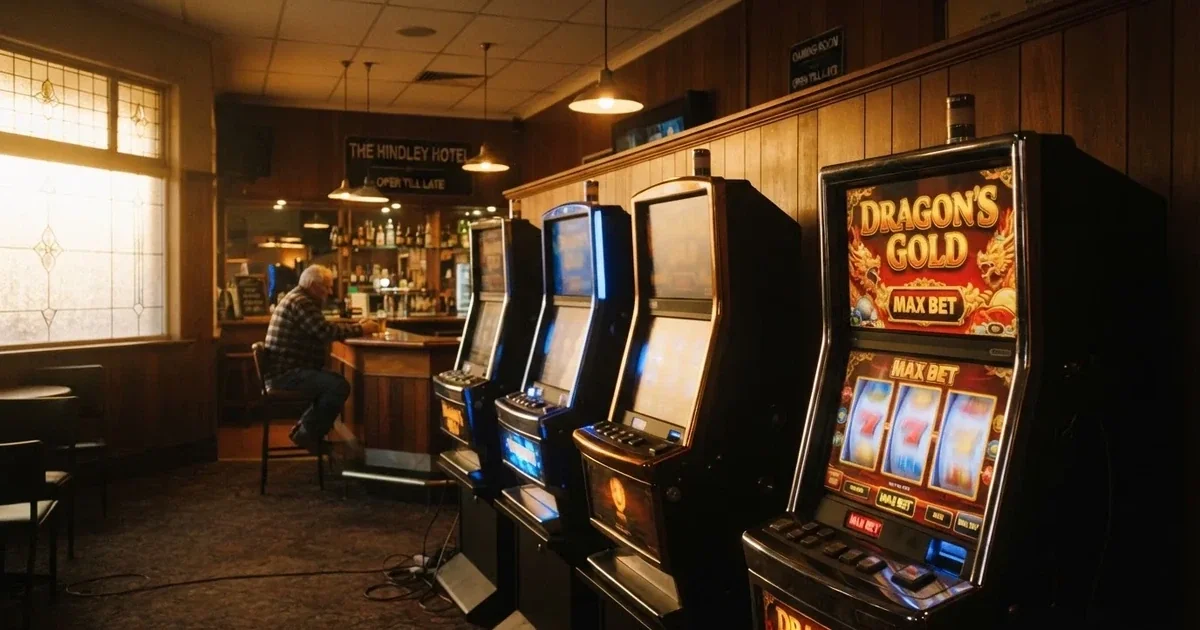
This page is built around that split. The first half walks through what is lawfully on offer in South Australia — the 471 hotels and clubs running 11,672 machines, the one casino, the cashless and self-exclusion systems that frame play. The second half names eleven offshore brands the ACMA has acted against, because the comparison most readers are silently making is “could I just play online instead?”, and the honest answer is the one the regulator has been publishing for years. The angle here is not “go play here.” It is “here is what is actually available, here is what it costs you in plain numbers, and here is who each option suits — including who it does not.”
Data current as of 25 November 2026; verified against the Australian Communications and Media Authority’s formal-warning register, Consumer and Business Services (SA), and the Gambling in Australia reference record on Wikipedia.
Table of Contents
- The eleven offshore brands South Australians most often see advertised — and what the ACMA did about each
- The licensed pokies scene in South Australia — what is actually on offer
- The legal frame: why the offshore option is closed
- Responsible gambling and self-exclusion in South Australia
- How deposits and withdrawals actually work in South Australian venues
- Specific games, providers and the 24-hour question
- How this shortlist was put together — and what it actually ranks
- Frequently asked questions about pokies in South Australia
The eleven offshore brands South Australians most often see advertised — and what the ACMA did about each
The roster below is not a ranking and not a recommendation. It is a list of eleven brands the ACMA has publicly named in formal warnings for offering prohibited online casino services to people in Australia. Every one of them describes itself elsewhere as a place to play “pokies.” None of them holds an Australian licence that allows that offer. The order is the order the ACMA itself used across its warning publications, from the most recent action back to the earliest in the pack.

The comparison that matters here is not which bonus is largest; offshore bonuses are not claimable inside Australia in any event, and the only sources for their terms were affiliate marketing pages. The comparison that matters is: which operator has the regulator named, when, and under which corporate entity — because that is the only specification the regulator has actually checked.
| Brand | ACMA action and date | Operator named by the ACMA | Subject support |
|---|---|---|---|
| RocketPlay | Formal warning, March 2026; earlier Dama N.V. action May 2022 | Pulsup Ltd | — |
| Jackbit | Formal warning, April 2026 | Ryker B.V. | — |
| Level Up Casino | Formal warning, May 2022 | Dama N.V. | listings only — see en.wikipedia.org and vgccc.vic.gov.au |
| Woo Casino | Formal warning, March 2025 | Dama N.V. | listings only — see en.wikipedia.org |
| Spirit Casino | Formal warning, May 2025 | Dama N.V. | — |
| National Casino | Formal warning, July 2025 | Consolutetish S.R.L. | listings only — see Abc.net.au and infrastructure.gov.au |
| Bizzo Casino | Formal warning, July 2025; earlier TechSolutions action 2022 | Consolutetish S.R.L. | — |
| Ignition Casino | Formal warning, July 2025 | Bamboo Media | — |
| Instant Casino | Formal warning, February 2025 | EOD Code SRL | — |
| Casino Intense | Formal warning, April 2025 | Sterplay Holding Ltd | listings only — see Abc.net.au, Asgam.com and cbs.sa.gov.au |
| Sky Crown | Formal warning, September 2022 | Hollycorn N.V. | listings only — see en.wikipedia.org |
What “listings only” means in two of those rows is that the only places this page found any reference to the brand were directory and aggregator sites — a Wikipedia page, a Victorian regulator’s responsible-gambling list, an ABC News article, a state infrastructure portal. The ACMA’s own register is the only authoritative source for the formal warning. Where the subject support cell is empty, nothing surfaced beyond the warning itself; that is the data, and it is not dressed up.
Two things follow from this table that any reader should hear before going further. First, the same corporate name appears over and over. Dama N.V. accounts for four of the eleven brands in the table, and has been warned for one or another of them in three separate years (2022, 2025, twice in 2025). Hollycorn, Consolutetish and Ryker each appear behind more than one. The regulator is not chasing a long tail of small operators; it is chasing a small set of corporate groups that rebrand quickly when one site is named. Second, the dates are recent. Five of the eleven warnings were issued in 2025 or 2026. Whatever a brand’s marketing page says about being a long-established operator, the ACMA’s most recent correspondence about it is recent too.
RocketPlay — the most recent action in the table
The March 2026 formal warning to Pulsup Ltd over Rocketplay.com.au is the freshest entry on the regulator’s list. Pulsup is the corporate entity the ACMA named; the site itself is a rebrand that has cycled through different operators in different warnings (Dama N.V. was named for an earlier Rocketplay brand in May 2022). For a South Australian punter, the relevant point is not the corporate shell but the date: this is what the regulator was doing about this brand less than twelve months before any reader lands on the page.

Rocketplay.com.au’s domain name targets Australians directly — the .com.au suffix is a clue that the marketing assumes an Australian audience even if the corporate seat is not. That is the configuration the ACMA’s action addresses: an offer aimed at Australians, hosted offshore, unlicensed in Australia. Any balance held with the operator sits outside any Australian dispute resolution, and if the site is added to a future blocking round (see the calculation further down) that balance becomes unreachable.
Jackbit — the other 2026 entry
Ryker B.V. received the April 2026 warning covering both Jackbit and CasinOK. Two brands, one operator, one warning — the regulator’s preferred efficiency when the same corporate vehicle is fronting multiple front-ends. Jackbit markets itself on speed-of-payout and crypto deposits; that pitch is doubly incompatible with the Australian rules, because crypto deposits for online wagering were banned in mid-2024, and “payout speed” is irrelevant when the site itself is unlawful here. There is no AU-facing alternative for a Jackbit customer to migrate to. They have been playing a site the regulator has now named.
The Dama N.V. cluster — Level Up, Woo, Spirit, plus an earlier Rocketplay
Four of the eleven warnings name Dama N.V. as the operator. The May 2022 warning covered six brands in one go; the March 2025 warning covered Woo Casino; the May 2025 warning covered Spirit Casino. A reader who has played on Level Up, then moved to Woo when Level Up was blocked, then moved to Spirit, has played three sites that are now on the same regulator’s list under the same corporate name. The marketing pages describe these as independent brands. The ACMA’s correspondence treats them as one offer under one operator.
National Casino and Bizzo — the Consolutetish pair
Consolutetish S.R.L. was named in July 2025 over National Casino and Bizzo Casino. Bizzo had already been the subject of a 2022 formal warning to TechSolutions (CY) Group Limited and TechSolutions Group N.V., which means the brand has now been warned under two different corporate owners. That is the textbook rebrand pattern: warning issued, brand cycled to a new entity, marketing continues.
Ignition, Instant, Casino Intense, Sky Crown — the remainder
Ignition Casino (Bamboo Media, July 2025), Instant Casino (EOD Code SRL, February 2025), Casino Intense (Sterplay Holding Ltd, April 2025) and Sky Crown (Hollycorn N.V., September 2022) round out the table. The Hollycorn warning also covered a sister brand, Blue Leo, which is not in this pack but operates under the same envelope. Sky Crown is the oldest entry; its being on the list at all is what matters — the regulator has not let the older warnings lapse, and a brand warned in 2022 is still being watched.
What this table is for, and what it is not
The table is for one thing only: showing, side by side, the brand name, the date, the operator the ACMA actually wrote to, and what other sources say about the brand beyond the warning. It is not a quality ranking. It is not a shortlist of “the offshore sites you might still consider.” Every row is a site the regulator has named for an unlawful offer to Australians, and every row carries the same outcome under Australian consumer law: no Australian licence, no Australian dispute resolution, and an entry on a blocking list that the ACMA has been steadily extending since November 2019. That is the comparison the reader came for, and that is what the table answers.
The licensed pokies scene in South Australia — what is actually on offer
The offshore list is one half of the picture. The other half is what the law actually permits, and the answer is concrete and specific.
The shape of the market on the ground
As of September 2023, South Australia had 11,672 gaming machines outside Adelaide Casino, distributed across 471 venues — pubs, clubs, and hotels licensed to host gaming. Statewide player losses on those machines totalled about A$0.92 billion in 2022–23, equivalent to roughly A$497 per adult. Those two numbers frame the rest: South Australia is not a small market, and it is not a lightly-regulated one. It is a sizeable, licensed, monitored industry that runs through roughly one venue for every 3,800 adults in the state.
The 471 venues are not interchangeable. A suburban pub might run 20 to 40 machines; a larger club might run several hundred. Return-to-player on those machines is set by the state at a minimum of 87.5%, with a general maximum bet of A$5.00 per spin. The 87.5% floor is meaningful: it is the regulator’s view of the edge a venue may charge, and below it the maths stops working for the operator. Adelaide Casino, by contrast, has no maximum-bet limit, and its machines sit on a different commercial envelope.
Adelaide Casino — the one casino licence in the state
Adelaide Casino, commercially known as SkyCity Adelaide, sits inside the heritage-listed Adelaide railway station on North Terrace. It is South Australia’s only licensed casino and operates under the Casino Act 1997, regulated by Consumer and Business Services within the Attorney-General’s Department. The venue runs 90 gaming tables and 950 gaming machines. Its table-game monopoly runs to 30 June 2035, a licence that also allows expansion to up to 200 tables and 1,500 machines subject to redevelopment. The 2015–2021 Riverbank redevelopment added the EOS by SkyCity tower (120 hotel rooms and expanded gaming space) at a cost of about A$330 million.
For a South Australian punter looking at “the best pokies” the city has, the casino is the largest single venue by machine count and the only one with no maximum-bet ceiling on the machines. The corresponding trade-off is the daily compliance presence Consumer and Business Services keeps there, and the host-responsibility interactions that follow — staff whose job is to watch the floor and act. That is the regulatory texture of a casino licence: more is possible, more is watched.
The regulator and the recent reform
The state’s gambling regulator is Consumer and Business Services (CBS), part of the Attorney-General’s Department, handling policy, licensing and compliance for betting, casinos, gaming machines and lotteries. The previous Independent Gambling Authority was abolished in December 2018, and the Liquor and Gambling Commissioner became the sole gambling regulator for the state. Adelaide Casino’s day-to-day compliance is run from inside that structure, with CBS staff on the floor focused on patron interactions.
The wider set of reforms that took effect on 3 December 2020 — pre-commitment, cashless gaming trials, signage and host-responsibility duties — is the current operating environment for every venue in the state. They are not headline-grabbing measures individually, but they are the rules that determine what a player experiences at the cashier and on the machine.
How the licensed market compares to the offshore one on payout percentage
South Australia sets an 87.5% minimum RTP on machines outside the casino. Adelaide Casino’s machines are higher — they have to be to compete on the floor — but no public figure for the casino floor’s blended RTP is available beyond the venue’s own statements. For offshore sites the figure is whatever the operator publishes, and what it publishes is whatever its regulator requires of it (most commonly Curaçao, where the disclosure regime is minimal). The honest comparison is: in South Australia you can read the floor in the state law; offshore, the operator tells you what it wants you to know.
The legal frame: why the offshore option is closed
The Interactive Gambling Act 2001, strengthened by the Interactive Gambling Amendment Act 2017, makes it an offence to provide online casino games, online pokies or in-play betting to a person physically in Australia. No state or territory issues a licence for those products. The “pokies” the offshore sites advertise are not a separate, lightly-regulated category; they are the same product the Act prohibits. The licence any offshore site displays — Curaçao, Anjouan, whatever else — does not authorise provision to Australians. The ACMA has been enforcing that position since 2017 and the volume of enforcement has only grown.
What the ACMA does in practice
The ACMA investigates complaints, issues formal warnings, and directs Australian internet service providers to block illegal sites. Since the first blocking request in November 2019 and through to the round reported in June 2026, 1,751 illegal gambling and affiliate marketing websites have been blocked, and more than 230 unlicensed gambling services have left the Australian market since the 2017 strengthening. The June 2026 round alone asked ISPs to block 12 more: 7Signs, ChromaBet, Donbet, Duospin, Freshbet, Slots Gem, Jacks Club, Lucky Start, Pointsbetz, Spinrise, Vinyl Casino and Wildsino.
The blocking works through the major Australian ISPs, which is what makes it operationally meaningful. A site on the blocking list does not load on the major residential networks; a reader who can still reach it is on a network that has not yet propagated the direction, or is using a tool to circumvent it. Either way, the site is on a list maintained by Australia’s communications regulator, and that fact does not go away when the workaround does.
What a blocking round means in plain numbers
Take the running total of blocked sites and the date the ACMA first asked ISPs to block, and you get the rate at which the regulator has been adding names to the list. From November 2019 to the June 2026 round, 1,751 sites were blocked across roughly six and a half years, an average of around 270 blocked sites per year. The recent pace is faster than that average: the June 2026 round alone added 12, and earlier 2026 and 2025 rounds added comparable numbers. As a band, the regulator is now blocking somewhere in the order of 250 to 300 illegal-gambling sites per year, with the recent runs sitting toward the upper end of that range. That is not a one-off crackdown; it is the steady operation of an enforcement regime that has been running for the better part of a decade and shows no sign of slowing.
That calculation matters for a punter because it tells them what kind of risk an offshore site carries over its lifetime. A site that opens today will, on the regulator’s recent track record, be either blocked or warned within a year or two. A punter who deposits with it is depositing into a window that is narrowing.
What enforcement means for the player personally
The IGA targets the provider, not the player. An Australian punter is not prosecuted for opening an account and placing bets on an offshore site. What they lose by going offshore is consumer protection: there is no Australian complaints body, no recourse if a withdrawal is refused, and no guarantee the balance can be moved out before the site is blocked. A blocked site can still hold a player’s balance; the only thing it cannot do is accept new Australian traffic through the major ISPs. That is a meaningful distinction for the player’s money, even if it is not a criminal one.
The 2024 payment ban and what it shut off
Since 11 June 2024, credit cards, credit-related products and digital currency cannot be used to fund licensed online wagering in Australia, with penalties up to A$247,500 for operators that breach the rule. The legal deposit routes for licensed wagering are debit card, bank transfer, PayID/Osko and BPAY. An offshore site that asks an Australian customer for a credit card or a crypto deposit is therefore not only operating outside the Australian licensing regime, it is also using a payment method that the licensed market has been told to stop accepting. The two rules layer: an offshore site is unlawful on the product side, and its payment flow is unlawful on the payment side.
Responsible gambling and self-exclusion in South Australia
The responsible-gambling supports available to a South Australian punter are tied to the venues and operators that hold an Australian licence. That distinction matters: BetStop, the National Self-Exclusion Register, has been live since August 2023, but it binds only Australian-licensed online and phone wagering services. An offshore casino is not connected to it. A punter who has self-excluded through BetStop has excluded themselves from licensed Australian bookmakers and wagering services, not from RocketPlay or Jackbit, and not from a Curaçao-licensed site that accepts Australian traffic in spite of the IGA.
What is actually available
The National Gambling Helpline (1800 858 858) is free, 24/7, with chat via Gambling Help Online. It is the front door for anyone in Australia, regardless of which kind of site they have been playing on. The state-level support sits inside that national framework, with Consumer and Business Services the regulator that patrons can contact with concerns about a licensed venue.
The South Australian venue-level support is the host-responsibility duty the venues themselves carry: the cashier who checks ID, the staff member who approaches a player who has been at a machine for a long stretch, the pre-commitment mechanisms the 2020 reforms brought in. Those mechanisms are part of the licensed product. They are what the law buys you, alongside the dispute resolution and the regulated payout floor.
What this means for someone who has been playing offshore
A punter who has been playing on one of the eleven brands in the table above has been playing outside every Australian protection. If they want to use BetStop to exclude themselves from wagering in Australia, they can — and it will cover the licensed bookmakers and licensed online wagering. It will not cover the offshore casino. The way out of the offshore casino is to stop depositing and to withdraw whatever balance the operator will release; there is no Australian body that can compel a withdrawal from an offshore operator.
For someone whose gambling has become a problem, the right first call is the National Gambling Helpline on 1800 858 858. The right second step is to close the offshore accounts directly. The right third step is to enrol in BetStop so the licensed side of the market is closed off as well.
How deposits and withdrawals actually work in South Australian venues
The “payout speed” question is one a lot of readers arrive with, and the answer is very different for a South Australian venue than for an offshore casino.
Cashless and card-based play inside venues
South Australian venues have moved progressively toward cashless gaming. A punter who walks into a pub with a gaming room in 2026 is likely to fund play through a pre-commitment card or a venue-issued account rather than feeding notes directly into the machine. The 3 December 2020 reforms gave the state the framework for that shift, and the venues have implemented it in stages since. The result is a session that is recorded, capped at whatever the player has set, and visible to the venue staff.
Withdrawals inside a venue are immediate in the sense that the funds are already on the system: a player takes their card to the cashier and the balance is paid out. There is no offshore-style “pending withdrawal” period, because there is no offshore-style operator. The venue cashier is the end of the chain.
Payout percentage as a feature
The 87.5% minimum RTP on machines outside the casino is set by the state. Adelaide Casino’s machines sit at higher published rates, but the relevant point for a punter is that the floor is the same in every pub, club and hotel in South Australia. A punter comparing two suburban venues is comparing service, atmosphere, food, machine selection, the size of the smoking area if that matters, and the cash-out procedures — not the payout percentage, which is fixed.
The maximum cash payout per machine is also set under the state rules; the limit varies by venue and machine class, and is published on the machine itself. For someone whose definition of “best pokies” is “the machines with the largest single-spin payout,” the answer is to check the machine’s placard before playing.
What does not apply
The offshore-style payout-speed talking points — “withdrawals in under an hour”, “instant crypto payouts”, “no fees” — do not translate to the South Australian venue context. They are marketing claims made by operators whose offer is itself unlawful in Australia, and the speed they describe is the speed of a payment that is going through an unregulated corridor. Inside a South Australian venue, payout is at the cashier, in cash or by transfer, on the spot.
Specific games, providers and the 24-hour question
The “best pokies” question in South Australia is partly a question about which machines are on the floor. South Australian venues carry the standard Australian machine mix — poker-style machines, spinning-reel games, the Aristocrat and IGT content the Australian market has run for decades — but the specific titles on any given venue’s floor are set by the venue operator and the state’s gaming-machine approval regime.
What the law says about 24-hour venues
The “24 hour pokies” framing is partly answered by venue opening hours, which are set by the venue’s liquor licence and its gaming-area hours, both of which are regulated by Consumer and Business Services. A 24-hour licence is not a standard pub licence; it is a casino-style licence, and in South Australia that licence sits with Adelaide Casino. Outside the casino, gaming hours are bounded by the venue’s general trading hours, which usually run from mid-morning to late night.
That makes Adelaide Casino the practical answer to the “24 hour pokies” question, with the constraint that the casino’s 24-hour operation is bounded by its own host-responsibility procedures and the daily CBS compliance presence on the floor.
The cashless system as a feature
South Australia’s cashless gaming system is the substantive answer to many of the questions a punter arrives with. A pre-commitment card with a set spend cap is the legal framework the 2020 reforms set up, and it is the way the venues give a punter a way to enforce their own limit without relying on willpower at the machine. For someone whose “best pokies” is the venue that respects their stated limit, the answer is: any venue running the cashless system, because the system applies uniformly under state law.
How this shortlist was put together — and what it actually ranks
The shortlist above ranks offshore brands by the date of the ACMA’s formal warning, with the most recent first and the oldest last. That order was chosen for one reason: it surfaces the brands the regulator has acted against most recently at the top, because the most recent action is the most relevant to a reader deciding whether to deposit today. It is not a ranking by quality, by bonus size, by payout speed or by user experience. None of those comparisons are available inside Australia for the products in question.
The criteria that separate one entry from another are four:
- The date of the most recent ACMA action. Recent actions mean the brand is under current regulatory attention; older actions mean the regulator has had time to act and the brand is still operating under a different corporate identity.
- The corporate operator named in the warning. A brand whose warning named a corporate group also named in other recent warnings (Dama N.V., Consolutetish, Hollycorn) is part of a rebrand pattern, not a single-operator story.
- The subject support available beyond the ACMA’s own register. Where Wikipedia, a state regulator, or an ABC News article independently references the brand, that is one signal; where the only reference is the ACMA warning itself, that is another.
- The product positioning. Crypto-first, AU-domained, sportsbook-and-casino bundled, slots-only — these are the marketing structures the regulator has had to act against, and they recur across the list.
A reader who treats the table as a shortlist to choose from is reading it wrong. The table is a list of sites the regulator has named, with the date and the operator, so that the reader can see for themselves what is and is not licensed in Australia. The ranking it produces is a ranking of regulatory attention, not of player experience, and that distinction is the one the offshore marketing pages never make.
Frequently asked questions about pokies in South Australia
Which venues in South Australia are licensed to operate pokies?
Licensed venues are pubs, clubs and hotels approved by Consumer and Business Services to host gaming machines — 471 of them as of September 2023, running 11,672 machines outside Adelaide Casino — plus Adelaide Casino itself, the state’s only licensed casino under the Casino Act 1997, which runs a further 950 gaming machines and 90 tables. There is no separate licence class for “pokies venues”; gaming is hosted inside the existing liquor-licensed venues and inside the casino, both regulated by CBS.
Are pokies in South Australia available around the clock?
Only at Adelaide Casino. Outside the casino, gaming hours are tied to the venue’s general trading hours, which are typically morning to late night and are set under the venue’s liquor licence. The “24 hour pokies” framing applies, in practice, to the casino’s gaming floor, with the casino’s own host-responsibility procedures and the daily CBS compliance presence operating on that floor.
What identification do venues in South Australia require before letting someone play pokies?
Identification is required for entry to the gaming floor and for any cashless gaming card. The 2020 reforms made pre-commitment and identification part of the standard play flow, with the venue cashier checking ID at account creation and the machine reading the player’s card. Minimum age is 18 across the state.
Can visitors to South Australia use self-exclusion schemes at local pokies venues?
Yes, in the sense that the national and state-level exclusion schemes apply to anyone entering a licensed venue. BetStop, the National Self-Exclusion Register, has been live since August 2023 and applies to Australian-licensed online and phone wagering; for the venue floor, the venue’s own self-exclusion process applies. Neither scheme extends to offshore casinos, which are not connected to the Australian framework at all.
How does the payout percentage on South Australia pokies compare with other Australian cities?
South Australia sets a minimum 87.5% RTP on machines outside the casino, with a general maximum bet of A$5.00. Queensland had 21,122 machines across 351 venues as of October 2023. The per-machine RTP figure is broadly comparable across states, all of which legislate a minimum around the high-80s. Adelaide Casino’s blended floor RTP is higher than the pub/club floor, but no published per-machine figure for the casino is available.
Is it legal for an online casino to advertise ‘pokies’ in South Australia the same way a pub or club does?
No. The Interactive Gambling Act 2001 makes it an offence to provide online casino games, including online pokies, to a person in Australia. No state or territory issues a licence for that offer. The ACMA’s enforcement record — 1,751 sites blocked since November 2019 and formal warnings naming the eleven brands in this page’s table — is the operational answer to that question.