
What an NDB Casino Offer Actually Means in Australia
An NDB casino offer — the kind that promises free spins or cash to an Australian who “just signs up” — sits in a market where no online casino is licensed to take that player at all. That contradiction is the most useful thing to know before reading any bonus terms, and it is the reason the ACMA’s stack of formal warnings, which now runs into the dozens, reads less like a regulator chasing strays than like a record of an offer that keeps being made.
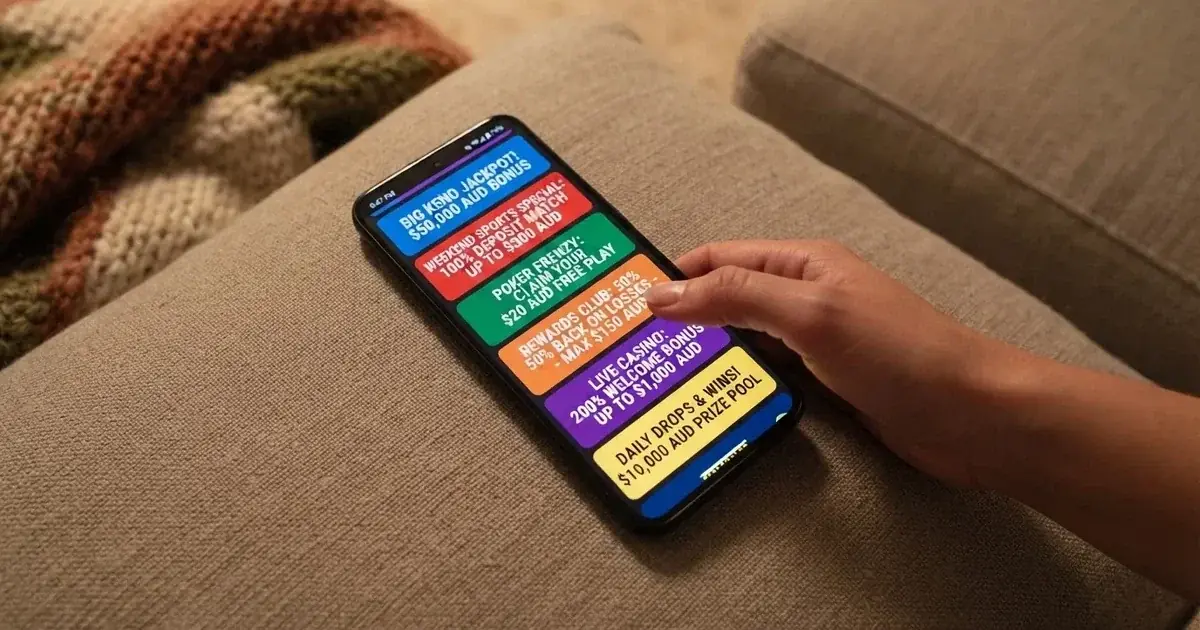
Drawn 29 October 2026 against the ACMA’s published formal warnings and the Interactive Gambling Act 2001 as in force at that date.
Table of Contents
- The Prohibition That Frames Every NDB Casino Offer
- Where Australians Actually Get Help
- Crypto, Osko and the Fundamentals of Australian Payments
- Anatomy of an NDB Inducement Pitch
- Eleven Brands the ACMA Has Formally Warned
- What No-Deposit Bonus Even Means at the Operator Level
- One Brand at a Time
- How Fast the ACMA Is Closing Sites Down
- Frequently Asked Questions
The Prohibition That Frames Every NDB Casino Offer
No online casino is licensed in Australia. The Interactive Gambling Act 2001, strengthened by the Interactive Gambling Amendment Act 2017, makes it an offence to provide online casino games, online pokies or in-play betting to a person physically in Australia. No state or territory has a regime that licenses them. What can be licensed is wagering on races and sport placed before the event, lotteries and keno — in practice licensed by the Northern Territory Racing and Wagering Commission, which regulates 52 of Australia’s online bookmakers, including Sportsbet, Bet365 and Ladbrokes, and meets once a month in Darwin with no full-time staff. The bookmaker licence exists for tax reasons. It does not extend to casino games.
The individual player is not the target of the law. The Interactive Gambling Act 2001 reaches the provider. That changes what enforcement looks like. The Australian Communications and Media Authority — the ACMA — investigates, issues formal warnings and directs Australian internet service providers to block illegal sites. The player does not get a knock at the door for opening an account at an offshore casino. The offshore casino, though, sits outside the rules that bind a licensed wagering service: no Australian dispute body, no local complaints process, no recourse if a withdrawal is refused, and a real chance the site is blocked with a balance still on it.
H2 Gambling Capital’s 2025 estimate puts what Australians lose to illegal sites at about A$3.9 billion a year. That is the consequence of the prohibition not being matched by a licensed alternative in the category it bans. The same report found the share of gambling going through legal channels fell from 74 per cent in 2021 to 64 per cent — a ten-point slide in four years. The legal bookmaker market kept growing. The casino market kept being illegal. The illegal market captured the gap.
The reform timetable matters here. The Interactive Gambling Amendment (Gambling Reform) Bill 2026 passed Parliament on 19 August 2026; its advertising and inducement measures commence on 1 January 2027. That is law with a start date — passed, gazetted, waiting. It does not change what is permitted on a 2026 page. It changes what advertising an operator can run once 2027 begins. Reading an offshore NDB offer in the second half of 2026 means reading it against the rules that will soon also cover the marketing.
The penalty regime lands on the operator, not the player. Under the credit-card ban that took effect on 11 June 2024, penalties reach A$247,500 per offence for licensed operators who accept a banned payment. The player does not face a fine for paying. The licensed bookmaker does for taking the payment. An offshore operator faces whatever the ACMA’s next move is — a formal warning first, then a block request, then the site stops resolving on Australian ISPs and the marketing budget is what stops working, not the law.
See also Newest online casinos no-deposit bonus in 2026.
Where Australians Actually Get Help
The responsible-gaming frame in Australia is built around Australian-licensed wagering. That is exactly where it stops.
BetStop, the National Self-Exclusion Register, has been live since August 2023. A person registered with BetStop is excluded from every Australian-licensed online and phone wagering service at once, for a minimum exclusion period that runs in years. Offshore casinos are not connected to BetStop. Self-excluding from a licensed bookmaker does not stop an account at an offshore casino being opened, funded or played. The protection BetStop offers is the protection the licensed market owes its players — and the licensed market is exactly the market the offshore operator is not part of. An offshore casino has no obligation to honour a BetStop registration, no way to check one, and no reason to refuse a self-excluded Australian.
The National Gambling Helpline is 1800 858 858. Free, 24/7, with chat available at Gambling Help Online. Both services are staffed to talk to Australians in distress about gambling harm and about the financial and family consequences that follow. They do not help a player recover a balance from an offshore casino. No Australian body does. The harm lines treat the symptom. The balance sits with the offshore operator’s payment processor, on the other side of every block list the ACMA can issue.
The Australian banks have built a parallel set of blocks that are worth knowing about for what they tell the player. Westpac’s gambling block works at the merchant-category level: it refuses authorisation on transactions registered under the code “Betting/Casino Gambling” on eligible personal credit and debit cards. ANZ’s gambling transaction block, activated in the ANZ app, also blocks gambling transactions made through Apple Pay on an eligible card — not just the physical card. Once activated, removing ANZ’s block requires a 48-hour waiting period, and the bank itself warns that not all gambling transactions will be blocked and that some non-gambling transactions might be blocked in error. Commonwealth Bank lets customers apply a gambling lock to eligible cards through the CommBank app, with the same caveat that it cannot guarantee every gambling-related purchase will be stopped.
The signal these tools send together is the one that matters. An offshore casino asking an Australian for a credit card or a crypto deposit is not operating inside the Australian system. A payment that arrives in the operator’s account is also the moment the player loses the protections the Australian system would otherwise offer. The bank’s gambling block is a refusal at the card terminal. The offshore site’s refusal is at the withdrawal queue. The first one is mechanical and Australian. The second one is discretionary and Curaçao.
Crypto, Osko and the Fundamentals of Australian Payments
Crypto does not buy a licence. Paying an offshore NDB casino in bitcoin or Ethereum does not turn the casino into a licensed one. The Interactive Gambling Act 2001 targets the provider, not the payment rail. The 2023 amendment to the Act bars Australian-licensed wagering services from accepting credit cards, credit-related products and digital currency; that rule binds the licensed bookmaker, not the offshore casino. The legal exposure sits with the operator, and paying in AUD or BTC does not move it.

The licensed rails a player can use for wagering are debit cards, bank transfer, PayID/Osko and BPAY. Osko, run by Australian Payments Plus, settles a transfer between participating Australian banks in under a minute, 24 hours a day, seven days a week — whether it is addressed to a BSB and account number or to a PayID. PayID-based instant transfers are now available at over 100 Australian financial institutions. More than 25 million PayID identifiers had been registered on the New Payments Platform by April 2025. Paying to a PayID shows the account holder’s name before the transfer is sent — a feature AP+ itself describes as a fraud signal: being asked to transfer money to a PayID on an illegal gambling site, the operator warns, almost certainly points to a scam site.
The speed comparison that “NDB crypto casino” marketing leans on is largely fictional for an Australian player funding an offshore site. Bitcoin settlement at the same minute requires paying network priority fees that rise and fall with congestion. The faster the crypto rail is sold to the reader, the less likely it is being sold by anyone in Australia paying AUSTRAC attention. AUSTRAC’s threshold-transaction-report rule — the A$10,000 reporting trigger — applies to physical cash only. Ordinary electronic bank transfers, including PayID, are not subject to that per-transaction requirement, whatever the amount sent.
The platform itself matters. Australia’s New Payments Platform became accessible to the public on 13 February 2018. It is owned by New Payments Platform Australia Ltd, a non-profit whose shareholders include the Reserve Bank of Australia and the major banks. Participants must keep the platform’s monthly outages to no more than two minutes. In 2021 the ACCC authorised the merger of NPP Australia with BPAY and eftpos into a single company — Australian Payments Plus. The rails an offshore site does not use are the rails an Australian bank is contractually bound to keep running at near-perfect uptime.
The wallet layer complicates the picture without changing it. By the end of 2025, Apple Pay, Google Pay and Samsung Pay collectively accounted for around 45 per cent of all card payments in Australia by number. Apple does not charge fees to consumers for using Apple Pay; any surcharge comes from the merchant’s card-processing costs, not from Apple. Apple states that transaction limits and PIN requirements are set by the card issuer or merchant, not by Apple itself. The Reserve Bank of Australia’s July 2025 review proposes removing surcharges only on eftpos, Mastercard and Visa card transactions — explicitly leaving American Express outside the scope of the proposed surcharge ban. American Express is a three-party scheme that issues cards and processes transactions itself, where Visa and Mastercard are four-party networks. The structural difference does not change what an Amex charge at an offshore casino means under Australian law. What does change is that ANZ’s gambling block — and similar blocks at Westpac and CBA — reach the digital wallet, not just the plastic.
BPAY is the older rail. It has operated in Australia since 1997 — launched on 18 November 1997, owned equally by ANZ, Commonwealth Bank, National Australia Bank and Westpac through Cardlink Services Limited. It is available in the online banking of over 140 banks and financial institutions and offered by over 95,000 businesses. A payer enters the Biller Code and the Customer Reference Number printed on the bill. It is a bill-payment service, not a person-to-person transfer. An offshore casino does not have an Australian biller code. That is the structural reason a licensed wagering deposit can use BPAY and an offshore casino deposit cannot.
Crypto’s pitch is speed and anonymity. Osko is the speed. PayID’s name display is the anonymity check. The licensed rails do the thing crypto was sold to do. The offshore site has no legitimate reason to prefer the crypto rail.
Anatomy of an NDB Inducement Pitch
NDB stands for no-deposit bonus — credit, free spins or a small cash amount that the casino credits to a new account before any deposit. The offer exists to convert search traffic into a registered account. The cost of the credit is the marketing budget. The expected return is a player who deposits later. The pitch is “free” in the same way a chocolate at the door of a real-estate open house is “free” — a sampler, paid for by the expected value of what comes after.
In Australia the pitch is made against a backdrop the operator does not name. The Interactive Gambling Amendment (Gambling Reform) Bill 2026, passed on 19 August 2026, includes advertising and inducement measures that commence on 1 January 2027. The measures are law, with a start date, not in force on a 2026 page. The ACMA has nevertheless been acting on inducement-style offers under its existing powers. In July 2025 the ACMA issued formal warnings to Bamboo Media over Ignition Casino, to Consolutetish S.R.L. over National Casino and to Consolutetish S.R.L. over Bizzo Casino — Bizzo Casino having already been the subject of a 2022 formal warning to TechSolutions (CY) Group Limited and TechSolutions Group N.V. Three operators named in a single month, two of them under the same corporate umbrella. The pattern of action against NDB-style inducements is older than the new law.
The mechanics of the offer, once claimed, sit in the small print. A no-deposit bonus is usually tied to a wagering multiple — the bonus amount has to be turned over a set number of times before any winnings can be withdrawn. The “free” amount is the smallest figure on the page. The wagering requirement is the largest. A bonus that looks modest at A$10 with a 50x multiple is A$500 of required turnover before any cashout. On a slot returning 96 per cent to the player, the expected cost of clearing that turnover is A$20 — double the bonus amount. The marketing keeps the “free” figure. The small print carries the arithmetic.
The inducement is the hook. The conversion is the goal. The offshore NDB casino’s business model assumes the player returns, deposits, and plays through the wagering requirement at the operator’s edge. None of that maths requires the operator to be licensed. It does require the operator to keep marketing — which is the surface the 2026 reform bill targets, not the underlying offer.
The marketing surface keeps moving. Affiliate sites rotate the brand; the offer rotates the bonus size; the small print carries the requirement. What does not move is the underlying fact: an NDB credit offered to an Australian is an inducement to use a service that cannot lawfully be provided to that Australian. The ACMA’s recent record shows enforcement catching up with the marketing, one formal warning at a time.
Eleven Brands the ACMA Has Formally Warned
These are eleven brands the ACMA has named in formal warnings under the Interactive Gambling Act 2001. None is recommended here. They are listed because the regulator acted on them — in the order the ACMA published the warnings — with the operator behind the brand and what any external directory says about how the brand is presented elsewhere. The page does not carry their bonus terms; the only sources for those were affiliate marketing pages.
| Brand | ACMA action and date | Operator named by the ACMA | Subject support | Other brands warned under the same operator |
|---|---|---|---|---|
| RocketPlay | Formal warning, March 2026 | Pulsup Ltd (RocketPlay); earlier Dama N.V., May 2022 | Listings-only (Gambling Insider) | Dama N.V. also covered Level Up, Woo and Spirit |
| Level Up Casino | Formal warning, May 2022 | Dama N.V. | Listings-only (Westpac) | Dama N.V. also covered RocketPlay, Woo and Spirit |
| Woo Casino | Formal warning, March 2025 | Dama N.V. | No data | Dama N.V. also covered RocketPlay, Level Up and Spirit |
| Spirit Casino | Formal warning, May 2025 | Dama N.V. | No data | Dama N.V. also covered RocketPlay, Level Up and Woo |
| National Casino | Formal warning, July 2025 | Consolutetish S.R.L. | Listings-only (ACMA, AUSTRAC, BetStop) | Consolutetish S.R.L. also covered Bizzo |
| Bizzo Casino | Formal warnings, July 2025 and 2022 | Consolutetish S.R.L. (2025); TechSolutions (2022) | Listings-only (Gambling Insider) | Consolutetish S.R.L. also covered National Casino |
| Ignition Casino | Formal warning, July 2025 | Bamboo Media | No data | Bamboo Media: no other brands on the record |
| Instant Casino | Formal warning, February 2025 | EOD Code SRL | Listings-only (ecoPayz, PayID) | EOD Code SRL: no other brands on the record |
| Jackbit | Formal warning, April 2026 | Ryker B.V. | No data | Ryker B.V.: no other brands on the record |
| Casino Intense | Formal warning, April 2025 | Sterplay Holding Ltd | Listings-only (AUSTRAC, BetStop, Gambling Insider) | Sterplay Holding Ltd: no other brands on the record |
| Sky Crown | Formal warning, September 2022 | Hollycorn N.V. | No data | Hollycorn N.V. also covered Blue Leo |
The pattern the table makes visible is not eleven separate stories. Dama N.V. appears behind four of them — RocketPlay when it was first warned in 2022, Level Up that same May, then Woo in March 2025 and Spirit in May 2025. Consolutetish S.R.L. appears behind two — National Casino and Bizzo Casino — both warned in July 2025. Bizzo is the only brand the ACMA has named twice under two different operators, in 2022 under TechSolutions (CY) Group Limited and TechSolutions Group N.V. and again in 2025 under Consolutetish S.R.L. The brand survived the change of operator. The warning came back.
The subject-support column reflects what external directories say, not what the operators themselves publish. “Listings-only” means a brand appears on a directory like Gambling Insider, BetStop, AUSTRAC’s register or a payment-method listing page — the directory has heard of the brand; the operator has not produced verifiable bonus terms in any source the page could check. “No data” means no such listing was found. In neither case is the brand confirmed or denied as an NDB provider: the table describes the ACMA’s record, not the operators’ pitch.
What an NDB Casino Offer Actually Means in Australia — More on this topic at casino no wager.
What No-Deposit Bonus Even Means at the Operator Level
The mechanism is simple. The operator credits a small amount to a new account before any deposit. The player wagers it. Any winnings become withdrawable once a wagering multiple is satisfied. The credit is a marketing cost. The expected return is the player’s later deposits. The operator does not need the player to win the bonus round. The operator needs the player to return.
In Australia the mechanism is offered in a market that does not license it. The ACMA’s enforcement record over six and a half years — 1,751 illegal gambling and affiliate-marketing websites blocked since the first blocking request in November 2019, with more than 230 unlicensed gambling services having left the Australian market since enforcement was strengthened in 2017 — is the closest Australia has to a substitute for a licensed casino market. The block list is long because the offer is persistent. Each new round names the same kinds of services; the names change; the category does not.
The expected cost to the player is the number the operator does not advertise. On a slot with a 96 per cent return to player, A$10 of bonus carry a 50x wagering requirement, the player must turn A$500 over to clear the bonus. The house edge on that turnover is 4 per cent. The expected loss is A$20. The bonus paid out A$10. The player is upside-down on the bonus the moment the wagering requirement kicks in. The marketing celebrates the “free” amount. The small print carries the A$20.
The consequence the operator-level picture carries is plain. An offshore casino’s offer to an Australian player is real money offered by an entity the Australian legal system does not reach. The player has no complaint channel inside Australia if a withdrawal fails. The block list can close the front door while a balance is on the inside. A licensed bookmaker — the only kind Australia does license — is not allowed to extend the offer at all. The market that does not exist is the market that keeps being advertised.
One Brand at a Time
Each section below describes one of the eleven brands the ACMA has formally warned. They are in the order of the ACMA’s most recent action, from the 2026 warnings back through to the 2022 ones. None is a recommendation. Each closes on what its specific block of warnings shows.
RocketPlay — The .com.au Domain the ACMA Named Directly
The March 2026 formal warning to Pulsup Ltd named a specific Australian-facing domain: Rocketplay.com.au. That makes RocketPlay the only one of the eleven where the ACMA’s action targeted a country-code domain, not a generic .com. The same brand had been the subject of an earlier May 2022 formal warning to Dama N.V., the operator running it at that time. Two operators, two warnings, the same brand. The intervening years produced the change of corporate vehicle and a fresh URL — and a fresh warning.
RocketPlay is listed on Gambling Insider as a brand; that is what the directory confirms. No bonus terms for the brand appear in any source the page could verify. The verdict on this block is structural: the ACMA has named the .com.au domain itself, which raises the practical cost of the offer in a way the other ten warnings do not. An Australian who lands on Rocketplay.com.au has reached a site the regulator has singled out, not merely a brand on a list.
Level Up Casino — One of the Six Brands in Dama N.V.’s May 2022 Cluster
In May 2022 the ACMA issued a formal warning to Dama N.V. covering six casino brands: Bambet, Dazard, Level Up, Rocketplay, Wild Tornado and Cobra Casinos. Level Up is one of those six. The original warning is the one that put Dama N.V. on the ACMA’s record. Three of the other brands from that 2022 cluster appear elsewhere on this page under later warnings — RocketPlay as Pulsup Ltd in 2026, Woo Casino as Dama N.V. in March 2025, Spirit Casino as Dama N.V. in May 2025. The 2022 warning was the first of four Dama N.V. appearances on this page.
The listing-only source for Level Up is Westpac, which is unusual — Westpac’s gambling block targets the merchant category code “Betting/Casino Gambling” rather than any brand list. The presence of the brand on a Westpac-related reference reflects the way a directory tracks gambling merchants, not Westpac’s own endorsement. The brand remains just one of six listed in that original Dama N.V. warning.
Woo Casino — Dama N.V.’s Second Warning, in March 2025
Dama N.V. returned to the ACMA’s record in March 2025, three years after the May 2022 cluster. This time the warning named Woo Casino alone. The intervening period — three years — was not enough to stop the same operator extending the same kind of service to Australians under a new brand name. The 2022 warning covered six brands; the 2025 warning covered one. The narrower scope does not suggest a softer approach from the operator. It suggests the ACMA is now naming each new brand individually as it appears.
No external directory carries Woo Casino in a way the page could verify. The verdict on this block is the operator’s repeat appearance: the same Dama N.V. that ran six brands in 2022 was still running new brands in 2025. The brand changes. The underlying operator does not.
Spirit Casino — Dama N.V.’s Third Warning in Fourteen Months
May 2025. A third Dama N.V. brand on the ACMA record in fourteen months — Rocketplay in 2022, Woo in March 2025, Spirit in May 2025. The 2022 cluster was a single warning covering six brands. The 2025 warnings are individual, brand by brand, suggesting the ACMA is now tracking each reappearance rather than waiting for a cluster. Dama N.V. is the operator the regulator has had to warn most often across the eleven brands on this page.
Spirit Casino carries no external directory listing the page could verify. The verdict on this block is the cadence of Dama N.V.’s appearances: from six brands in one warning, to one brand per warning, the operator’s footprint on the ACMA record is growing, not shrinking. The regulator is keeping pace. The operator is not slowing.
National Casino — Listed by the ACMA, AUSTRAC and BetStop Alike
Consolutetish S.R.L. was named in the July 2025 formal warning that covered both National Casino and Bizzo Casino. National Casino also appears on listings held by the ACMA itself, AUSTRAC and BetStop — the National Self-Exclusion Register. Three Australian registers, not one, carry the brand. That makes National the most cross-listed of the eleven, in registers an Australian who is trying to verify a brand would actually check.
The BetStop listing is the consequential one. BetStop excludes registered Australians from every Australian-licensed wagering service. The fact that National appears in the register’s data is the register doing its job — recognising a brand Australians may encounter, even if BetStop cannot bind an offshore casino. National Casino stands as an example of a brand appearing in multiple regulatory and exclusion databases simultaneously.
Bizzo Casino — Warned Twice, by Two Different Operators
Bizzo Casino is the only brand in this table the ACMA has warned twice. The first warning, dated 2022, named TechSolutions (CY) Group Limited and TechSolutions Group N.V. The second warning, in July 2025, named Consolutetish S.R.L. The brand is the same in both. The operator changed. The warning came back.
Gambling Insider lists Bizzo Casino; that is the directory’s contribution. The structural reading of this block is the resilience of the brand across a corporate change: a brand can outlive the operator that was first warned for it. The ACMA’s July 2025 action on Consolutetish S.R.L. is the second time the regulator has had to name Bizzo specifically, which raises the question of how a brand that has now been warned twice under two operators continues to be marketed. The page does not answer that question. The regulator’s record does.
Ignition Casino — Bamboo Media’s First Brand on the Record
July 2025. Bamboo Media. Ignition Casino is the first brand in Bamboo Media’s name on the ACMA’s formal-warning record. None of the other ten brands on this page is attributed to Bamboo Media. The single appearance does not make Bamboo a serial offender — it makes Bamboo a new operator on the regulator’s list.
No external directory carries Ignition Casino in a verifiable way. The verdict on this block is its place in the July 2025 trio: Ignition, National Casino and Bizzo Casino were the three formal warnings the ACMA published in July 2025, all under different operators, all in the same month. The cluster of three warnings in a single month is the ACMA’s working tempo on this category in mid-2025.
Instant Casino — Listed on ecoPayz and PayID Alongside the Warning
February 2025. EOD Code SRL. Instant Casino is the second-newest operator on the list (after Bamboo Media in July 2025). The brand carries a listings-only footprint on payment directories — ecoPayz and PayID. A payment directory listing means the brand is known to the directory’s editorial process; it does not mean the brand is licensed under the directory’s terms or that any payment route is open to an Australian.
The PayID listing in particular is worth noting. AP+ describes being asked to transfer to a PayID on an illegal gambling site as almost certainly meaning a scam site. A brand appearing on a PayID-related listing page is not the same as a brand accepting PayID — the listings are directories, not payment endpoints. The verdict on this block is the gap between directory presence and actual payment availability: a brand that appears on a payment directory’s listing page is still operating outside the Australian legal frame, regardless of how the directory file presents it.
Jackbit — The April 2026 Warning Over Ryker B.V.
April 2026. Ryker B.V. Jackbit is one of the most recent formal warnings on the ACMA’s record, published alongside the CasinOK warning in the same month. Ryker B.V. is a new operator name on this page. The warning itself is the only verified fact about the brand here; no external directory was found carrying Jackbit in a verifiable way.
The verdict on this block is the recency: the ACMA was still acting on NDB-style offers as of April 2026, the latest month for which a published formal warning appears in the sources the page could verify. The regulator’s enforcement tempo in the second quarter of 2026 is the one most relevant to a reader comparing how current each brand’s warning is.
Casino Intense — Sterplay Holding’s Single Brand on the Record
April 2025. Sterplay Holding Ltd. Casino Intense is the only brand on this page attributed to Sterplay Holding. Three external directories carry the brand: AUSTRAC’s register, BetStop and Gambling Insider. The cross-listing is similar to National Casino’s footprint, although without the regulator’s own formal-warning list appearing in the same three names.
Sterplay Holding’s single-brand footprint is a different shape from Dama N.V.’s or Consolutetish S.R.L.’s. A single brand on the regulator’s record may reflect a smaller operator, or one whose other brands have not yet drawn a formal warning. Either reading is consistent with the data; the page does not choose between them. The verdict on this block is the unusual combination of a single brand on the ACMA record with a wide directory presence — a footprint that does not match the cross-brand pattern of the larger operators.
Sky Crown — Hollycorn N.V.’s Paired Warning With Blue Leo
September 2022. Hollycorn N.V. The ACMA’s formal warning to Hollycorn covered both Sky Crown and Blue Leo casino services — two brands in one warning. The pairing is the distinctive feature; Hollycorn has not appeared again on the ACMA record since. Sky Crown and Blue Leo appear together in the same PDF publication, which is the only place they appear on this page.
No external directory carries Sky Crown in a verifiable way. The verdict on this block is the paired warning itself: two brands at once, named under the same operator, with no further appearances since. The pattern is rare on this page — only Hollycorn has its brands named together in a single PDF. The operator has not reappeared. Whether that is restraint or a different set of brand names is not something the ACMA record can settle.
How Fast the ACMA Is Closing Sites Down
The arithmetic of the ACMA’s block list is the most direct way to read what is happening. From the first blocking request in November 2019 to the most recent published tally in June 2026, 1,751 illegal gambling and affiliate-marketing websites had been blocked. That is roughly six years and seven months — 79 months, about 343 weeks.
Dividing the total by the period gives a long-run rate. 1,751 blocked sites across 79 months works out at about 22 a month, or roughly 5 a week — close to 260 a year. The single June 2026 round alone added 12 sites: 7Signs, ChromaBet, Donbet, Duospin, Freshbet, Slots Gem, Jacks Club, Lucky Start, Pointsbetz, Spinrise, Vinyl Casino and Wildsino. Twelve sites in one round is two and a half weeks’ worth at the long-run average. The recent rounds have been running faster, not slower.
State the result as a band with its condition. Since the first blocking request in November 2019, the ACMA has been adding to the block list at roughly 5 sites a week — somewhere between 4 and 6 a week depending on the year, equivalent to 200 to 300 a year. The June 2026 round, with 12 sites added in one announcement, is consistent with the upper end of that band being where enforcement is now running. The block list is not slowing. It is on a steady upward slope that has held across the period the regulator has been tracking it.
The same source reports that more than 230 unlicensed gambling services have left the Australian market since enforcement was strengthened in 2017. That is a different number — services that withdrew, not sites that were blocked — and the two together describe a market that is being pruned from the inside (services leaving) and from the outside (sites being blocked) at the same time. The arithmetic does not predict the next round. It describes the rate the rounds have been running at so far, and that rate has not yet shown the kind of slowdown that would let the marketing catch up.
Frequently Asked Questions
What does NDB actually mean in an offshore casino’s bonus line to an Australian?
NDB stands for “no deposit bonus” — a small credit, set of free spins or token cash amount the casino credits to a new account before any deposit. In Australia no online casino is licensed to extend one. The offer exists; the licence that would make it safe to claim does not.
Does paying with bitcoin change whether an NDB casino offer is legal in Australia?
No. The Interactive Gambling Act 2001 targets the provider, not the payment rail. Bitcoin and other cryptocurrencies do not turn an unlicensed casino into a licensed one. The legal exposure sits with the operator, and paying in AUD or BTC does not move it.
Why do NDB casino sites keep marketing to Australian search terms when online casinos cannot be licensed here?
Because affiliate marketing converts search traffic into sign-ups wherever the search traffic exists. The Interactive Gambling Act 2001 prohibits offering online casino games to Australians; enforcing that requires blocking the sites one round at a time. By the time one block lands, the marketing has already collected the email it was after.
How fast does a PayID or Osko transfer settle compared with bitcoin at an offshore NDB crypto casino?
An Osko transfer between participating Australian banks arrives in under a minute, 24 hours a day, seven days a week, whether addressed to a BSB and account number or to a PayID. Bitcoin settlement at that speed requires paying network priority fees that rise and fall with congestion. The AUD rails are predictable in a way crypto is not.
What should a reader check before trusting an offshore casino’s claimed NDB terms?
Check whether the operator appears on the ACMA’s list of formal warnings, and whether any entity behind it has been warned more than once. Offshore sites offer no Australian dispute body. The smaller the operation, the more likely a withdrawal refusal ends at the operator’s inbox.