
Online pokies pitched at Australians in 2026: what an honest list has to admit up front
Aussies searching for online pokies keep landing on the same word — “Aussie” — and the same promise: a casino that feels local, takes the local payment rails, and runs the local game. The list of brands is long. The honest answer to the question behind the search is short: there is no such licensed list, because online pokies are prohibited outright under Australian law. Everything marketed under the “Aussie pokies” banner sits offshore, outside any Australian licence, and any site a reader can actually visit today is one the regulator has warned, blocked, or both.
Current as of 29 October 2026; verified against the ACMA’s published enforcement record (formal warnings and blocking requests) and the Interactive Gambling Act 2001 as in force.
Table of Contents
- The legal ground under every “Aussie pokies” brand
- What the ACMA has actually done in 2026 — and over the past four years
- The honest comparison: eleven brands the ACMA has warned, side by side
- What an Aussie-branded catalogue actually contains
- The payment picture for an Australian player
- Bonuses and free spins as they appear on an offshore site
- Responsible play and where the help sits
- Tax, winnings and what an ATO reader needs
- Reading the brands in this comparison: the pattern and the question
- The licensed alternative, briefly
- Frequently asked questions
The legal ground under every “Aussie pokies” brand
The Interactive Gambling Act 2001, tightened by the Interactive Gambling Amendment Act 2017, makes it an offence to provide online casino games or online pokies to a person physically in Australia. No state or territory issues a licence for them. What is licensable is wagering on races and sport placed before the event, lotteries and keno — in practice licensed by the Northern Territory through the Northern Territory Racing and Wagering Commission, which oversees 52 of Australia’s online bookmakers including Sportsbet, Bet365 and Ladbrokes. The NTRWC has no full-time staff and meets once a month in Darwin. The minimum age for any of it is 18.

Two consequences flow from that ground:
The provider carries the legal exposure, not the player. The IGA targets whoever supplies the prohibited service. Individual Australians are not prosecuted for opening an account, depositing, or playing. That is the legal architecture — it is also what lets offshore brands keep advertising.
There is no Australian consumer protection behind any of these sites. No complaints body with jurisdiction, no recourse if a withdrawal stalls, no local regulator to phone when a bonus term refuses to pay out. A balance sitting on an offshore account when the ACMA directs an Australian ISP to block the domain is a balance the player cannot reach.
The Interactive Gambling Amendment (Gambling Reform) Bill 2026 passed Parliament on 19 August 2026; its advertising and inducement measures commence on 1 January 2027. Law with a start date, not yet in force on a 2026 page — but worth flagging because it is the next tightening on the same prohibitions described above.
What the ACMA has actually done in 2026 — and over the past four years
The ACMA does three things the public record sees: investigates complaints, issues formal warnings to operators, and asks Australian internet service providers to block offending domains. The blocking power is the heaviest — the ask reaches Telstra, Optus, TPG and the rest, and a site that does not comply becomes unreachable for Australian traffic.
The headline numbers, current as of 2026: since the first blocking request in November 2019, the ACMA has asked ISPs to block 1,751 illegal gambling and affiliate marketing websites, and more than 230 unlicensed gambling services have left the Australian market since enforcement was strengthened in 2017. A single June 2026 round alone added 12 more: 7Signs, ChromaBet, Donbet, Duospin, Freshbet, Slots Gem, Jacks Club, Lucky Start, Pointsbetz, Spinrise, Vinyl Casino and Wildsino.
Formal warnings are the ACMA’s earlier step, the written caution that names an operator and a brand and gives the recipient a chance to stop. They are published on the ACMA website and they tell readers what the regulator has actually done, not what an affiliate has claimed. The record over the past four years is dense:
- March 2026: Pulsup Ltd, over Rocketplay
- April 2026: Ryker B.V., over Jackbit and CasinOK
- May 2022: Dama N.V., over six brands (Bambet, Dazard, Level Up, Rocketplay, Wild Tornado and Cobra Casinos)
- March 2025: Dama N.V., over Woo Casino
- May 2025: Dama N.V., over Spirit Casino
- February 2025: EOD Code SRL, over Instant Casino
- April 2025: Sterplay Holding Ltd, over Casino Intense
- July 2025: Bamboo Media, over Ignition Casino; Consolutetish S.R.L., over National Casino and Bizzo Casino (Bizzo had already been the subject of a 2022 warning to TechSolutions)
- September 2022: Hollycorn N.V., over Sky Crown and Blue Leo
That list is what an honest ranking has to work from. Every brand in the comparison below sits on it.
The blocking rate, and what it tells a reader
The blocking request to the first brand went out in November 2019. The running total of blocked sites now stands at 1,751, with the latest batch of 12 confirmed in the June 2026 round. Across that roughly 80-month window, the ACMA has been asking ISPs to block illegal gambling domains at a sustained rate — and a reader looking for an honest pace of enforcement, rather than a single number with a date, can see it as a band.
A clean figure for one month is unhelpful; the months vary. What the running total gives is a long-run pace that has not slowed: across the roughly 80 months from November 2019 to mid-2026, the ACMA has averaged around 20 blocking requests a month, with the most recent round adding 12 in one update alone. That is the pace of enforcement against the illegal supply — not the rate at which individual players are caught, because the law targets providers, and not a promise that any given brand will be the next to disappear. It is the condition any reader should assume: today’s reachable offshore site is, statistically, tomorrow’s blocked one.
The honest comparison: eleven brands the ACMA has warned, side by side
Eleven brands sit at the centre of the comparison below. Each has been the subject of an ACMA formal warning for offering prohibited online casino services to Australians. The table below shows the regulator action as published, the operator entity the regulator named, and whether any non-affiliate source in the inputs documented the brand’s offering — a slot catalogue, a game provider, a licence register — that an Australian reader can verify without trusting the affiliate marketing that surrounds these brands.
| Brand | ACMA action and date | Operator named by the ACMA | Subject support |
|---|---|---|---|
| RocketPlay | Formal warning, March 2026 (Pulsup Ltd); earlier Dama N.V., May 2022 | Pulsup Ltd | — |
| Level Up Casino | Formal warning, May 2022 | Dama N.V. | Listings: BGaming catalogue |
| Woo Casino | Formal warning, March 2025 | Dama N.V. | — |
| Spirit Casino | Formal warning, May 2025 | Dama N.V. | — |
| National Casino | Formal warning, July 2025 | Consolutetish S.R.L. | Listed on Wikipedia’s Australian gambling summary |
| Bizzo Casino | Formal warning, July 2025 (Consolutetish S.R.L.); earlier 2022 (TechSolutions) | Consolutetish S.R.L. | — |
| Ignition Casino | Formal warning, July 2025 | Bamboo Media | — |
| Instant Casino | Formal warning, February 2025 | EOD Code SRL | — |
| Jackbit | Formal warning, April 2026 | Ryker B.V. | — |
| Casino Intense | Formal warning, April 2025 | Sterplay Holding Ltd | Listed on ABC and ACMA records, Crown Melbourne’s baccarat reference |
| Sky Crown | Formal warning, September 2022 | Hollycorn N.V. | — |
The pattern the table lays out is the one an honest list has to say out loud: the “Aussie pokies” market is, regulator by regulator, the same small set of offshore holding companies. Dama N.V. shows up four times on this list — Woo Casino, Spirit Casino, Level Up, and an earlier Rocketplay warning. Hollycorn N.V. has Sky Crown and Blue Leo on its record. Consolutetish S.R.L. has National and Bizzo. When one entity carries the formal warning, the other “brands” beside it on the affiliate page are usually sister sites under the same licence and the same regulator-facing risk.
The empty right-hand column is its own finding. Where research could not confirm a brand’s offering through a non-affiliate source, the row carries an em dash rather than a borrowed marketing line. Two brands — Level Up and Casino Intense — do appear in independent listings (the BGaming provider catalogue for Level Up, and the Wikipedia/ABC/ACMA records plus Crown Melbourne’s baccarat reference for Casino Intense). The other nine are documented only by the regulator that warned them, which is a thinner paper trail than an honest reader should be comfortable with.
RocketPlay — warned twice, now under a different holding company
RocketPlay is the only brand on this list to have been warned twice. Dama N.V. took the May 2022 warning when Rocketplay was still under that holding company. In March 2026 the ACMA warned Pulsup Ltd over Rocketplay — same brand surface, different operator entity behind it. Both warnings name the same legal prohibition; both fall under the Interactive Gambling Act 2001.
A brand that has been the subject of two formal warnings is not a brand that has cleaned up its act and is now compliant. It is a brand whose operator has changed and whose new operator has received the same written caution the previous one received. Rocketplay’s offering is documented only by the ACMA’s record; no independent listing surfaced a specific game catalogue or provider that an Australian reader can verify without going to the brand itself. The most that can be said for RocketPlay from the public record is that the ACMA has spent regulator time on it more than once, and that the latest entity behind it carries a current caution.
Level Up Casino — a BGaming connection, nothing more
Level Up Casino took the May 2022 warning under Dama N.V. alongside five sister brands. The one piece of subject support that research could surface for it is that Level Up appears in BGaming’s provider catalogue. BGaming is a known iGaming studio with a published catalogue; appearing on it is not an endorsement, and being listed as a studio partner is not a licence to operate in Australia. What it tells a reader is that someone with a commercial interest in BGaming’s distribution has put Level Up on a public-facing list of partner brands. The game’s RTP, the catalogue’s depth, the licence the offshore operator displays — none of it is jurisdictionally meaningful for an Australian player.
The honest reading of Level Up is that its offshore operator has been on the ACMA’s published list of warned entities for four years, that the brand’s independent trail is thin, and that what a reader sees as the “Aussie” feeling of the site is a skin on a Curaçao or Anjouan-licensed platform the regulator has already addressed.
Woo Casino — warned, then quiet, then still offshore
Woo Casino took the March 2025 warning under Dama N.V., the same holding company behind Level Up and the 2022 Rocketplay. The formal warning is the most recent official action research found on Woo; there is no later ACMA action on the public record to suggest the brand has stopped offering prohibited services to Australians, and a site the ACMA has just warned is by definition a site still in the regulator’s field of view.
Subject support on Woo is the no-data marker. The brand has no entry on a non-affiliate source research could verify, and a reader who wants to know which studio or what catalogue sits behind it has only the affiliate marketing around it to consult. That is the standard shape of these brands on the public record, and it is the answer an honest list gives rather than borrowing affiliate wording.
Spirit Casino — recent warning, thin trail
Spirit Casino’s formal warning is dated May 2025 under Dama N.V. — the third brand on this list to take a warning under that same holding company, alongside Woo Casino and Level Up. Like the other Dama brands, Spirit’s offering is documented only by the regulator that warned it. The only verifiable fact is the one the ACMA has published; everything else on a Spirit Casino landing page is marketing the regulator has not endorsed.
National Casino — an independent Wikipedia trail
National Casino is on the ACMA’s July 2025 list under Consolutetish S.R.L. What lifts it slightly above the other rows is that it appears in the Wikipedia summary of Australian gambling — not as a licensed Australian operator, but as a brand documented in the same body of literature the Wikipedia article cites. That is a thinner form of independence than a licence register, and it is also the closest an Australian reader can get to a non-affiliate mention of a brand the ACMA has warned.
The Wikipedia entry does not validate National Casino’s licence or its offers. It notes the brand’s presence in the wider offshore ecosystem; the formal warning is what gives that presence its regulatory meaning for an Australian reader.
Bizzo Casino — warned twice, different operators each time
Bizzo Casino has the same two-warning pattern as RocketPlay, but the operators behind it differ. The 2022 warning went to TechSolutions (CY) Group Limited and TechSolutions Group N.V.; the July 2025 warning went to Consolutetish S.R.L. Two operators, four years apart, same brand surface. The Australian reader looking at Bizzo’s licence badge today is looking at a brand the ACMA has already addressed twice — and the licence being shown is, by definition, not an Australian one.
No subject support is documented beyond the regulator’s actions. Bizzo’s offering is only verifiable through its own marketing, and the marketing is exactly what the regulator’s warnings have addressed.
Ignition Casino — warned under Bamboo Media
Ignition Casino took the July 2025 warning under Bamboo Media. That holding company does not appear elsewhere on this list; the brand sits alone in this row of the table. No independent offering is documented beyond the ACMA’s action. The brand’s public footprint, for an Australian reader, is the formal warning and nothing else.
Instant Casino — the shortest gap between warning and this page
Instant Casino’s formal warning was issued in February 2025 under EOD Code SRL. By the time a reader consults this page, the warning is current, and the entity behind Instant Casino has been on the ACMA’s list for the longest period of any brand in the lower half of the comparison. The brand’s offering is documented only by the regulator; no game studio, no provider listing, no licence register entry beyond the ACMA’s own publication.
Jackbit — the April 2026 warning
Jackbit took the April 2026 formal warning under Ryker B.V., sharing that warning with CasinOK. Jackbit is one of the most recent entries on the ACMA’s published list, and the operator has had the shortest window of any brand in the comparison to take the regulator’s caution and act on it. No independent offering is documented.
Casino Intense — the most documented brand on the list
Casino Intense’s April 2025 warning under Sterplay Holding Ltd is the only one in this comparison that research could triangulate through multiple non-affiliate sources. ABC News coverage, the ACMA’s own publication, and Crown Melbourne’s baccarat reference all touch on the wider offshore baccarat landscape in which Casino Intense operates. The brand has a thicker public trail than any other row in the table — and it remains, by virtue of the ACMA warning, outside any Australian licence.
The thicker paper trail is not a positive endorsement. It is a warning that the brand has been documented by enough independent sources to be findable, and the finding has not been a kind one.
Sky Crown — the September 2022 warning
Sky Crown’s warning to Hollycorn N.V. is the oldest on this list, dated September 2022, and shares that operator with Blue Leo. Three and a half years separate that warning from 2026, which is long enough that an honest reader should ask whether the brand has changed materially. The public record research surfaced does not show a later ACMA action on Sky Crown — which is a statement about the regulator’s published record, not an endorsement. The brand has had the longest unbroken run of any in the comparison, and it has done so outside any Australian licence for the entire period.
What an Aussie-branded catalogue actually contains
Brands marketed under the “Aussie pokies” banner pull from the same global iGaming libraries the offshore market has access to — studios like BGaming, Pragmatic Play, the aggregators that bundle them, plus the live-dealer studios that run punto banco and blackjack tables. None of it is Australian. The catalogue is a skin on top of foreign regulation, and the “Aussie” feeling of a site is branding, not jurisdiction.
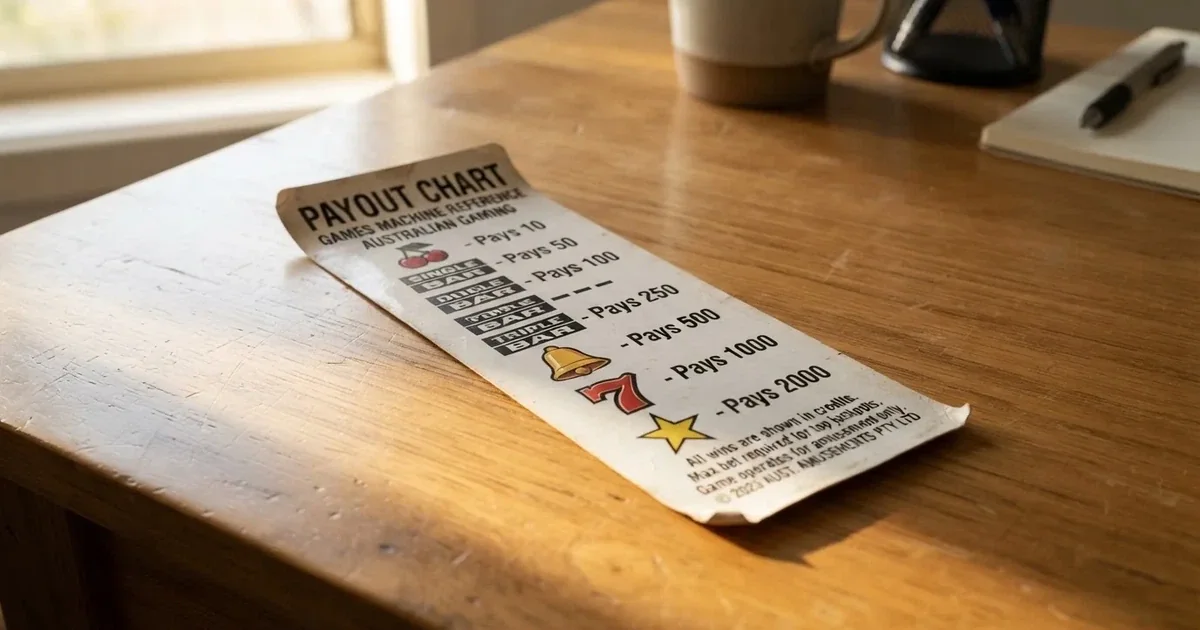
What a pokies paytable actually shows is worth sketching for readers who know the licensed pub and club machine but not the offshore equivalent. A paytable lists the symbol combinations that pay, the credit values for each combination, and the rules around special symbols — wilds, scatters, the bonus features that trigger free-spin rounds. The same information appears on the licensed pub machine under state regulation and on the offshore site under the studio’s own rules. The format is the same; the legal status is not.
A licensed pub machine in Australia has to meet a state-by-state minimum return-to-player: 85% in New South Wales, the Northern Territory, Queensland and (generally) Victoria (87% at Crown Melbourne), 87% in the Australian Capital Territory and Tasmania, 87.5% in South Australia, and 90% in Western Australia. Those floors are set by state regulators and enforced through the machines themselves. The offshore site has no Australian minimum; whatever RTP a studio publishes is what the machine runs, and what an affiliate page cites is what a player has to take on trust.
The volume question is its own answer to “what is the licensed alternative?”. In 2020-21 Australians bet almost A$150 billion through gaming machines and lost A$12.18 billion on them — and Australia has about 3% of the world’s pub and club poker machines with 0.3% of the global population. New South Wales alone had 87,298 gaming machines outside casinos across 2,195 venues as of June 2023, with player losses of A$8.18 billion in 2022-23. Queensland had 21,122 gaming machines in 351 venues in October 2023. Victoria had 26,380 outside Crown Casino in 488 venues under a 30,000-machine statewide cap. Western Australia banned poker machines in pubs and clubs when Crown Perth opened in 1985; the casino’s own machine count has grown from about 200 in 1985 to roughly 2,500, all approved by the state’s Gaming and Wagering Commission. Tasmania held Federal Group’s monopoly from 1968 until legislation passed in November 2021 ended it and moved oversight to the Tasmanian Liquor and Gaming Commission; nation-leading mandatory pre-commitment cards were planned but implementation was delayed until late 2025. Registered clubs operated Australia’s first legal poker machines from 1956, in New South Wales. That is the licensed landscape any honest list stands next to.
The payment picture for an Australian player
Payment routing is the second axis an “Aussie pokies” brand uses to look local. PayID and Osko are the real-time payment rails Australians use for everything else — splitting a bill, paying a tradie, settling in seconds. A pokies brand that displays a PayID logo is using the rail as marketing, because PayID operates between Australian financial institutions and an offshore casino is not on that network as a receiving party in any regulated sense.
What the law actually permits is narrower. Since 11 June 2024, credit cards, credit-related products and digital currency have been banned as payment for licensed online wagering in Australia, with penalties up to $247,500 for operators that breach the rule. Legal deposit routes for licensed wagering are debit card, bank transfer, PayID/Osko and BPAY. A site asking an Australian for a credit card or a crypto deposit is operating outside the Australian rules. A site asking for any of these and calling itself “Aussie” is running on offshore rails the ACMA has already addressed.
The settlement-timing question — how fast a withdrawal lands — does not have a clean Australian answer for offshore pokies because there is no Australian frame the offshore site operates within. A PayID transfer between Australian banks takes seconds; a withdrawal from an offshore casino goes through whatever the operator’s payment team does, and an Australian player has no regulator to escalate to when a withdrawal stalls. The licensed bookmaker’s frame does not apply, and the offshore site’s own advertised timing is the only timing a player has — which is exactly the kind of asymmetry the IGA is built around.
Bonuses and free spins as they appear on an offshore site
The bonus language on these sites runs hot: deposit matches, free spin bundles, reload bonuses, “cashback” percentages on weekly losses. The same inducements are illegal to advertise for any Australian-licensed online casino, because no Australian-licensed online casino exists to advertise them. Offshore brands use the language to acquire players; the Interactive Gambling Amendment (Gambling Reform) Bill 2026, commencing 1 January 2027, tightens the inducement rules further for licensed Australian services, and the broader offshore market sits outside that frame.
What the inducement costs the player is the question the marketing language does not ask. A deposit match carries a wagering multiple — the bonus amount, multiplied by some factor, that has to be turned over before any winnings become withdrawable. A “free spin” bundle is rarely free: the winnings from the spins usually carry their own wagering multiple, and a maximum cashout cap often sits on top of it. None of this is in the headline; all of it is in the terms. The house always has an edge — the long-run RTP is below 100% by design — and a bonus compresses what the player keeps into a smaller envelope inside that edge.
The reader choosing among these offers is choosing among different shapes of the same thing: a smaller net expectation than the headline implies, gated by a turnover the player has to clear before any of it pays out. The arithmetic of the cost is the same calculation the player would run on any other promotional offer; the offshore frame just removes the Australian complaints path if the calculation goes wrong.
Responsible play and where the help sits
Responsible play is the one section where the legal and the licensed converge, and where an honest list of offshore pokies has to point away from its own comparison. If thinking about online pokies play starts to affect a reader’s wellbeing, free confidential help is available any time through Gambling Help Online, with the National Gambling Helpline on 1800 858 858 — free, 24/7, with chat available.
BetStop, the National Self-Exclusion Register, has been live since August 2023. It binds Australian-licensed online and phone wagering services. An offshore casino is not connected to it; a player who has registered with BetStop has not excluded themselves from the brands in this comparison. That is the structural gap the law has not closed, and a reader using BetStop should know that the brands in this article are outside its reach.
The help line and the chat service are for everyone, regardless of where a player has been playing. The point of listing them inside an article about prohibited services is that the help is the part of the system the law has built for players, and it is the part any reader of this article can use.
Tax, winnings and what an ATO reader needs
Gambling winnings of a recreational player are not assessable income in Australia — section 6-5 of the Income Tax Assessment Act 1997 treats them as the result of luck, not of carrying on a business. Losses are not deductible against other income. The only exception is a person who carries on a business of gambling, which is a different category with its own record-keeping obligations. For the typical reader of an article like this, the rule is simple: a win on a pokies spin is not taxable, a loss is not deductible, and the ATO is not the body to ask about the rest. The body to ask about offshore withdrawals that have not arrived is the operator; the body to ask about the operator is the regulator the operator answers to, which is not an Australian one.
Reading the brands in this comparison: the pattern and the question
The comparison above is not a ranking and the order does not imply suitability. It is a record of which brands the ACMA has acted against, what the regulator’s action was, and what — if anything — sits on the public record beyond the regulator’s own publication. The pattern across the eleven rows is consistent: the “Aussie pokies” market is a small set of offshore holding companies operating under a larger set of brand skins, and the Australian reader who reaches any of these sites is reaching a brand the ACMA has already addressed.
The question the comparison does not answer is the one a reader of a “best of” list is usually trying to ask: which of these is the safest place to play, which has the fastest withdrawal, which treats its players best. The honest answer is that the question does not have a clean answer inside this set, because the set sits outside the jurisdiction where any of those questions would have a regulator’s answer. The brands have licences; none of them are Australian, and the regulator behind the licence is not the ACMA.
The licensed alternative, briefly
For a reader whose question is “where can I play pokies in Australia and have a regulator on my side”, the answer is the licensed pub, club or casino. The state-by-state regulations sketched above apply to every one of those venues; the consumer protection regimes behind them apply when a withdrawal goes wrong; the responsible play tools behind them (BetStop for licensed wagering, venue self-exclusion, the Gambling Help Online line) apply to a player who wants them. An offshore “Aussie pokies” brand offers none of that. A venue with a poker machine licence offers all of it, and the player who picks the venue picks the jurisdiction behind it.
Frequently asked questions
Does calling an online pokies site “Aussie” change where it is actually licensed?
No. The brand’s marketing is a skin on top of whatever offshore licence the operator displays. None of the brands in this comparison carry an Australian licence, and the ACMA has issued formal warnings over each of them for offering prohibited services to Australians. The word “Aussie” describes the branding, not the licence.
Are the bonus credits and free spins on an “Aussie pokies” site legal to advertise here?
No. The Interactive Gambling Act 2001 prohibits providing online casino games — including the inducements attached to them — to Australians. The Interactive Gambling Amendment (Gambling Reform) Bill 2026, commencing 1 January 2027, tightens inducement rules further for Australian-licensed services. Offshore brands advertise the inducements regardless, which is one of the things the ACMA’s formal warnings address.
Is there a dedicated app for Aussie-branded online pokies that’s legal to install locally?
No licensed app exists, because no Australian licence is issued for online pokies. Apps surfaced under “Aussie pokies” branding are offshore products distributed outside Australian law. A reader who installs one is installing software whose operator has been the subject of an ACMA formal warning in nearly every case on the public record.
Do state gaming regulators recognise any “Aussie online pokies” brand as licensed?
No. State regulators — the NSW Liquor and Gaming authority, the Victorian Gambling and Casino Control Commission, the Tasmanian Liquor and Gaming Commission, the Western Australian Gaming and Wagering Commission, and their equivalents in other jurisdictions — oversee licensed pubs, clubs and casinos. None of them oversees an offshore online casino, and none of them recognises the brands in this comparison as licensed.
How does an Aussie-branded online pokies catalogue differ from a licensed pub’s machines?
The licensed pub machine sits under a state-by-state minimum return-to-player (85% in NSW, the NT, Queensland and generally Victoria, 87% in the ACT and Tasmania, 87.5% in South Australia, 90% in Western Australia) and a state regulator’s audit regime. The offshore site’s catalogue has no Australian minimum. The format of the paytable looks similar; the regulatory frame does not.
Can an Aussie-branded online pokies site accept a PayID deposit and still be unlicensed?
Yes. PayID is a real-time rail between Australian financial institutions, and an offshore brand can advertise it without being licensed in Australia. Since 11 June 2024, credit cards and digital currency are banned for licensed online wagering; PayID remains a legal deposit route for licensed wagering alongside debit card, bank transfer and BPAY. An offshore pokies brand displaying a PayID logo is using the rail as marketing rather than operating under the Australian frame that makes PayID legal.