
Online Pokies for Australian Players: What Actually Exists, What Costs What
Someone typing the words at the top of this page is looking for a ranked list of the best places to play pokies online from inside Australia. The honest answer is that this list does not exist, because the product it ranks does not exist either — and the rest of this page is what an honest search returns instead.
Data current as of 30 October 2026; warnings, blockings and operator identities verified against the Australian Communications and Media Authority register.
Table of Contents
- Pokies on a Phone in Australia
- What a Pokies Paytable Shows — and What It Doesn’t
- What the Comparison Looks Like
- The Fundamentals of Pokies in Australia
- Prohibition: Why No Online Pokies Site Has an Australian Licence
- When Online Pokies Stop Feeling Like a Choice
- Paying and Getting Paid
- What a Welcome Bonus Is Worth
- Frequently Asked Questions
Pokies on a Phone in Australia
The first thing to settle is what “playing pokies on a phone” actually means here. The Apple App Store and Google Play do not carry real-money online casino apps for the Australian market — the product is prohibited under the Interactive Gambling Act 2001, and the stores reflect that. What appears in an Australian storefront is licensed sports and racing apps from Northern Territory bookmakers, social casino apps with no real-money payout, and offshore apps that get pulled the moment they are reported to either platform.
What most people end up using is the mobile browser. Every offshore casino reviewed later on this page is browser-first, built to be played in Safari or Chrome with no install step. The experience is closer to mobile banking than to a downloaded game — same login, same balance, same withdrawal queue, regardless of which device happens to be open. For a reader used to the App Store model, that itself is a signal. A site that does not bother to ship an installable app, in a market this large, in 2026, is not pitching itself to an Australian audience — it is letting one in on its own terms, and disclaiming the relationship the moment a regulator’s letter arrives.
The redirect chain matters too. A search ad for “Australian pokies online” typically lands on a domain that resolves through an offshore-registered front company, with the actual casino platform sitting one or two hops behind. The phone is reaching a server in Curaçao, Malta or somewhere similar, the deposit is clearing through a payment processor in a third jurisdiction, and the balance is held against terms of service written under yet another. None of those hops is illegal in itself. Together they place the player outside any consumer protection regime that an Australian would recognise.
There is a third option that does not involve a screen. Crown Melbourne, Crown Perth, the Star Sydney, the pokies floors of every registered club in New South Wales and Queensland, and the smaller casinos in Hobart, Darwin and Canberra all run real poker machines on premises — with rules approved by a state regulator, an identity check at the door, and a payout counter staffed by a human. That is the legal Australian pokies product. The body of this page sets out what happens when readers decide not to take it, and what that choice actually costs.
What a Pokies Paytable Shows — and What It Doesn’t
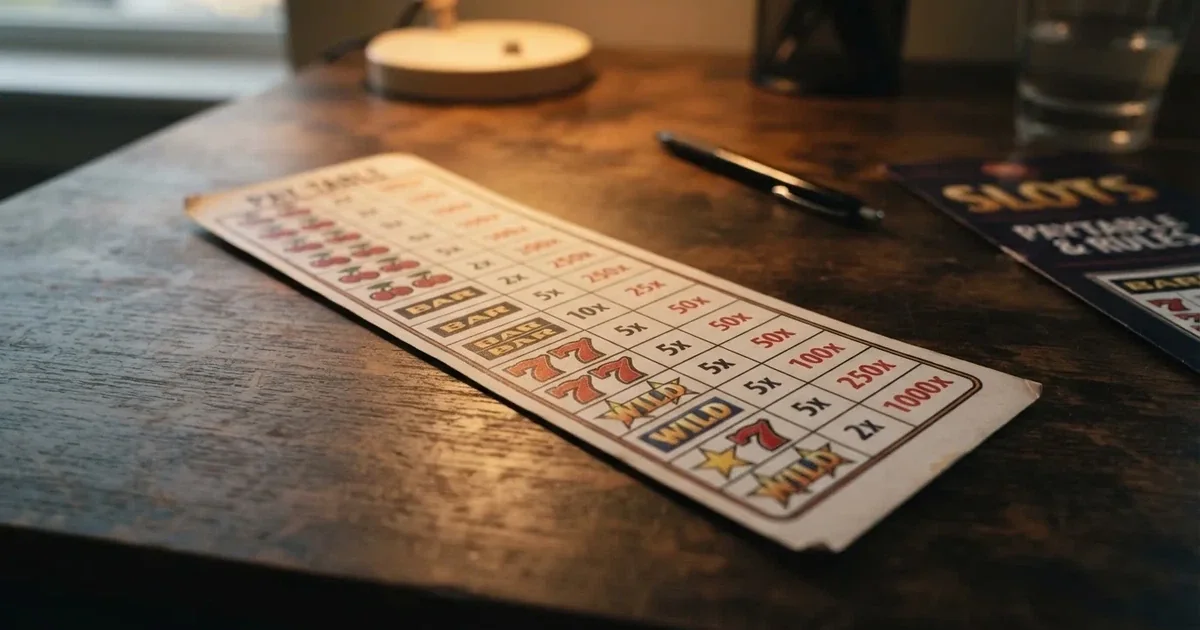
The single most useful thing to read on any pokie is its paytable, and the single most common mistake is to read it as a promise.
A paytable is a printed or on-screen chart that lists what each symbol is worth, how many in a row triggers a payout, and which combinations unlock bonus features. It also states the theoretical return to player — the percentage of every dollar wagered that the game is designed to return across a very large number of spins. Australian pokies, the ones that sit in pubs and clubs, are required to publish that figure, and the minimum varies by state: 85 per cent in New South Wales, the Northern Territory, Queensland and most of Victoria, rising to 87 per cent at Crown Melbourne, 87.5 per cent in South Australia, and 90 per cent in Western Australia.
That return is a long-run average, not a session forecast. A game with a 90 per cent return is not paying back 90 cents on the dollar on any given spin, or any given hundred spins, or any given evening. It is built to keep, on average, ten cents of every dollar across millions of spins. The shorter the session, the wider the spread around that average gets, and a player can lose everything they brought in well before the average has anything useful to say about their evening. The average is what the house plans around. The session is what the player actually has.
Volatility sits beside return on the paytable and gets less attention than it deserves. A high-volatility game pays out less often, but the wins are larger when they land; a low-volatility game does the opposite. Both can return 90 per cent in the long run, and they feel like different products while playing. Players who want long sessions on a small bankroll generally do better on the lower-volatility side of the catalogue; players chasing a single large payout accept that most of their spins will be losers. Neither is a “better” game. They are different shapes of the same long-run edge.
For the offshore pokies set out below, the paytable mechanism is identical, and so is the long-run edge. The difference is that the offshore operator publishes no Australian state regulator alongside the figure, so the published RTP has no one checking it. What the marketing claims and what the math actually delivers are two different documents, and only one of them is enforced anywhere.
What the Comparison Looks Like
Eleven offshore brands have been the subject of a formal warning from the ACMA for offering prohibited online casino services to people in Australia. Each has a parent operator named in the warning, a date the warning was issued, and — for a few — repeat attention from the regulator across more than one company. The table lays out the record as the regulator itself publishes it; the write-ups beneath it add the context a brand name strips out.
| Brand | ACMA action and date | Operator named by the ACMA | Repeat ACMA action |
|---|---|---|---|
| RocketPlay | Formal warning, March 2026 | Pulsup Ltd | Also warned 2022 (Dama N.V.) |
| Level Up Casino | Formal warning, May 2022 | Dama N.V. | No |
| Woo Casino | Formal warning, March 2025 | Dama N.V. | No |
| Spirit Casino | Formal warning, May 2025 | Dama N.V. | No |
| National Casino | Formal warning, July 2025 | Consolutetish S.R.L. | No |
| Bizzo Casino | Formal warning, July 2025 | Consolutetish S.R.L. | Also warned 2022 (TechSolutions) |
| Ignition Casino | Formal warning, July 2025 | Bamboo Media | No |
| Instant Casino | Formal warning, February 2025 | EOD Code SRL | No |
| Jackbit | Formal warning, April 2026 | Ryker B.V. | No |
| Casino Intense | Formal warning, April 2025 | Sterplay Holding Ltd | No |
| Sky Crown | Formal warning, September 2022 | Hollycorn N.V. | No |
What stands out from the warnings themselves is how few operators sit behind the brand names. Dama N.V. alone accounts for three of the eleven. The Consolutetish / TechSolutions pair accounts for two more, with a corporate reshuffle in between. Hollycorn N.V. runs Sky Crown and the separately-warned Blue Leo Casino from the same platform. Offshore casino groups routinely operate dozens of skin brands from a single licence and a single back end; an ACMA warning addressed to one skin does not stop the others, and the regulator works through them in turn.
What the table does not say is the size of the market the regulator is trying to police. That is in the section on prohibition below. The table’s job here is to name the eleven sites a reader searching this topic is most likely to encounter, in the regulator’s own framing, and to mark which of them the regulator has had to address more than once.
RocketPlay — Two Warnings, Two Different Operators
RocketPlay is the only brand in this comparison where the ACMA has caught up with the same offering twice under two different operators. The first warning, in May 2022, named Dama N.V. as the operator. The second, in March 2026, named Pulsup Ltd for the .com.au-facing version of the site. The pattern — rebrand after warning, same product under a new parent company — is one of the easier tells in this market, and RocketPlay is the cleanest example of it on the ACMA register.
The brand is positioned as a higher-end offshore casino, with a tiered loyalty scheme, a large game catalogue, and the usual welcome-package framing. None of that changes the regulator’s verdict: a third formal warning over the same product is a matter of time, not probability. The relevant fact for a reader weighing RocketPlay against any other brand here is not the catalogue or the welcome offer. It is that the same casino has already been told twice that it is not allowed to take Australian play, and has continued to take it each time.
Level Up Casino — One of Six Brands in the Same 2022 Action
Level Up was one of six Dama N.V. brands named in a single May 2022 warning — the same batch that caught RocketPlay, Bambet, Dazard, Wild Tornado and Cobra Casino at the same parent. Reading the six together tells a reader more than any one brand’s marketing page would: the operator was running a stable of skins, each styled differently, and the regulator chose to address the parent rather than chase each skin individually.
Level Up itself is listed by the game studio BGaming as one of the operators carrying their catalogue, which is a useful piece of provenance for any reader trying to figure out who actually runs the back end. It does not change the legal status. A studio that licenses its games to an offshore operator has not made that operator Australian, and BGaming’s listing is a commercial relationship, not an Australian regulatory endorsement.
Woo Casino — A Follow-Up Warning Three Years On
Woo Casino took its warning in March 2025, again under Dama N.V., nearly three years after the same operator was warned over a different batch of brands. By the time the ACMA acted on Woo, the parent had already been put on notice; the warning reads as a follow-up rather than a first contact. The site’s Australian-facing marketing had been active throughout that gap, which is itself the pattern that the ACMA’s blocking requests are designed to interrupt.
For a reader who arrived at Woo through an affiliate review, the relevant context is the operator history, not the welcome package. The brand’s styling, its tournament schedule, its VIP tiers — none of that survives the regulator’s address. The thing that survives is the legal posture, and that posture is the same one the ACMA spelled out in 2022.
Spirit Casino — A Newer Skin of an Already-Warned Parent
Spirit Casino was the second of Dama N.V.’s 2025 warnings, issued in May, two months after Woo’s. It is a more recent skin than Woo, and the warning reads as the regulator working through a portfolio it had already started to dismantle. There is no record of Spirit facing an Australian regulator before 2025; this was a first contact for the brand, and the parent’s history is what gives the warning its weight.
The honest reading of Spirit is straightforward: a newer skin of an operator the ACMA has already addressed twice, on a product category that has not been licensed in Australia since the IGA was amended in 2017. The fact that it is newer does not make it safer. If anything, the opposite — newer skins tend to be launched into a market the older brand has already burned, picking up redirected traffic while the original domain sits on a block list.
National Casino — Sibling Brand to Bizzo Under the Same Operator
National Casino sits under Consolutetish S.R.L., the same operator named in the July 2025 warning that also caught Bizzo Casino. The two brands share a back end, a payment stack, and a game catalogue, with different colour schemes wrapped around each. Public coverage of National Casino treats it as part of the same group, which is consistent with the ACMA’s habit of addressing the parent rather than each skin separately.
For a reader trying to decide between National and Bizzo, the honest answer is that there is no decision to make — they are the same product under different names, and the warning that catches one catches the other. Picking the “less warned” of two siblings offers no protection. The regulator does not play favourites between its own enforcement targets.
Bizzo Casino — A Warning Each Side of a Corporate Change
Bizzo is the second brand in this comparison with two ACMA warnings attached, and the more puzzling of the two. The first warning, in 2022, named TechSolutions Group N.V. as the operator; the second, in July 2025, named Consolutetish S.R.L. Either the operating company changed hands in the gap, or one entity was a front for the other, and the ACMA has not spelled out which. Either way, the brand has spent more time in the regulator’s view than out of it, which is the kind of track record that belongs on the same scale as the welcome offer when a reader weighs one against the other.
The 2022 warning was a separate matter to a separate corporate entity under the same brand. That is a harder fact to dismiss than a single warning to a single operator. It says the brand itself has been a moving target for the regulator across two corporate lives.
Ignition Casino — A US Brand Running an Australian-Facing Operator
Ignition is the most internationally-recognised brand in this comparison — it has a long US-facing history and was one of the better-known names in the offshore poker and casino space before the ACMA took action. The July 2025 warning named Bamboo Media as the operator, which is consistent with the brand’s history of being run out of an Australian-adjacent media group despite the US positioning. An American-style brand on an Australian-facing operator does not change what the IGA says about offering casino games to people in Australia.
For a reader who arrived at Ignition from the US poker scene, the relevant detail is that the brand’s Australian incarnation is exactly what the ACMA warned about. The warning does not distinguish between a player who came in through the US site and a player who came in through a regional redirect. The legal framing catches both.
Instant Casino — Speed as the Marketing Frame, Risk as the Frame Behind It
Instant Casino took its warning in February 2025 under EOD Code SRL, one of the earliest of the recent batch and the one that established the rhythm the regulator has kept up since. The brand positions itself around speed — instant deposits, instant withdrawals, instant play — and the marketing leans hard on that. It is worth being precise about what “instant” means in this context. A deposit that clears instantly is a deposit into an account the ACMA has already told the operator it cannot lawfully accept from an Australian. Speed on the way in is not speed on the way out, and the regulator’s address says nothing about how a balance is treated if the site is blocked mid-session.
The marketing word is “instant.” The legal frame behind it is “no Australian consumer protection.” The two sentences sit on different parts of the page and do not contradict each other; they just describe different things, and a reader who reads only the first has read none of the second.
Jackbit — Crypto-First, the Newest Warning in the Set
Jackbit is the most recent entry in the table — warned in April 2026 under Ryker B.V. It is a crypto-first brand, which puts it in a different category from the card-facing skins. The credit card ban that took effect on 11 June 2024 does not touch crypto, and an Australian player using Bitcoin or USDT to fund an account is using a rail that the regulator has fewer tools to interrupt. That makes Jackbit a more durable target from the operator’s perspective, and a more exposed one from the player’s. A crypto deposit cannot be reversed and is not protected by any chargeback mechanism. Once it lands, it has gone.
For a reader who arrived at Jackbit specifically because it advertises crypto support as a feature, that same feature is the part of the offer that strips out the last layer of consumer protection an Australian might have hoped to lean on.
Casino Intense — A Stand-In for the Whole Offshore Category
Casino Intense took its warning in April 2025 under Sterplay Holding Ltd, and has been the subject of media coverage by both the ABC and the ACMA itself. The ABC’s reporting on Casino Intense tends to frame it as a representative example of the offshore sites Australians get redirected to through search ads and SEO. That framing is useful for any reader who arrived at Casino Intense through exactly such a redirect. The product itself is unremarkable by offshore standards — a mid-sized game catalogue, a standard bonus structure, the usual payment mix, a brand name that gives no hint of where it is actually licensed.
For a reader who is reading this page because Casino Intense is the specific site that brought them here, the honest summary is: it is not different from the other ten in this comparison in any way the regulator recognises. The site’s appeal is its ordinariness. So is its legal position.
Sky Crown — The Oldest Warning in the Comparison
Sky Crown carries the oldest warning in this comparison — September 2022, under Hollycorn N.V., which was also the operator warned over Blue Leo Casino in a separate action. Hollycorn runs a portfolio of offshore brands, and the ACMA has worked through several of them over the years; Sky Crown was the first of the two in the Australian-facing register. The age of the warning is not in Sky Crown’s favour. A site that has had four years to adjust its Australian-facing operation and has not done so is not the site a careful reader chooses on the assumption it will behave differently in the future. The pattern across Hollycorn’s portfolio is the same one Dama N.V.’s brands followed, just slower.
The Fundamentals of Pokies in Australia
Before looking at why online pokies have no licensed Australian equivalent, it is worth being clear about what the licensed equivalent actually is.

Electronic gaming machines — pokies — operate in every Australian state and territory, and each jurisdiction regulates them separately. The machines first appeared in registered clubs in New South Wales in 1956, which is the deepest local root the product has. Western Australia took a different path, banning poker machines outside the casino floor when Crown Perth opened in 1985; that floor started with about 200 machines and now holds roughly 2,500, all approved by the state’s Gaming and Wagering Commission. Tasmania ran a single-operator monopoly from 1968 until legislation in November 2021 moved oversight of the Tasmanian machines to the Tasmanian Liquor and Gaming Commission, and Tasmania has been rolling out nation-leading mandatory pre-commitment cards from late 2025 onwards, after an earlier delay.
The scale is hard to grasp without the comparison. Australians bet almost A$150 billion through gaming machines in 2020-21 and lost A$12.18 billion on them, on a population that is 0.3 per cent of the world’s people running about 3 per cent of its pub and club poker machines. New South Wales alone, outside its casinos, ran 87,298 machines across 2,195 venues in June 2023, with player losses of A$8.18 billion for the financial year. Queensland had 21,122 machines in 351 venues in October 2023. Victoria had 26,380 outside Crown Casino in 488 venues in 2021-22, sitting under a statewide cap of 30,000. Tasmania is the smallest market; Western Australia is the most concentrated.
That is the market the offshore sites are reaching for. It is also the market the state regulators, the clubs, the casino operators and the venues themselves have spent decades learning how to police — slowly, imperfectly, and with new tools being rolled out. None of that infrastructure exists for the offshore online product, because the offshore operator is not in the country and is not subject to any of it.
The land-based machine, for all its well-documented harms, has a defined complaints body in every state, a defined payout procedure, a defined identity check at the door, and a defined recourse if a machine malfunctions. None of those definitions carries over to a spin on a phone browser pointed at a Curaçao-licensed skin. The reader who treats the two products as interchangeable is the reader the comparison further down this page is built to address.
Prohibition: Why No Online Pokies Site Has an Australian Licence
The Interactive Gambling Act 2001, strengthened by the Interactive Gambling Amendment Act 2017, makes it an offence to provide online casino games, online pokies or in-play betting to a person in Australia. No state or territory issues a licence for any of those products; no licence from Curaçao, Malta, the Isle of Man or Kahnawake changes that, because the law targets the provider, not the licence. The Federal Group’s old Tasmanian monopoly was about the land-based machine. The IGA is about the online one, and it sits across the entire category rather than each game individually.

Enforcement sits with the Australian Communications and Media Authority. The ACMA investigates, issues formal warnings, and asks Australian internet service providers to block illegal sites. As of the most recent published round, 1,751 illegal gambling and affiliate marketing websites had been blocked since the first blocking request in November 2019, and more than 230 unlicensed gambling services had left the Australian market since enforcement was strengthened in 2017. The most recent blocking round, reported on 26 June 2026, added twelve more names: 7Signs, ChromaBet, Donbet, Duospin, Freshbet, Slots Gem, Jacks Club, Lucky Start, Pointsbetz, Spinrise, Vinyl Casino and Wildsino.
The arithmetic on that figure tells its own story. From November 2019 to the most recent published round, the ACMA has been adding blocked sites at a rate of roughly 20 to 25 a month, or about 250 to 280 a year, averaged across the full period. That is the regulator’s standing throughput, not a spike. New sites enter the market, the ACMA moves against them, some leave voluntarily, some get blocked, some rebrand, and the cycle restarts. For a reader weighing whether to play on an offshore site in 2026, the rate itself is the answer: there are always going to be more. The 1,751 figure is a snapshot of a moving total.
The cost of that flow, in player losses, has been estimated by H2 Gambling Capital at about A$3.9 billion a year to illegal gambling sites in Australia. The same source put the share of gambling going through legal channels at 74 per cent in 2021 and 64 per cent in the 2025 estimate — a ten-point drift in four years, with all of it absorbed by the offshore market.
What the player does not get, on an offshore site, is Australian consumer protection. There is no Australian complaints body, no recourse if a withdrawal is refused, no requirement that the operator hold player funds in segregated accounts, no guarantee a balance is reachable when the site is blocked, and no Australian court to enforce an offshore operator’s own terms of service. The site can be interrupted mid-session. The ACMA’s warnings are public. The operator’s terms are not enforceable in the country the player is sitting in.
The next layer of reform is already on the statute book. The Interactive Gambling Amendment (Gambling Reform) Bill 2026 passed Parliament on 19 August 2026, with its advertising and inducement measures commencing on 1 January 2027. It is law with a start date, not yet in force — which is the way a 2026 reader meets it. The bill tightens what licensed wagering operators can do around inducements, and it sharpens the ACMA’s hand against affiliates that point Australians at offshore sites. The details of its commencement belong to the regulator’s own communications; the headline is that the law is heading in one direction, and that direction is not toward a licensed online pokies category.
When Online Pokies Stop Feeling Like a Choice
There is a version of this page that ends at the legal section and considers its work done. The honest version adds the part that comes next, because the reader who has reached this point is the reader for whom the choice is starting to cost something.
The National Self-Exclusion Register, BetStop, has been live since August 2023. It binds every Australian-licensed online and phone wagering service, and it lets a person exclude themselves from all of them with a single registration. The licensed wagering market in Australia is racing and sport, not online pokies, so BetStop’s reach into the subject of this page is narrow. It does not bind a single offshore casino. A reader who has registered with BetStop is not stopped from opening an account on any of the eleven brands named above. The exclusion is real, and it is also partial.
What BetStop does not do, the National Gambling Helpline does, around the clock, free, on 1800 858 858 or via chat at Gambling Help Online. Beyond the helpline sits a network of face-to-face counsellors in every state and territory, financial counsellors who specialise in gambling-related debt, and peer support groups run by people who have been through the same loop. None of that infrastructure is offshore. All of it is reachable from inside Australia, regardless of what is on the screen in front of a reader at the time.
The single fact worth holding onto from this section is the boundary. Australian-licensed services are reachable through BetStop; offshore services are not. A self-exclusion that does not include the offshore sites is a partial self-exclusion. A helpline that does pick up is a complete one, and it picks up at any hour of any day.
Paying and Getting Paid
For Australian-licensed online wagering — the racing and sport market, not the casino one — the legal deposit routes are debit card, bank transfer, PayID/Osko and BPAY. PayID in particular has become the rail of choice for Australian-facing licensed operators because it settles in seconds through the New Payments Platform and is reachable from any Australian bank account. The licensed bookmakers licensed by the Northern Territory Racing and Wagering Commission — 52 of them as of April 2026, including Sportsbet, Bet365 and Ladbrokes — route their Australian payments through this stack.
Credit cards, credit-related products and digital currency have been banned as a means of paying for licensed online wagering since 11 June 2024, with penalties up to A$247,500 for an operator that takes them. The ban applies to the licensed market, which is the racing and sport one. It does not extend in practice to offshore casinos, which is why those sites keep accepting cards and crypto regardless. From a player’s perspective, the practical reading is: an offshore site asking for a credit card or a crypto deposit is operating outside the Australian rules, and that is consistent with everything else on this page.
The withdrawal side is where the asymmetry shows up. PayID’s instant settlement works in both directions for a licensed operator; an offshore site advertising “instant PayID withdrawals” is usually routing the deposit through PayID on the way in and using a slower manual method on the way out. That is not a universal pattern, but it is the common one, and the only way to know which side of it any given site sits on is to test a small withdrawal before committing a balance. The offshore sites reviewed here do not provide enough information on their marketing pages to make that call from the outside.
There is also a tax framing to be aware of, since offshore winnings are not the same as domestic winnings from a paperwork perspective. Gambling winnings of a recreational Australian player are not assessable income under section 6-5 of the ITAA 1997, and losses are not deductible — unless the person carries on a business of gambling, which is a different tax position entirely. The advice is generic and runs out of usefulness at the edges; the Australian Taxation Office’s own guidance is the reference for any specific situation.
What a Welcome Bonus Is Worth
A welcome bonus is a marketing budget, dressed as a gift.
The standard offshore casino welcome package combines a deposit match — the casino adds a percentage of the player’s first deposit, often spread across the first two or three deposits — with a tranche of free spins on a named title. The headline figure (“up to A$1,500 plus 200 free spins”) is what the marketing leads with. What the small print adds is a wagering requirement, usually expressed as a multiple of the bonus amount: thirty times, forty times, sometimes higher. A A$1,000 bonus with a 40x wagering requirement means the player has to wager A$40,000 before any of the bonus money, or the winnings from the free spins, can be withdrawn.
The wagering requirement is also where the game weighting bites. Most table games contribute 10 per cent or less to the wagering total; some — typically live dealer and jackpot titles — contribute nothing. The effective wagering burden on a deposit match is therefore higher than the headline multiple suggests, and the games the bonus can sensibly be cleared on are usually the same games with the highest house edge. A reader who tries to clear a slots bonus by playing blackjack is doing ten times the wagering per dollar and wondering why the balance is not moving.
Max cashout caps are the next layer. Free spin winnings are routinely capped at a small multiple of the spins’ value, sometimes A$100, sometimes less, regardless of what the bonus game actually pays out. The cap is not negotiable. The bonus terms say so on the same page as the welcome offer, and the same terms typically extend the cap across the entire bonus, not just the free spin portion. A player who lands a large feature during the bonus round and reads the cap after is reading the cap after.
For a reader trying to weigh a welcome bonus on any of the eleven brands above, the honest conversion is this: the bonus is a deferred discount on the house edge, conditional on playing the games the bonus is good for, for long enough to clear the wagering requirement, and accepting the cashout cap. That is a real value. It is just not the value the headline figure claims. The arithmetic that turns a A$1,500 offer into A$200 of cleared cash is the arithmetic the marketing copy is built not to mention.
Frequently Asked Questions
Is “Australian pokies online” a category that any Australian regulator actually licenses?
No. The Interactive Gambling Act 2001 prohibits the provision of online casino games — including online pokies — to people in Australia, and no state or territory issues a licence for them. What Australian regulators license in the online space is wagering on racing and sport before the event, lotteries and keno.
Is there a legal Australian online pokies app?
No. Real-money online casino apps are not available in the Australian Apple App Store or Google Play storefronts. Those stores carry licensed sports and racing apps from Northern Territory bookmakers, social casino apps with no real-money payout, and offshore apps that get pulled when reported. The legal Australian pokies product is the on-premises machine in a licensed venue.
How do online pokies differ from the ones in an Australian pub or club?
The mechanical product is similar — reels, paylines, a published return-to-player — but the regulatory frame is not. Pub and club pokies are licensed and supervised by a state or territory regulator, with approved games, identity checks at the door, mandatory pre-commitment cards in some jurisdictions, and an Australian complaints body. Online pokies at an offshore operator are none of those things.
Are the sign-up bonuses on these sites issued by an Australian-licensed operator?
No. Eleven brands have received formal warnings from the ACMA for offering prohibited online casino services to people in Australia. None of them holds an Australian licence. The bonuses are marketing spend by an offshore operator, governed by the operator’s own terms, with no Australian consumer protection behind them.
Does the word “Australian” in a casino’s name mean it’s licensed here?
No. Some brands include “Australian” in their title; others carry an Australian feel through colour scheme, marketing language and PayID acceptance. None of that is a regulatory signal. The test of whether a casino is Australian-licensed is whether it appears on a state or territory register, and no online pokies operator does — because no such licence exists.