
Best video slots in Australia for 2026 — the legal route, the offshore pitch, and the ACMA file behind both
Current as of 8 November 2026 · checked against the ACMA’s published formal warnings and blocking orders
A “video slot” in 2026 is a five-reel, multi-payline machine with a screen rather than a set of physical reels, and the term “pokies” still covers everything from a 1956 NSW one-armed bandit to a 2024 mobile Megaways release. Most Australians looking for the best video slots are doing so because they want the modern, multi-feature version — the cascading reels, the bonus rounds, the free-spin retriggers, the megaways and the hold-and-spin mechanics that older three-reel machines never had. That is also the version that offshore casino sites push hardest in Australian-facing advertising.
What follows is a practical map of that landscape for 2026: what a video slot actually is in technical terms, what is and isn’t licensed for Australian residents, what bonuses around these games really cost a player, and which brands the ACMA has formally warned or asked ISPs to block for offering prohibited services to Australians. Nothing here is sold as a recommendation. The product is prohibited; the choice is between ignoring that, and understanding what ignoring it means.
Table of Contents
- How video slots differ from the three-reel pokies Australians grew up with
- The paytable, the house edge, and the numbers that actually matter
- What’s actually licensed in Australia — and what isn’t
- The ACMA’s enforcement record against offshore brands
- Calculating the blocking rate the ACMA is running
- Self-exclusion, monitoring and the player side of the rule book
- Bonuses, free spins and the arithmetic behind an “inducement”
- Mobile play and the dedicated app question
- Specific games and providers — what an Australian punter is actually choosing between
- Operator licensing and ACMA action
- What the EGMs you can actually play in Australia look like
- How to read this material if you’re trying to choose
- FAQ
How video slots differ from the three-reel pokies Australians grew up with
The mechanical predecessor of the modern video slot was Charles Fey’s Liberty Bell, a three-reel machine built in late-nineteenth-century San Francisco with five symbols — horseshoes, diamonds, spades, hearts and the Liberty Bell — paying ten nickels for three bells in a row. A classic three-reel mechanical machine uses around ten symbols per reel, which produces roughly 1,000 possible combinations across the three reels. Three Liberty Bells in a row was the top prize; getting there was a one-in-a-thousand shot. Those machines didn’t need a screen, didn’t have bonus rounds and didn’t have anything other than the spin and the payout.

Two technical shifts moved the format on. The first was Bally’s 1963 Money Honey, the first slot with a bottomless hopper that paid out up to 500 coins without an attendant — the change that let the machines run unattended on a casino floor. The second was the 1976 Fortune Coin machine, built in Kearny Mesa, California, which was the first video slot: a screen-driven game with no physical reels at all, the symbols drawn in software.
From there the format multiplied. Modern video slots typically use five or more reels with fifty or more symbols per reel, and the odds against a top combination can reach around 300 million to one. That is not because the games are rigged in a way older machines weren’t; it’s the simple arithmetic of more symbols and more reels. A five-reel slot with sixty symbols per reel has 60⁵ — about 777 million — possible symbol combinations. Strip the bonus features out and you’re left with a much longer game where the rare outcomes are correspondingly rarer.
The features that distinguish a modern video slot from a classic three-reel pokies machine are layered on top of that arithmetic. Multi-payline layouts — 20, 25, 40, 243, or even 117,649 ways to win on Megaways titles — let a single spin produce multiple winning combinations across the visible symbol grid. Wild symbols substitute for other symbols; scatter symbols usually trigger a free-spin round; expanding reels, cascading wins, hold-and-spin features and progressive jackpots each alter the rhythm of the game in a way a one-payline, three-reel machine never did.
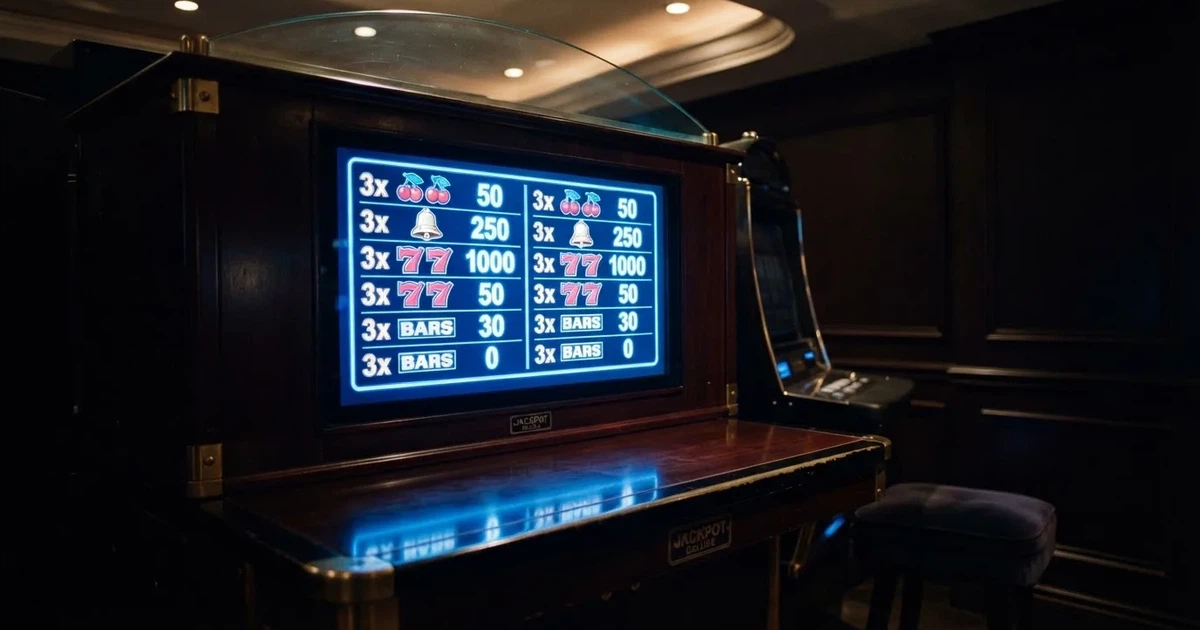
The capabilities listed on a paytable (a slot machine’s paytable screen glowing on a monitor in a dim room) is the cleanest window into that change. Paytables now run to several screens, list multiple bonus features, and assign each symbol a value that depends on the bet level. A classic three-reel paytable was a single line of numbers. The depth of the modern paytable is itself the reason the genre has its own name.
The paytable, the house edge, and the numbers that actually matter
A video slot’s paytable is a contract. It lists every winning combination, every symbol’s value at each bet level, the rules of every bonus feature, and — in jurisdictions that require it — the theoretical return to player. In Australia, paytables on licensed electronic gaming machines (EGMs) in clubs, pubs and casinos are governed by state-level regulators and must meet minimum return-to-player standards set by each jurisdiction. The Northern Territory Racing and Wagering Commission, the Victorian Gambling and Casino Control Commission, Liquor & Gaming NSW and their interstate equivalents each publish the rules that apply in their state.
The math behind those numbers is the same math behind every other casino game. House edge is the difference between what’s paid out and what’s taken in, expressed as a percentage of the wager. A few reference points from the standard house-edge tables: baccarat’s Banker bet runs at 1.06%, the Player bet 1.24%, the Tie at 14.36%; craps’ Pass/Come line sits at 1.41%, Don’t Pass/Don’t Come at 1.36%, Any Craps at 11.11%; with optimal strategy, blackjack runs around 0.28% under liberal Las Vegas Strip rules and 0.43% under Atlantic City rules.
Video slots sit at the higher end of that spectrum. Most modern video slots return somewhere between 94% and 97% to the player over an extremely long run — meaning the house edge is in the 3% to 6% band, sometimes higher on progressive jackpot titles where a slice of every wager funds the top prize. State regulators in Australia require EGMs to meet minimum return-to-player thresholds (typically 85% to 90% depending on the state and venue category), and they audit the machines physically to confirm. That audit is the reason a licensed pub or club pokie is not the same product as an offshore site advertising the same theme.
For comparison, the United States takes a different approach: state regulation sets minimum slot payout percentages, with Nevada requiring at least 75%, Mississippi at least 80% and New Jersey at least 83%. Those numbers are floor levels, not actual returns, but they’re a useful reminder that “RTP” is a regulator-enforced number rather than a manufacturer’s promise.
What’s actually licensed in Australia — and what isn’t
Australian gambling law runs on a federal prohibition layered with state-level licensing. The Interactive Gambling Act 2001 (the IGA), tightened by the Interactive Gambling Amendment Act 2017, makes it an offence to provide online casino games, online pokies or in-play betting to a person in Australia. No state or territory licenses those products. What is licensable is wagering on races and sport placed before the event, lotteries and keno. In practice that wagering is licensed by the Northern Territory — the Northern Territory Racing and Wagering Commission regulates 52 of Australia’s online bookmakers, including Sportsbet, Bet365 and Ladbrokes, which are licensed in the Territory largely for tax reasons. The NTRWC has no full-time staff and meets once a month in Darwin.
What that means for a person looking for video slots is straightforward. The licensed product in Australia is the EGM you can sit at in a pub, club or casino — a physical machine, in a regulated venue, supervised by a state regulator. The product that offshore casino sites advertise to Australians — a video slot played in a browser or an app, against software run from Curaçao or another offshore jurisdiction — is a prohibited interactive gambling service. The site displaying an offshore licence does not change that. The IGA targets the provider, not the individual player, but the offshore operator gives no Australian consumer protection, no complaints body, and no recourse if a withdrawal is refused. A site can be blocked with a player balance still on it.
The penalties are calibrated to operators. From 11 June 2024, accepting credit cards, credit-related products or digital currency as payment for licensed online wagering carries penalties up to $247,500 for the operator. The legal deposit routes for licensed wagering are debit card, bank transfer, PayID, Osko and BPAY. A site asking an Australian for a credit card or a crypto deposit for what it calls a “pokies deposit” is operating outside the Australian rules. So is an Australian-facing site offering casino games rather than pre-event wagering.
The Interactive Gambling Amendment (Gambling Reform) Bill 2026 passed Parliament on 19 August 2026; its advertising and inducement measures commence on 1 January 2027. It is law with a start date, not yet in force on a 2026 page. The measure most relevant to video slots marketing is the new prohibition on inducements — bonus offers, “free” spins and the like — designed to lure Australians onto prohibited services. The current rule is enforced as written.
The ACMA’s enforcement record against offshore brands
The ACMA investigates breaches of the IGA, issues formal warnings, and directs Australian internet service providers to block illegal sites. As reported in June 2026, a total of 1,751 illegal gambling and affiliate marketing websites had been blocked since the first blocking request in November 2019, and more than 230 unlicensed gambling services had left the Australian market since enforcement was strengthened in 2017.
In a round reported on 26 June 2026 the ACMA asked Australian ISPs to block another 12 sites: 7Signs, ChromaBet, Donbet, Duospin, Freshbet, Slots Gem, Jacks Club, Lucky Start, Pointsbetz, Spinrise, Vinyl Casino and Wildsino. None of those names had been on an earlier formal-warning list, which is itself the point: by the time a site is on a blocking list, the ACMA has usually already issued a warning, given the operator a chance to comply, and watched nothing happen.
The formal-warning file behind those blocks is long and current. The ACMA issued a formal warning to Hollycorn N.V. in September 2022 over its Sky Crown and Blue Leo casino services. In May 2022 the ACMA warned Dama N.V. over six brands at once — Bambet, Dazard, Level Up, Rocketplay, Wild Tornado and Cobra Casinos. The Dama file kept growing: the ACMA issued further formal warnings to Dama N.V. over Woo Casino (March 2025) and Spirit Casino (May 2025). In April 2025 the ACMA warned Sterplay Holding Ltd over Casino Intense. In February 2025 the ACMA warned EOD Code SRL over Instant Casino. In July 2025 the ACMA warned Bamboo Media over Ignition Casino, and Consolutetish S.R.L. over National Casino and Bizzo Casino — Bizzo having already been the subject of a 2022 formal warning to TechSolutions (CY) Group Limited and TechSolutions Group N.V. In April 2026 the ACMA warned Ryker B.V. over Jackbit and CasinOK. In March 2026 the ACMA warned Pulsup Ltd over Rocketplay.
The pattern behind that list (a person at a laptop reading a plain-language explainer article at a home desk) matters more than any single brand. The ACMA names an operator, a brand and a date. The operator may run ten brands from the same shell company; the warning may be the third in a series over the same parent. The brand on the home page of the site is rarely the entity the ACMA holds responsible. A punter looking at a casino’s “About” or “Licence” page is looking at a marketing artefact, not at the regulatory file behind it.
H2 Gambling Capital’s 2025 report estimates Australians lose about A$3.9 billion a year to illegal gambling sites, and that the share of gambling going through legal channels fell from 74% in 2021 to 64%. That is the demand the offshore sites are chasing.
Calculating the blocking rate the ACMA is running
The arithmetic behind the ACMA’s blocking record is the cleanest information-gain a reader can take from the file. The first blocking request the ACMA made was in November 2019. By the figures published in June 2026, the running total of blocked sites was 1,751.
That gives a blocking rate of roughly 1,751 sites across the 79 months from November 2019 to June 2026 — about 22 sites blocked per month on average, or around 266 per year. The rate has not been steady. Earlier rounds were smaller; the June 2026 round alone added 12 sites, and the 2024-2026 period has run hotter than 2019-2022. So the honest read of the number is a band: somewhere in the order of 250 to 300 sites blocked per year across the most recent enforcement period, with a long-run average of closer to 22 per month since the start. The condition that sits beside the figure matters more than the figure: every blocked site has had a formal warning first, has failed to comply, and has then been escalated through an ISP-level block. The block is the end of a process, not the beginning of one.
What that cadence tells a reader is that the offshore market is not static. Sites disappear, rebrand and reappear under a new name within weeks. A site that the ACMA blocked in 2024 is the same site, sometimes, as a 2026 brand on a different domain — which is why the formal-warning file (which names operators and parent companies, not just domains) is the durable record.
Self-exclusion, monitoring and the player side of the rule book
Player protection in the licensed Australian market runs through BetStop, the National Self-Exclusion Register, which has been live since August 2023. BetStop binds Australian-licensed online and phone wagering services — the same 52 NT-licensed bookmakers, plus the lotteries and keno operators. It does not bind an offshore casino. A punter who has self-excluded through BetStop and then opens an account with an offshore site has not violated BetStop, because BetStop has no jurisdiction over the offshore site; the offshore site has no obligation to honour the exclusion.
For the offshore product, the only monitoring that applies is payment-side: from 11 June 2024, the credit-card and crypto ban means an Australian-licensed bank will block a credit-card deposit to a wagering merchant under the ePayments Code, but a debit-card deposit to an offshore casino is harder for the bank to identify and stop. A punter who has decided to stop is reliant on the offshore site honouring the request, which is not enforceable through any Australian body.
Support, on the other hand, is reachable. The National Gambling Helpline on 1800 858 858 is free, 24/7, with chat at Gambling Help Online. Those services are not offshore-aware: they help a person who’s decided they have a problem, regardless of which product produced it. The financial and legal complications of the offshore product (the absence of any Australian complaints body, the risk of a blocked withdrawal, the absence of recourse) compound the harm that helpline staff are dealing with on the call.
For the licensed product, the protection runs deeper. State regulators can audit a machine’s software, fine a venue for breaches, suspend a licence, and order a payout dispute resolved. The Victorian Gambling and Casino Control Commission replaced the VCGLR as Victoria’s casino regulator on 1 July 2022; its public log of approved changes at Crown Melbourne records rule changes down to the renaming of a side bet (Perfect Pairs became Crown Pairs on 23 December 2024) and the introduction of a Free Bet option with a new Pot of Gold side bet on 25 March 2024. New South Wales’ Casino Control Act 1992 (section 66) requires a casino operator to not permit a game such as baccarat to be played unless the game and its rules are approved by the regulator, and to make a copy of the approved rules available to patrons on request. That level of record-keeping and rule-approval is what the licensed product is — and what the offshore product explicitly is not.
Bonuses, free spins and the arithmetic behind an “inducement”
A video slots bonus page on an offshore site reads like a gift list: deposit match, free spins, no-deposit free spins, cashback, reload bonus, loyalty points. The mechanics are universal enough that describing them once is enough; the arithmetic behind each is what costs the player.
A deposit match bonus pays the player a percentage of their deposit as bonus money, with the bonus then subject to a wagering requirement — a multiplier that determines how many times the bonus must be staked before it (and any winnings from it) can be withdrawn. A$100 deposit matched at 100% with a 35x wagering requirement on the bonus means A$3,500 in qualifying wagers before the bonus and any associated winnings are withdrawable. The deposit itself is usually not part of the wagering requirement; the bonus is.
Free-spin offers are similar. The casino credits the player’s account with a fixed number of free spins at a fixed stake-per-spin on a named game, with winnings from those spins credited as bonus money and subject to the same wagering requirement. Where the offer specifies a maximum cashout — a cap on how much of the bonus-balance winnings can be withdrawn — that cap is the real ceiling on what the “free” spins are worth.
The marketing word the casino uses (and a tablet screen displaying an official regulator warning notice on a desk beside a coffee cup) for these offers is “free”. They are not free. They are conditional, and the conditions are designed so the casino keeps the edge. A 35x wagering requirement on a 96% RTP slot means that for every A$100 of bonus money, the player must put A$3,500 through a game that returns A$3,360 over the long run. The expected cost of clearing that bonus is A$140 — the casino’s edge applied to the required turnover. A 50x requirement on the same game lifts the expected cost to A$200. A max-cashout cap below the bonus-balance total caps the upside independently of the wagering requirement.
The Australian-licensed market does not run deposit-match bonuses on EGMs; pubs, clubs and casinos in Australia operate the machines on a cash-and-play basis with no deposit bonus or free-spin offer. Some licensed wagering services run inducement-style promotions (bonus bets, odds boosts) on racing and sport — and even those are being tightened by the 2026 reform, with the inducement measures commencing on 1 January 2027.
The honest summary: an offshore “free spins” offer is a conditional credit, priced by the wagering requirement and the RTP of the named game, with the casino’s edge intact. The marketing word is “free”; the arithmetic is the casino’s edge applied to the turnover the player must run.
Mobile play and the dedicated app question
Most offshore video slots sites run on a responsive web platform: the same HTML5 game loads on a desktop browser, a phone browser, and a tablet browser, and the game state syncs through the account. The difference between mobile-browser play and desktop-browser play is the touch interface and the screen size — the game itself is the same build, the same RTP, the same math. What changes is how it feels to play: a five-reel slot with cascading wins and a Megaways mechanic that reads well on a 27-inch monitor can feel cramped on a 5.5-inch phone, particularly when the bonus-round animation carries important information.
The dedicated app question is a marketing question rather than a math question. Most offshore sites offer an Android APK download — sideloaded, because Google Play does not host real-money casino apps in Australia — and either an iOS app via a TestFlight or enterprise certificate, or a mobile-web shortcut dressed to look like an app. The game inside is the same HTML5 build either way. There is no separate “mobile game” with different math; the difference is in the loading path and the screen handling.
The licensed Australian product has its own app footprint. The big wagering operators — the NT-licensed bookmakers running racing and sport — have iOS and Android apps in the Australian stores, because racing and sport wagering is legal to advertise in Australia. They do not offer casino games inside those apps; casino games are the prohibited product.
So a punter who downloads a casino app for video slots from outside the Australian stores is downloading an offshore app, and any “real money” function inside it is operating outside the IGA. The convenience argument for an app — faster load, push notifications, biometric login — does not change that.
Specific games and providers — what an Australian punter is actually choosing between
For the licensed Australian EGM market, the game catalogue is state-managed. Each state’s regulator approves a list of games and game variants, and only those games can be deployed in venues in that state. The games are made by a small set of manufacturers — IGT, Aristocrat, Ainsworth, Konami and Scientific Games are the major names — and the titles themselves are Australian-specific. Aristocrat’s Lightning Link, Buffalo and Queen of the Nile series are widely deployed in NSW clubs; IGT’s range runs through the US-derived formats adapted for Australian requirements.
For the offshore market, the catalogue is global. The same game (NetEnt’s Starburst, Pragmatic Play’s Gates of Olympus, Microgaming’s Mega Moolah) appears on dozens of offshore sites under identical branding. The RTP is set by the provider, not the casino; the casino chooses which games to host and at what stake levels. The same theme can appear from multiple studios, and the same studio can publish through multiple aggregators — which is why an Australian-facing site may show a “Pragmatic Play” lobby section, a “NetEnt” lobby section and a “Betsoft” lobby section, all drawing from a single integration.
The volatility rating — low, medium, high — is the second number on the paytable that matters for the player. Low-volatility slots pay small amounts often; high-volatility slots pay less often and bigger when they do. A punter with a small bankroll and a preference for longer sessions usually wants a low-volatility title; a punter chasing a feature round or a larger top prize usually accepts a higher-volatility title and the longer losing runs between wins. Volatility is set by the game’s paytable — the symbol values, the reel-strip weighting and the bonus-round hit frequency — and is a property of the game, not the casino.
RTP and volatility are reported on the paytable for most modern video slots. Where a site does not publish the RTP for a given title, that absence is itself information: the casino is choosing not to display the math. The licensed Australian market requires the information to be displayed.
Operator licensing and ACMA action
The list below is not a ranking. Each brand is named because the ACMA has issued a formal warning under the Interactive Gambling Act 2001 over it, for offering prohibited services to Australians. Online casino games cannot be licensed anywhere in Australia, whatever offshore licence the site displays. The order is the ACMA’s own filing order, not an editorial choice about which brand is “best”.
| Brand | ACMA action and date | Operator named by the ACMA | Subject support |
|---|---|---|---|
| RocketPlay | Formal warning March 2026; earlier warning over the same operator’s wider portfolio in May 2022 | Pulsup Ltd (Rocketplay); earlier Dama N.V. | No data |
| Level Up Casino | Formal warning May 2022 | Dama N.V. | Listings only (BGaming) |
| Woo Casino | Formal warning March 2025 | Dama N.V. | No data |
| Spirit Casino | Formal warning May 2025 | Dama N.V. | No data |
| National Casino | Formal warning July 2025 | Consolutetish S.R.L. | Listings only (en.wikipedia.org) |
| Bizzo Casino | Formal warning July 2025; earlier formal warning 2022 | Consolutetish S.R.L.; earlier TechSolutions | No data |
| Ignition Casino | Formal warning July 2025 | Bamboo Media | No data |
| Instant Casino | Formal warning February 2025 | EOD Code SRL | No data |
| Jackbit | Formal warning April 2026 | Ryker B.V. | No data |
| Casino Intense | Formal warning April 2025 | Sterplay Holding Ltd | Listings only (ABC, acma.gov.au, Crownmelbourne) |
| Sky Crown | Formal warning September 2022 | Hollycorn N.V. | No data |
“Subject support” here means independent confirmation of the brand’s claim to offer video slots to Australian customers; where the figure is “no data”, independent listings did not corroborate the offering, and where it is “listings only”, reference pages exist but the operator’s own marketing pages are the only source for the specific offer. The single column that matters more than the others is the second: every brand on this list has had the ACMA hold an operator entity on the record for providing prohibited services to Australians, regardless of which offshore licence the site displays.
A reader comparing the table reads the same record the ACMA has on file. Three patterns stand out. Dama N.V. is the operator entity behind three of the eleven brands on this list and was named in five separate ACMA actions across 2022 and 2025, which is the strongest single signal in the table that the offshore parent-company model is built to absorb warnings without changing the customer-facing brand. TechSolutions and its successor TechSolutions Group N.V. are similarly recurrent, with Bizzo Casino warned twice under different operating entities. And the ACMA’s record is current — six of the eleven warnings are dated 2025 or 2026, and the most recent is Rocketplay in March 2026.
What the EGMs you can actually play in Australia look like
The licensed alternative to the offshore product is the electronic gaming machine on a pub, club or casino floor. The numbers give a sense of the scale: pokies-style slot machines outside casinos numbered 87,298 in New South Wales (June 2023), 26,380 in Victoria (2021-22), 21,122 in Queensland (October 2023), 11,672 in South Australia (September 2023) and 3,587 in the ACT (November 2023). By 2010 Australia operated an estimated 97,103 gaming machines outside casinos — a per-capita rate about five times that of the United States. New South Wales legalised slot machines in 1956; the category has had seventy years of state-level governance behind it.
Those machines are not the multi-feature video slots the offshore sites advertise. The Australian club pokie is closer in format to the Aristocrat Lightning Link series than to the Megaways titles on an offshore site’s lobby page — five-reel video, but with bonus features tuned to a quick bonus-round hit frequency and a stake ceiling that is the subject of ongoing reform debate at the state level. The state-by-state maximum-stake tier, the default deposit ceiling (the maximum a player can load onto a player card at the venue), and the self-exclusion register are the levers each state regulator pulls; the offshore site is outside that framework entirely.
A punter who wants the modern, multi-feature video slot format and is unwilling to use an offshore site is, in 2026, choosing between the licensed Australian product (with its narrower game catalogue and venue-based play) and using the offshore product with full awareness that it is prohibited, that the ACMA has warned the operator, and that any dispute is unresolvable through an Australian body.
How to read this material if you’re trying to choose
Three honest choices follow from what is on the page. The first is to play the licensed product — pubs, clubs and casinos in your state — and to use the state regulator’s complaint channel if a venue breaches the rules. The state regulators have audit power; the offshore sites do not. The second is to not play at all, and to use BetStop if self-exclusion from licensed wagering is the right step. The third is to use an offshore site with eyes open: understanding that it is operating outside the IGA, that the ACMA has warned the operator (and may block the site at any point), that bonuses carry the wagering requirement and the max-cashout cap, that RTP and volatility are properties of the game rather than the casino, and that any withdrawal dispute has no Australian remedy.
The middle option is the most expensive by a margin. The marketing word is “free spins”; the arithmetic is the casino’s edge. The regulatory word is “licensed offshore”; the reality is that no licence issued outside Australia legitimises the supply of a prohibited interactive gambling service to a person in Australia.
The figure that closes the case is the H2 Gambling Capital estimate: A$3.9 billion a year flowing out of Australia to illegal gambling sites. That money is leaving the country, leaving the state regulator’s audit, leaving the complaints framework, and leaving the self-exclusion register. The punter pays it; the country does not get it back.
FAQ
What makes a video slot different from a classic three-reel pokies machine?
A classic three-reel mechanical machine uses around ten symbols per reel and produces roughly 1,000 possible combinations, with no bonus features beyond the spin and the payout. A modern video slot uses five or more reels with 50 or more symbols per reel, multi-payline layouts (sometimes 243 or 117,649 ways to win), and stacked bonus mechanics: wilds, scatters, free spins, cascading reels, hold-and-spin, and progressive jackpots. The top combination on a modern title can run to odds of around 300 million to one, which is the simple arithmetic of more symbols and more reels rather than a different kind of unfairness.
Do video slots typically include bonus rounds that classic machines don’t have?
Yes. The bonus round is one of the defining features of the genre — a free-spin trigger from three or more scatter symbols, a pick’em screen, a hold-and-spin feature with sticky symbols, or an expanding-reel mechanic that changes the symbol grid during the round. Classic three-reel machines had no such features; their only “bonus” was the top jackpot on the payline. Modern video slots typically have multiple bonus modes running in parallel, which is why their paytables run to several screens rather than a single line of numbers.
Are video slots on a mobile browser the same game as the desktop version?
Yes — the underlying game is the same HTML5 build, the same RTP, the same math. What changes between desktop and mobile is the touch interface and the screen layout: the same five-reel Megaways title that reads clearly on a 27-inch monitor can feel cramped on a 5.5-inch phone, especially during the bonus-round animation. A site that offers a dedicated app is typically wrapping the same HTML5 build in a downloadable shell rather than shipping a separate mobile game with different math.
How many paylines does a typical modern video slot use?
It depends on the format. A standard five-reel video slot usually has 20 to 40 fixed paylines. “Ways to win” titles (243, 1,024) drop the line structure in favour of any matching symbols on adjacent reels. Megaways titles, licensed by Big Time Gaming, vary the number of symbols per reel on every spin and can offer up to 117,649 ways to win on a single spin. A three-reel classic uses a single payline down the centre. The payline count affects the hit frequency, the volatility, and how stake-per-spin translates into cost-per-spin.
Why do video slots vary in volatility even within the same provider’s catalogue?
Volatility is set by the paytable — the symbol values, the reel-strip weighting, and the hit frequency of the bonus features. A provider can ship a low-volatility title that pays small amounts often (a 96% RTP game with frequent small line wins), a high-volatility title that pays larger amounts rarely (a 96% RTP game with most of the return concentrated in a rare bonus round), and anything in between, all from the same studio. The provider tunes the math to fit the theme; the casino chooses which titles to host and at what stake levels. Volatility is a property of the game, not the casino, and a serious punter picks the volatility that matches their bankroll and session length.
Which Australian state has the most licensed gaming machines outside casinos?
New South Wales, by a wide margin. The count was 87,298 EGMs outside casinos in NSW as of June 2023, against 26,380 in Victoria (2021-22), 21,122 in Queensland (October 2023), 11,672 in South Australia (September 2023) and 3,587 in the ACT (November 2023). New South Wales was also the first state to legalise slot machines, in 1956, which is why the venue-based EGM density in Sydney and regional NSW is so much higher than elsewhere. The states and the ACT each regulate their own machines under their own casino-control and gaming-machine legislation, with the Northern Territory Racing and Wagering Commission handling online wagering rather than EGMs.