
Best Booongo Online Casinos Australia: The Landscape a Reader Is Searching Through
A search for “best Booongo online casinos Australia” lands in an empty room. Australians who want to play online pokies or online casino games for real money have no licensed local product to walk into; what carries the Booongo name sits offshore, beyond the reach of any Australian regulator, and the Australian Communications and Media Authority has spent several years naming the brands one by one. The page below sets out the landscape as it stands this year — the studio behind the games, the legal frame, the brands the ACMA has acted against, and what a fair comparison would weigh if a fair comparison were possible.
Current as of 8 November 2026 — verified against the ACMA’s published formal-warning register and H2 Gambling Capital’s 2026 market figures.
Table of Contents
- Mobile play and what a Booongo app would actually look like
- Specific games, paytables and what a Booongo title actually shows
- What a fair ranking would weigh — and why no such ranking exists
- How online gambling is regulated in Australia — and what that means for a Booongo casino
- Responsible gambling — what help is available
- Payments and payout speed — the money side of the picture
- Bonuses and free spins — what the marketing word is worth
- Studios in the wider Australian slot conversation
- Frequently asked questions
Mobile play and what a Booongo app would actually look like
Booongo is the trade name under which 3 Oaks Gaming distributes content; the studio builds HTML5 slots that load in a phone browser without a separate install, and a “Booongo casino app” is, in practice, a mobile browser pointed at an offshore site. Australian app stores block real-money casino apps, and the sideloaded file an offshore operator emails a new account holder is outside any consumer protection the user has in Australia.

The mobile experience the marketing describes — portrait and landscape layouts, a finger-sized spin button, paytables that rotate to fit a six-inch screen — is real at the software layer. It is built on the same HTML5 framework most modern slot studios use, and it works the same way whether the player is in Sydney or São Paulo. What changes between jurisdictions is the regulatory one: in a market where the studio’s games are licensed, the mobile product comes with a complaints body, an identity check, a self-exclusion register and a deposit limit. In Australia, the player gets the HTML5 layer and none of the regulatory layer.
For a player deciding what to install on a phone, the practical question is not “which app is best.” It is “which app is going to be here in six months.” Offshore brands the ACMA has acted against are routinely blocked at the ISP level, and a casino that vanishes overnight takes the balance with it. The market’s mobile offer, in other words, is structurally unstable in a way the desktop offer is not — a smartphone screen does not make the underlying legal position any different from a laptop one.
A note on the marketing term “best mobile Booongo casino.” It is the kind of phrase an affiliate page writes to capture a search query, and it carries no comparative weight the reader can verify. Every mobile casino that runs Booongo content looks much the same on a phone: a vertical reel stack, a balance counter at the top, a deposit button at the bottom. The differentiation the marketing claims — fast payouts, slick UX, exclusive titles — is the differentiation every offshore casino claims, and none of it is checked by an Australian regulator.
Specific games, paytables and what a Booongo title actually shows
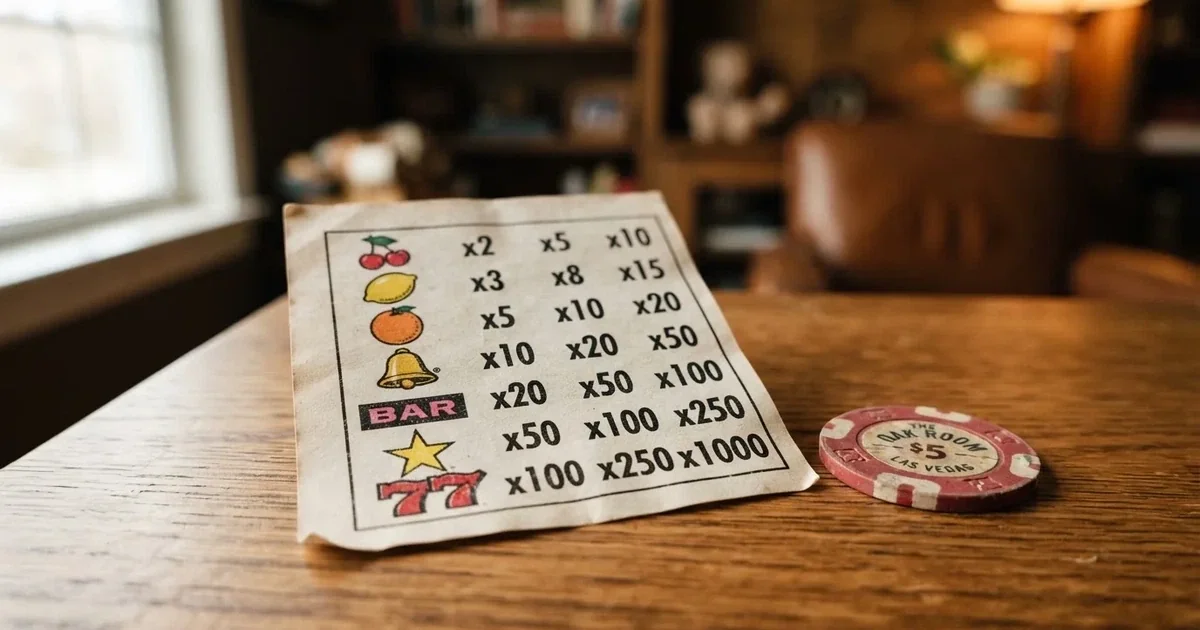
A Booongo slot is a five-reel video slot with a configurable number of paylines, a bonus round and a “Hold and Win” mechanic the studio has used across most of its catalogue. The paytable is the screen that lists what each symbol pays, how the wild substitutes and what triggers the bonus; on a desktop it is usually a tab behind an “i” button, on mobile it sits in the same place. Reading the paytable before a first spin is the single most useful thing a player can do, and on most slots it takes longer to find than to read.
3 Oaks Gaming, the regulated-market brand that grew out of Booongo’s 2021 restructuring, was granted a remote operating licence by the UK Gambling Commission on 9 February 2024 under licence number 063055-R-338209-005, and the company operates under Green Rock Ltd from Douglas, Isle of Man. Following that licence the UK Gambling Commission certified more than 50 of 3 Oaks Gaming’s slot titles, including 3 Pots of Egypt, Storm of Olympus, 777 Fruity Classic and Hawaii Riches. The Malta Gaming Authority issued a recognition notice on 4 August 2025, letting the studio offer titles such as Sun of Egypt 4, Coin UP: Lightning and 3 Hot Chillies to MGA-licensed operators, on top of earlier market approvals in the UK, Portugal and Romania.
What that regulatory trail means for an Australian reader: the studio has cleared the kind of compliance checks that make a game legal in a regulated market, and the same games are available on offshore sites that take Australian players without any of that compliance. The product is regulated; the route to an Australian wallet is not.
Hit frequency, volatility and return-to-player are the three numbers a paytable sometimes prints and a reader should know how to read. Return-to-player is the share of wagered money a slot returns over a very large number of spins — usually tens of millions — and is the closest thing a slot has to an honest price tag. Volatility is how the money comes back: low volatility pays out often and small, high volatility pays out rarely and large. Hit rate is the share of spins that pay anything at all. None of the three is a guarantee of any individual spin’s outcome; together they sketch the shape of a session.
The Australian reader who arrives at this page through a search query rarely wants a tutorial on paytables; they want to know which Booongo title to look for. The honest answer is that there is no Australian-licensed site on which to look for one. The titles the UKGC has certified and the MGA has approved are exactly the titles the offshore casinos promote — the difference between the regulated and unregulated routes is everything around the title, not the title itself.
What a fair ranking would weigh — and why no such ranking exists
A ranking of “best Booongo casinos” implies a comparative framework: payout times, bonus value, game catalogue depth, customer support, the licence the site operates under. Each of those is measurable, and each of them produces a different ordering of the same set of brands. The order a punter lands on after a search is the order an affiliate page chose to publish — not an order that survives a check.
A reader who wants to compare would weigh, at minimum, the licence the site displays against the regulator that issued it, the bonus terms against the bonus value, the catalogue against the studio’s full release list, and the withdrawal time against the deposit method. Every one of those comparisons fails the moment the brand is one the ACMA has acted against, because the comparison presupposes a regulator a reader can complain to and a licence that means something in the reader’s jurisdiction.
The table below is not a ranking. It is the set of brands the ACMA itself has named in formal warnings, with the operator and date the regulator published. It is the only ordering the ACMA supports, and it is an enforcement record rather than a recommendation.
| Brand | ACMA action and date | Operator named by the ACMA | Subject support |
|---|---|---|---|
| RocketPlay | Formal warning, March 2026 | Pulsup Ltd | — |
| Level Up Casino | Formal warning, May 2022 | Dama N.V. | Listed on Wazdan’s partner pages |
| Woo Casino | Formal warning, March 2025 | Dama N.V. | — |
| Spirit Casino | Formal warning, May 2025 | Dama N.V. | — |
| National Casino | Formal warning, July 2025 | Consolutetish S.R.L. | Listed by Betsoft, Pragmatic Play, Wikipedia |
| Bizzo Casino | Formal warning, July 2025; earlier 2022 | Consolutetish S.R.L.; earlier TechSolutions | — |
| Ignition Casino | Formal warning, July 2025 | Bamboo Media | — |
| Instant Casino | Formal warning, February 2025 | EOD Code SRL | — |
| Jackbit | Formal warning, April 2026 | Ryker B.V. | — |
| Casino Intense | Formal warning, April 2025 | Sterplay Holding Ltd | Listed by 1spin4win, Wikipedia, UK Gambling Commission records |
| Sky Crown | Formal warning, published September 2022 | Hollycorn N.V. | — |
The columns the table does not carry are the columns a normal comparison would lean on: payout time, wagering multiple, game count, payment methods. The research that informs this page carries no such data for any of these brands — only affiliate pages do, and those pages describe the offer the affiliate is paid to promote. The honest comparison, in other words, is the table the regulator already publishes.
RocketPlay
RocketPlay is one of two brands in the table with two published ACMA actions against the same operating history. The May 2022 warning named Dama N.V. across six casino brands including Rocketplay; the March 2026 warning named Pulsup Ltd specifically over Rocketplay, the Australian-facing domain. Two separate operators, four years apart, running the same product to Australian customers. The brand’s own claim that it holds a Curaçao licence is a licence from a jurisdiction the ACMA does not recognise for Australian-facing casino play. Whatever balance a reader leaves in a RocketPlay account is outside Australian consumer protection.
The brand carries no Booongo-specific listing in the research available to this page. A reader searching for “Booongo casino” and landing on RocketPlay is being pointed at it by an affiliate page, not by the studio’s own distribution list. That distinction — promoted by an affiliate rather than distributed by the studio — is the one that decides what kind of recourse a player has if a withdrawal stalls.
Level Up Casino
Level Up was named in the May 2022 Dama N.V. warning alongside five other brands, and it appears on Wazdan’s published partner page. The Wazdan listing is a distribution relationship with a different studio and carries no information about the operator’s licence or its standing with Australian regulators. A brand’s presence on a game provider’s partner page tells a reader one thing — the studio is happy to be distributed through that operator — and nothing else. It does not endorse the operator, the operator’s terms or the operator’s standing in any jurisdiction.
Level Up is the brand on which the gap between what an affiliate page claims and what the regulator has found is widest. An affiliate writes “trusted online casino, fast payouts, thousands of games.” The ACMA writes “formal warning under the Interactive Gambling Act 2001.” Both are on the public record, and only one of them is enforceable in Australia.
Woo Casino
Woo Casino was the subject of a March 2025 formal warning to Dama N.V., the same operator warned in 2022 over a different set of brands. Dama N.V. is a Curaçao-incorporated operator that runs a portfolio of casino brands, and the ACMA has now published actions against at least three of them in three years. A reader looking at any brand under Dama N.V. is looking at a portfolio the ACMA has acted against more than once, and the absence of a fresh warning is not the same thing as the operator having been vindicated.
The image Woo Casino markets itself with — a stylish brand, a packed game lobby, a “Woo” persona across its social channels — is the standard offshore-casino surface. The substance is a Curaçao licence the ACMA does not accept and a regulator in Australia that has already named the brand once.
Spirit Casino
Spirit Casino is the second Dama N.V. brand warned in 2025, with a May 2025 formal warning following the March 2025 action over Woo Casino by two months. The pattern — same operator, two brands, same year — is the one the ACMA’s enforcement record most often surfaces, and it is the one a reader should treat as a signal about the operator rather than about the individual brand.
National Casino
National Casino was the subject of a July 2025 formal warning to Consolutetish S.R.L., alongside Bizzo Casino. National Casino appears on the partner pages of Betsoft, Pragmatic Play and on Wikipedia — three distribution listings, none of them endorsements. A brand listed by a game studio is a brand the studio has a contract with; it is not a brand the studio vouches for, and the studio’s contract with an offshore operator does not survive an ACMA action.
Bizzo Casino
Bizzo Casino has been the subject of two formal warnings: one to TechSolutions (CY) Group Limited and TechSolutions Group N.V. in 2022, and a second to Consolutetish S.R.L. in July 2025. Two operators, two warnings, three years apart — the same pattern RocketPlay shows, and a stronger one. A reader looking at a brand with two ACMA warnings is looking at a brand no amount of affiliate-page reassurances can put right.
Ignition Casino
Ignition Casino is named in the July 2025 warning to Bamboo Media, and the brand carries no Booongo-specific listing in the research available. The brand has a longer history in the US-facing market, where it is positioned as a poker-and-casino hybrid; its appearance in the ACMA’s Australian enforcement record is a warning over the Australian-facing operation specifically.
Instant Casino
Instant Casino is named in the February 2025 warning to EOD Code SRL, and the brand carries no Booongo-specific listing in the research available. The marketing around Instant Casino leans heavily on speed of registration and breadth of payment methods; neither of those is regulated by an Australian authority, and the “instant” in the brand name refers to account opening rather than to withdrawal processing.
Jackbit
Jackbit was the subject of an April 2026 formal warning to Ryker B.V., alongside CasinOK. Jackbit positions itself around cryptocurrency deposits, which is the single payment route the ACMA’s June 2024 credit-and-crypto ban expressly blocks for licensed Australian wagering. A brand asking an Australian customer for a crypto deposit is, by definition, operating outside the Australian ruleset that applies to licensed wagering.
Casino Intense
Casino Intense was the subject of an April 2025 formal warning to Sterplay Holding Ltd. The brand appears on the partner pages of 1spin4win, on Wikipedia and in UK Gambling Commission records, and the UKGC listing is the regulatory detail that does most of the work: a brand licensable in the UK is not, on that basis alone, licensable in Australia, and the ACMA has acted against it specifically for Australian-facing play.
Sky Crown
Sky Crown is named in the ACMA’s September 2022 formal warning to Hollycorn N.V., alongside Blue Leo. The 2022 action is the oldest in the table, and the brand has continued to operate and to market to Australian customers in the years since. A formal warning under the IGA is the regulator’s first step; the operator’s response is voluntary, and the brand’s continued appearance in affiliate lists aimed at Australian players is its response.
How online gambling is regulated in Australia — and what that means for a Booongo casino
Australia’s online gambling rules live in the Interactive Gambling Act 2001, strengthened by the Interactive Gambling Amendment Act 2017. The IGA makes it an offence to provide online casino games, online pokies or in-play betting to a person physically in Australia, and no state or territory issues a licence for any of those products. What is licensable is wagering on races and sporting events placed before the event, lotteries and keno — and in practice those licences sit with the Northern Territory.
The Northern Territory Racing and Wagering Commission regulates 52 of Australia’s online bookmakers — Sportsbet, Bet365 and Ladbrokes among them — licensed in the Territory for tax reasons. The commission has no full-time staff and meets once a month in Darwin, a structural detail that goes a long way toward explaining why so much Australian-facing gambling sits offshore. A regulator that meets monthly is not a regulator that supervises a casino floor in real time.
The individual player is not the target of the IGA — the offence is the provider’s. An Australian punter does not face prosecution for opening an offshore account; what an Australian punter does not have is the consumer protection a licensed product carries. No complaints body, no dispute resolution, no enforced identity check, no enforced payout. If an offshore site refuses a withdrawal, the punter’s recourse is the site’s own customer support and, beyond that, the regulator the site claims to be licensed by — a regulator that does not cover Australian customers.
The Interactive Gambling Amendment (Gambling Reform) Bill 2026 passed Parliament on 19 August 2026, and its advertising and inducement measures commence on 1 January 2027. The bill is law with a start date, not yet in force at the time of writing — a distinction that matters for any operator currently marketing to Australian customers, because the rules under which they will be measured change at the turn of the year.
What the ACMA’s enforcement record looks like in numbers
The ACMA’s published enforcement record, as of June 2026, includes a cumulative total of 1,751 illegal gambling and affiliate marketing websites blocked since the first blocking request in November 2019, and more than 230 unlicensed gambling services that have left the Australian market since enforcement was strengthened in 2017. In the round reported on 26 June 2026 the ACMA asked Australian internet service providers to block 12 more sites: 7Signs, ChromaBet, Donbet, Duospin, Freshbet, Slots Gem, Jacks Club, Lucky Start, Pointsbetz, Spinrise, Vinyl Casino and Wildsino.
The figures behind the cumulative total show how the regulator’s blocking programme has progressed. The first blocking request went out in November 2019, and the cumulative figure of 1,751 blocked sites was reported in June 2026 — a span of roughly 79 months. That gives a band of about 22 blocked sites per month across the entire programme, or roughly 265 per year. The headline figure of 230 services that have left the market entirely since 2017 is a different measure — a service that voluntarily withdraws is not the same as a site blocked at the ISP level — and the two should not be added together.
The relevant band for a reader is the year-by-year figure: somewhere between 250 and 350 blocked sites per year, with the rate varying month to month as the ACMA issues fresh rounds. A reader who treats the cumulative total as a snapshot is reading the wrong number; the snapshot is the rate, and the rate is the regulator’s working pace.
The credit card and crypto ban that applies to licensed wagering
Since 11 June 2024, credit cards, credit-related products and digital currency have been banned as payment methods for licensed online wagering in Australia. The penalty for an operator that accepts them is up to A$247,500. The legal deposit routes for a licensed wagering account are debit card, bank transfer, PayID/Osko and BPAY.
A site asking an Australian customer for a credit card or a crypto deposit is, by definition, operating outside the Australian ruleset — which is consistent with what an offshore site is, and which a reader should know before they deposit. The crypto angle is worth flagging: a brand that markets itself around Bitcoin deposits is marketing itself around a payment method that is banned for the only Australian wagering product the player could legally use.
Tax treatment of gambling winnings
Gambling winnings of a recreational Australian player are not assessable income under section 6-5 of the ITAA 1997, and losses are not deductible — unless the person carries on a business of gambling, which a recreational punter does not. The tax treatment is straightforward at the recreational level; it becomes a question for the ATO only when the gambling is the person’s primary income source, and that is not the profile of a reader searching for an online casino.
Responsible gambling — what help is available
If thinking about Booongo-powered online casino play ever starts to feel compulsive or stressful, free confidential help is available around the clock. The National Gambling Helpline on 1800 858 858 is free and runs 24/7, with web chat at Gambling Help Online. The service is paid for by the Australian government and is independent of any operator.
BetStop, the National Self-Exclusion Register, has been in operation since August 2023. A person who registers with BetStop is excluded from every Australian-licensed online and phone wagering service simultaneously, and the exclusion period is the registrant’s choice. What BetStop covers is the licensed wagering market — sports and race bookmakers licensed in Australia. It does not cover offshore casino sites. An Australian punter who self-excludes from Australian wagering and then opens an offshore casino account is not protected by the exclusion at the offshore casino, which is one of the structural reasons the ACMA’s enforcement record matters.
The self-exclusion mechanic itself is worth understanding: it is a regulatory layer enforced by the licensed operator, and the operator checks the exclusion register on every login. An offshore operator has no access to BetStop, no obligation to honour an Australian self-exclusion, and no Australian licence to lose if it ignores the exclusion. The protection a player has against their own gambling is exactly the protection the licensed market provides, and the offshore market does not.
Payments and payout speed — the money side of the picture
The “best Booongo casino” search query usually arrives carrying a payments question: how quickly does the casino pay out, what does it cost, what are the methods. On the licensed Australian wagering market the answer is debit card, bank transfer, PayID/Osko and BPAY, with payouts running same-day to two business days on PayID and one to three on bank transfer. That is the Australian benchmark.
On an offshore casino carrying Booongo content, the methods lean the other way: cryptocurrencies, e-wallets the player may not have heard of, and credit-card deposits the player should not be using. The payout time is whatever the site claims, with no regulator checking it, no complaints body the player can take a stalled payout to, and no deposit guarantee. A withdrawal the player requests on a Monday can be “pending review” on a Friday with no recourse; the regulator the site claims to be licensed by does not cover Australian customers, and the ACMA’s enforcement action does not give the player their money back.
The payments angle is also where the credit-card ban and the crypto ban bite. A licensed Australian operator cannot take a credit card or a crypto deposit. An offshore operator can, because the ban does not apply to it — and that is the same reason the offshore operator is not licensed in Australia in the first place. The method a site asks a player to use is itself a signal about which side of the regulatory line the site sits on.
Bonuses and free spins — what the marketing word is worth
A Booongo casino bonus is, on the licensed side, a thing the regulator controls: maximum bonus size, maximum wagering requirement, clear terms, a complaints body if the terms are broken. On the offshore side, a bonus is a thing the operator writes: a headline number, a wagering multiple the player discovers on withdrawal, a max-cashout cap, a list of “restricted games” that includes most of the lobby.
The marketing word “free” does the work the marketing wants it to do. A “free” bonus is not free: it is a sum of bonus money the player wagers through a multiple before it becomes withdrawable, and the multiple is where the offer’s real cost sits. A “100% match” sounds generous; the question is the wagering multiple, the game contribution percentage, the time limit, and the maximum cashout — none of which the headline carries.
Research that informs this page does not give wagering multiples, game contribution tables or cashout caps for any of the brands the ACMA has acted against, because the only sources for those figures are affiliate marketing pages, and the regulator that does have the figures does not publish them for offshore operators. A reader who sees a bonus number on an affiliate page should treat the number as a marketing claim and read the terms page before depositing. The terms page is where the bonus lives or dies, and on an offshore site the terms page is the regulator’s evidence file.
What a paytable shows on a typical Booongo title
A typical Booongo paytable lists the symbol values across five reels and the win lines that pay. The wild substitutes for all symbols except the scatter and the bonus; the scatter triggers the free-spins round; the bonus symbol triggers the Hold and Win feature. The numbers the paytable prints are the numbers the game pays out at maximum line bet, and they are the only numbers the player can verify by reading.
The paytable does not print the RTP, the volatility or the hit rate — those are usually on a separate info screen or on the studio’s game page, not on the paytable. A player who wants the RTP needs to look for it; on a regulated market it is published by the studio and verified by the regulator, on an offshore market it is whatever the operator publishes, and the only verification is the studio’s own catalogue.
Studios in the wider Australian slot conversation
The Booongo name sits inside a wider Australian slot conversation that includes Aristocrat Leisure — the Australian gambling-machine manufacturer with its administrative and research headquarters in the Sydney suburb of North Ryde, and marketing and development offices in South Africa, Russia and the United States. Aristocrat develops electronic gambling machines, casino management systems, online real-money gambling technology, iLottery products and social casino games; its online arms are Product Madness (social games) and Aristocrat Interactive.
Aristocrat Leisure was founded in 1953 by Leonard Ainsworth and listed on the Australian Securities Exchange in 1996 under the ticker ALL. The 2025 accounts show revenue of A$6.30 billion, normalised net profit after tax and amortisation of A$1.55 billion, and 7,400 employees. Aristocrat Interactive — Aristocrat’s regulated online real-money-gambling business — was formed in April 2024 by combining Aristocrat’s Anaxi unit with the newly acquired NeoGames group, which includes Aspire Global, BtoBet and Pariplay. The acquisition cost was roughly US$1 billion and followed the 2014 purchase of Video Gaming Technologies for about US$1.3 billion, the 2017 purchase of Plarium for US$500 million and the 2017 purchase of Big Fish Games for US$990 million.
Aristocrat is the largest gambling-machine manufacturer in Australia and the second-largest slot-machine manufacturer worldwide, behind International Game Technology. Its online real-money business is regulated where it operates, and Aristocrat Interactive is the kind of brand an Australian punter can encounter in a regulated market — not at an offshore casino, and not on the ACMA’s enforcement list. The contrast between an Aristocrat product and a Booongo product on an offshore casino is the contrast between a regulated online arm and a studio whose games are licensed in the UK and Malta but distributed to Australians through channels the ACMA acts against.
1spin4win and Betsoft as distribution reference points
1spin4win is a slot provider founded in 2021 by a group of professionals with 15 years of iGaming experience; its games are built in HTML5 for low-bandwidth connections. The studio is headquartered at Scharlooweg 39, Willemstad, Curaçao, and holds a Curaçao gaming licence. Its portfolio spans more than 190 online slots, and the studio reports more than 1,000 partnerships with online casinos and aggregators, with a total bet sum that grew 46% in the first half of 2025 compared with the first half of 2024.
Betsoft was founded in 2006 and describes a catalogue of more than 200 RNG games spanning slots, table games, video poker and specialty titles. Betsoft’s slot Good Girl Bad Girl 2 has a published RTP of 96.22%, “Very High” volatility and a 15.59% hit rate, played on 5 reels and 20 paylines. The Slotfather, live since 13 December 2012, has a published RTP of 95.69%, “Medium” volatility and an 8.17% hit rate, played on 5 reels and 30 paylines. Betsoft describes itself as operating in compliance with licensing authorities including Italy’s ADM, with RNG certification from Quinel and Gaming Labs International, and states it partners with more than 500 operators across regulated markets in Europe, Scandinavia, Latin America and Africa.
Both studios are present on the partner pages of several brands in the table above — 1spin4win on Casino Intense, Betsoft on National Casino. Their presence on a partner page is a distribution relationship and nothing more; it does not endorse the operator, and it does not survive an ACMA action.
BGaming as a comparison point on licensing
BGaming’s team has worked on games since 2012; the brand itself debuted in 2018 and offers more than 250 certified games including video slots, video poker, lottery, card, scratch, crash and casual games. BGaming, operated by Stable Games Ltd of Valletta, Malta, holds a Malta Gaming Authority Critical Gaming Supply Licence (Number MGA/B2B/785/2020) for Type 1 B2B gaming services, issued 18 March 2021.
The Malta licence is the kind of detail that puts BGaming’s games into the MGA-regulated market — and MGA-regulated markets exclude Australia for casino games. A studio with an MGA supply licence can offer its content to MGA-licensed operators in Europe; it cannot, on the basis of that licence alone, offer its content to Australian customers through a licensed Australian casino, because there is no licensed Australian casino to offer it through.
Frequently asked questions
Is Booongo itself an operator, or just a game studio that supplies content to sites?
Booongo is the trade name under which 3 Oaks Gaming distributes content. The studio designs and builds HTML5 slot titles and licences them to online casino operators; it does not run a casino, hold player balances or process withdrawals. The 3 Oaks Gaming brand grew out of Booongo’s 2021 restructuring and now holds the regulated-market licences, including a UK Gambling Commission licence granted 9 February 2024.
Can Booongo titles be played for real money at any licensed Australian casino?
No. Online casino games and online pokies cannot be licensed in Australia under the Interactive Gambling Act 2001, and no state or territory issues a licence for them. The only real-money wagering products Australian regulators license are sports and race betting placed before the event, lotteries and keno. Booongo titles are available only on offshore sites operating outside Australian law.
How does a Booongo slot typically differ from other studios’ games in its paytable?
The paytable shows five reels, a configurable number of paylines, a wild symbol, a scatter and a Hold and Win bonus feature the studio uses across most of its catalogue. Return-to-player, volatility and hit rate are not always printed on the paytable itself; the studio publishes them separately, and on a regulated market they are verified by the regulator. On an offshore site the numbers are whatever the operator publishes, and the only cross-check is the studio’s own catalogue.
Does Booongo operate its own casino, or licence its games to other operators?
Booongo licences its games to other operators and does not run a casino. The 3 Oaks Gaming brand operates under Green Rock Ltd from Douglas, Isle of Man, and the studio’s UK Gambling Commission licence covers distribution to UK-licensed operators; the Malta Gaming Authority recognition notice of 4 August 2025 extends the same to MGA-licensed operators. Australian players encounter Booongo titles through the offshore operators the studio distributes to, not through a Booongo-owned casino.
Why do offshore casinos highlight Booongo as a selling point to Australian visitors?
The studio’s games are licensed in the UK and Malta, which is a higher regulatory standing than most offshore studios carry, and the titles travel well on mobile. The marketing angle is that “Booongo” is a recognisable brand to a player who has played slots in a regulated market and is now being courted by an offshore site. The regulatory standing of the studio is real; the regulatory standing of the offshore site offering it to Australians is not, and the ACMA has acted against several of the brands that lean hardest on the Booongo name.
Is it legal for a site to offer Booongo games for real money to people in Australia?
The Interactive Gambling Act 2001 makes it an offence for a provider to offer online casino games — including Booongo slots — to a person in Australia. The individual player is not prosecuted; the offence is the provider’s. An offshore site offering Booongo games to Australian customers is operating outside Australian law, and the ACMA has issued formal warnings to a string of brands that do, with blocking requests issued to Australian ISPs and more than 230 unlicensed services having left the market since 2017.