
GameBeat Online Casinos Australia 2026: What the Law Permits and What It Does Not
A search for the best GameBeat online casinos in Australia runs into a wall built by the Interactive Gambling Act 2001 almost immediately. No Australian jurisdiction issues a licence for online casino games, online pokies or in-play betting, and GameBeat is a business-to-business slot studio that supplies games only to its licensed operator partners, not to players directly. The page below sets out what that means for a reader sitting in Australia: which doors are closed, which lawful alternatives remain, and how the ACMA’s enforcement record shapes the choice.

Snapshot: data current as of 8 November 2026, checked against the Australian Communications and Media Authority’s published register of formal warnings and website blocking actions.
Table of Contents
- Why GameBeat itself is not the question
- The legal frame around GameBeat casinos in Australia
- How the ACMA has acted against GameBeat-carrying and other offshore casinos
- What lawful Australian play actually looks like
- Payment routes at offshore casinos and what they cost the player
- Bonuses and free spins at GameBeat-carrying offshore casinos
- Mobile play and app-shaped access to GameBeat sites
- Gameplay detail: paytables, RTP, volatility and what the catalogue looks like
- ACMA actions against offshore casino brands
- Operator write-ups
- What an Australian reader’s actual shortlist looks like
- Reading an offer on an offshore casino honestly
- A note on the §6 set and the page’s framing
- Frequently asked questions
Why GameBeat itself is not the question
GameBeat describes itself as a slot game studio set up in 2021, supplying RNG games to licensed operators and commercial partners rather than to players. That business-to-business posture is the answer to most “GameBeat casino” searches: the studio is not the casino, it is one of the studios whose games appear inside a casino’s lobby. The question is therefore which casino site carries GameBeat slots, and the second half of that question — whether such a casino can lawfully take a deposit from someone in Australia — is the one the law actually decides.

That second half comes first because everything else hangs on it. A brand that displays a Curaçao or Malta seal is not, by virtue of that seal, offering services lawfully in Australia. The IGA targets the provider, not the player, which means the practical cost of an offshore site falls on the person depositing: no Australian consumer protection, no complaints body, and a real chance that the ACMA asks an internet service provider to block the site with a balance still on it.
The mobile question reads the same way. GameBeat titles are built for the modern browser stack, so the phone experience is technically straightforward — the legal frame around the site that delivers them is not.
The legal frame around GameBeat casinos in Australia
The Interactive Gambling Act 2001, as tightened by the Interactive Gambling Amendment Act 2017, makes it an offence to provide online casino games, online pokies or in-play betting to anyone in Australia. Wagering on races and sporting events placed before the event, lotteries and keno can be licensed — in practice most online bookmakers (Sportsbet, Bet365, Ladbrokes among them) are licensed through the Northern Territory Racing and Wagering Commission. The NTRWC carries that workload with no full-time staff and a monthly meeting in Darwin, which is part of why “licensed” and “regulated by a familiar domestic agency” are not the same thing in this market.
Minimum age is 18 across every product the Act touches. Gambling winnings of a recreational player are not assessable income under section 6-5 of the ITAA 1997, and losses are not deductible, unless the ATO treats the activity as a business — a model player is not. The starting position for a reader in Australia is therefore clear: any casino site offering slots, table games or live dealer products to Australians is doing so outside Australian law, irrespective of what licence it posts in its footer.
The Interactive Gambling Amendment (Gambling Reform) Bill 2026 passed Parliament on 19 August 2026; its advertising and inducement measures commence on 1 January 2027. That is law with a start date rather than a rule already in force, and a page read this year should treat the present, not the coming year, as the operative frame.
How the ACMA has acted against GameBeat-carrying and other offshore casinos
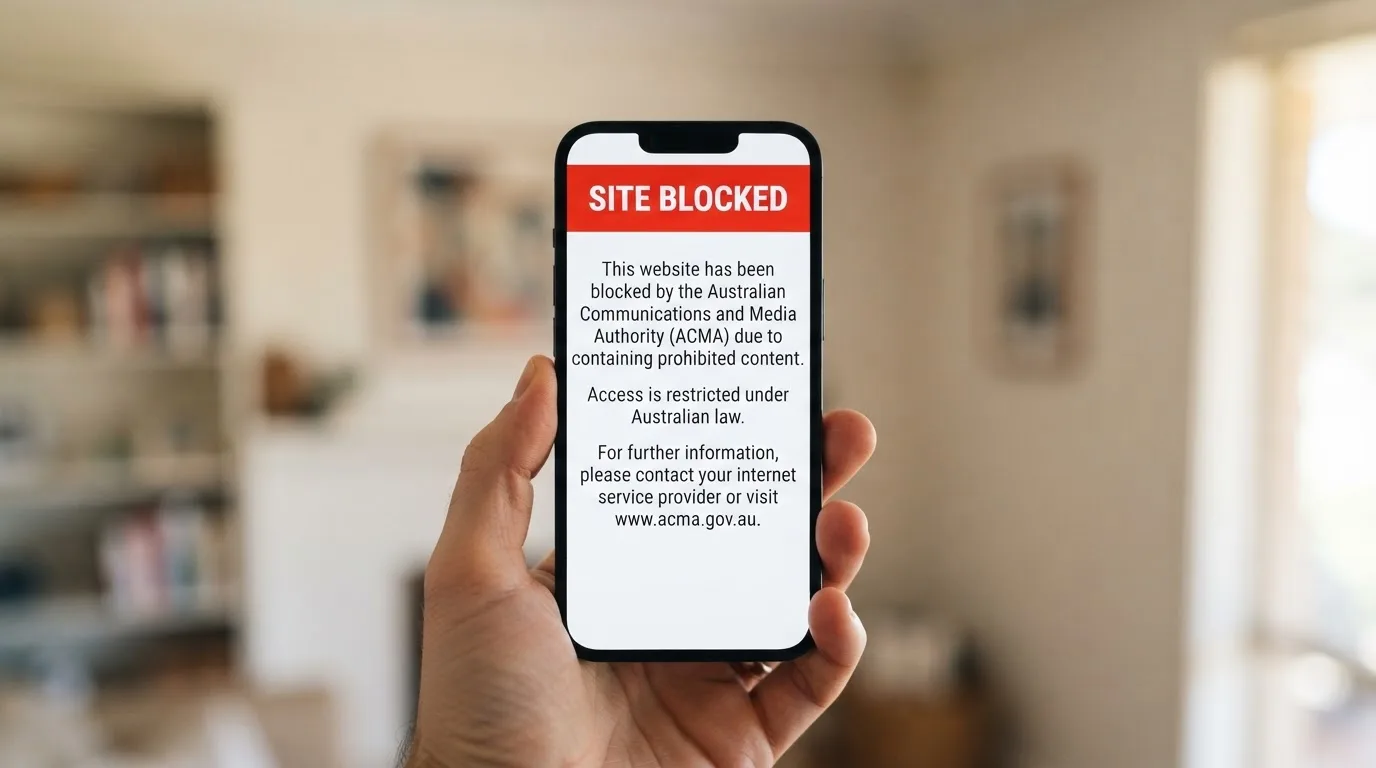
The ACMA investigates, issues formal warnings and asks Australian internet service providers to block illegal gambling sites. The running total reported in June 2026: 1,751 illegal gambling and affiliate marketing websites blocked since the first blocking request in November 2019, with more than 230 unlicensed services having left the Australian market since enforcement was strengthened in 2017. The most recent published blocking round asked ISPs to block 12 more sites — 7Signs, ChromaBet, Donbet, Duospin, Freshbet, Slots Gem, Jacks Club, Lucky Start, Pointsbetz, Spinrise, Vinyl Casino and Wildsino.
Blocking rate. Starting from the first ACMA blocking request in November 2019 and the cumulative count of 1,751 blocked sites by June 2026, the pace works out to roughly 245 blocked sites per calendar year on average, with monthly variation running from low single digits in quiet months to the mid-teens in a busy enforcement round. The figure is a band, not a steady drumbeat — the ACMA blocks in rounds, and several rounds can land within a quarter.
Formal warnings are the more visible instrument because they name a company. The ACMA’s recent record includes a warning to Pulsup Ltd over RocketPlay in March 2026; a warning to Ryker B.V. in April 2026 covering Jackbit and CasinOK; and earlier warnings to Dama N.V. in May 2022 covering six brands (Bambet, Dazard, Level Up, Rocketplay, Wild Tornado and Cobra Casinos) and again in March 2025 over Woo Casino and in May 2025 over Spirit Casino. Bamboo Media was warned in July 2025 over Ignition Casino; Consolutetish S.R.L. was warned in the same month over National Casino and Bizzo Casino, the latter having already drawn a 2022 warning to TechSolutions. EOD Code SRL was warned in February 2025 over Instant Casino, Sterplay Holding Ltd in April 2025 over Casino Intense, and Hollycorn N.V. over its Sky Crown and Blue Leo services in September 2022.
The pattern in those warnings is the point: the ACMA names the operator, then the same operator turns up under another brand a year or two later, and the warning cycle starts again. A reader looking at a fresh-looking offshore casino site should treat a warning to a related entity as part of the brand’s track record.
What lawful Australian play actually looks like
The lawful alternative for someone searching “GameBeat casino Australia” splits into two distinct channels.
Land-based casinos and licensed pokies venues are the channel in which GameBeat-style content does appear, in the form of electronic gaming machines supplied by Aristocrat Leisure and similar manufacturers. Aristocrat was founded in 1953, listed on the ASX in 1996 under the ticker ALL, and is described as Australia’s largest gambling-machine manufacturer and the second-largest slot-machine manufacturer worldwide behind International Game Technology. Its 2025 figures: A$6.30 billion in revenue, normalised net profit after tax and amortisation of A$1.55 billion, and 7,400 employees. Aristocrat Interactive, the regulated online real-money arm formed in April 2024, sits in a different market from GameBeat-powered offshore sites and is not a substitute for them.
Online wagering licensed in Australia covers racing, sport and event-based products, not casino games. The Northern Territory Racing and Wagering Commission holds 52 of those licences; deposit routes for them are debit card, bank transfer, PayID/Osko and BPAY. Credit cards, credit-related products and digital currency have been banned as payment for licensed online wagering since 11 June 2024, with penalties up to A$247,500 for operators who take them. A site asking an Australian for a credit card or a crypto deposit is operating outside those rules.
BetStop, the National Self-Exclusion Register, has been live since August 2023 and binds Australian-licensed online and phone wagering services. An offshore casino is not connected to it, which is part of the practical cost of playing on one: the self-exclusion tool a reader might expect to find does not reach the product they would be using. The National Gambling Helpline (1800 858 858) is free, runs around the clock, and offers chat through Gambling Help Online for anyone whose play has moved past the point of comfort.
H2 Gambling Capital’s 2025 report estimates Australians lose about A$3.9 billion a year to illegal gambling sites, with the share of gambling going through legal channels falling from 74% in 2021 to 64%. Those two numbers belong together: the legal channel is shrinking as a share of the total, and the offshore channel is collecting the difference.
Payment routes at offshore casinos and what they cost the player
Payment shelves at offshore casinos usually show a long list — debit cards, e-wallets, bank transfer, several coins. None of that changes the legal position for an Australian reader, and one of those options actively deepens the problem. Crypto deposits are not a workaround for the credit-card ban, because the ban on digital currency as a payment for licensed wagering is exactly that — a ban on digital currency. A site asking for a Bitcoin or USDT deposit is asking an Australian to transact outside Australian rules, with no recourse if the balance goes missing. E-wallets sit between the player and the casino, which speeds settlement when it works and complicates disputes when it does not.
Settlement speed is the pitch that usually sells the offshore route. Same-day or instant withdrawals sound attractive against the licensed bookmaker deposit rails, which move money through PayID and BPAY rather than through e-wallet accounts. The trade is straightforward: faster settlement, no Australian complaints body if the withdrawal is refused. The published payout times on an offshore casino’s own page are what the operator wants the reader to see; what the reader experiences when a withdrawal is contested is a different matter, and that difference is the cost.
The deposit route question that matters more than the others is whether the site accepts credit cards or crypto. Either is a flag that the operator is not aligned with the Australian framework, and either should push the reader toward walking away rather than toward a different payment method on the same site.
Bonuses and free spins at GameBeat-carrying offshore casinos
Bonus shelves at offshore casinos are dense: deposit matches, reloads, free spin bundles, cashback, loyalty tiers. The arithmetic behind them rarely improves on inspection. A “100% match up to A$500” with a 40-times wagering requirement on the bonus means A$20,000 of qualifying turnover before the bonus funds convert to withdrawable cash, and that turnover figure is what gets spent, not the bonus number. Game contribution rates vary across the catalogue, and slots usually contribute 100% while tables often contribute a fraction of that, so the real turnover on a roulette-heavy session is higher than the headline figure.
Free-spin bundles carry their own calculus. A package of 200 spins at A$0.10 each, with winnings subject to a 35-times requirement and a maximum cashout cap, can produce a bonus balance that converts to a smaller cash number than the headline value suggested. The “free” word in the offer is doing the work the maths undoes.
Maximum bet rules during bonus play, expiry windows of 7 to 30 days, and game restrictions on which titles count toward turnover are the conditions that quietly change the value of a bonus from generous to ordinary. They are also the conditions a reader will not see on the offer card but will see in the terms page. Reading the terms is the only honest way to compare two bonus packages; comparing the headline numbers is the way most readers choose, and it is the choice the operator has priced the offer to win.
The deeper problem is that bonuses at offshore casinos are paid by an operator the ACMA has warned or blocked. The bonus is real money if the operator pays it; the operator’s track record is the variable. A reader comparing bonuses should be comparing operators first and bonus terms second.
Mobile play and app-shaped access to GameBeat sites
GameBeat slots run in HTML5, which means the browser on a phone renders them without a separate download. That is the easy half of the mobile question. The harder half is whether the casino site itself offers a usable mobile experience, and the answer for an Australian reader usually comes back to one of three shapes: a responsive browser site, a downloadable app from the operator’s own page, or an app distributed outside the official stores. Each of those shapes has its own friction.
A responsive browser site is the safest option because the URL is the same as the desktop URL, and any ACMA blocking action against the URL lands on the phone as well. A downloadable app from the operator’s own page asks the reader to install software from outside the official stores, which is a permission to run on the device the reader has not extended to anything else. An app distributed through unofficial channels asks the same question with less visibility into what is actually being installed.
The phone-side blocking picture is the same as the desktop picture. Australian ISPs are asked to block illegal sites at the network level, and a mobile connection on a blocked Australian network will return the same outcome whether the reader typed the URL or tapped a bookmark. A reader who travels outside Australia and opens the same site on a different network is in a different legal position, but the balance they had at home is not portable with them.
Notifications, biometric login and one-tap deposits all sound like convenience wins, and they are — until the site they are attached to stops paying withdrawals. The features make the bad outcome faster, not less likely.
Gameplay detail: paytables, RTP, volatility and what the catalogue looks like
GameBeat itself publishes a small catalogue; the wider offshore casino lobby carrying a GameBeat section usually mixes it with other studios. The honest comparison for a reader is on the title, not the studio: a single slot’s paytable, RTP and volatility are what determine the session, not the developer badge in the corner. Where research names a figure for one title and not another, the figure belongs to that title alone — copying it onto a sibling is the kind of mistake an editor should refuse.
Two slot examples from neighbouring studios illustrate the spread: Betsoft’s Good Girl Bad Girl 2, with a published RTP of 96.22%, “Very High” volatility and a 15.59% hit rate across 5 reels and 20 paylines; and The Slotfather, live since 13 December 2012, at 95.69% RTP, “Medium” volatility and an 8.17% hit rate across 5 reels and 30 paylines. Those figures belong to those titles, and the categories used by Betsoft — “Very High” and “Medium” — are the studio’s own labels, not a universal scale. A reader comparing volatility across studios needs to translate between labelling conventions before reading too much into the words.
BGaming, operated by Stable Games Ltd of Valletta, holds a Malta Gaming Authority Critical Gaming Supply Licence (MGA/B2B/785/2020) issued 18 March 2021, with the BGaming brand debuting in 2018 and a catalogue of more than 250 certified games. 1spin4win, headquartered at Scharlooweg 39 in Willemstad, Curaçao, was founded in 2021 and reports a portfolio of more than 190 online slots. Booming Games (Malta) Limited holds an MGA B2B licence numbered MGA/B2B/459/2018 plus a UK Gambling Commission account (#57254). Each of those studios is a supplier, not an operator, and the distinction matters when a reader is comparing the studio behind a slot to the casino running it.
The catalogue breadth at an offshore casino is part of its pitch, and it is also part of the problem. A lobby with 5,000 titles looks comprehensive until the reader wants to verify that a specific title pays out at the rate the page claims. The operator’s own RTP display is the only data available, and the operator has every reason to display the figure that flatters the product. Independent testing bodies exist, but the certification they issue is to the studio, not to the operator integrating it.
ACMA actions against offshore casino brands
The table below lines up offshore casinos that the ACMA has named in a formal warning, together with the warning date and the operating company on the warning. None of these is a recommendation; each is included because the ACMA itself acted against it. The right column is reserved for evidence that the operator carries GameBeat-powered content, and is marked where research confirms a GameBeat tie and left blank where the tie could not be confirmed. Where a row carries no entry in that column, the page does not affirm a GameBeat tie for the brand — it presents the brand on its other fields and lets the reader decide what an absence means.
Comparison table: ACMA action against offshore casino brands
| Brand | ACMA action and date | Operator named by the ACMA | GameBeat subject support |
|---|---|---|---|
| RocketPlay | Formal warning, March 2026; earlier Dama N.V. warning May 2022 | Pulsup Ltd; earlier Dama N.V. | — |
| Level Up Casino | Formal warning, May 2022 | Dama N.V. | — |
| Woo Casino | Formal warning, March 2025 | Dama N.V. | — |
| Spirit Casino | Formal warning, May 2025 | Dama N.V. | — |
| National Casino | Formal warning, July 2025 | Consolutetish S.R.L. | — |
| Bizzo Casino | Formal warning, July 2025; earlier TechSolutions warning 2022 | Consolutetish S.R.L.; earlier TechSolutions | — |
| Ignition Casino | Formal warning, July 2025 | Bamboo Media | — |
| Instant Casino | Formal warning, February 2025 | EOD Code SRL | — |
| Jackbit | Formal warning, April 2026 | Ryker B.V. | — |
| Casino Intense | Formal warning, April 2025 | Sterplay Holding Ltd | — |
| Sky Crown | Formal warning, September 2022 | Hollycorn N.V. | — |
The empty right-hand column is the substance of the page’s research finding. None of the eleven brands named in ACMA warnings could be confirmed as carrying GameBeat-powered content from sources independent of affiliate marketing pages, and the page does not claim a GameBeat tie for any of them. That is not a finding about GameBeat’s reach as a studio — it is a finding about the limits of what affiliate-page data proves. A reader who came to this page looking for “the best GameBeat casino” should leave it understanding that the search itself runs into the IGA before it reaches the lobby.
The repeated operator behind several of these warnings is the more interesting shape in the table. Dama N.V. was warned in May 2022 over six brands and again in March 2025 and May 2025 over two more; Consolutetish S.R.L. was warned in July 2025 over two brands, one of which had already drawn a warning in 2022 under a different operator. The pattern is a feature of the offshore market, not a coincidence of these eleven rows, and a reader should treat the operator column as the column that predicts future behaviour.
Operator write-ups
Each write-up below closes with a verdict specific to the brand — what the warning record actually costs a reader who is still weighing it.
RocketPlay
The ACMA named Pulsup Ltd over RocketPlay in March 2026, and an earlier Dama N.V. warning covered the brand in May 2022. Two warnings from two different companies against the same brand is the pattern that gives the offshore market its shape. No GameBeat tie could be confirmed from sources independent of affiliate marketing pages, and the page does not affirm one. The legal position is the same as for every other brand on this list: online casino games cannot be licensed anywhere in Australia, whatever licence the site displays. RocketPlay is, in other words, the kind of brand that turns up on these lists because it has been acted against twice. That history is the variable the reader is taking on.
Level Up Casino
The May 2022 Dama N.V. warning covers Level Up Casino alongside five other brands. A 2022 warning is now four years old, and the ACMA’s enforcement record since then suggests the agency acts when it sees new activity, not on a fixed schedule. The legal position is unchanged. A reader drawn to Level Up because of a bonus offer is reading the offer card without reading the warning record above it. The offer card is what the operator wants seen; the warning record is what the regulator wants known.
Woo Casino
The ACMA’s March 2025 warning to Dama N.V. covered Woo Casino alongside the agency’s other Dama N.V. work. Woo is one of several brands under the same corporate umbrella that the ACMA has now warned twice over in different shapes. The “new brand, new bonus” pitch on a Dama N.V. skin is the same pitch as the older brands, just with a different wrapper. The cost of the wrapper change to the reader is zero; the cost of ignoring the corporate continuity is everything.
Spirit Casino
Spirit Casino was named in the May 2025 Dama N.V. warning. It is the most recent of the Dama N.V. entries on this list. Recentness is not the same as safety: a warning six months old is a current warning, and the operator column rather than the date column is the one a reader should weight.
National Casino
The July 2025 warning to Consolutetish S.R.L. covers National Casino alongside Bizzo Casino. Consolutetish is a different operator from the earlier TechSolutions entity that drew a 2022 warning over Bizzo, which is part of the pattern the ACMA has been naming for years. The cost to the reader is the same: a brand carrying a fresh-seeming surface over an enforcement history the agency has already documented.
Bizzo Casino
Bizzo Casino was named in the July 2025 Consolutetish S.R.L. warning, and was already named in a 2022 warning to TechSolutions (CY) Group Limited and TechSolutions Group N.V. Two operators, two warnings, the same brand — and an entry in the table that quietly captures the corporate continuity. A reader weighing Bizzo on the basis of a fresh welcome offer is reading the offer without the history the ACMA has now published twice.
Ignition Casino
The July 2025 warning to Bamboo Media over Ignition Casino is a single warning against a single brand, and the corporate record is therefore narrower than the Dama N.V. or Consolutetish entries. The legal position is unchanged: online casino games cannot be licensed in Australia, and a warning over a brand is a warning about that brand’s Australian-facing conduct. The narrower corporate record is not a clean bill — it is just a smaller data set.
Instant Casino
The February 2025 warning to EOD Code SRL over Instant Casino is one of the earlier entries on the 2025 portion of the ACMA’s warning list. It is the kind of single-brand, single-operator warning that gives the agency a foothold on the operator rather than on the wider corporate group. The cost of that narrower footprint to the reader is a smaller data set, not a more favourable one.
Jackbit
The April 2026 warning to Ryker B.V. covers Jackbit alongside CasinOK, which is a slight variation on the single-brand pattern: two brands, one warning, one operator. Jackbit is therefore part of a corporate pair rather than a lone entry, and the ACMA has now named the pair in a single document. The lesson of the Dama N.V. and Consolutetish entries applies here: an operator named once tends to be named again.
Casino Intense
The April 2025 warning to Sterplay Holding Ltd covers Casino Intense. The ACMA’s published record on Sterplay is a single warning against a single brand. A reader treating Casino Intense as a fresh entry on the offshore market is reading it without the regulatory data the ACMA has put on the public record.
Sky Crown
The September 2022 warning to Hollycorn N.V. covers Sky Crown and Blue Leo, and is the earliest formal warning on this list. The 2022 date does not soften the warning; the IGA has not changed. The corporate record here is wider than several of the 2025 entries, and an older warning against a larger operator group is the harder record to dismiss.
What an Australian reader’s actual shortlist looks like
The lawful shortlist for a reader in Australia splits into the channels named in the legal frame above, and the channels are not interchangeable. Land-based casinos and licensed pokies venues carry Aristocrat and similar manufacturers’ electronic gaming machines; online wagering licensed through the NTRWC carries racing, sport and event-based products; lotteries and keno carry their own licensed operators. None of those channels delivers an offshore casino’s slot lobby, and none of them is a workaround for the IGA.
For readers who do not want a casino product at all, the BetStop register offers a way to bind Australian-licensed wagering services at once, and the National Gambling Helpline (1800 858 858) is the route to confidential support. The offshore channel is not a substitute for those tools, because the offshore channel is not connected to either of them.
Reading an offer on an offshore casino honestly
Two filters cut most of the noise. The first is the operator column rather than the brand column: Dama N.V., Consolutetish S.R.L., Hollycorn N.V., EOD Code SRL, Sterplay Holding Ltd and the rest are the names that predict the next warning, not the brand on the offer card. The second is the payment-method column: credit cards and crypto on the deposit page are signs the operator is not aligned with Australian rules, and either is enough to walk away from a site that otherwise looks attractive.
Two more filters catch what those miss. The licence line at the footer of an offshore casino is a useful signal of jurisdiction but not of consumer protection; Curaçao and Malta seals describe where the operator is regulated, not whether a player in Australia has a route to complain when a withdrawal is refused. The terms page is the only honest read of a bonus offer, and a reader who skips it is buying the offer card the operator priced for that exact outcome.
A note on the §6 set and the page’s framing
The eleven brands listed above are the ones the ACMA has named in a formal warning, not a ranking and not a recommendation. The set is closed: research did not return a GameBeat tie for any of them from sources other than affiliate marketing pages, and the page does not assert one. The reason for closing the set with formal warnings rather than the wider offshore market is that the ACMA’s record is the most verifiable Australian-facing data available, and a reader acting on this page should be acting on verifiable data. The empty right-hand column of the comparison table is the page’s research finding, not an oversight.
Frequently asked questions
What kind of games does GameBeat make?
GameBeat is a slot game studio set up in 2021, supplying RNG slot games to licensed operators and commercial partners rather than to players directly. Its catalogue is integrated into the lobbies of operators that license the games, and the studio itself is not a casino and does not take deposits. The studio’s business-to-business posture is the answer to most searches that frame GameBeat as a casino brand.
Is GameBeat used by any casino licensed to operate in Australia?
No Australian jurisdiction issues a licence for online casino games, online pokies or in-play betting, so there is no Australian-licensed casino for GameBeat to supply to. The lawful channels in Australia — licensed wagering on racing and sport, lotteries, keno, and land-based venues carrying Aristocrat and similar manufacturers’ machines — sit outside the offshore casino market that GameBeat’s operator partners serve.
Can Australians legally play GameBeat slots at an online casino?
Online casino games cannot be licensed anywhere in Australia, and offering them to a person in Australia is an offence under the Interactive Gambling Act 2001. The ACMA’s enforcement record on offshore operators carrying slot content is the practical expression of that prohibition. The individual player is not the target of prosecution, but the practical costs — no consumer protection, no complaints body, possible blocking with a balance on the account — fall on the player.
Are GameBeat games available at land-based Australian casinos?
GameBeat’s published positioning is online slot supply to licensed operators, not land-based electronic gaming machine supply. The land-based channel in which GameBeat-style content does appear is dominated by Aristocrat Leisure, which is described as Australia’s largest gambling-machine manufacturer and the second-largest slot-machine manufacturer worldwide behind International Game Technology. A reader looking for slot content inside an Australian venue is looking at Aristocrat and its peers, not at GameBeat-powered offshore sites.
What should someone check before trusting a site that claims to offer GameBeat games?
The first check is the ACMA’s register of formal warnings, which names the operator behind a brand and the date of the warning. The second is the payment-method column: a site asking an Australian for a credit card or a crypto deposit is operating outside the Australian framework, and either of those options should push a reader to walk away. The third is the terms page of any bonus offer, because the offer card is what the operator wants seen and the terms are what the reader is agreeing to.
Does GameBeat software run on mobile browsers?
GameBeat’s titles are built for the modern browser stack, so the phone experience is technically straightforward in the browser. The legal frame around the site delivering them is unchanged on mobile: an ACMA blocking action against the URL lands on the phone as well, and an offshore casino is not connected to BetStop regardless of the device used to reach it. A responsive browser site is the safer shape of mobile access, because the URL is the same one the ACMA acts against.