
Offshore casinos and Australian players in 2026: the cost of an offer the law has already closed
A reader who arrived here searching for the best offshore casinos for Australian players in 2026 has come to a page that cannot honestly hand over that ranking. The Interactive Gambling Act 2001 prohibits the offer of online casino games and online pokies to anyone in Australia. No state or territory issues a licence for it. The list that the reader hopes for is the same list the regulator has spent the past several years telling one offshore operator after another to close — and the answer below is therefore a different kind of page: the legal frame, the ACMA’s actual enforcement record, the brands the regulator has named, the mechanics of an offshore welcome bonus in plain language, and the practical tools a reader in Australia can use today.
This is not a ranking and not a recommendation. It is an account of what is on offer, what it costs, and where the lawful alternative is.
Data current as of 8 November 2026. Verified against the Australian Communications and Media Authority register and the Interactive Gambling Act 2001 as in force in 2026.
Table of Contents
- Prohibition under the Interactive Gambling Act, and what the ACMA has actually done
- Player wellbeing tools that reach Australians in 2026
- The brands the ACMA has acted against
- What an offshore casino actually is, and what it costs in plain language
- ACMA warnings, brand by brand
- Frequently asked questions
Prohibition under the Interactive Gambling Act, and what the ACMA has actually done
The Interactive Gambling Act 2001 makes it an offence to provide certain interactive gambling services to customers physically present in Australia. The list is specific and the IGA names it directly: online casino games, online pokies and in-play betting are prohibited interactive gambling services. Race wagering, sports betting placed before the event, lotteries and keno are not. The distinction is not about who runs the site but about what is on it — a Curaçao-licensed offshore casino running a roulette wheel for an Australian punter is offering a prohibited service regardless of any overseas licence its footer displays.

No Australian state or territory issues a licence for an online casino game. The country has fifty-two online bookmakers on its books, but those are wagering services that take bets on sport and racing before the event, and they are licensed by the Northern Territory Racing and Wagering Commission — a body that, according to an April 2026 ABC report, has no full-time staff and meets once a month in Darwin. The Australian-licensed online wagering market exists; the Australian-licensed online casino market does not. The gap between those two statements is the entire subject of this page, and the reason the ACMA’s enforcement has a target.
The ACMA enforces the prohibition on the supply side. It can issue formal warnings to operators, refer matters to the Australian Federal Police, accept court-enforceable undertakings and ask Australian internet service providers to block illegal sites at the network level. The individual player is not the target. The IGA does not make it an offence for an Australian to gamble online; it makes it an offence for an operator to offer prohibited services to them. That distinction is what keeps Australian readers out of the criminal frame, but it also means the protections in the frame do not reach them either. The balance that an offshore casino holds is held under an operator’s house rules, with no Australian complaints body, no Australian regulator to escalate to and no Australian court process that picks up the IGA breach as a private cause of action.
The ACMA’s enforcement record since 2017
The ACMA’s preferred first move is a formal warning: a published notice to the operator naming the prohibited service and the Australian audience it was being offered to. Across the brands discussed further down this page, those warnings have been issued to Dama N.V. (six brands in May 2022, then Woo Casino in March 2025 and Spirit Casino in May 2025), to Consolutetish S.R.L. (National Casino and Bizzo Casino in July 2025), to Bamboo Media (Ignition Casino in July 2025), to EOD Code SRL (Instant Casino in February 2025), to Sterplay Holding (Casino Intense in April 2025), to Hollycorn N.V. (Sky Crown and Blue Leo in September 2022), to Pulsup Ltd (RocketPlay in March 2026) and to Ryker B.V. (Jackbit and CasinOK in April 2026). The pattern is consistent: a warning is issued, the operator either ignores it or re-emerges under a different corporate name, and another warning follows.
| Enforcement Action | Description |
|---|---|
| Formal Warning | ACMA notice to operator regarding illegal service |
| ISP Blocking | DNS-level blocking of illegal sites via Australian ISPs |
| Referral to AFP | Escalation of serious/repeated IGA breaches |
| Enforceable Undertakings | Court-backed commitments to cease illegal activity |
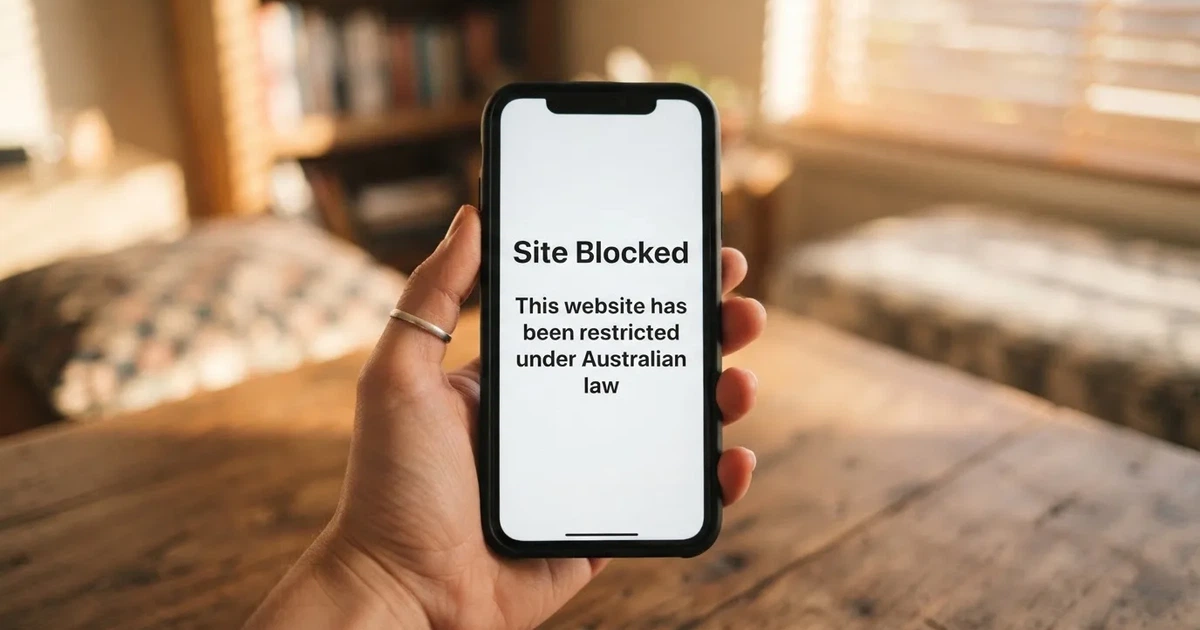
When a warning is not enough, the ACMA asks Australian ISPs to block the offending sites at the DNS level. In a single round reported on 26 June 2026 the ACMA asked providers to block twelve more websites — 7Signs, ChromaBet, Donbet, Duospin, Freshbet, Slots Gem, Jacks Club, Lucky Start, Pointsbetz, Spinrise, Vinyl Casino and Wildsino. That round was one of many. According to the ACMA as reported in June 2026, more than 1,750 illegal gambling and affiliate-marketing websites had been blocked since the first blocking request in November 2019, and more than 230 unlicensed gambling services had left the Australian market since enforcement was strengthened in 2017. The enforcement has been sustained, not episodic, and it has produced a record a reader can read.
The pace of blocking, in a usable band
A reader looking at 1,751 sites blocked across roughly eighty months wants to know what kind of pace that is, in something more honest than a single round. The arithmetic starts from two inputs the ACMA itself gives: 1,751 sites blocked in total, and November 2019 as the date of the first blocking request. From November 2019 to the 26 June 2026 reporting round works out to approximately eighty months. The long-run average comes to somewhere in the band of twenty to twenty-five sites blocked per month over that period — the precise centre sits just above twenty-two per month, and the band sits around it because the early rounds were smaller and the more recent rounds have been heavier. Individual rounds run well above that average: the June 2026 round alone added twelve sites in a single sweep, which would represent several weeks of the long-run pace landed in one batch. The result the page can stand behind is a sustained low-twenties-per-month floor with periodic spikes when a particular operator’s network of mirror sites is caught together. That is the pace of blocking. It is not a number a reader can use to predict which site is next, and it is not a number that says the market is shrinking — H2 Gambling Capital’s 2025 figure, taken up further down this page, says the opposite.
The 2026 reform, and what is not yet in force
Parliament passed the Interactive Gambling Amendment (Gambling Reform) Bill 2026 on 19 August 2026. Its advertising and inducement measures commence on 1 January 2027 — they are law with a start date, not a regime already operating on a reader who is in Australia this year. This page reflects that distinction. A reader who hears a podcast or sees an article about “the new gambling advertising rules” is hearing about a regime that has not yet commenced; the page reflects what is in force on the date at the top. The credit-card ban that does bite today — prohibiting Australian-licensed online wagering services from accepting credit cards or other credit-related products since 11 June 2024 — is the rule whose reach into daily play this page treats as live.
What the offshore offer actually costs the Australian household
H2 Gambling Capital’s 2025 report estimates that Australians lose around A$3.9 billion a year to illegal gambling sites. That figure represents money that leaves Australian households and cannot be recovered through any Australian complaints process. The same report records the share of Australian gambling going through legal channels falling from 74 per cent in 2021 to 64 per cent in 2025 — the illegal market’s slice grew by ten percentage points in four years while the ACMA was running the blocking programme described in the subsection above. The reader sitting at the keyboard is, in that arithmetic, part of a market that grew in spite of the enforcement aimed at it. The gap between 74 per cent and 64 per cent is the size of the answer to the reader’s search.
What is at stake when the balance cannot be withdrawn
The offshore casino that refuses to pay out a withdrawal is the operator the reader has no recourse against. There is no Australian complaints body for an unlicensed site, no Australian regulator to escalate to, and no Australian court process that picks up the IGA breach as a private cause of action. The site can be blocked at the DNS level while a balance is still on it, and there are readers for whom that has already been the experience. The price of an offshore casino is therefore not the bonus headline or the wagering multiple on its welcome page; it is the absence of any path back to the money once the operator decides the player has won too much, played an “irregular” hand, or breached a maximum-bet rule during wagering that no one bothered to read. That absence is what the rest of this page is for.
Player wellbeing tools that reach Australians in 2026
The Australian reader who wants to stop gambling on offshore sites does have tools. None of them were built for offshore casinos, because offshore casinos do not participate in Australian regulatory systems. What is available is built for the legal Australian market, and for the moment an Australian wants to leave both markets at once.

BetStop, and what it does not cover
BetStop, the National Self-Exclusion Register, has been live since August 2023. It binds every Australian-licensed online and phone wagering service — every licensed bookmaker is required by the regulator to honour a BetStop registration and refuse the punter’s account access for the duration of the exclusion. An offshore casino is not connected to BetStop at all. A punter who has excluded themselves through BetStop can still open an account at an offshore casino the next day, deposit from an Australian bank and play, because BetStop’s mechanism only reaches operators that participate in the Australian regulatory system. That gap is the reason this page exists.
Registration is free, and the minimum exclusion period is three months. Once the period expires the punter can choose to re-enter the legal market or extend the exclusion. BetStop does the work it was built to do, on the wagering services it covers. The reader who wants it to cover offshore casinos as well is asking for a tool that does not exist in the form they want — and asking the regulator to extend it, rather than the operator to honour it, is the correct direction for that request.
Bank-side gambling blocks at the merchant level
Australian banks offer card-level gambling blocks that operate independently of where the merchant is licensed. Westpac’s block refuses authorisation of any transaction tagged with the merchant category code for betting and casino gambling, on eligible personal credit and debit cards — the block sits at the card network, and the merchant behind it does not get to argue with the card. ANZ’s block, activated in the ANZ app, blocks gambling transactions made through a digital wallet such as Apple Pay on an eligible card, not just the physical card, and once turned on can only be removed after a forty-eight-hour waiting period that prevents an impulse-driven reversal. ANZ also warns, in plain terms on its support page, that not all gambling transactions will be blocked and that some non-gambling transactions might be blocked in error — the bank is being honest about the limits of its own tool. Commonwealth Bank offers a gambling lock through the CommBank app with the same merchant-category-level scope.
These blocks are useful precisely because they sit on the payment rail rather than on the operator. The operator cannot route around a card-level block by re-merchanting under a different trade name as easily as it can rebrand itself for a second ACMA warning. The block is the strongest practical layer between an Australian reader and an offshore casino, and it has the virtue of being free, instant and reversible only after a deliberate action that includes a waiting period.
The credit-card ban on licensed wagering
Since 11 June 2024, Australian-licensed online wagering services cannot accept credit cards or other credit-related products. The ban applies to the operator, prohibiting the offer of credit for wagering.
| Payment Type | Legal for Licensed Wagering |
|---|---|
| Debit card | Yes |
| Bank transfer | Yes |
| PayID / Osko | Yes |
| BPAY | Yes |
| Credit card | No |
| Cryptocurrency | No |
Civil penalties for operators that breach this rule run up to A$234,750 per offence under the IGA as amended in 2024. The ban is on the operator, not the cardholder, but its effect is that the licensed wagering market stops offering credit as a payment method — and the same restriction reaches digital wallets like Apple Pay when they are tied to a credit account. The ban does not reach offshore casinos, which is part of why the offshore market still attracts Australian deposits; it does mean that a reader trying to fund an AU-licensed bookmaker with a credit card has hit a wall that, at the offshore casino, has not been built. The asymmetry is the kind of detail the page is for.
Helplines and immediate support
The National Gambling Helpline is 1800 858 858 — free, twenty-four hours, every day. The same service offers web chat at Gambling Help Online. For readers in the moment of deciding what to do after a bad run at an offshore casino, those two routes are the practical answer to the question the site phrases as “what should someone do instead”. The cost of the call is zero. The cost of not making it is the next deposit.
The brands the ACMA has acted against
The table below summarises the enforcement actions the regulator has taken against the brands discussed in this guide. Each brand named has had a formal warning issued about it by the ACMA for offering prohibited interactive gambling services to people in Australia. The warnings are public and are the regulator’s own statements, not third-party allegations.
| Casino brand | ACMA action and date | Operator named by the ACMA | Subject support |
|---|---|---|---|
| RocketPlay | Formal warning, March 2026 | Pulsup Ltd | Listed by Gambling Insider |
| Level Up Casino | Formal warning, May 2022 | Dama N.V. | Listed by Westpac |
| Woo Casino | Formal warning, March 2025 | Dama N.V. | No-data |
| Spirit Casino | Formal warning, May 2025 | Dama N.V. | No-data |
| National Casino | Formal warning, July 2025 | Consolutetish S.R.L. | Listed by ACMA, AUSTRAC, BetStop |
| Bizzo Casino | Formal warning, July 2025 | Consolutetish S.R.L. | Listed by Gambling Insider |
| Ignition Casino | Formal warning, July 2025 | Bamboo Media | No-data |
| Instant Casino | Formal warning, February 2025 | EOD Code SRL | Listed by ecoPayz, PayID |
| Jackbit | Formal warning, April 2026 | Ryker B.V. | No-data |
| Casino Intense | Formal warning, April 2025 | Sterplay Holding | Listed by AUSTRAC, BetStop, Gambling Insider |
| Sky Crown | Formal warning, September 2022 | Hollycorn N.V. | No-data |
The “Subject support” column says where the brand appears in listings an Australian reader would consult — the regulator’s enforcement lists, the bank’s blockable-merchant list, the payment processors’ published warnings. None of the brands above are licensed in Australia. None can lawfully offer their casino games to an Australian reader. Where a row carries an em dash under “Subject support”, the consulted sources did not name the brand; the page does not invent a listing it could not find, and the reader can take the absence as the absence rather than as a clean bill of health.
What an offshore casino actually is, and what it costs in plain language
The Australian reader who has not already met one needs the mechanics, because the marketing hides them. An offshore casino is an online casino licensed by a regulator outside Australia — Curaçao, the Isle of Man, Malta, Kahnawake — that targets Australian players through search advertising, affiliate sites and bonus offers. The site accepts deposits in Australian dollars, runs a cashier in real time and pays out through bank transfer, card or, increasingly, cryptocurrency. None of that makes it licensed in Australia. The “Curaçao licence” on the footer is a real licence in a real jurisdiction, but it is not an Australian licence, and the operator behind it is bound by Curaçao’s rules rather than by the Interactive Gambling Act 2001. The distinction matters at the moment something goes wrong; it does not show up at the moment a deposit is made.
The fundamentals of the offer are familiar from any licensed casino — slots, table games, live dealer tables — wrapped in a bonus structure the Australian reader has come for. Welcome bonuses, reload bonuses, free spins, cashback. The arithmetic behind those offers is the same shape anywhere: a wagering requirement applied to the bonus amount, a maximum-cashout cap that puts a ceiling on how much of a bonus-derived balance can actually be taken out, a list of games that contribute differently to the requirement. The offer does not change because the operator is offshore. What changes is the recourse when something goes wrong, and the recourse was the section above the table.
The mechanics of an offshore welcome bonus
A typical welcome package credits the new account with bonus money on the first deposit, sometimes spread across the first three or four. The bonus carries a wagering multiple — how many times the bonus amount must be wagered before withdrawal — and a maximum withdrawal cap that puts a ceiling on how much of a bonus-derived balance can actually be taken out. Game weighting means that slots count 100 per cent towards the requirement, while table games count a fraction of that or are excluded entirely. Maximum bet rules during wagering mean a single spin above the cap can void the bonus. None of this is unique to offshore casinos; it is the same shape any licensed casino uses. The difference is what happens when the casino decides the player has breached a term — the “irregular play” clause that voids winnings on a technicality. At a licensed operator, a regulator hears the complaint. At an offshore operator, there is no regulator to hear it, because the operator is not licensed in Australia. The bonus was always a marketing word for a constraint; offshore, the constraint comes without the appeal.
What the reader’s dollar actually buys
A$3.9 billion a year flows from Australian households to illegal offshore sites, per the H2 Gambling Capital 2025 figure used earlier on this page. The reader’s dollar buys the experience the marketing describes — the slots, the live dealer, the cashier that takes Australian dollars — plus the exposure to an operator that does not have to honour any Australian consumer-protection obligation. The marketing emphasises the bonus. The dollar buys the bonus minus the chance that a withdrawal is refused, a maximum-cashout cap is applied, a maximum-bet rule during wagering is cited as irregular play, or the operator is reblocked at the DNS level while a balance is still on it. The arithmetic the reader is running in their head when they click “deposit” is not the arithmetic the operator is running in theirs, and the operator’s arithmetic is the one that gets to keep the money.
The tax position of the recreational player
For an Australian who gambles recreationally, winnings are not assessable income and losses are not deductible. The rule sits in section 6-5 of the Income Tax Assessment Act 1997 and applies to the recreational player by default. The person who carries on a business of gambling is taxed differently and should check with the ATO; that is a different reader with a different problem. The default rule — recreational gambling is not taxable income — is what most readers coming to this page sit under, and it is worth stating plainly so the offshore casino’s “tax-free winnings” pitch does not become a reason on its own to play. The pitch is true under Australian tax law; it would be true at a licensed Australian venue too; it is not a feature unique to offshore.
The reader who has had a bad experience
A bad run at an offshore casino is the experience that brings readers back to pages like this one. What they cannot do is complain to an Australian regulator — the IGA gives no private right of action, and the ACMA does not arbitrate disputes between players and operators. What they can do is block the operator at the payment rail (turning on a bank-side gambling block makes future deposits from the same source more difficult), self-exclude from the Australian-licensed market through BetStop to remove the legal route to the same behaviour, and contact the National Gambling Helpline on 1800 858 858 or via the chat at Gambling Help Online if the experience has moved from a financial loss to something heavier. None of those routes claws back the money already lost; they are about stopping the next deposit. The arithmetic the marketing hid when the deposit was made is now the only number that matters, and it is the number the rest of this page was written to surface.
ACMA warnings, brand by brand
RocketPlay — warned twice, under two different operators
The ACMA has issued formal warnings about RocketPlay on two occasions, against two different corporate operators. The May 2022 warning was issued to Dama N.V. and covered six casino brands at once, including Rocketplay alongside Bambet, Dazard, Level Up, Wild Tornado and Cobra Casinos. The March 2026 warning was issued to Pulsup Ltd and named RocketPlay specifically. The intervening years did not change the underlying offer — online casino games to people in Australia — but the corporate vehicle did. From a reader’s point of view, Rocketplay is the brand that has been warned twice and is still reachable through search advertising; that is the clearest available signal that the operator believes rebranding its corporate parent is a workable defence against the ACMA’s enforcement. Subject support for the brand, in the consulted listings, is reported by Gambling Insider only. The verdict for a reader is that the brand has not been deterred by one warning and was not deterred by the second; the assumption that a third one would be is the assumption the operator’s history is built to encourage.
Level Up Casino — one of six brands in the 2022 Dama round
Level Up was named alongside five other brands when the ACMA’s May 2022 warning was issued to Dama N.V. The corporate parent at that point was the same as Rocketplay’s, before the brand migrated to Pulsup Ltd for the second warning. Level Up is one of two Dama-linked brands on this list whose subject coverage showed up somewhere other than the ACMA’s own warnings: Westpac’s gambling-block merchant list names Level Up, which means a Westpac customer with the gambling block turned on has a deposit attempt refused at the merchant level rather than letting the transaction reach the operator. That is a more practical layer of protection than the warning itself, because it fires at the moment of deposit rather than at the moment of enforcement. The verdict for a reader is that this is one brand of a six-brand warning, distinguishable on this list by the fact that the bank has it on the blocked-merchant list — the rest of the offer, the bonus, the wagering multiple, the games catalogue, follows the standard Dama template.
Woo Casino — Dama N.V.’s second warning, four years after the first
The March 2025 ACMA warning to Dama N.V. over Woo Casino is the first of two follow-up warnings the operator received after the original 2022 six-brand notice; the second followed in May 2025 over Spirit Casino. Between the 2022 warning and the 2025 one, the operator behind Woo Casino had three years to change its offer, which it did not. The subject-support listings for Woo Casino were not surfaced in any of the consulted sources. The brand is a repeat warning rather than a first, and that is what distinguishes it on this list. For a reader, Woo Casino is the operator the ACMA has now told twice, in three years, to stop doing what it is still doing. The brand’s continued presence in the search results an Australian reader sees is itself the answer to the question of whether the first warning landed.
Spirit Casino — the second Dama follow-up, less than a year after Woo
The May 2025 ACMA warning to Dama N.V. over Spirit Casino came just over a year after the Woo Casino warning and within a month of the National Casino and Bizzo Casino warning to Consolutetish S.R.L. — the ACMA was running warnings at a tempo in 2025 that suggests the agency treated the period as a focused enforcement window. Like Woo, Spirit Casino’s subject-support listings were not surfaced by the consulted sources, and the page does not paper over that gap with a guess. The verdict on Spirit Casino is the same on the regulator’s record but different in its timing: another Dama brand, another warning, another year during which the offer to Australians continued. The brand’s distinguishing feature on this list is the proximity of its warning to those issued to other operators in the same period — it sits inside a stretch of ACMA activity that did not let the offshore-casino market rest.
National Casino — listed by the ACMA, AUSTRAC and BetStop at once
The July 2025 warning to Consolutetish S.R.L. over National Casino is the brand’s first ACMA warning, and it was issued in the same round as the warning to the same operator over Bizzo Casino. What distinguishes National Casino from most other brands on this list is the breadth of its listings footprint: the ACMA itself lists it, AUSTRAC has it on record, and BetStop names it. The last of those is notable because BetStop is the register Australian-licensed wagering services honour, and an offshore casino appearing in BetStop’s records is the register saying it is not connected to the exclusion mechanism — which is, again, the reason this page exists. The verdict for a reader is that the brand sits at the intersection of three different Australian institutional lists. None of them licence it; all of them name it. That is the most explicit signal of any brand on this page that the operator has been tracked across more than one of the systems an Australian reader uses to vet a casino.
Bizzo Casino — warned twice, by two different operators
Bizzo Casino has been the subject of two ACMA formal warnings. The first was issued in 2022 to TechSolutions (CY) Group Limited and TechSolutions Group N.V.; the second was issued in July 2025 to Consolutetish S.R.L., in the same round as National Casino. The corporate parent has changed, and the warning has followed. The brand is on Gambling Insider’s listing and was, at the time of the 2022 warning, one of the names most directly associated with the TechSolutions corporate group that runs a large network of casino brands marketed at Australians. For a reader, Bizzo is the clearest example on this list of an offshore casino that was warned, changed its corporate parent, was warned again and continued to operate. The 2022 warning was issued; the operator responded by changing the corporate shell, not the offer; the 2025 warning was issued to the new shell. The reader’s expectation, on the evidence, is that a third warning will follow a third reorganisation.
Ignition Casino — Bamboo Media’s only warning on this list
The July 2025 ACMA warning to Bamboo Media over Ignition Casino is the only warning in this list whose subject-support listings were not surfaced by any of the consulted sources — the brand has no Australian institutional footprint beyond the ACMA’s own warning. Ignition Casino is one of the better-known offshore casino brands globally; its appearance on this list is the Australian regulator’s notice that the brand’s Australian-facing offer has been called out specifically. The verdict for a reader is the simplest on this list: one warning, one operator, no prior action on this page, no subject listings, no other institutional trace in the Australian sources consulted. The single warning is the entirety of what the ACMA has said about the brand.
Instant Casino — EOD Code SRL’s warning, with its payment processors named as well
The February 2025 ACMA warning to EOD Code SRL over Instant Casino is the brand’s only warning on this list. What distinguishes Instant Casino is that it is the only brand whose subject-support listings surfaced through payment-processor sources: ecoPayz and PayID both name the brand. PayID’s published warning, in particular, is worth reading — the platform warns that being asked to transfer money to a PayID associated with an illegal gambling site is itself a signal of fraud. Instant Casino sits in that warning zone. The verdict for a reader is that this is a brand whose payment rails carry their own warning, beyond the ACMA’s. The PayID-name warning is the kind of practical detail the reader wants before committing a deposit; it is here in plain language, and it comes from PayID rather than from the casino.
Jackbit — Ryker B.V.’s warning, alongside CasinOK
The April 2026 ACMA warning to Ryker B.V. covered both Jackbit and CasinOK in the same notice. The warning is the operator’s first on this list, and the subject-support listings for Jackbit were not surfaced by the consulted sources. The brand’s distinguishing feature on this list is that it was named in the same warning as another brand — CasinOK — meaning the ACMA treated them as one operator’s portfolio rather than as two separate notices. For a reader, Jackbit’s specific position is as one of two brands warned together. The CasinOK side of that warning is not a separate row on this page because the research did not separate them; the reader who clicks through to either is reading about the same corporate operator’s offer and the same corporate operator’s exposure.
Casino Intense — Sterplay Holding’s warning, with the broadest subject footprint
The April 2025 ACMA warning to Sterplay Holding over Casino Intense sits alongside the broadest subject-support footprint on this list outside National Casino’s three-list reach: AUSTRAC lists the brand, BetStop names it, and Gambling Insider carries it. Three institutional Australian sources plus the industry publication, on a single brand. The brand is on more Australian lists than any operator other than National Casino, which carries the same breadth. The verdict for a reader is that Casino Intense is the brand whose Australian institutional footprint is most clearly mapped outside the ACMA’s own enforcement record. The brand has not been licensed; it has been tracked across the regulator, the financial-crime authority, the self-exclusion register and the industry press. The reader is looking at an operator whose presence in Australian administrative systems is otherwise than as a licensed entity.
Sky Crown — Hollycorn N.V.’s 2022 warning, with Blue Leo in the same notice
The ACMA issued a formal warning to Hollycorn N.V. covering both Sky Crown and Blue Leo. The warning is the oldest on this list — September 2022 — and is also the only one not surfaced through the more recent enforcement rounds. Sky Crown’s subject-support listings were not surfaced by the consulted sources. The brand’s distinguishing feature on this list is its age: the warning has been public for long enough that the test of whether it has been heeded is the brand’s continued operation. For a reader, Sky Crown is the brand with the longest gap between warning and current Australian offer. The reader who arrives here four years on has arrived at a brand the ACMA told to stop in 2022 and that is still reachable from Australian search results today.
Frequently asked questions
What makes a casino “offshore” rather than Australian-licensed?
An offshore casino is an online casino licensed by a regulator outside Australia — Curaçao, Malta, the Isle of Man, Kahnawake among them — that targets Australian customers. The word “offshore” describes the licensing jurisdiction, not the location of the servers or the nationality of the staff. The single defining feature is that the operator is not licensed by an Australian regulator and is therefore not bound by the Interactive Gambling Act 2001 in the way Australian-licensed wagering operators are.
Does the ACMA block offshore casino websites for Australian readers?
Yes. The ACMA asks Australian internet service providers to block illegal sites at the DNS level. The June 2026 reporting round added twelve websites in a single sweep, and more than 1,750 sites had been blocked since the first blocking request in November 2019. The blocks affect access from Australian IP addresses; they do not stop the site from continuing to operate in other jurisdictions.
Is it legal for an offshore casino to accept Australian players?
It is the operator, not the player, who commits the offence under the Interactive Gambling Act 2001. Offering prohibited interactive gambling services — online casino games, online pokies and in-play betting — to a person in Australia is the offence, and it is the operator’s exposure, not the player’s. The reader sitting in Australia is not breaking a law by playing; they are playing with an operator that is.
Why doesn’t BetStop cover offshore online casino sites?
BetStop is the National Self-Exclusion Register, and it binds every Australian-licensed online and phone wagering service. An offshore casino is not licensed in Australia, and BetStop’s mechanism only reaches operators that participate in the Australian regulatory system. A punter who self-excludes through BetStop is excluded from the legal wagering market; the exclusion does not extend to offshore casinos because the offshore casino is not connected to the register.
What should someone do after a bad run at an offshore casino?
The practical steps are to block the operator at the payment rail by enabling a bank-side gambling block on every eligible card and digital wallet, to self-exclude from the Australian-licensed market through BetStop to remove the legal route to the same behaviour, and to contact the National Gambling Helpline on 1800 858 858 or via the chat at Gambling Help Online if the experience has moved from a financial loss to something heavier. None of those steps claws back the money already lost; they are about stopping the next deposit.