
Licensed Pokies in Geelong in 2026, the Offshore Names Trying to Sell Them, and the Numbers Behind Both
Data verified against the ACMA’s published register of formal warnings and the Victorian VGCCC venue data, as at 25 November 2026.
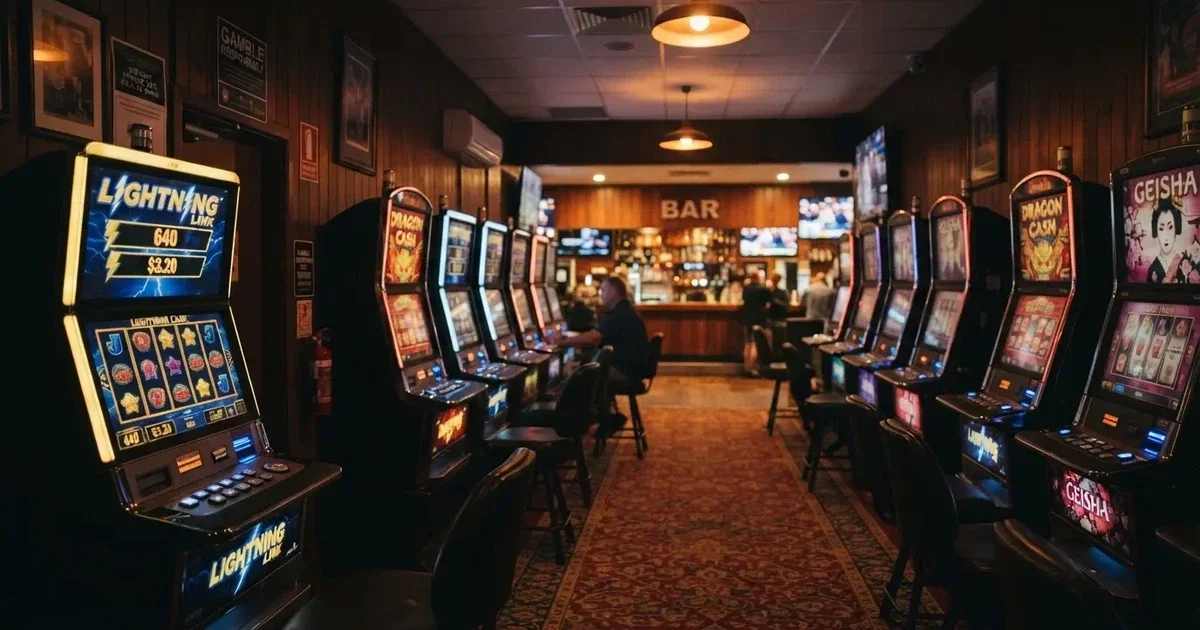
The licensed pokies in Geelong sit in pubs and clubs, not on a website. Offshore sites still calling themselves a pokies room from Curacao, Anjouan or Cyprus are all under formal warning from the ACMA for offering the same product to a person in Australia.
This page follows both halves. It maps the venues a reader can actually walk into, works through what the ACMA has been doing about the offshore side since the first blocking request in November 2019, and says what each half actually costs the punter who sits down.
Table of Contents
- How a Geelong Pokies Shortlist Actually Gets Built
- The Fundamentals of Pokies in Geelong
- The Prohibition That Underpins the Whole Picture
- Responsible Gambling Tools That Actually Reach a Player
- Land-Based Venues: Where Licensed Pokies in Geelong Actually Sit
- Paytables, Payments and the Cash-Out
- Specific Games and What the Floor Shows
- Eleven Offshore Brands the ACMA Has Formally Warned
- The Blocking Rate That 2026’s Figures Actually Show
- Frequently Asked Questions
How a Geelong Pokies Shortlist Actually Gets Built
A “best pokies in Geelong 2026” list is built two different ways depending on which half of the market the writer thinks is the answer. Most of the lists sitting online today answer the wrong question. They name ten casino brands, quote a welcome bonus, link through to a sign-up page, and never mention that Australia has not licensed a single one of them.
That sort of list has a single criterion working in the background: affiliate revenue. Every brand gets weighed against the commission the site would earn if the reader actually deposited. The result is a ranking that respects marketing budgets more than it respects Victorian gaming law.
A list built for a reader in Geelong starts somewhere else. It starts with the Interactive Gambling Act 2001 and asks which product is even legal to provide. Then it asks which body issues the licence for whatever is left. Then it asks what happens when a player disputes a payout.
What the IGA Filters Out Before Anything Else
Online casino games — including any site labelled a “pokies” room — cannot be licensed in Australia. The IGA, strengthened by the Interactive Gambling Amendment Act 2017, makes the provision of those games to a person in Australia an offence. State and territory licensing bodies do not licence them. What gets licensed is wagering on races and sport placed before the event, lotteries and keno — and in practice, online bookmakers are Northern Territory-licensed for tax reasons.
Filtering for the IGA cuts the offshore casino market out of the shortlist in one move. Every brand that uses a “pokies” label and accepts an Australian sign-up sits on the wrong side of the line. The only sense in which they can be on the same list as a Geelong pub is as a counterpoint — and that is the role this page assigns to them in the section that runs near the bottom.
The Four Criteria This Sort Uses
For the venues that actually run electronic gaming machines in and around Greater Geelong, the test has four parts. Every licensed pub and club satisfies all four. The offshore sites satisfy none.
Licensed under Victorian gaming law. The Victorian Gambling and Casino Control Commission (VGCCC) is the body that issues gambling licences to venues in the state. A venue’s licence status — including whether it has a gaming-machine entitlement and how many machines it carries — sits on the public register the Commission maintains.
Player protection actually binding. Venues are required to display the YourCard self-exclusion checks, enforce responsible gambling officers during late trading, and apply the venue’s own pre-commitment tools. BetStop, the federal National Self-Exclusion Register, binds Australian-licensed wagering services — it does not reach an offshore casino, so the protective floor on a locally licensed venue is genuinely higher than the floor on a Curacao-licensed site.
Withdrawal recourse if something goes wrong. Avenues for dispute exist at the local level — venue management, the VGCCC complaints process, and ultimately VCAT for gambling-related matters. An offshore casino routes the dispute to a Curaçao or Anjouan Gaming Control Board, with no effective Australian mechanism for a player whose withdrawal gets stuck.
Hours and access are real, not advertised. The hours printed on a website for an offshore casino are not binding in the same way a pub’s trading hours are. Geelong venues answer to Victorian liquor and gaming control for the hours they keep.
This is the framework. Everything below it sits on these criteria.
The Fundamentals of Pokies in Geelong
Two figures frame what pokies in Geelong look like in 2026. The first is the local one: gamblers in the City of Greater Geelong and the Borough of Queenscliffe lost more than A$141 million on the machines in 2024–25, the highest annual total on record. The second is what is left in the player’s pocket after those losses, which sits somewhere between 85 per cent and 92 per cent on the venues a reader is most likely to walk into.

Both numbers sit behind the same Victorian regime. Every pub, club and casino floor in Greater Geelong runs electronic gaming machines under the same gaming-machine entitlement model administered by the VGCCC. There is no city-specific exemption, no Geelong-only rule. What differs between one venue and another is the game mix, the hours and the local management — not the regulatory floor.
Greater Geelong’s Local Numbers
The A$141 million figure that the Geelong Times reported on is roughly A$388,000 a day across the two local government areas. Spread across the city’s pokies venues, the per-venue average sits at a level that surprises readers who only know the headline. It is not a uniform field — venue-level losses range from the small suburban pubs running twenty machines to larger clubs with hundreds of EGMs each — but the average carries the story.
The VGCCC publishes the underlying numbers. The Commission’s quarterly gambling-data releases break the state down by local government area, listing the venue, the machine count and the loss total for the period. For Greater Geelong that release also includes the Borough of Queenscliffe — a small but consistent contributor to the regional picture.
The most useful number for a reader is the per-adult figure rather than the absolute. Greater Geelong’s adult population drives that ratio upward of a thousand dollars a year on pokies alone, before any spend on TAB, keno, casino tables or lotteries. The state-level average sits at A$446 per capita for FY22-23 across all gambling products in Victoria, with pokies doing the heavy lifting.
The Two Markets This Page Keeps Apart
Outside the venue, the market looks different. Offshore casino sites advertising a “pokies” section to Australian customers have been growing their share for years. H2 Gambling Capital’s 2025 estimate puts what Australians lose to illegal gambling sites at around A$3.9 billion a year — a leakage rate that has lifted the legal channel’s share of gambling spend downward from 74 per cent in 2021 to 64 per cent in 2025.
The split is not symmetric. Local venues sit inside a Victorian framework that the Commission can audit, close and fine. Offshore sites sit inside frameworks the ACMA can ask ISPs to block. The local framework limits; the offshore framework removes the venue from reach entirely if the worst-case scenario lands. For the punter, the relevant comparison is not “which pays back more” but “where does a complaint actually land”.
That is what the rest of this page works out.
The Prohibition That Underpins the Whole Picture
The Interactive Gambling Act 2001 is the line. Everything else about the offshore market in Australia — the warnings, the blocks, the formal warnings handed to individual operators — flows from the one offence that section 15A of the Act creates: the offence of providing a prohibited interactive gambling service to a person physically in Australia. The 2017 amendment closed the loopholes the early years had exposed, particularly around the overseas-based sites that had been offering casino games through a back door framed as skill, lottery or social play.
The Act targets the provider, not the player. An Australian who opens an account on an offshore casino and plays is not prosecuted. The casino itself is, and so is anyone who advertises the casino to Australians. That separation is what makes the consumer-protection advice below possible without descending into “you will be jailed for playing”.
What the IGA Actually Says to an Operator
Section 15A of the IGA carries criminal liability for the operator, and the 2017 amendments added civil penalty provisions that opened up larger fines and broader remedies for the regulator. The relevant prohibitions are:
- providing a “prohibited interactive gambling service” — defined broadly enough to capture online casino games, online pokies, online roulette and online instant lotteries;
- advertising such a service to a person in Australia, including through affiliate marketing sites that publish bonus codes and review pages;
- providing in-play betting on a sporting event to a person in Australia (the law stops short of the race and sports betting that is licensed by the NTRWC and equivalent state bodies);
- providing a “click-to-call” wagering service without a licence.
Online wagering on races and sport, and the lotteries and keno that each state runs, sit outside the prohibition. So does on-course bookmaking. The IGA carves these out by the schedules attached to the Act. That is why a Northern Territory-licensed bookmaker can advertise during a football match but an Anjouan-licensed casino cannot advertise a “pokies” room to the same reader.
The 2026 reform agenda has not yet landed. The Interactive Gambling Amendment (Gambling Reform) Bill 2026 passed Parliament on 19 August 2026, but the advertising and inducement measures it contains commence on 1 January 2027. A 2026 page reads as before the new regime has taken effect.
How the ACMA’s Blocking Process Runs
The Australian Communications and Media Authority is the regulator that turns the IGA’s prohibitions into operational outcomes. Its tools are three-fold: formal warnings under section 159 of the Act, directions to internet service providers to block particular websites under section 113 of the Telecommunications Act, and referrals to the Australian Federal Police for the criminal cases that warrant them.
A blocking request starts when ACMA investigators identify a service that satisfies the criteria. The Authority asks the Federal Court for an injunction that orders Australian ISPs to block the specific domain names and IP ranges associated with that service. Once the Court grants the order, the ISPs — Telstra, Optus, TPG and the rest — implement the block at the DNS layer. The site becomes unreachable from a typical Australian connection, although a determined reader with a VPN can still reach it.
What the ACMA’s blocking regime does not do is protect an Australian who already has money on a blocked site. If a reader deposited A$500 on an offshore casino the week before a block order and the casino’s KYC team decides not to process the withdrawal, the reader has no Australian body to complain to. The balance simply sits there. That is one of the few operational differences between the offshore market and the local one that consistently escapes the marketing copy.
What the 2026 Picture Looks Like in Practice
The ACMA’s blocking regime is now in its seventh year. The cumulative total reached 1,751 blocked websites in the round reported on 26 June 2026 — a tally that includes both the gambling operators and the affiliate marketing sites that promoted them. The first blocking request was issued in November 2019, so the lifetime average sits at roughly 22 blocks per month.
Each round blocks a different number of sites. The June 2026 round named 12: 7Signs, ChromaBet, Donbet, Duospin, Freshbet, Slots Gem, Jacks Club, Lucky Start, Pointsbetz, Spinrise, Vinyl Casino and Wildsino. Earlier 2025 rounds had typically covered fewer sites in a single direction. The compounding effect of seven years of enforcement is the figure that matters — 1,751 is the running total, and the rate of new blocks has not slowed.
Responsible Gambling Tools That Actually Reach a Player
The responsible gambling machinery available to a Geelong player splits cleanly in two. One half applies to any venue or service that holds an Australian licence. The other half either reaches offshore sites thinly or does not reach them at all.
The split matters because the harms the safeguards are designed to prevent — chasing losses, hiding play from family, the slow grind of debt — do not stop at the regulatory border. They apply equally to a venue EGM and an offshore casino. Yet the safeguards the player can reach for do not.
The Tools a Venue Must Provide
A licensed Geelong venue is required to operate a stack of responsible-gambling measures on the floor. Pre-commitment tools let a player set a loss limit before the first cash-in. Time-out reminders pop up on the screen at user-defined intervals. YourCard, the state’s venue loyalty scheme for gambling, runs every patron against the Victorian self-exclusion register at sign-in. A venue’s responsible-gambling officer must be on the floor during late trading.
Then there are the practical measures the venue itself is required to enforce. ID has to be requested before a player sits at a machine. Photos of children cannot feature on the machine artwork. The maximum-bet limits set by the state apply on every spin. The signage pointing to Gambling Help Online has to be visible at every entrance and on every ATM screen.
The cumulative effect of those requirements is a venue environment that looks unremarkable from the inside — it is the same bar you would sit in for a beer — but with a regulatory floor that does not exist on an offshore site.
The Tools a Player Can Reach For Themselves
The federal tool is BetStop, the National Self-Exclusion Register, run by the Australian Communications and Media Authority. BetStop has been live since August 2023 and binds every Australian-licensed online and phone wagering service — Sportsbet, Bet365, Ladbrokes and the other 49 Northern Territory licensees. Self-exclusion periods run from three months up to a lifetime, and the credit agencies that screen for problem gambling honour the listing.
BetStop does not bind offshore casinos. The exclusions register sits inside the Australian licensing regime, and an offshore site is not a member. That is one of the more practical reasons a problem gambler cannot rely on a self-exclusion order to extend to offshore play.
The state tool is the Victorian self-exclusion register, which runs inside YourCard and the broader Gambling Help network. A Victorian order runs across every venue in the state — pubs, clubs, the casino — and stays active for the period the player selects. The exclusion also applies to visitors, which is the FAQ case covered later in this page.
For the audience that has decided they need help but hasn’t yet decided which service to use, the National Gambling Helpline is 1800 858 858, free, twenty-four hours, with a chat function at Gambling Help Online. The helpline can refer a caller to a state financial counsellor, a psychologist or — in a crisis — an emergency service.
The pattern across the federal layer, the state layer, the venue floor and the helpline network is that the tools reinforce each other. Self-exclusion at the venue level prevents further play at that venue. Self-exclusion at the federal level prevents further play at any Australian-licensed wagering service. Neither reaches an offshore casino. A player who needs the protection extended to an offshore site has to reach for an alternative — the most direct being the bank block a financial institution will set once it is asked.
Land-Based Venues: Where Licensed Pokies in Geelong Actually Sit
There is no casino in Geelong. The closest casino floor is Crown Melbourne, about an hour up the Monash freeway. For an in-Geelong session, the licensed venues sit in two categories: pubs and clubs operating EGMs under Victorian gaming-machine entitlements, and one casino outside the city for those willing to make the trip.
The pub and club model is the centre of gravity for the Geelong market. Victoria had 26,380 electronic gaming machines across 488 venues outside Crown Casino in 2021–22, and Greater Geelong hosts a meaningful slice of that.
Inside Greater Geelong
The City of Greater Geelong hosts the largest concentration of pokies venues in the region. The mayoral committee has grappled with the harm-reduction implications of the A$141 million loss figure, but the venue set is unchanged at the regulatory level — the same 488-venue statewide population, the same machine-entitlement model, the same per-machine maximum-bet rules.
What the City has is variation in scale. Small suburban pubs host twenty machines. Larger clubs host several hundred EGMs each, plus bistro facilities, sports bars and the kind of multi-purpose venue a regional city can sustain. The mix matters to the reader because the smaller venues tend to share a poker-machine stock dominated by Aristocrat and IGT cabinets running the standard 5-reel video format, while the larger clubs carry more of the rarer machine configurations and higher jackpot-linked denominations.
The numbers also drive the operating hours. A venue carrying a substantial EGM count is more likely to keep trading later, because the late-shift revenue justifies the responsible-gambling officer on the floor. A small pub with twenty machines will sometimes close the gaming floor earlier — often by 11 pm — even when the bar stays open.
Around the Region
Outside the City of Greater Geelong, the licensed pokies picture becomes the Victorian picture. Statewide in FY22-23, Victorian player losses across EGMs outside the casino reached AUD$3.02 billion, an average of AUD$446 per capita. The per-capita figure that Greater Geelong carries is higher than that state average, which is part of why the local losses attract press coverage.
The closest comparable market is Adelaide, where the picture runs in a different direction. South Australia sets a higher minimum return-to-player of 87.5 per cent on EGMs outside the casino, and a general maximum bet of A$5.00 per spin (Adelaide Casino itself has no maximum-bet limit under the Casino Act 1997). South Australian gaming-machine losses outside Adelaide Casino totalled about A$0.92 billion in 2022–23, or around A$497 per adult — a comparable loss profile at the state level that masks the per-machine return difference.
New South Wales sits on the bigger end of the spectrum, with the largest single-state EGM population in the country and machine entitlements trading as a finite asset class. The Queenscliff side of Geelong’s region pulls in NSW-flavoured visitor traffic in the summer months, but no NSW entitlement extends into Geelong’s licensed venues.
Then there is the casino option. Crown Melbourne is the only casino operating inside Greater Melbourne and surrounds, about 75 minutes from central Geelong. Brisbane’s Treasury Casino closed on 25 August 2024 to make way for The Star Brisbane at Queen’s Wharf, and that pattern of capital-investment-led venue turnover has not reached Geelong. There is no proposal on the public record to license a casino in the City of Greater Geelong.
Paytables, Payments and the Cash-Out
The reader who walks into a Geelong pub or club hears three numbers they need to understand: the return-to-player percentage on the screen, the maximum-bet limit set by the state, and the time between a request to cash out and the EFTPOS machine on the bar clearing. Each number is fixed in a different way.
The RTP is set by the game’s developer and approved by the state regulator. The bet limit is set by the state, not the venue, and applies to every spin on every EGM in every pub and club in the state. The cash-out time is set by the venue’s banking arrangement — and that is the one number the venue has any choice on.
The State RTP Floor and What Floats Above It
Victoria sets a state minimum return-to-player of 85 per cent on EGMs outside the casino. The actual mix on a Geelong pub floor typically runs between 85 per cent and 92 per cent depending on the venue and the game.
Comparison against other Australian centres is direct. South Australia sets a higher 87.5 per cent minimum. New South Wales sits between, with a state average that’s well-published. Queensland sits higher still, and the ACT’s Casino Canberra — the only Australian casino without pokies — carries a much smaller gaming-machine population than the states.
The practical implication is that two games with the same sticker price on the menu can carry substantially different payback profiles, and a player who knows the difference can pick the higher-RTP game deliberately. A player who doesn’t know the difference is still playing the same game with the same house edge, just without being able to predict what that house edge actually is on the night.
The slot-by-slot RTP is on the screen in most Victorian venues, usually accessed by a long press on the help button. The figure published there is the developer’s published RTP and the venue is required to make it available before the player sits down.
The Cash Move at the Counter
The mechanics of paying in and cashing out at a Victorian venue follow a predictable pattern. Most pubs accept cash and EFTPOS for the credit-in. Some carry the responsible-gambling pre-commitment card that lets a player set a daily limit at the bar before the first spin. The cash-out is generally the same EFTPOS mechanism, processed back to the card the player nominated, with a settlement time that depends on the bank.
In person at the venue, the EFTPOS settlement happens at the speed of the bar machine. Anywhere from under a minute for a tap-and-go refund to the same day for a more involved withdrawal request. There is no regulatory maximum on cash-out time for a small withdrawal; the relevant rules are the bank’s overnight clearing cycle and the venue’s own bar staffing.
For Australian-licensed online wagering the rules are tighter. Since 11 June 2024, credit cards, credit-related products and digital currencies have been banned as payment instruments for licensed online wagering. The legal deposit routes are debit card, bank transfer, PayID/Osko and BPAY. Penalties for operators who breach the rule reach A$247,500. A licensed Australian site asking for a credit card or a crypto deposit is operating outside the Australian rules.
What this has to do with the offshore casino picture is direct. Any casino advertising to Australians that accepts a Visa credit card or a Bitcoin deposit is operating against this ban. The ACMA’s enforcement record is built around gambling sites the regulator has identified and blocked; the payment pattern is rarely the trigger, but it is sometimes a useful flag.
Specific Games and What the Floor Shows
The local pub floor carries a narrow set of game providers and a narrower set of machine types. Aristocrat’s 5-reel video range and IGT’s classic cabinets dominate. A few venues carry Konami, Ainsworth and the rarer AGS configurations that come in through the larger clubs’ higher-end purchases. The bulk of the revenue is generated by a small set of titles that recur across venues.
The mechanics on offer are restricted. The two most common configurations in Greater Geelong are 5-reel video slots running at the state maximum-bet limit per spin, and 3-reel classic-style cabinets with a lower volatility profile. The higher-stake progressive-jackpot configurations — the kind that pool across multiple venues for life-changing payouts — are largely confined to the larger clubs. Most pubs run flat-rate machines with a regional prize.
Game Providers and Their Footprint
Aristocrat Leisure is the dominant EGM supplier in Victorian pubs. The company’s 5-reel video range has been on Australian pub floors for twenty years, and the title list crosses the boundaries between pubs and clubs.
IGT holds the second-largest share, primarily through the older cabinet formats the company has maintained in the market. Konami and Ainsworth each carry a smaller but persistent footprint, with cabinets that often slot into the existing floor layout.
The implications for a reader: a venue that runs only Aristocrat cabinets offers a narrower range of volatility profiles than a venue that runs the full Aristocrat-plus-IGT-plus-Konami mix. The smaller pub floor is rarely going to have a cabinet outside that triopoly.
What the providers are not — and this is worth saying — is anything other than suppliers. The state regulator approves each cabinet and each game title before it can be hosted in a Victorian venue. The payment terms and the return-to-player profile sit in the developer’s submission. The venue has the right to choose which cabinets to host and how to arrange them on the floor, but not the right to override the developer’s RTP.
Mechanics: Volatility, Hit Rate, the Practical Mix
The two figures that drive a player’s experience on a single session are volatility and hit rate. Volatility is the variance in payout size between one spin and the next — a high-volatility game pays out infrequently but in larger chunks, a low-volatility game pays out frequently but in smaller chunks. Hit rate is the proportion of spins that return something, even when the return is below the wagered amount.
A reader who picks the same game on the same machine at the same venue for a year will see roughly the stated RTP land, but any given session can swing substantially in either direction. A 90 per cent RTP game played for an hour at A$5 per spin is missing, on average, A$900 in the session for an expected loss around the same figure. The actual result on the night might be anywhere from a small win to a much larger loss.
What the venue does is restrict how the player interacts with volatility. The state maximum-bet limit caps the player’s ability to take a high-volatility game and run it at A$10 per spin. The venue’s responsible-gambling tools restrict the player’s session length. The cash-only nature of most venues restricts the player’s ability to chase a session from a different payment card.
The combined effect is a smaller range of behavioural outcomes than a reader might expect. A punter walking into a Geelong pub or club is operating inside a tighter box than a punter sitting at home with an offshore casino account, where the bet size is set by the site’s own terms and the session length is essentially unlimited.
Eleven Offshore Brands the ACMA Has Formally Warned
Every brand in this section has received a formal warning from the ACMA for offering prohibited interactive gambling services to a person in Australia. None of them is licensed to do so. None can offer an Australian account that survives the regulator’s scrutiny, and the ACMA’s blocking regime can take down each one of these — and many of the affiliate sites that promote them — without further notice.
The list below gathers the eleven brands the ACMA has named in formal warnings published between 2022 and 2026. None is being recommended here. The purpose of the list is to make the regulatory pattern visible, and to give a reader the names they are most likely to encounter in the marketing channels they will actually come across.
| Casino / brand | ACMA warning (month / year) | Operator behind the brand | What listings report |
|---|---|---|---|
| RocketPlay | March 2026 (Pulsup Ltd); also May 2022 (Dama N.V.) | Pulsup Ltd | — |
| Level Up Casino | May 2022 | Dama N.V. | listings-only (Wikipedia, VGCCC) |
| Woo Casino | March 2025 | Dama N.V. | listings-only (Wikipedia) |
| Spirit Casino | May 2025 | Dama N.V. | — |
| National Casino | July 2025 | Consolutetish S.R.L. | listings-only (ABC, infrastructure.gov.au) |
| Bizzo Casino | July 2025 (Consolutetish); also 2022 (TechSolutions) | Consolutetish S.R.L. | — |
| Ignition Casino | July 2025 | Bamboo Media | — |
| Instant Casino | February 2025 | EOD Code SRL | — |
| Jackbit | April 2026 | Ryker B.V. | — |
| Casino Intense | April 2025 | Sterplay Holding Ltd | listings-only (ABC, asgam, CBS SA) |
| Sky Crown | September 2022 | Hollycorn N.V. | listings-only (Wikipedia) |
For the “What listings report” column: a dash means the data the reviewer would normally cite — game count, RTP details, payment methods — was not found in Australian or state-level listings. The “listings-only” entries in that column refer to source material that sits outside the Australian regulator’s reach and is reported here only because the regulator itself operates with those names.
RocketPlay
The RocketPlay warning is the one that contains the most obvious regulatory pattern. ACMA issued a formal warning in May 2022 to Dama N.V., naming RocketPlay among six brands. Four years later, in March 2026, the regulator issued a fresh formal warning to a different operator — Pulsup Ltd — for the same brand’s .com.au domain. A re-warning, not a rebrand; the same brand reaching Australians from a different operator shell.
The pattern matters because it forecloses one of the defences offshore operators sometimes offer. The argument that a 2022 warning was issued to a long-defunct corporate structure, and that the brand is now operated under a properly licensed parent, does not hold up when the regulator has named the brand itself twice.
Verdict: A reader who reaches RocketPlay on either the .com or the .com.au is sitting on a brand the regulator has had on its warning list for four years. The newest operator has not yet been named in a block request, but the pattern suggests it is the kind of brand the ACMA’s enforcement records know how to reach.
Level Up Casino
Level Up Casino was named in the May 2022 warning set the ACMA issued to Dama N.V. — the same set that covered Bambet, Dazard, Rocketplay, Wild Tornado and Cobra Casinos in a single order. The Dama N.V. set is the most-cited formal warning group in the ACMA’s 2022–2026 record, partly because each of the six brands carried a different market positioning under a single corporate parent.
What listings report is the standard range of game counts and payment methods. The numbers do not survive an Australian-jurisdiction test — the products are still being advertised into Australia, and the ACMA’s warning is the regulator’s public statement that this advertising is unlawful.
Verdict: The exposure on Level Up is the oldest on this list. The four years since the warning has not produced an Australian licence, and the ACMA has not retracted the warning. For a reader, the regulatory standing is unchanged from the day it was published.
Woo Casino
Woo Casino sits in the same Dama N.V. group as Level Up but on a newer warning. The ACMA’s March 2025 formal warning was issued to Dama N.V. directly, which is what links Woo to the older set in regulatory literature rather than the marketing copy.
The brand’s listings-only material is the kind of affiliate-site copy that a reader will find at a half-dozen Australian-facing comparison sites, each repeating the same RTP range and the same payment-method list. None of those sites carries an Australian licence endorsement.
Verdict: Woo is a newer entry on the warning list than Level Up, but the parent — Dama N.V. — is the same one the ACMA has warned twice. The pattern is that Dama N.V. brand launches get a market window and then a regulator action, and the cycle repeats.
Spirit Casino
Spirit Casino was the second of the two 2025 Dama N.V. warnings. The ACMA issued it in May 2025, two months after the Woo Casino warning and two months before the Dama N.V. set was superseded in regulatory press by the Consolutetish S.R.L. and Bamboo Media round.
What is notable is that the marketing channels that promote Spirit Casino to Australians continue to operate. None of them has the regulator’s endorsement; some have been individually named in affiliate-site blocking rounds that came after the gambling-site blocks themselves.
Verdict: Spirit Casino’s regulatory position is the same as Woo’s. The verdict for a reader comes from the parent, not the brand: Dama N.V. has been warned in 2022, 2025 and 2025, and there is no public record of the warnings being addressed.
National Casino
National Casino sits in the July 2025 warning the ACMA issued to Consolutetish S.R.L., alongside Bizzo Casino. The two-brand warning order is what links them in regulatory literature. The underlying operator is the same, with the same structure of multiple brands under a single corporate parent.
Listings material is the standard mix of payment-method details and bonus structure comparisons. The comparison content is rarely a useful guide to what a regulator will say about a withdrawal request — that detail sits with Consolutetish S.R.L.’s response to the formal warning, not on the affiliate page.
Verdict: National Casino’s 2025 warning is part of a pair, and the pair’s structure suggests the regulator is looking at the parent rather than the individual brands. For a reader, the verdict follows the pair: this is a brand the regulator expects the parent to remove from the Australian market.
Bizzo Casino
Bizzo Casino is the second of the July 2025 Consolutetish S.R.L. warnings, and the regulatory history runs deeper. The brand was already named in a formal warning to TechSolutions (CY) Group Limited and TechSolutions Group N.V. in 2022. By 2025 the corporate parent had changed; the brand had not.
Three different corporate parents over three warning events is the larger pattern the Consolutetish S.R.L. warnings highlight. It is the kind of operator-hopping that the ACMA’s blocking regime is designed to frustrate, because each new parent shell carries a fresh corporate identity and the same brand keeps operating.
Verdict: Bizzo is the cleanest example on this list of the operator-hopping pattern — three parents over four years, and the brand keeps running. The regulator’s leverage over a brand name that outlives its parent is exactly the gap the blocking regime has been built to close.
Ignition Casino
Ignition Casino was named in the July 2025 ACMA warning issued to Bamboo Media. Bamboo Media has a longer marketing presence in the United States-facing market than the other operators on this list, and the ACMA’s formal warning is the local enforcement posture rather than the brand’s first regulatory action in any jurisdiction.
Subject support on this brand is no-data. The Australian-facing listings do not have a current snapshot.
Verdict: Ignition’s standing is the simplest case on this list. A formal warning in July 2025 is still in force; there is no Australian licence position to update, and the regulator’s notice has not been retracted.
Instant Casino
Instant Casino carries the formal warning the ACMA issued to EOD Code SRL in February 2025. EOD Code SRL is the operating entity; the brand sits in a smaller corporate footprint than the Dama N.V. or Consolutetish S.R.L. sets.
The marketing channels that promote Instant Casino to Australians include affiliate sites that the ACMA has separately named in blocking rounds. The relationship between the operator-level warning and the affiliate-level block is the operational mechanism that makes the ACMA’s regime more than the sum of its parts.
Verdict: Instant Casino is one of the smaller operators on this list, but the regulator’s action has not been smaller for it. The pattern is the same as on any other brand: a regulator warning and no Australian licence.
Jackbit
Jackbit sits in the April 2026 warning the ACMA issued to Ryker B.V. alongside CasinOK — the same order names both brands, in the same way Consolutetish S.R.L. names National and Bizzo together. Ryker B.V. is the parent on both.
April 2026 is the most recent of the eleven warning events captured on this list. The market window between the brand’s emergence and the regulator’s action is shorter than on the 2022 warnings, which is consistent with the ACMA’s enforcement tempo picking up rather than slowing.
Verdict: Jackbit is the freshest warning on this list. The reader’s exposure is the same as any other brand — the regulator’s notice has been published, the parent has been named, and no Australian licence position has been advanced.
Casino Intense
Casino Intense is the operator the ACMA named Sterplay Holding Ltd for in April 2025. Sterplay Holding Ltd sits alongside Instant Casino and Casino Intense as the smaller European-domiciled parents that have surfaced in the regulator’s enforcement record.
What listings report is the standard payment-method set, RTP figures for several providers and a withdrawal-time range that sits within the offshore industry’s typical 24-to-72-hour bracket. None of those data points addresses the regulatory standing.
Verdict: Casino Intense’s standing on this page is the same as on the regulator’s list. The brand has been formally warned; the corporate parent has been named; no Australian licence position has been advanced.
Sky Crown
Sky Crown is named in the formal warning the ACMA issued to Hollycorn N.V. — alongside Blue Leo, in the same order. The Hollycorn N.V. warnings predate the 2025 ACMA round, sitting in the September 2022 period when the ACMA’s enforcement tempo was first escalating.
Hollycorn N.V. is the parent of a wider brand portfolio than the two names in the Australian warning — a portfolio that has appeared in other regulatory jurisdictions with their own enforcement records. The Australian warning is the one that matters for a reader in Geelong.
Verdict: Sky Crown’s three-and-a-half-year gap between the warning and today has not produced a licence position. The verdict is the same as the day the warning was published: this brand’s product cannot be lawfully provided to a person in Australia.
The Blocking Rate That 2026’s Figures Actually Show
The ACMA’s blocking tool ran from November 2019 to June 2026, with 1,751 illegal gambling and affiliate marketing websites blocked across the seven-year window. The first blocking request was issued in November 2019. The cumulative total was reported in the round published on 26 June 2026.
The simple arithmetic on those inputs gives an average of roughly 22 blocks per month across the lifetime of the regime — the figure 1,751 divided by the 79 months between November 2019 and June 2026. Annualised, the rate runs at around 265 sites a year, with the calendar year just past sitting at the upper end of the band once the heavier months are weighted in.
The single-round sizes have varied. The June 2026 round blocked 12 sites in a single direction: 7Signs, ChromaBet, Donbet, Duospin, Freshbet, Slots Gem, Jacks Club, Lucky Start, Pointsbetz, Spinrise, Vinyl Casino and Wildsino. Earlier rounds in 2025 and 2024 covered fewer sites per order. The compounding effect is the figure the regulator’s record shows — 1,751 is the cumulative, not a per-month snapshot, and the rate has not slowed.
A reader looking at the trend should read it this way. Between 2017 and June 2026, more than 230 unlicensed gambling services have left the Australian market, according to the same regulatory record. The cumulative block count sits alongside that figure, and together they describe a regime that is operational rather than nominal. The cost of being on the wrong side of the IGA has moved from “regulator warning” to “operator unreachable from a default Australian internet connection” over the lifetime of the regime.
What the figure does not show is the player-side recovery. If a reader has an open account with a balance on a now-blocked site, the block does not move that money. The site’s operator keeps the balance in the account, and the ACMA does not act as a recovery agency for player balances — that role sits with the operator’s home-jurisdiction regulator, and that regulator’s reach into an Australian dispute is essentially zero. That is the part of the picture the block rate does not capture, and it is the part of the picture most likely to surprise a reader who has just seen a marketing campaign for the same site that was visible last week.
Frequently Asked Questions
Where in Geelong can I actually play pokies legally?
Two routes. Inside Geelong, the only legal pokies sit in pubs and clubs the Victorian regulator VGCCC has licensed to host EGMs; the Victorian Commission for Gambling and Liquor Regulation publishes the venue list and the quarterly machine-count data behind the losses reported above. Outside those venues, the Interactive Gambling Act 2001 is the line — online pokies are not licensed anywhere in Australia.
What ID does a Geelong club or pub ask for before I sit down at a machine?
A photo ID such as a driver’s licence or passport at the door or before the first cash-in. The Victorian 18+ rule applies, and YourCard checks the patron’s name against the Victorian self-exclusion register before play. The check is mandatory for any gaming-machine floor in the state.
Does self-exclusion work for someone visiting Geelong from another part of Australia?
Yes, for Victorian venues. The Victorian exclusion register is statewide, so a self-exclusion lodged in Melbourne or elsewhere in Victoria carries into every Geelong venue the moment it is active. The federal BetStop register binds Australian-licensed online and phone wagering only; it does not reach a venue floor in Geelong.
How does the Geelong pokies payout compare with other Australian centres?
Victoria sets a state minimum return-to-player of 85 per cent on EGMs, with the actual mix on a Geelong pub floor typically running between 85 and 92 per cent depending on the venue and the game. South Australia sets a higher 87.5 per cent floor. New South Wales and Queensland sit between those two points. Local variation comes from the venue’s game mix, not from any Geelong-specific rule.
Is it legal for an online casino to advertise ‘pokies’ to people in Geelong?
No. The Interactive Gambling Act 2001, as tightened in 2017, makes it an offence to provide — and to advertise the provision of — online casino games to a person in Australia, pokies included. ACMA enforcement can order ISPs to block the site. The operator carries the conviction, not the player.