
Best pokies in Melbourne: where the licensed machines actually are
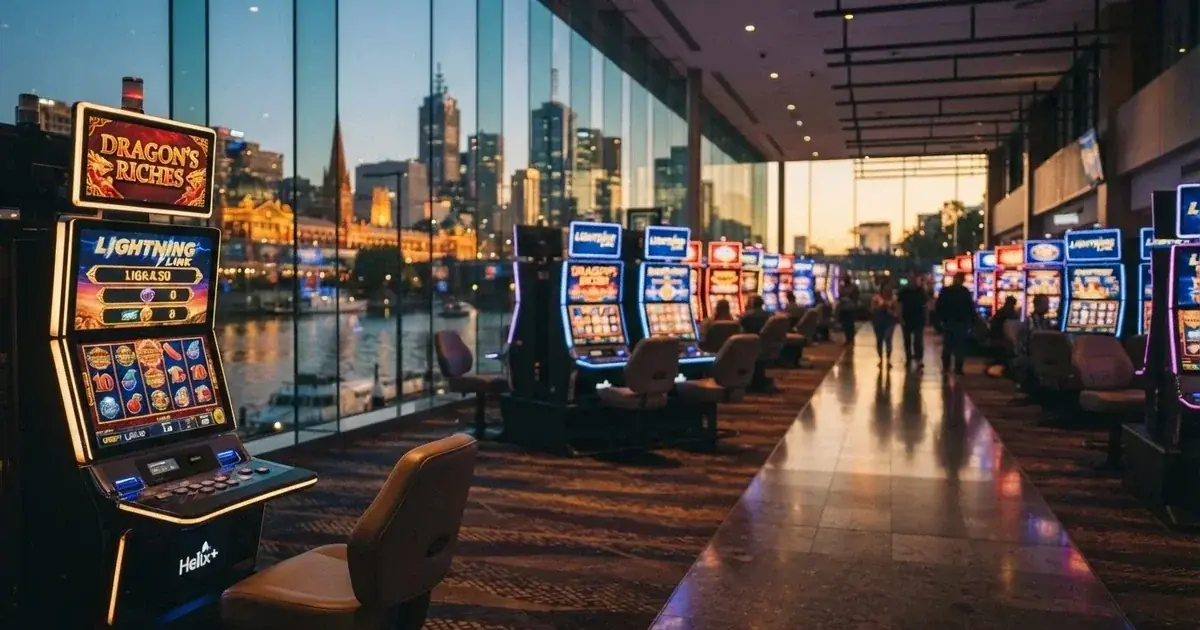
A punter walking the Crown Melbourne gaming floor, stepping into a suburban RSL on a Friday night, or sliding a note into a machine at a CBD pub is doing something different from someone who has just typed “online pokies Melbourne” into a search bar. The first is sitting in front of a real, state-licensed electronic gaming machine in Victoria. The second is being courted by an offshore site that the Australian Communications and Media Authority has already told, in writing, to stop. Both situations end up on the same search-results page, and that is where this one starts. Melbourne runs roughly 26,000 licensed machines outside the casino, and Crown Melbourne runs about 2,500 more under its own Victorian licence. None of them is reachable from a browser, which is the line this article refuses to blur.
Current as of 25 November 2026. Licences and ACMA actions checked against the Australian Communications and Media Authority register and the Victorian Gambling and Casino Control Commission.
Table of Contents
- How this shortlist of Melbourne pokies venues was put together
- What a Melbourne pokies venue actually is, and what an online one pretends to be
- The legal frame: why every offshore site in this picture is operating unlawfully
- Responsible gambling in a Melbourne pokies venue
- Where the licensed machines in Melbourne actually are
- Payments and payout speeds at Melbourne pokies venues
- Specific games, providers and what is on the Melbourne floor
- What the ACMA’s enforcement record actually shows
- A note on what is not on this page
- Final word on the comparison
- Frequently asked questions about pokies venues in Melbourne
How this shortlist of Melbourne pokies venues was put together
A “best pokies in Melbourne” list is usually a string of pub names pulled from a tourist blog. That is not a comparison; that is a postcode directory with adjectives. A shortlist worth reading starts from the question “best for what” — and answers it openly, because the answer changes the entire lineup.

Three filters drive the ranking below. First, a venue only counts if a Victorian regulator has actually licensed its machines. Second, the venue has to be operating within the Victorian caps on number of machines, opening hours and the mandatory responsible-gambling code that the Victorian Gambling and Casino Control Commission enforces. Third, the venue has to be the kind of place a person might reasonably visit in the same week — large enough to find a free machine on a Saturday evening, close enough to a transport link to matter, and run by an operator whose name a reader can look up. These three filters rule out the things the search results tend to lead with: unlicensed offshore sites that copy Melbourne pub names for SEO, club-floor counts taken from old licensing submissions, and venues whose licence has lapsed since the data was last refreshed.
A few choices follow from those filters. Crown Melbourne sits at the top by machine count and by floor size, and it is licensed by Victoria through its own casino licence — a different instrument from the pub-and-club gaming-machine entitlements that cover the rest of the state, and the reason its 2,500 machines do not count against the 30,000-machine cap that binds everything else. The suburban RSLs and clubs that take most of the actual money — Victoria’s machines outside Crown took a record A$3.318 billion in losses in 2025–26 — sit below Crown for size but well ahead of it for accessibility, because most Melburnians live closer to an RSL than to Southbank. Crown is the headline venue. It is not the one most people use.
The criteria that separate the venues below the headline are machine count, return-to-player transparency, hours and ID requirements, and proximity to public transport — in that order of weight, because a venue with a higher machine count and a published RTP is a more useful answer to the search than a venue with a shorter cab ride and nothing else to compare on. Where research could not pin a figure for a column the venue should reasonably have, the column is left empty rather than padded with a number. Gaps are the point; a venue that has not published its RTP for the current year should not have a number invented for it.
What a Melbourne pokies venue actually is, and what an online one pretends to be
A “pokies venue in Melbourne” is a building with walls, a Victorian liquor and gaming licence on the wall, and a count of electronic gaming machines on a register maintained by the Victorian Gambling and Casino Control Commission. Each machine is registered individually. Each has a return-to-player setting audited against the regulator’s minimum. Each has a maximum bet — A$5 in clubs and pubs outside the casino, no maximum on the casino floor under Crown’s licence — and a clock on the wall showing how long the patron has been playing, because Victorian law has required that clock since the reforms of the early 2010s.
“Online pokies Melbourne” is a different product, even when the URL ends in .com.au. The Interactive Gambling Act 2001, as tightened by the Interactive Gambling Amendment Act 2017, makes it an offence for an operator to offer online casino games — including the slots the industry markets as “online pokies” — to a person physically in Australia. No state or territory regulator can license one. The licence displayed at the bottom of an offshore site is one issued by Curaçao, Anjouan, the Philippines or the Isle of Man, and not one of those regulators answers to the VGCCC when an Australian punter asks where their withdrawal is. The site may brand itself with Melbourne suburbs, run a .com.au landing and call its games “pokies”. That vocabulary does not turn it into one.
The two are not alternatives. One is a legal product the punter uses in a building. The other is a service the law prohibits the provider from offering. Putting them on the same comparison page is the trick the search results already pull, and this page refuses it. The offshore sites in the table later in this article are listed because the ACMA has formally warned each of them, not because they belong in the ranking.
The legal frame: why every offshore site in this picture is operating unlawfully
The Interactive Gambling Act 2001 is the central instrument, and it works in a particular way. It targets the provider, not the player. A punter in Richmond who opens a Curaçao-licensed casino on a laptop does not commit an offence under the IGA. The operator offering the games to that punter does, and the ACMA has a graduated set of tools for dealing with them. The first step is a formal warning, published on the ACMA’s website and naming the operator behind the brand. The second is a direction to Australian internet service providers to block the site at the DNS level. The third, available for repeat offenders and for operators who refuse to engage, is referral to the Australian Federal Police or the relevant international regulator.
The practical effect, five years into the strengthened regime, is that an Australian-facing site without a local licence is in one of three states. It is operating openly and waiting for the ACMA’s next round of warnings. It has been warned and is hoping the warning was a polite gesture. Or it has been blocked, has rotated to a fresh domain, and is hoping the ACMA’s next block list catches up. None of these states is a steady one, and the A$3.9 billion that H2 Gambling Capital estimates Australians lose each year to illegal offshore sites is the size of a market that exists in spite of the law, not with its permission.
Two pieces of reform are worth knowing about. The first is the Interactive Gambling Amendment (Gambling Reform) Bill 2026, which passed Parliament on 19 August 2026. Its advertising and inducement measures commence on 1 January 2027 — a law with a start date, not yet in force on a page read in the current year. The second is the credit-card ban on licensed online wagering, in force since 11 June 2024, which makes it an offence for an Australian-licensed wagering operator to accept credit cards, credit-related products or digital currency for a wager. The ban binds Australian-licensed bookmakers. An offshore site accepting Bitcoin deposits is breaking the credit-card ban’s spirit and the IGA’s letter, and an Australian punter using it has none of the protections the ban was written to provide.
A consequence the law does not advertise loudly: BetStop, the National Self-Exclusion Register that has been live since August 2023, binds only Australian-licensed online and phone wagering services. It does not bind an offshore casino. A punter who has self-excluded through BetStop and then opens an offshore account is not violating the exclusion; the offshore site is not a party to it. The exclusion has to be the punter’s own discipline on top of whatever the licensed site enforces.
Responsible gambling in a Melbourne pokies venue
A Victorian pokies venue is required by law to display responsible-gambling materials at the entrance, on the gaming floor, and at every ATM. Pre-commitment — a voluntary limit the punter sets before playing — has been a feature of the Victorian system since 2015 and was the first mandatory pre-commitment regime in Australia when it took effect for clubs and pubs. The clocks on the wall, the trained responsible-gambling officers on shift at larger venues, and the right to be barred from any venue on request are not amenities the venue offers as goodwill. They are conditions of holding a gaming-machine entitlement.
The numbers behind the Victorian system are not small. The 26,380 gaming machines outside Crown Casino in 488 venues across the state, as the regulator reported in 2021–22, run under a 30,000-machine statewide cap that has not been lifted since it was set. The A$3.318 billion that Victorians lost on those machines in 2025–26 — a record, and an uncomfortable one — is the figure the Victorian Local Governance Association published at the start of September this year. It is roughly the entire NSW clubs-sector loss for the same period, concentrated on a smaller machine base. Every responsible-gambling policy in Victoria is written against that number.
For a punter who wants help, three channels are open regardless of which venue they are sitting in. Gambling Help Online is the national online counselling service, free, available around the clock, with chat and callback. The National Gambling Helpline is 1800 858 858, also free and 24/7. And Victoria’s own self-exclusion scheme, run through the VGCCC, allows a person to be barred from every venue in the state, or from a chosen subset, for a period of their choosing — and unlike BetStop, it operates against the licensed venues themselves, because the venues are the ones the VGCCC can compel.
A reminder that the off-shore alternatives have no equivalent. There is no Australian complaints body that will chase a Curaçao-licensed operator on behalf of a Victorian punter whose withdrawal has been delayed or refused. There is no Australian regulator the punter can ring. There is no Australian small-claims path. The offshore site may, in fairness, pay out. It may also not, and the punter’s only remedy is whatever the operator’s own customer-service team decides to offer.
Where the licensed machines in Melbourne actually are
Melbourne is a city of two pokies geographies, and a reader who knows which one they are in has already answered most of the questions they will ask.
The first is the casino geography. Crown Melbourne sits on the south bank of the Yarra, downstream of the city centre, in a complex that takes up roughly 510,000 m² — about two city blocks — and that, by floor area, is the largest casino complex in the Southern Hemisphere. The complex opened on the Yarra’s north bank in 1994 and moved to the permanent south-bank building, designed by Bates Smart, Perrott Lyon Mathieson and Daryl Jackson, in 1997. The gaming floor spans about 20,000 m² and runs 540 licensed table games — of which around 100 are poker tables — and 2,500 poker machines. Crown Resorts has owned the venue since Publishing and Broadcasting Limited took it over from the original founder’s operation in 1999.
The casino runs under a Victorian licence that is not the same instrument as the gaming-machine entitlements that cover the rest of the state. That licence was the subject of the Finkelstein Royal Commission into the Casino Operator and Licence, which concluded in October 2021 and found evidence of money laundering and close ties to organised crime. Crown kept the licence on a two-year review period under a court-appointed Special Manager, and Victoria’s gambling regulator later fined Crown A$80 million in June 2022 for processing A$164 million in illicit payments and another A$120 million in November 2022 for responsible-gambling breaches that included letting patrons gamble for more than 24 hours without a break. The Casino and Gambling Legislation Amendment Act 2021, passed after the Royal Commission, created the Victorian Gambling and Casino Control Commission as the new regulator and banned junket operations at Victorian casinos.
The second is the pub-and-club geography. Roughly 488 venues outside the casino run gaming machines under the 30,000-cap system, and the geography of those venues follows Melbourne’s pub-and-club heritage rather than its tourist map. RSLs and leagues clubs anchor the suburban rings — the inner-northern, the bayside, the western and the eastern suburbs all have several within a short drive. CBD pubs concentrate around the casino end of Southbank, around Flinders Street and around the top end of Bourke Street. The closer a punter lives to a train line, the more venues sit within a short walk of a station — which is also why CBD machines tend to attract higher tourist-spend play than suburban machines, even when their RTP settings are the same.
A practical division follows from this. A punter looking for the largest single venue, the widest choice of machines and a late-night licence goes to Crown. A punter looking for a quick session after work, a meal-and-machine combination and the shortest possible walk goes to a suburban club. The two choices answer different questions, and the right answer for a given reader is whichever one is closer at the time.
The other Australian capitals, for context
Melbourne’s pub-and-club machine count is high by Australian standards, but the comparison that interests a reader is mostly with the other state capitals. Adelaide’s non-casino machine base sits at around 11,672 machines across 471 venues as of September 2023, lower than Melbourne’s. Queensland had 21,122 machines across 351 venues in October 2023, also lower than Victoria’s. New South Wales, which runs the largest machine base of any state but counts its hotels and clubs differently, sits above both.
On return-to-player, South Australia sets a statutory minimum of 87.5% for non-casino machines and a general maximum bet of A$5.00 outside the casino, while Adelaide Casino itself — known commercially as SkyCity Adelaide until 2009 — has no statutory maximum-bet ceiling on its 950 gaming machines and 90 tables. Adelaide’s non-casino losses were about A$0.92 billion in 2022–23, equivalent to roughly A$497 per adult. Melbourne’s 2025–26 number is several times that. Victoria’s losses are higher because the machine count is higher, the venues are denser and the hours are longer — not because the machines themselves are set tighter.
Casino licences in Australia’s other capitals
A reader comparing Melbourne’s Crown with what is on offer elsewhere meets three other major casino licences.
Adelaide Casino sits in the heritage-listed Adelaide railway station building on North Terrace, opened on 12 December 1985 under the state’s Lotteries Commission, was sold to SkyCity Entertainment Group in June 2000 and renamed SkyCity Adelaide in April 2001 before reverting to the Adelaide Casino name in 2009. A 2015–2021 Riverbank redevelopment worth about A$330 million added the EOS by SkyCity tower, which opened in 2021 with 120 hotel rooms and expanded gaming space. Its table-game monopoly was extended to 30 June 2035 under a licence formalised on 11 October 2013, which also allows the casino to expand to up to 200 gaming tables and 1,500 gaming machines. It is the sole licensed casino in South Australia under the Casino Act 1997 and is regulated by the state’s Independent Gambling Authority and Liquor and Gambling Commissioner.
Brisbane’s Treasury Casino, operated by Star Entertainment Group, closed on 25 August 2024 to make way for The Star Brisbane. The new venue began a staged opening at the A$3.6 billion Queen’s Wharf Brisbane precinct on 29 August 2024, with the main casino floor and premium gaming rooms opening first. The opening came amid concerns about the licence position of Star Entertainment Group, the lead partner on the precinct. Treasury itself, in Brisbane’s historic Treasury Building, opened as a casino in April 1995 and ran 80 gaming tables and more than 1,300 gaming machines across three levels, with a hotel, six restaurants, five bars and a nightclub.
These three venues are not alternatives to Melbourne for a Melburnian choosing where to play. They are alternatives for a reader comparing Australian casino licences at the state level, which the Crown story above is part of: a Crown patron in 2026 is playing in a venue whose licence survived the most serious royal-commission investigation of any in the country, under a regulator that did not exist before 2021.
Payments and payout speeds at Melbourne pokies venues
A pokies venue in Melbourne does not process payments the way an online casino does. The punter hands over cash or, at most venues, a debit card at the bar to load a card-based gaming account. The “withdrawal” is the ticket the machine prints when the player cashes out, exchanged at the cashier for cash. The settlement is instantaneous, because there is nothing to settle: no third-party processor, no overnight batching, no foreign-exchange margin.
This is the part of the Melbourne pokies experience that an offshore site most actively imitates. A real-money offshore slot page will advertise “instant withdrawals” or “payouts in under an hour”, and a reader who has just used a Melbourne pub machine for an hour and walked out with the winnings in their pocket finds the promise easy to believe. The difference is what instant actually means. At the pub, instant means a paper ticket and a cashier’s till. At an offshore site, instant means the operator’s payments team has chosen to release the funds, in the operator’s currency, through the operator’s chosen payment channel, after any “review” the operator’s terms page reserves the right to apply.
A reader weighing the two has to weigh three numbers. The first is the time-to-cash at a real venue: minutes. The second is the time-to-cash at a licensed Australian online wagering operator, which is also typically fast — debit-card withdrawals to Australian bank accounts are usually same-day or next-business-day, and PayID/Osko transfers settle in near-real-time to participating banks. The third is the time-to-cash at an offshore casino, which varies from hours to weeks, runs entirely at the operator’s discretion and has no Australian complaints channel behind it.
The credit-card ban matters here too. A licensed Australian online wagering operator cannot accept a credit card, credit-related product or digital currency for a wager; the only legal deposit routes are debit card, bank transfer, PayID/Osko and BPAY, with penalties of up to A$247,500 for operators who breach. An offshore site that happily takes Bitcoin deposits and a credit card is not running on these rails, and an Australian punter using it has none of the consumer protection the ban was written to provide. The payment method is the signal. A site that wants an Australian punter’s crypto or their credit limit is a site that has decided not to bother with the local rules.
A practical note on Pokies payout percentage: the Victorian regulator requires venues to publish the return-to-player setting on each machine or on a clearly visible gaming-floor notice. The figure is the long-run average the machine is set to return to players across millions of spins, not a guarantee for any single session. The setting on pub-and-club machines sits around the low- to mid-90s as a percentage; the Crown floor’s machines, which run under a different licence class, are set at the casino’s discretion. The number to remember is that RTP is an average over the life of the machine, and any session short enough to fit inside a Melbourne evening is statistically independent of it.
Specific games, providers and what is on the Melbourne floor
The “specific games” shelf for a Melbourne venue is not a slot catalogue. The games on a Melbourne pub-and-club floor are electronic gaming machines, mostly manufactured by the small set of approved suppliers whose games the Victorian regulator has certified — Aristocrat and IGT are the largest of those suppliers by Australian floor share. The variations that interest a punter are denomination, lines, bonus features and the visible RTP display, not the brand on the cabinet. A reader searching “best paying pokies in Melbourne” is, in practice, asking which machines in the venue closest to them carry the highest visible RTP, and that information is on a sticker on the machine or on a notice at the venue entrance.
Crown Melbourne’s 2,500 machines are a wider catalogue because the casino licence class permits a different certification regime. The machines there include higher-denomination games and the larger-jackpot configurations the casino licence permits, and the floor is large enough that a punter can move between denomination tiers within the same venue. The headline machines — the ones marketing materials and tourist blogs photograph — are the large-format video slots with linked jackokts, which sit alongside the standard multi-line video and stepper configurations.
For a reader who is searching by Melbourne suburb — “pokies North Melbourne”, “pokies South Melbourne”, “pokies Port Melbourne”, “pokies East Melbourne”, “pokies Western Suburbs Melbourne” — the answer is the suburb’s pub-and-club density. North Melbourne, South Melbourne and Port Melbourne sit close to the casino and have the highest venue density per square kilometre. East Melbourne has fewer machines than the inner-western or bayside suburbs but is close to several large RSLs. The western suburbs are the densest machine geography in greater Melbourne by venue count, which is also why the western-suburbs losses per adult tend to run higher than the state average.
For a punter at Melbourne Airport, the geography is a different one. There is no licensed pokies venue inside the airport terminals themselves; the airport’s gaming-machine footprint was wound back in the 2010s and the licensed venues near the airport precinct are the standard suburban pub-and-club offering, not an airport-specific configuration. A reader searching “pokies Melbourne Airport” is more often looking for a venue to kill a layover than an airport-floor game.
What the ACMA’s enforcement record actually shows
The Australian Communications and Media Authority is the regulator with the job of enforcing the Interactive Gambling Act against offshore operators. It does the job in waves — a round of formal warnings, then a round of blocking requests, then a quieter period before the next round. The June 2026 round, as reported by industry trade press, asked Australian internet service providers to block 12 more illegal gambling websites: 7Signs, ChromaBet, Donbet, Duospin, Freshbet, Slots Gem, Jacks Club, Lucky Start, Pointsbetz, Spinrise, Vinyl Casino and Wildsino. That brought the total of blocked illegal gambling and affiliate-marketing sites to 1,751 since the first blocking request in November 2019, and the count of unlicensed services that have left the Australian market since enforcement was strengthened in 2017 to more than 230.
The arithmetic the ACMA does not publish but the figure supports: from November 2019 to June 2026 is roughly eighty months. Divide 1,751 blocked sites by eighty months and the working average is about twenty-two blocked sites a month across that period, or roughly one new site every thirty-six hours. The figure is an average, not a rate the ACMA publishes, and the round-by-round pace is uneven — some rounds have blocked twelve, some have blocked three — but the band is the order of magnitude a reader should have in mind when an offshore site tells them it has been “operating for years”.
The H2 Gambling Capital estimate that Australians lose about A$3.9 billion a year to illegal gambling sites puts a price on the gap between what the ACMA blocks and what continues to operate. The legal-channel share of Australian gambling fell from 74% in 2021 to 64% in the H2 estimate — a ten-point swing in five years that is not primarily about Australians choosing to play more, but about the offshore market capturing a larger share of what they already play. The blocking record and the loss estimate are two readings of the same drift.
Comparison of licensed venues and offshore operators
| Brand | ACMA action and date | Operator named by the ACMA | Subject support |
|---|---|---|---|
| RocketPlay | Formal warning, March 2026 (and earlier Dama N.V., May 2022) | Pulsup Ltd | — |
| Level Up Casino | Formal warning, May 2022 | Dama N.V. | Listings reports only (Wikipedia, VGCCC) |
| Woo Casino | Formal warning, March 2025 | Dama N.V. | Listings reports only (Wikipedia) |
| Spirit Casino | Formal warning, May 2025 | Dama N.V. | — |
| National Casino | Formal warning, July 2025 | Consolutetish S.R.L. | Listings reports only (ABC, infrastructure.gov.au) |
| Bizzo Casino | Formal warning, July 2025 (and earlier TechSolutions, 2022) | Consolutetish S.R.L. | — |
| Ignition Casino | Formal warning, July 2025 | Bamboo Media | — |
| Instant Casino | Formal warning, February 2025 | EOD Code SRL | — |
| Jackbit | Formal warning, April 2026 | Ryker B.V. | — |
| Casino Intense | Formal warning, April 2025 | Sterplay Holding Ltd | Listings reports only (ABC, ASGAM, CBS SA) |
| Sky Crown | Formal warning, September 2022 | Hollycorn N.V. | Listings reports only (Wikipedia) |
The table above is not a ranking and not a recommendation. Each brand appears because the ACMA itself has issued a formal warning naming the operator behind it, for offering prohibited online casino services to people in Australia under the Interactive Gambling Act 2001. Online casino games cannot be licensed anywhere in Australia, whatever licence the site displays at the bottom of its homepage. The licence on an offshore site is the licence the regulator in that jurisdiction issued; it is not a licence to take bets from a person sitting in Richmond or Brunswick.
Reading the table beside the law
Three things the table makes plain that the marketing copy does not. First, the operators behind these brands are concentrated: Dama N.V. appears four times, in 2022 and twice in 2025, with the ACMA returning to the same holding company after warnings. A formal warning is not a final order, and the law allows an operator to keep offering services after one; what it does is build a record. Second, the dates cluster between 2022 and 2026, which is the period the strengthened 2017 amendments have been in active enforcement. A reader looking at the table who assumed the IGA was unenforced is looking at the wrong five-year window. Third, the brands rebrand. Bizzo Casino had already been the subject of a 2022 formal warning to TechSolutions before the July 2025 warning to Consolutetish S.R.L.; the warning followed the operator, not just the brand.
The verdict on each row is the same in form and different in detail. None of these is a place for a Melburnian to play pokies, because all eleven are prohibited products under Australian law and the ACMA has said so in writing. The reader who nevertheless opens one has no Australian regulator behind them if the operator refuses a withdrawal, no path to BetStop self-exclusion that the operator is bound by, and no assurance that the balance on their account will survive the next ACMA blocking round. The reader who walks to a Crown machine or a suburban pub instead has all three.
A note on what is not on this page
A page that promises a “best pokies in Melbourne” ranking and then refuses to rank offshore casinos is, by the standards of the search-results page it competes with, an oddity. The oddity is the point. There is no version of “best online pokies in Melbourne” that is not, in Australian law, a description of a prohibited service. The ranking that follows from that is the ranking of licensed venues, not the ranking of unlicensed sites pretending to be venues.
Two consequences follow. A reader who came to this page looking for an offshore casino review will not find one, and they will find instead the ACMA record of the brands such reviews would have recommended. A reader who came looking for a licensed venue in Melbourne will find the Crown story and the pub-and-club geography, the VGCCC framework and the numbers that go with it, and enough of the responsible-gambling architecture to know what protections they have when they walk through the door.
Final word on the comparison
A Crown machine and a suburban RSL machine are both licensed. A Curaçao-licensed slot page is not. The distinction is the one the law makes and the one the ACMA enforces, and the one a Melbourne punter is best served by holding to. The choice the law leaves on the table is the choice the page recommends: the licensed venue, the licensed hours, the licensed responsible-gambling code, and the cashier’s till that pays out in cash on the way out the door.
Frequently asked questions about pokies venues in Melbourne
Which venues in Melbourne are licensed to operate pokies?
Pokies in Melbourne are operated under two Victorian licensing regimes. Crown Melbourne runs about 2,500 machines under its own casino licence. Outside the casino, around 488 venues — pubs, clubs and RSLs — operate the remaining 26,380 or so gaming machines under a 30,000-machine statewide cap administered by the Victorian Gambling and Casino Control Commission. The VGCCC maintains a public register of every licensed venue and its entitlements.
Are pokies in Melbourne available around the clock?
No. Crown Melbourne runs extended hours but does not operate continuously, and pub-and-club gaming floors are bound by their liquor-licence hours, which generally require the venue to cease gaming well before the small hours. The exact hours vary by venue and by licence conditions, and the VGCCC register is the place to confirm them for a specific venue. Operating hours are part of the licence conditions, not a venue-level decision.
What identification do venues in Melbourne require before letting someone play pokies?
A Victorian pokies venue is required to verify that a patron is 18 or older before entry to the gaming floor. Identification requirements vary by venue — a driver’s licence or a passport is the standard request at Crown and at larger suburban clubs. Pre-commitment, the voluntary limit a patron sets before playing, has been a feature of the Victorian system since 2015 and was the first mandatory pre-commitment regime in Australia for clubs and pubs.
Can visitors to Melbourne use self-exclusion schemes at local pokies venues?
Yes. Victoria runs its own self-exclusion scheme through the VGCCC, which allows a person to be barred from every venue in the state or from a chosen subset for a period of their choosing. The exclusion is enforced against the venues themselves because the venues are the parties the regulator can compel. BetStop, the National Self-Exclusion Register that has been live since August 2023, binds only Australian-licensed online and phone wagering services and does not extend to offshore casinos.
How does the payout percentage on Melbourne pokies compare with other Australian cities?
Victorian pub-and-club gaming machines are required to publish a return-to-player figure, generally sitting in the low- to mid-90s as a percentage across the state’s machine base. South Australia sets a statutory minimum of 87.5% on non-casino machines and a general maximum bet of A$5.00, while Adelaide Casino itself has no maximum-bet ceiling. The headline RTP figure is an average over the machine’s life and not a guarantee for any individual session. The setting matters less than the duration the punter plays.
Is it legal for an online casino to advertise ‘pokies’ in Melbourne the same way a pub or club does?
No. The Interactive Gambling Act 2001, strengthened by the 2017 amendments, makes it an offence to offer online casino games — including the slots marketed as “online pokies” — to a person in Australia. The vocabulary is not a defence: a site that brands itself with Melbourne suburbs, calls its games “pokies” and runs a .com.au landing is not a Melbourne venue and is not covered by the Victorian licensing regime. The ACMA has issued formal warnings and blocking orders against many such sites, and the Interactive Gambling Amendment (Gambling Reform) Bill 2026, which passed Parliament on 19 August 2026, will tighten the rules on advertising and inducements when its measures commence on 1 January 2027.